CISRS has strengthened its management team through the appointment of a hugely experienced scaffolding industry professional.
CISRS has today announced that Tony Barry, who has worked in the industry for 40 years – the most recent 20 of which have been with the CITB, takes up the position of CISRS Compliance Manager.
In his new role, Tony will have the primary responsibility for the development and review of course content, Scheme accreditation criteria, auditing procedure and scheme policy, ensuring that they remain high quality, cost effective and ‘fit for purpose’.
CISRS said that Tony will also be heavily involved with the Scaffolding Apprentice Trailblazer review due to take place later this year. Having delivered many apprenticeship programmes over the years he will no doubt offer a unique insight into the training and assessment process.
Talking about his CISRS role, he said: “I’m looking forward to promoting the scaffolding industry as an exciting opportunity for all to become competent, valued and skilled members of the construction industry workforce. “I’m also relishing the opportunity to review CISRS Scheme content. Standardised training such as the CISRS Scheme helps ensure a safe working environment through continually looking to enhance the training requirements to mirror new industry innovations and development.”
In his new role, Tony will work closely with CISRS Managing Director Dave Mosley.
Tony started working with NCC Midlands (CITB) around 20 years ago around the same time Dave Mosley began working with CISRS. They have worked together on several working parties over the years and already have a good working relationship
Dave Mosley, CISRS Managing Director
Dave said: “Myself, the Directors and the CISRS staff are really pleased to have Tony on the team. He has a wealth of industry knowledge and experience which will be a massive boost to CISRS. “He has really hit the ground running, currently revising the CISRS Training modules to reflect the changes to TG20. There is plenty more to come with course content and scheme accreditation reviews in the pipeline. “We know he will bring the same enthusiasm, professionalism and rigour to CISRS as he that he has shown in his various roles at CITB in the last 20 years.”
Everyone’s heard of the old saying ‘You get What You Pay For’ – here in the scaffolding industry this certainly applies to both Scaffolders and materials. As the summer heatwave arrives, quite a few are getting hot under the collar over the subject as Matthew Cousins, Director of Apex Scaffolding explains.
We all know the eternal problem Scaffolding companies face in terms of finding both scaffolders and materials. Scaffmag and the media has widely documented the soaring costs of both timber and steel, and how companies are struggling to obtain both for reasonable cost, to fulfil the contracts tendered for pre-pandemic.
I’m not sure there’s ever been a lack of available labour like there is now. Whose fault is that? Are we not being welcoming? Are we not attending careers fairs to promote the job? Do we have a training programme that takes years to complete? What teenager now wants to spend two years training to be a scaffolder, when it seems like you can become a fully qualified bricky just by owning your own trowel.
Is it our recruitment strategy appears to be, ‘my uncle did it once so he said I should have a go’? Ironically, it’s how I got into scaffolding in the first place. Are we still looked upon as not clever enough to get into college?
I’m passionate about working with the NASC to get into schools and colleges. We need to promote the industry as something exciting, challenging and ultimately a decent way to earn good money, without racking up tuition fee debts.
If you need an example, how about this, the other morning yet another scaffolder had come into our office and said: “So and so has rung me up and offered me £X per hour, so I’m off as you don’t pay me enough.” Now anyone who has worked in the office of a scaffolding company will have heard this countless times, and the normal response is as a company we do not like being held to ransom. As soon as word gets round everyone wants a pay rise, because ‘They’re all worth it’.
The week before, as a response to all the previous leavers we had got everyone together in a toolbox talk and said to them: “Do you know what, we’ve been looking at the rates you are all on, and think you have done well in the last 12 months’, so every single person in the firm gets a £1 an hour increase. Even the lad who started three days before had the fastest ever increase! But is this enough?
We always felt our company was the place scaffolders wanted to work. Perhaps that was naïve of us, certainly conceited. We do high profile jobs on amazing buildings and work for the biggest and the best clients – but is this our downfall? We had a chat about it – if we were still on the tools would we want to work to all the extra conditions laid down by the main contractors, glasses, gloves, double lanyards, tool tethers, long trousers, long sleeves, pre-start briefings, safety stand downs, next day briefings, all while earning less than other guys jumping around in shorts on building sites? Do the Tier 1 construction sector actually value the lengths that we, and our operatives go to?
I would like to think our employees appreciate how much we value their safety. We would hope they’d like us to buy them all bacon rolls when someone gets an award. That we offer more training courses than local companies and look after our workers interests. I am still not sure all scaffolders care about is their wage packet. There are some who change companies for 25p an hour and must have a cupboard full of branded t-shirts from every company in the region. That doesn’t excuse the fact that as an industry we haven’t been paying enough for a long time.
The recent pandemic and furlough payments showed being self-employed, or moving companies meant people missed out on government support. But like footballers’ scaffolders only have a certain window to earn the big money so they must get all they can without penalties while they can. Sorry about that.
Someone suggested we could offer them other benefits – I know a lot of other industries offer different perks including healthcare and gym membership. But if they have enough energy for the gym, have they been working hard enough? Do scaffolders really want any of these things?
Vans are popular – but surely only one from the gang gets the benefit of the van, outweighed by the fact he must get up earlier to pick everyone up on the way?
Down here in the South-West we have a housing boom and the HPC project creating a major vacuum point for scaffolders. It’s not a situation we can easily fix. We are starting again with five new apprenticeships, bringing new blood into the industry. Hopefully, they will see the gains of being with us, for the long haul. We like investing in people and watching them grow, and ultimately making them into the sort of people who are worth every penny.
We are exceptionally proud of everyone who puts on an Apex shirt because we want them to be proud of wearing it. If it means we must up our wage bill, then so be it. If this has a knock-on effect on our prices, so be it.
Just like us, if they want the best, they must be prepared to pay for it.
Altrad has announced the signature of a new three-year contract with its long-term partner Doosan Babcock.
The contract will see Altrad provide a range of support services in support of the UK Atomic Energy Authority’s fusion research and technology programme at its Culham Science Centre HQ in Oxfordshire and its new facility in Rotherham, Yorkshire.
Commencing in July 2021, Altrad will be working in partnership with Doosan Babcock to provide UKAEA with a year-round, core site team to support the UK’s fusion research and technology programme.
Altrad’s Business Unit Director (Nuclear) – Simon Roberts said, “The award of this contract builds upon our long-term, successful strategic relationship with Doosan Babcock and we look forward to using the ingenuity of our people to support the safe and efficient operations at the Culham and Rotherham sites”.
The company said this latest contract award reinforces Altrad’s position as the market leader in the provision of support services to the UK’s nuclear sector, which are delivered by over 1,000 of its talented, nuclear professionals.
Every day, 365 days a year, Altrad provides support services at a number of UK nuclear facilitates including; six nuclear-decommissioning sites across the Magnox estate, several decommissioning contracts at Sellafield, the entire EDF generation fleet, Hinkley Point C and at Capenhurst and Aldermaston.
Altrad’s Director of Business Development & Strategy – Peter Hughes added “We are delighted to have been awarded this contract, which supports the development of new technologies to enable the UK’s low carbon energy transition. The contract award aligns with the bold ambitions set out in our 2026 strategy, which will see Altrad become carbon neutral by 2030 or sooner”.
Betley Court Manor House was a residential home, where 20 people lived. As the house was completely unsafe after a fire broke out, the project needed to be restored quickly and safely.
To restore the beloved grade II listed 18th-century manor house, scaffolders needed to protect the whole area from the elements, allowing the building to dry out after being drenched by 40 firefighters. Once dried, the building needed ongoing protection to allow the restoration work to be carried out unhindered. George Roberts was engaged to supply all scaffolding, access, and weather protection equipment to this important project.
Space on site was limited, meaning George Roberts drivers had to Hiab the equipment onto ground level, and to minimise impact on those who reside around the building, careful planning was required to maximise the delivery schedule.
Working closely with its customer and their design team to specify the 1.3m X Beams for the support structure, George Roberts provided full and open technical data during the design process. This helped them to act quickly and mobilise equipment to support our customer’s programme and budget.
Challenges
As the building had been completely destroyed by the fire, serious care had to be taken in order for the job to be undertaken safely. Consideration for the historical elements of the building also had to be a priority, as with any listed building restoration.
One of the complexities of the project was to design the temporary roof structure around the numerous chimneys where extra beam work was required to support the roof. The best solution for this was utilising its 1.3m deep X Beams.
George Roberts Ltd provided a full UBIX roof system and the Aluminium X Beams in both 750mm and 1300mm deep for the additional support to enable the whole structure to be covered for restoration to begin.
Our high stock holding with beams being manufactured in the UK meant we were able to react quickly and mobilise the equipment within 7 days, allowing MD to stay on track with their tight programme.
Scaffold Package is £600k. Overall project estimated to be appx £6m.
The Construction News Specialist Awards has announced it’s 2021 finalists.
Now in its the seventeenth year, the Construction News Specialists Awards are the only national awards recognising the outstanding achievements of specialist contractors.
Focusing on our sector the Access & Scaffolding Specialist of the Year category have been shortlisted and well represented by scaffolding firms across the country.
Access & Scaffolding Specialist of the Year Finalists:
Benchmark Scaffolding
Lee Marley Brickwork
LTC Scaffolding
Millcroft
PHD Modular Access
WellMax Scaffolding
In other categories, WellMax scaffolding has also been named as a finalist for Project of the Year by a Specialist Contractor (subcontract up to £1m) for its work at The British Museum.
While Millcroft has been shortlisted in four other categories including; Specialist Contractor of the Year (turnover up to £25m), Project of the Year by a Specialist Contractor (subcontract from £1m to £5m), Health, Safety and Wellbeing Excellence and Training Excellence category.
The judges will reconvene for the final stage of the judging process, where they will interview finalists face to face before weighing up their achievements and deciding on a winner.
The awards take place on the 19th October 2021 at The Brewery, London.
See the full list of finalists here.
Legal restrictions on both mask wearing and social distancing in England are to be scrapped from Monday, July 19th. This could carry serious implications for those working on-site in the scaffolding industry.
The British Safety Council believes the scrapping of masks is the wrong decision and is putting workers in danger.
They’ve made it clear leaving the decision on the wearing of masks to individuals will lead to chaos and confusion, perhaps putting scaffolders health at serious risk, urging the government to change course.
Lawrence Waterman, chairman of the British Safety Council, said: “To go from the controls put in place for the last 15 months to nothing overnight is a significant risk and particularly to UK workers. While we would all like to believe that everyone will act responsibly, experience shows us this is not guaranteed.
“There has been a fantastic level of public compliance with the rules, why go from collective protection to a free-for-all? The Prime Minister himself has said caution is absolutely vital – if he truly believes this, then he should show leadership on the wearing of masks, rather than take a leap of faith into the unknown that risks all the sacrifices and hard-won progress made since March 2020.”
Prime Minister Boris Johnson has said Brits will not be fined if they don’t wear a mask on public transport after July 19. He wants masks to be a personal choice rather than a legal requirement enforced with fines of up to £6,400.
He also explained an ‘exit wave’ was inevitable adding, “We know we’re going to see more hospitalisations and more deaths from Covid.” but that unlocking had to happen at some point and summer was the best time to do it.”
A recent opinion poll revealed half of those in the UK would have preferred the July 19 easing to be postponed. In an industry where some employees have been working right through the pandemic, such mixed messaging on masks has only succeeded in muddying the waters for bosses across the country.
Given all of this, Graham Medley, chair of the SPI-M modelling group, told listeners to the Radio Four Today programme earlier in the week: “There is evidence to suggest that it does good, but only if everybody does it.“Without the [mandated approach] we end up in a situation where even if the majority – say 70 per cent wear a mask – will that do any good because of the 30 per cent who don’t? If it’s not mandated it probably won’t do any good.”
One of the biggest worries centres around the NHS Furthermore, where an expected 100,000 cases a day could lead to 2,000 admissions. Twice the number normally seen across the winter months for all respiratory infections.
Duncan Spencer, IOSH’s Head of Advice and Practice, urged employers to help influence safe behaviours.
He said: “Despite the relaxations, we encourage employers to ensure they continue to put in place preventative measures to reduce the likelihood of Covid-19 being transmitted in their workplaces.”“Risk assessments can help to identify proportionate controls to protect workers, clients, consumers and communities. With COVID risks, this might include a reasonable request for people to continue wearing face masks and observe social distancing measures. Employers might wish to emulate other socially conscious organisations by asking workers to test themselves regularly, including supplying them with lateral flow test kits.“It is crucial that any preventative measures are communicated clearly, thereby empowering people to work safely while this disease remains a significant threat.”
Brogan Group have signed up to the Building Mental Health Charter and are also halfway through its Tall Building Charity Challenge raising money for the Lighthouse Charity.
The company have signed up to the Building Mental Health Charter with Building Mental Health This is a cross-industry group that enable all parts of the construction sector to access mental health support, provide awareness and training and put in place a structure and systems to support people working in and around our industry.
Brogan Group are also now halfway through the Tall Building Charity Challenge they set up, raising money for the Lighthouse Charity that provides emotional, physical, and financial wellbeing support to construction workers and their families.
Bill Hill, CEO of the Lighthouse Construction Industry Charity said, “As well as being one of our valued Company Supporters, Brogan are also undertaking a fantastic fundraising challenge for us which is great news. They’re also helping us raise awareness of the importance of positive mental health in the industry which is crucial to our mission that no construction worker or their family should feel alone in a crisis”.
Brogan Group volunteers in the UK and Ireland have so far clocked up over 1,900km walking or running a set distance each week for 8 consecutive weeks with the distance based on a multiple of the height of 8 Tall buildings Brogan Group have provided Access on.
So far Brogan Group volunteers have climbed buildings including Boland’s Quay Dublin, Apex House, Wembley, West Tower, Liverpool and are now walking up the ‘Walkie Talkie’ Tower.
Brogan Group work with organisation’s like the Lighthouse Club on training up their own Mental health ‘First Aiders’ that support the wider staff at Brogan Group.
Brogan Group are looking to raise £5000 for the Lighthouse Club Charity, who receive no public funding to support their mental health provisions and help out those of our industry in need. https://www.justgiving.com/fundraising/tallbuildingchallenge
Independent Design House (IDH), furtherexpands globallywith the launch ofIDH Bahrain in the Middle East.
With an expanding order book and bases in the UK and Poland,the engineering design consultancyalready employs 40 people and recently launched IDH North, in Lancashire.
IDH Bahrainis based in the Gulf,and will also service markets in nearby Saudi Arabia, Qatar and the United Arab Emirates.
Hany Ibrahim CEng
IDH Bahrainwill be run by local partner, Hany Ibrahim CEng, aUK-trained specialist in temporary works. A recent report predicted that theBahraini construction industrywill growat an average rate of 4.3% between 2022 and 2025.
IDH provides both temporary and permanent works design, with full 2D draughting and 3D modelling services along with all BIM requirements. Clients include industry leading firms such as ISG and Laing O’Rourke Construction Ltd.
Hany Ibrahim CEngbrings with him 20years of industry experience. Previousroles includeHead of the Technical Department in KSA followed by Associate of Wentworth House Partnership.
HanyIbrahimoffers anintimate knowledge of the construction process,incorporatingsafe, efficient, andcost-effectivemethodologies into projects.
Drawing on the strengths and skillsets of the IDH group, IDH Bahrain will benefit from the central engineering and admin resource pool of the other offices.
Hany Ibrahim CEng said: “Middle East is presenting excellent business opportunities this year and even more in the next few years. Mega projects are set to come live and some of these projects include those in alignment with Vision 2030 plans that Qatar, United Arab Emirates, and Saudi Arabia have in place, which aim to help create a thriving post-hydrocarbon economy for the region.”
“Our vision is not only to establish the business in Bahrain but to expand it to Saudi Arabia, Qatar and UAE.”
IDH CEO, Tim Burt, added: “I am extremely excited about the opportunitiesopeningIDH Bahrain will generate for us, and I believe it will take us to the next level as a business. We foresee continued growth over the coming months as IDH North and IDH Bahrain come on-stream, and we are genuinely forming an international business.”
Industrial services firm Altrad has secured a significant three-year contract with Shell for the provision of critical support services in the Southern North Sea.
The £24m contract covers the support of Shell’s Clipper and Leman Alpha offshore gas platforms and the Bacton gas processing plant, near Great Yarmouth in the UK. The deal has options for two further, one-year extensions and commences in July 2021.
Altrad will be providing services including access, rope access, insulation, painting and deck crew to support the assets’ critical maintenance and project activities.
Altrad’s Director of Upstream Operations – Chris Garland said, “The award of this contract builds upon our successful international, strategic relationship with Shell and we look forward to using the ingenuity of our people to support the safe and efficient operation of these assets.”
The new contract award, which according to Altrad has displaced both Bilfinger Salamis and Brand Energy Infrastructure Services, will allow the company to offer permanent employment to approximately 80 new people which is expected to reach around 120 during peak activity periods.
“This latest contract award marks another exciting milestone in Altrad’s repositioning of its upstream business – aligning with the objectives of the Altrad 2026 strategy – which will see Altrad transition into a business that is 75% larger than it is today, by 2026” added Peter Hughes – Altrad’s Director of Business Development & Strategy.
Provisional data released by the HSE show that a total of 142 workers were killed at work in Great Britain in 2020/21, an increase of 29 from the previous year, though the number of deaths in 2019/20 (113) was low compared to other recent years.
In statistical terms the HSE say the number of fatalities has remained broadly level in recent years – the average annual number of workers killed at work over the five years 2016/17-2020/21 is 136.
Over the past 20 years there has been a long-term reduction in the number of workplace fatalities, demonstrating that Great Britain is one of the safest places to work in the world.
The figures released by the Health and Safety Executive (HSE) relate to workplace incidents. They do not include deaths arising from occupational exposure to disease, including Covid-19.
HSE’s Chief Executive, Sarah Albon, said: “Whilst the working world in which we now live has created new health challenges for workers and for those who have a duty towards them, safety must also remain a priority. Whilst the picture has improved considerably over the longer term and Great Britain is one of the safest places to work in the world, every loss of life is a tragedy, we are committed to ensuring that workplaces are as safe as they can be and that employers are held to account and take their obligations seriously.”
The three most common causes of fatal injuries continue to be workers falling from height (35), being struck by a moving vehicle (25) and being struck by a moving object (17), accounting for more than half of fatalities in 2020/21.
These figures also continue to highlight the risks to older workers with around 30 per cent of fatal injuries in 2020/21 involving workers aged 60 or over, even though such workers only make up around 11 per cent of the workforce.
In addition, members of the public continue to be killed in connection with work-related incidents. In 2020/21, 60 members of the public were killed as a result of a work-related incident.
The figures for Mesothelioma, which is cancer contracted through past exposure to asbestos and is one of the few work-related diseases where deaths can be counted directly, show 2,369 people died in Great Britain in 2019. This is seven per cent lower than the average of 2,540 deaths over the previous seven years.
Current mesothelioma deaths largely reflect occupational asbestos exposures that occurred before the 1980s. The figure for 2019 is consistent with projections that a reduction in total annual deaths would start to become apparent at this point. However, it is still not certain how quickly annual deaths will decline.
A fuller assessment of work-related ill-health and injuries, drawing on HSE’s full range of data sources, will be provided as part of the annual Health and Safety Statistics release on 16 December 2021.
We use cookies on our website to give you the most relevant experience by remembering your preferences and repeat visits. By clicking “Accept”, you consent to the use of ALL the cookies.
This website uses cookies to improve your experience while you navigate through the website. Out of these, the cookies that are categorized as necessary are stored on your browser as they are essential for the working of basic functionalities of the website. We also use third-party cookies that help us analyze and understand how you use this website. These cookies will be stored in your browser only with your consent. You also have the option to opt-out of these cookies. But opting out of some of these cookies may affect your browsing experience.
Necessary cookies are absolutely essential for the website to function properly. These cookies ensure basic functionalities and security features of the website, anonymously.
Cookie
Duration
Description
cookielawinfo-checbox-analytics
11 months
This cookie is set by GDPR Cookie Consent plugin. The cookie is used to store the user consent for the cookies in the category "Analytics".
cookielawinfo-checbox-functional
11 months
The cookie is set by GDPR cookie consent to record the user consent for the cookies in the category "Functional".
cookielawinfo-checbox-others
11 months
This cookie is set by GDPR Cookie Consent plugin. The cookie is used to store the user consent for the cookies in the category "Other.
cookielawinfo-checkbox-necessary
11 months
This cookie is set by GDPR Cookie Consent plugin. The cookies is used to store the user consent for the cookies in the category "Necessary".
cookielawinfo-checkbox-performance
11 months
This cookie is set by GDPR Cookie Consent plugin. The cookie is used to store the user consent for the cookies in the category "Performance".
viewed_cookie_policy
11 months
The cookie is set by the GDPR Cookie Consent plugin and is used to store whether or not user has consented to the use of cookies. It does not store any personal data.
Functional cookies help to perform certain functionalities like sharing the content of the website on social media platforms, collect feedbacks, and other third-party features.
Performance cookies are used to understand and analyze the key performance indexes of the website which helps in delivering a better user experience for the visitors.
Analytical cookies are used to understand how visitors interact with the website. These cookies help provide information on metrics the number of visitors, bounce rate, traffic source, etc.
Advertisement cookies are used to provide visitors with relevant ads and marketing campaigns. These cookies track visitors across websites and collect information to provide customized ads.



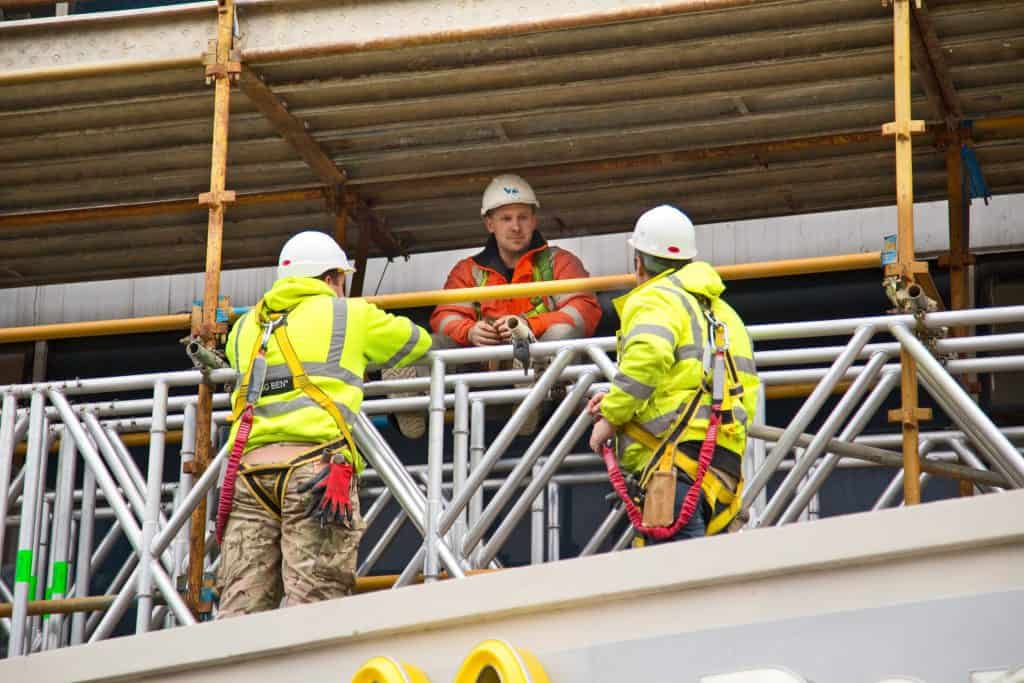 We always felt our company was the place scaffolders wanted to work. Perhaps that was naïve of us, certainly conceited. We do high profile jobs on amazing buildings and work for the biggest and the best clients – but is this our downfall? We had a chat about it – if we were still on the tools would we want to work to all the extra conditions laid down by the main contractors, glasses, gloves, double lanyards, tool tethers, long trousers, long sleeves, pre-start briefings, safety stand downs, next day briefings, all while earning less than other guys jumping around in shorts on building sites? Do the Tier 1 construction sector actually value the lengths that we, and our operatives go to?
I would like to think our employees appreciate how much we value their safety. We would hope they’d like us to buy them all bacon rolls when someone gets an award. That we offer more training courses than local companies and look after our workers interests. I am still not sure all scaffolders care about is their wage packet. There are some who change companies for 25p an hour and must have a cupboard full of branded t-shirts from every company in the region. That doesn’t excuse the fact that as an industry we haven’t been paying enough for a long time.
The recent pandemic and furlough payments showed being self-employed, or moving companies meant people missed out on government support. But like footballers’ scaffolders only have a certain window to earn the big money so they must get all they can without penalties while they can. Sorry about that.
Someone suggested we could offer them other benefits – I know a lot of other industries offer different perks including healthcare and gym membership. But if they have enough energy for the gym, have they been working hard enough? Do scaffolders really want any of these things?
Vans are popular – but surely only one from the gang gets the benefit of the van, outweighed by the fact he must get up earlier to pick everyone up on the way?
Down here in the South-West we have a housing boom and the HPC project creating a major vacuum point for scaffolders. It’s not a situation we can easily fix. We are starting again with five new apprenticeships, bringing new blood into the industry. Hopefully, they will see the gains of being with us, for the long haul. We like investing in people and watching them grow, and ultimately making them into the sort of people who are worth every penny.
We are exceptionally proud of everyone who puts on an Apex shirt because we want them to be proud of wearing it. If it means we must up our wage bill, then so be it. If this has a knock-on effect on our prices, so be it.
Just like us, if they want the best, they must be prepared to pay for it.
We always felt our company was the place scaffolders wanted to work. Perhaps that was naïve of us, certainly conceited. We do high profile jobs on amazing buildings and work for the biggest and the best clients – but is this our downfall? We had a chat about it – if we were still on the tools would we want to work to all the extra conditions laid down by the main contractors, glasses, gloves, double lanyards, tool tethers, long trousers, long sleeves, pre-start briefings, safety stand downs, next day briefings, all while earning less than other guys jumping around in shorts on building sites? Do the Tier 1 construction sector actually value the lengths that we, and our operatives go to?
I would like to think our employees appreciate how much we value their safety. We would hope they’d like us to buy them all bacon rolls when someone gets an award. That we offer more training courses than local companies and look after our workers interests. I am still not sure all scaffolders care about is their wage packet. There are some who change companies for 25p an hour and must have a cupboard full of branded t-shirts from every company in the region. That doesn’t excuse the fact that as an industry we haven’t been paying enough for a long time.
The recent pandemic and furlough payments showed being self-employed, or moving companies meant people missed out on government support. But like footballers’ scaffolders only have a certain window to earn the big money so they must get all they can without penalties while they can. Sorry about that.
Someone suggested we could offer them other benefits – I know a lot of other industries offer different perks including healthcare and gym membership. But if they have enough energy for the gym, have they been working hard enough? Do scaffolders really want any of these things?
Vans are popular – but surely only one from the gang gets the benefit of the van, outweighed by the fact he must get up earlier to pick everyone up on the way?
Down here in the South-West we have a housing boom and the HPC project creating a major vacuum point for scaffolders. It’s not a situation we can easily fix. We are starting again with five new apprenticeships, bringing new blood into the industry. Hopefully, they will see the gains of being with us, for the long haul. We like investing in people and watching them grow, and ultimately making them into the sort of people who are worth every penny.
We are exceptionally proud of everyone who puts on an Apex shirt because we want them to be proud of wearing it. If it means we must up our wage bill, then so be it. If this has a knock-on effect on our prices, so be it.
Just like us, if they want the best, they must be prepared to pay for it. 



 He also explained an ‘exit wave’ was inevitable adding, “We know we’re going to see more hospitalisations and more deaths from Covid.” but that unlocking had to happen at some point and summer was the best time to do it.”
A recent opinion poll revealed half of those in the UK would have preferred the July 19 easing to be postponed. In an industry where some employees have been working right through the pandemic, such mixed messaging on masks has only succeeded in muddying the waters for bosses across the country.
Given all of this, Graham Medley, chair of the SPI-M modelling group, told listeners to the Radio Four Today programme earlier in the week: “There is evidence to suggest that it does good, but only if everybody does it.
“Without the [mandated approach] we end up in a situation where even if the majority – say 70 per cent wear a mask – will that do any good because of the 30 per cent who don’t? If it’s not mandated it probably won’t do any good.”
One of the biggest worries centres around the NHS Furthermore, where an expected 100,000 cases a day could lead to 2,000 admissions. Twice the number normally seen across the winter months for all respiratory infections.
Duncan Spencer, IOSH’s Head of Advice and Practice, urged employers to help influence safe behaviours.
He said: “Despite the relaxations, we encourage employers to ensure they continue to put in place preventative measures to reduce the likelihood of Covid-19 being transmitted in their workplaces.”
“Risk assessments can help to identify proportionate controls to protect workers, clients, consumers and communities. With COVID risks, this might include a reasonable request for people to continue wearing face masks and observe social distancing measures. Employers might wish to emulate other socially conscious organisations by asking workers to test themselves regularly, including supplying them with lateral flow test kits.
“It is crucial that any preventative measures are communicated clearly, thereby empowering people to work safely while this disease remains a significant threat.”
He also explained an ‘exit wave’ was inevitable adding, “We know we’re going to see more hospitalisations and more deaths from Covid.” but that unlocking had to happen at some point and summer was the best time to do it.”
A recent opinion poll revealed half of those in the UK would have preferred the July 19 easing to be postponed. In an industry where some employees have been working right through the pandemic, such mixed messaging on masks has only succeeded in muddying the waters for bosses across the country.
Given all of this, Graham Medley, chair of the SPI-M modelling group, told listeners to the Radio Four Today programme earlier in the week: “There is evidence to suggest that it does good, but only if everybody does it.
“Without the [mandated approach] we end up in a situation where even if the majority – say 70 per cent wear a mask – will that do any good because of the 30 per cent who don’t? If it’s not mandated it probably won’t do any good.”
One of the biggest worries centres around the NHS Furthermore, where an expected 100,000 cases a day could lead to 2,000 admissions. Twice the number normally seen across the winter months for all respiratory infections.
Duncan Spencer, IOSH’s Head of Advice and Practice, urged employers to help influence safe behaviours.
He said: “Despite the relaxations, we encourage employers to ensure they continue to put in place preventative measures to reduce the likelihood of Covid-19 being transmitted in their workplaces.”
“Risk assessments can help to identify proportionate controls to protect workers, clients, consumers and communities. With COVID risks, this might include a reasonable request for people to continue wearing face masks and observe social distancing measures. Employers might wish to emulate other socially conscious organisations by asking workers to test themselves regularly, including supplying them with lateral flow test kits.
“It is crucial that any preventative measures are communicated clearly, thereby empowering people to work safely while this disease remains a significant threat.”