Scaffolding supplier Leach’s has launched a range of new environmentally-friendly products and to celebrate 100 years in business it’s planting 100 trees to help reduce its carbon footprint.
Leach’s, one of the UK’s most trusted suppliers of scaffolding supplies and height safety equipment, is planting 100 trees to celebrate 100 years of business as part of its ongoing sustainability initiative.
The company is working with Trees for Life to plant 100 trees in the Scottish Highlands.
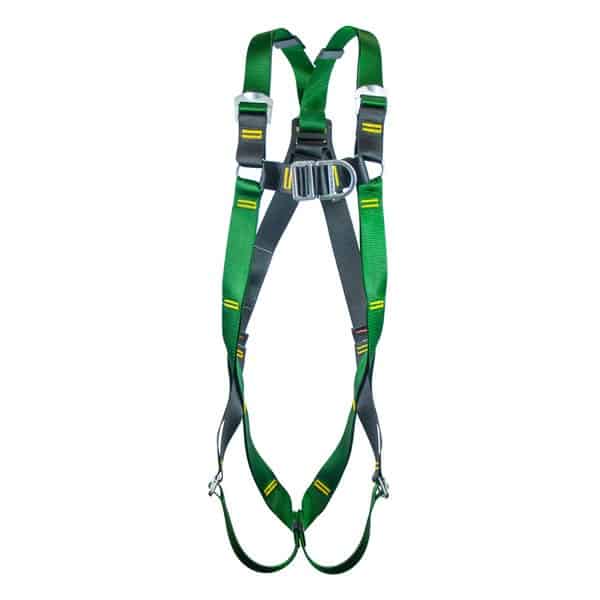
As the firm continues its efforts to reduce its carbon footprint, it is also launching two brand-new environmentally friendly products, Leach’s Eco Harness and BIGBEN® Ultralite Eco Gloves, delivering sustainable product options to the scaffolding and construction industries.
For much of Leach’s first 100 years, it has prioritised taking care of people. That has involved delivering the ultimate protection for all tradespersons working at height, including scaffolders and construction workers. Now, it is widening its focus to include protecting our planet.
Leach’s has launched a first if it’s kind Eco Harness that’s made from upcycled PET bottles and is certified-free from harmful chemicals. As scaffolders get through many pairs of gloves week in week out the company is also launching BIGBEN® Ultralite Eco Gloves that are made from one recycled plastic bottle per pair of gloves. What’s more, they are washable and reusable too.
Russell Tennent, Managing Director at Leach’s, said: “In recent years, as part of our efforts to implement environmentally friendly working practices across industry, we’ve successfully introduced products like BIGBEN Eco Scaffold Sheeting that can be recycled; we’ve taken more of our manufacturing in house to help reduce our carbon footprint; and we have plans to reduce the waste from our packaging. We’ve been taking the steps needed to push the industry towards sustainable business practices. These new product launches, alongside the trees initiative, forms the latest in a series of new endeavours to protect our planet.”
TRAD UK has launched a new product that offers complete flexibility for both temporary and permanent roof edge protection.
TRAD UK, part of the TRAD Group, has launched its latest innovation – the All-in-One EdgeGuard system. Building on the popularity of its long-standing EdgeGuard product, the new all-in-one has been designed to meet both British and European Standards that offers an easier, safer and smarter way to protect roof edges up to a pitch of 10°.
This new patent-pending product offers a range of features:
Meets BS EN 13374:2018 Class A and the new BS 13700:2021, making it the leading choice for all project site, whether it be for temporary or permanent installation, or both.
Lightweight modular components that are easy to install.
No specialist tools are required.
Improved safety with low-profile feet and non-slip rubber mat.
Free-standing, folding or fixed options.
Minimal training is required to install.
“Designed by our in-house product development and innovation team, the All-in-One EdgeGuard is a fantastic example of TRAD’s creativity at work,” says Alan Slater, Head of Technical and Product Support at TRAD UK.
“Our design department delivers really imaginative solutions that meet not just the health and safety standards required, but our customers’ demands, helping them to be more time and cost efficient on site.”
As an example of this, the All-in-One EdgeGuard can be switched from a temporary installation to a permanent one with just a few adjustments. So installers can now fit temporary roof edge protection during a new build, and then change it to a safe, permanent edge protection quickly and easily, without the costs of taking one full system down and installing another.
“We believe TRAD UK is the first company to come to the UK market with such an adaptable solution,” says Alex Ackers, TRAD UK Regional Manager and Innovations PU leader.
“We find that, across our product design work, whether it is driven by updated standards, by customer demand, or by seeing gaps in the market, our in-house team has the experience and imagination to create products for the industry by the industry. That means we always have something new to offer, with more in the pipeline, and the All-in-One EdgeGuard is a great example of this.”
The new All-in-One EdgeGuard is available now for sale or hire nationwide across all TRAD UK depots, with sale basis finance solutions available through the company’s business finance partner, Approved Business Finance.
To mark Testicular Cancer Awareness Month, Northwest firm Teal Scaffold is encouraging its team and urging the wider industry to perform self-examinations.
Teal Scaffold is backing the national campaign to highlight the importance of self-examination and regular testing. It is widely reported that testicular cancer most often develops in young and middle-aged men between 20 to 30 years old.
The company’s management is going to great lengths this month to stamp out the stigma, to promote positive male health and wellbeing.
As part of the UK’s Best Place to Work, The Sovini Group, the scaffolding company plans to build on their momentum of raising awareness of testicular cancer beyond April, encouraging, and signposting the Group’s colleagues to get tested.
As part of the campaign, Teal will be advocating on behalf of The Testicular Cancer Network within the Group and encouraging conversations amongst colleagues.
Teal Scaffold Head of Operations, Dan McGregor says: “We are encouraging the men in our team and our wider Group to take their health seriously. We are always looking for ways to further elevate key health messages to our colleagues, customers and beyond.”“Just like the checks we perform on scaffolding to ensure health and safety; testicular self-examination should be a part of our daily routine too. It is incredibly important that we support Testicular Cancer Awareness Month. It is remarkable the work that The Testicular Cancer Network are doing and hopefully we can help amplify their message. Awareness will save lives.”
Community Engagement Manager, Darren Couchman at The Robin Cancer Trust shares: “It is so important that men get to know the signs and symptoms of testicular cancer and how to carry out a self-examination. Us chaps need to talk about our health more and break the stigma that testicular cancer is an embarrassing illness. It’s not. As a testicular cancer survivor of 21 years, I know first-hand how vitally important it is to be aware, perform a monthly self-check and not to be embarrassed to visit your GP. It’s fair to say that if I wasn’t aware of what to look out for, I wouldn’t be here now. It’s fantastic that Teal Scaffold is advocating testicular cancer awareness amongst their employees. With companies like Teal Scaffold supporting the cause, we can reach so many more men with our life saving campaigns.”
Testicular Cancer is the most commonly diagnosed cancer for young men in the UK, but if detected in its early stages, it’s 98% curable.
For a guide on how to check for testicular cancer, or for more information on how to join, support or donate to the charities visit The Orchid Cancer Charity, Testicular Cancer Charity , Robin Cancer Trust or Baggy Trousers UK.
CITB data reveals that almost 14,000 businesses have been supported in the form of grants, with over £77m paid out in the last year, and over 45% of grant spent went to small and micro businesses.
The CITB Grants Scheme provides grants for employers in the construction industry that provide day-to-day training for their workforce. There are several areas whereby businesses can apply for grants, including apprenticeships, short courses, and short/long qualifications.
The scheme is just one of the many ways CITB supports employers to maintain standards on construction sites and ensuring the right skills are available for the industry to grow. CITB also offers employer funds, which last year amounted to over £19m back to industry, assisting with standards development, training delivery and apprenticeships.
The data from the last year also indicates that apprenticeships have taken prominence, being the highest utilised area of grant amongst businesses, with 64% of grant spend claimed by apprenticeships in 2021/22. This support was maintained at a crucial time following the pandemic, allowing employers to adapt to the changing environment while continuing to deliver training. An additional £14m has been made available for 2022/23 to support a forecast increase in apprenticeship take up.
This is extremely encouraging news at a time when an additional 217,000 workers are required by 2025 to meet demand. CITB’s recent Rethinking Recruitment report also highlights some of the challenges industry currently face when recruiting new entrants, and this places greater emphasis on apprenticeships as a key way of securing a pipeline of future talent.
One business that has benefitted from the CITB Grants Scheme in recent years is Daniel Jeffries Carpentry. The Bournemouth based business has become well-known for taking on elaborate, quirky builds, garnering attention far and wide and helping them to secure various contracts across the world.
Speaking about the support he’s received, Daniel said: “The scheme was great for me because when I first started, I was just on my own. Then I got talking to a painter on site one day and he suggested I look into getting some support. I’d never thought about it really because I’d always thought it would be a bit complicated, and a bit too much paperwork and hassle, but it was actually really easy.”
Following a call with a CITB Adviser, Daniel discovered he was entitled to grant support and has since expanded the business, now employing a team of 10 people, including two apprentices. This has enabled the business to venture into larger-scale projects, having recently worked on a design of a snow lodge in the UK, which they then shipped out to America.
Daniel said: “Harvey was my first apprentice; he’s qualified now but just needs to complete his final assessment. I watch him on site and he’s so good at what he does; being able to get that extra support into the team really made a big difference to us.
“I was also able to get the rest of the team on training courses through CITB support. They’ve been doing all sorts of different tests here, including some essential training like the health and safety courses.”
Tim Balcon, CITB Chief Executive, said: “We’re incredibly proud of the support the Grant Scheme has been able to provide in the last year, helping many smaller businesses through a turbulent time. The Grant Scheme is in place for all eligible employers who are registered with CITB, making it a huge opportunity that could really make all the difference for a business wanting to expand or further develop their skills.
“If you would like more information about becoming registered and claiming a grant, we’d really encourage you to get in touch and speak to one of our advisers.”
Watch teams of scaffolders from eight different scaffolding contractors based in Lithuania, Finland and Sweden take part and compete in the scaffolding championship held in Vilnius, Lithuania.
Participants include employees from Hot Rema, Globalita, Bjorli Bygg, Global Scaffolders, Bailey Industries, MSA Telineet, Bygg Stillas as and Telinetiimi.
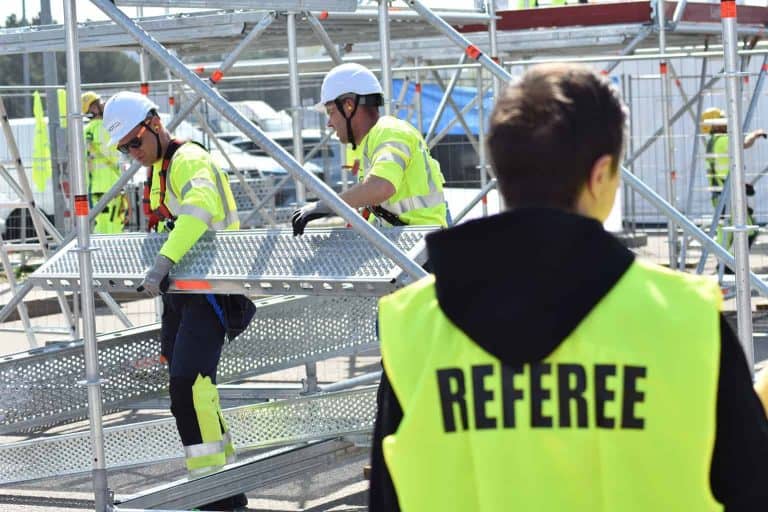
After two long years of postponements due to the Covid pandemic and travel restrictions organisers in Lithuania are ready to welcome eight teams of scaffolders from around Europe to compete in the 2nd Scaffolding Championship.
Teams of scaffolders from eight different scaffolding contractors based in Lithuania, Finland and Sweden are limbering up in preparation to compete in tomorrow’s scaffolding championship held in Vilnius, Lithuania.
Participants include employees from Hot Rema, Globalita, Bjorli Bygg, Global Scaffolders, Bailey Industries, MSA Telineet, Bygg Stillas as and Telinetiimi.
In 2019 Scaffmag’s Editor visited the first successful scaffolding championship event that aimed to promote a professional scaffolding trade while showcasing the improved safety standards in the Baltic region.
That event saw nine teams participating from five countries, Poland, Lithuania, Latvia, Estonia and Russia. Each team had to safely erect and dismantle a designed freestanding scaffold within two hours. The teams were against the clock and the scrutiny of industry expert referees.
This year’s event organisers, The Baltic Scaffolding Association (BSA) are live streaming the championships that we will be hosting here from 7am Friday 22nd April.
New research has revealed the UK’s biggest hotspots for van theft, with some regions seeing the number of offences more than double year-on-year.
The study, conducted by IronmongeryDirect, the UK’s largest supplier of specialist ironmongery, issued Freedom of Information requests to police forces to discover how many vans were stolen in 2020 and 2021.
Cambridgeshire is the UK’s biggest hotspot for the crime, with a 103% increase in van theft over the two years. The number of trade vehicles stolen rose from 68 in 2020 to 138 in 2021.
Cumbria isn’t far behind, with offences doubling over the time period from 15 to 30 (100%).
In fact, almost two in five (38%) police forces saw increases in van theft between 2020 and 2021.
Over the two years, 14,919 vans were reported stolen across the UK, with an average of 466 per police force.
However, as many crime reports fail to specify the type of vehicle, this figure could be even higher.
Almost half (46%) of the total number of offences were in London. In 2020 and 2021, 6,839 incidents of van theft were reported to The Metropolitan Police Service.
To help tradespeople protect themselves from van theft, Dan Powell, motoring expert at Desperate Seller, offers security advice.
1) Park in well-lit, highly trafficked areas
“This can often be the most effective deterrent as it makes a discrete getaway extremely difficult. If it means paying a little more for parking or walking an extra few minutes to your destination, it’s a lot less effort and cost than the alternative.”
2) Secure your spare wheel
“Spare wheels are often unscrewed and stolen without the van owner’s knowledge. Once you’ve checked that you still have yours, make sure it’s secured with a wheel lock. There are inexpensive products on the market that can save you the hassle of being caught out.”
3) Make sure you have insurance
“Most importantly, it’s always worth having adequate van insurance in case of theft or damage. Ensure the insurance policy includes tools and equipment left in the van overnight. Not all insurance products will provide this, and if you need to leave valuables in the vehicle, it’s essential to make sure they are covered.”
Dominick Sandford, Managing Director at IronmongeryDirect, said: “Sadly, van theft is a common problem across the UK and offences can have a devastating impact on tradespeople, both personally and professionally.
“Our research has revealed which areas are seeing particularly large spikes in cases, but you need to be careful wherever you live, and that’s why we’re working with experts to share their top bits of advice on how to protect yourself.”
CITB Chief Executive Tim Balcon is one of 15 construction industry leaders on a new Skills for a Sustainable Skyline Taskforce.
The aim of the taskforce, which will meet for the first time in May, is to look at addressing skills gaps around the construction, retrofit and maintenance of low carbon commercial buildings in Central London boroughs.
Commenting on his new role Tim said: “CITB is in the business of skills and training which is why I am pleased to be part of the Skills for a Sustainable Skyline Taskforce’s Strategy Steering Board.“Decarbonisation is a major challenge – and opportunity – for the construction industry. A green-skilled workforce will be vital as the UK strives to achieve the government’s net zero targets.“CITB has conducted extensive work on skills and sustainability, most recently in our Net Zero and Construction: Perspectives and Pathways report. “The report examined the skills and training needed to deliver retrofit work. It shows how training and recruitment must move with the times. This means new methods of working and the need to diversify the workforce. Construction must encourage and welcome under-represented groups, like women and people from ethnic minorities, into industry.“CITB is working with stakeholders to promote construction careers in a variety of ways, our Go Construct website is a good example. We want to see new, diverse recruits raring to use their green skills, for the good of everyone, from day one of their careers.“For this to happen governments, employers, the training sector and businesses must collaborate effectively on green skills. I’m looking forward to making progress on the challenges ahead with the Skills for a Sustainable Skyline Taskforce’s Strategy Steering Board.”
The exclusive partnership will enable TRAD UK customers to directly access Approved Business Finances market leading funding solutions.
TRAD UK one of the UK’s leading scaffolding and access companies, has announced a new exclusive partnership with Approved Business Finance (‘Approved’) to accelerate the access to their scaffolding equipment through bespoke finance products.
Trad UK, part of the global Altrad Group, and Approved Business Finance, one of the fastest-growing finance brokerages in the UK, will bring their collective expertise and products to market.
TRAD is one of the UK’s leading scaffolding and safety product supply companies. Their innovative approach to scaffolding and safety systems means they can offer leading technology that allows contractors to work safely at height and across all project types.
With a UK-wide network of depots, their highly trained and knowledgeable team have the experience to offer comprehensive advice and technical expertise, rendering TRAD as the go-to scaffold supply company for businesses of all sizes.
TRAD were keen to partner with Approved, a finance broker with clear links to the scaffolding sector and an impressive track record in securing funding for many mutual clients.
“When TRAD sought to offer a financial solution to market, we needed a partner that would listen and make recommendations that made sense for our business. We have been delighted with the Approved Finance team’s approach and are looking forward to building a successful partnership together. Having the option of finance available for our clients to help aid their growth through the purchase of materials while also helping us to grow our client base should prove to be a real positive for our company,” said Colin Dobson, TRAD UK M.D.
Since its inception, Approved – awarded SME Champions 2021 by the NACFB, has facilitated over £200M of business finance and helped nearly 2,000 clients. They have utilised a lender framework where scaffolding firms can draw on the knowledge and resources of a UK leading brokerage that can source best in class finance products.
Approved has been working to further establish themselves as the go-to finance broker within scaffolding, being members of the Scaffolding Association for the past two years and reaching a wider audience with outlets such as ScaffMag.
Rory Dunn, Joint Managing Director of Approved Business Finance added, “This strategic partnership with TRAD is an exciting development for the construction division of Approved Finance and shows our flexibility in funding less traditional asset classes for SMEs throughout the UK. We couldn’t be more pleased to be working alongside one of the UK’s leading scaffolding equipment suppliers and we look forward to seeing the partnership flourish.”
Tom Sudds, Senior Finance Broker at Approved, will be spearheading the account, “Having worked with TRAD on a consistent basis for several years with numerous mutual clients, I’m extremely excited to be working alongside them in an official capacity. I look forward to helping scaffolding firms across the UK secure the funding they need to grow.”
Today’s announcement builds on Approved’s pioneering work to provide accessible finance solutions to SMEs – and specifically scaffolding firms, with the aim of making finance the preferred purchasing option for businesses nationwide.
For more information about Approved Business Finance visit: www.approvedbusinessfinance.co.uk
London based GKR Scaffolding are trialling high-quality sustainable workwear and on a major HS2 project.
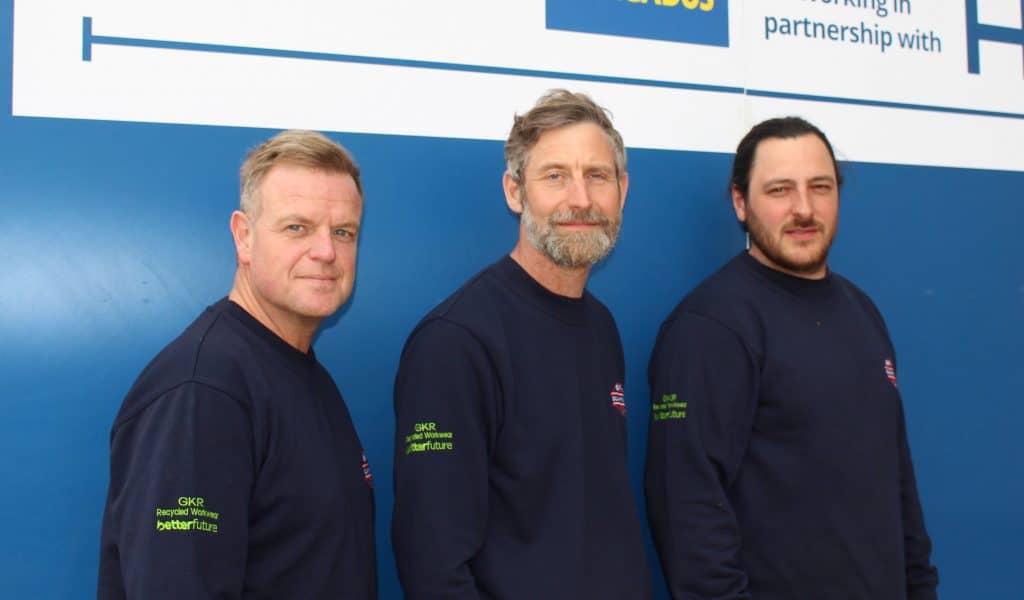
As part of its drive to be a more sustainable business GKR operatives and management working on the Euston Station Redevelopment for HS2 are wearing workwear made from recycled materials.
The ECOVIS products supplied for the HS2 orange reflective workwear (shown above) are derived from clothing and follows a process that converts the material to polyester fabric that complies with ISO 20471.
GKR say the Earthpro range is also being used that is made from a majority of recycled materials such as polyester with the range including jumpers, t-shirts and polo shirts worn on the project as part of the GKR uniform.
65% of the recycled polyester is sourced from plastic collected from seas, rivers and landfill, with the logos embroidered using Polyneon Green recycled thread.
Image credit: GKR
According to the firm, this is part of a wider move into expanding the business’ range of recycled and recyclable products in GKR’s supply chain.
Recyclable sheeting is also being trialled on some GKR projects as well as scaffolding tags that can be recycled at the end of their life.
The fire rated sheeting is certified to TS62 and manufactured with sustainable material that doesn’t contain any persistent organic pollutants. It can be 100% recycled and re-used in other construction elements.
GKR is trialling the products to ensure they maintain the standards of the products typically used and encouraging their use in the wider industry.
GKR’s Commercial Director, Paul Hersey, is GKR’s Sustainability Lead he said: “As more businesses use these products the costs will hopefully reduce and become more accessible for all scaffolding contractors to use them on site.It is important that any alternatives to our usual products do not compromise quality and we welcome our supply chain being proactive in helping the industry find sustainable, cost-effective alternatives to materials that usually end up in landfill.Being a Carbon Neutral Business, these switches also contribute to reducing our embodied carbon which is vital to achieving our Net Zero Carbon target by December 2023.”
We use cookies on our website to give you the most relevant experience by remembering your preferences and repeat visits. By clicking “Accept”, you consent to the use of ALL the cookies.
This website uses cookies to improve your experience while you navigate through the website. Out of these, the cookies that are categorized as necessary are stored on your browser as they are essential for the working of basic functionalities of the website. We also use third-party cookies that help us analyze and understand how you use this website. These cookies will be stored in your browser only with your consent. You also have the option to opt-out of these cookies. But opting out of some of these cookies may affect your browsing experience.
Necessary cookies are absolutely essential for the website to function properly. These cookies ensure basic functionalities and security features of the website, anonymously.
Cookie
Duration
Description
cookielawinfo-checbox-analytics
11 months
This cookie is set by GDPR Cookie Consent plugin. The cookie is used to store the user consent for the cookies in the category "Analytics".
cookielawinfo-checbox-functional
11 months
The cookie is set by GDPR cookie consent to record the user consent for the cookies in the category "Functional".
cookielawinfo-checbox-others
11 months
This cookie is set by GDPR Cookie Consent plugin. The cookie is used to store the user consent for the cookies in the category "Other.
cookielawinfo-checkbox-necessary
11 months
This cookie is set by GDPR Cookie Consent plugin. The cookies is used to store the user consent for the cookies in the category "Necessary".
cookielawinfo-checkbox-performance
11 months
This cookie is set by GDPR Cookie Consent plugin. The cookie is used to store the user consent for the cookies in the category "Performance".
viewed_cookie_policy
11 months
The cookie is set by the GDPR Cookie Consent plugin and is used to store whether or not user has consented to the use of cookies. It does not store any personal data.
Functional cookies help to perform certain functionalities like sharing the content of the website on social media platforms, collect feedbacks, and other third-party features.
Performance cookies are used to understand and analyze the key performance indexes of the website which helps in delivering a better user experience for the visitors.
Analytical cookies are used to understand how visitors interact with the website. These cookies help provide information on metrics the number of visitors, bounce rate, traffic source, etc.
Advertisement cookies are used to provide visitors with relevant ads and marketing campaigns. These cookies track visitors across websites and collect information to provide customized ads.
 Russell Tennent, Managing Director at Leach’s, said: “In recent years, as part of our efforts to implement environmentally friendly working practices across industry, we’ve successfully introduced products like BIGBEN Eco Scaffold Sheeting that can be recycled; we’ve taken more of our manufacturing in house to help reduce our carbon footprint; and we have plans to reduce the waste from our packaging.
We’ve been taking the steps needed to push the industry towards sustainable business practices. These new product launches, alongside the trees initiative, forms the latest in a series of new endeavours to protect our planet.”
Russell Tennent, Managing Director at Leach’s, said: “In recent years, as part of our efforts to implement environmentally friendly working practices across industry, we’ve successfully introduced products like BIGBEN Eco Scaffold Sheeting that can be recycled; we’ve taken more of our manufacturing in house to help reduce our carbon footprint; and we have plans to reduce the waste from our packaging.
We’ve been taking the steps needed to push the industry towards sustainable business practices. These new product launches, alongside the trees initiative, forms the latest in a series of new endeavours to protect our planet.” 
 Russell Tennent, Managing Director at Leach’s, said: “In recent years, as part of our efforts to implement environmentally friendly working practices across industry, we’ve successfully introduced products like BIGBEN Eco Scaffold Sheeting that can be recycled; we’ve taken more of our manufacturing in house to help reduce our carbon footprint; and we have plans to reduce the waste from our packaging.
We’ve been taking the steps needed to push the industry towards sustainable business practices. These new product launches, alongside the trees initiative, forms the latest in a series of new endeavours to protect our planet.”
Russell Tennent, Managing Director at Leach’s, said: “In recent years, as part of our efforts to implement environmentally friendly working practices across industry, we’ve successfully introduced products like BIGBEN Eco Scaffold Sheeting that can be recycled; we’ve taken more of our manufacturing in house to help reduce our carbon footprint; and we have plans to reduce the waste from our packaging.
We’ve been taking the steps needed to push the industry towards sustainable business practices. These new product launches, alongside the trees initiative, forms the latest in a series of new endeavours to protect our planet.”