The UK’s largest scaffolding trade association has called on the Government not to scrap or relax the Working at Height Regulations.
Following our news that the Government is planning on scrapping the Working at Height Regulations by the end of 2023, the Scaffolding Association has appealed to business secretary Grant Shapps to reconsider and rescue the regulations
According to reports the Government is poised to automatically scrap the Working at Height Regulations and over 2,400 other laws and regulations at the end of 2023 following the UK leaving the European Union.
The Revocation and Reform Bill which is currently being passed through Parliament seeks to remove EU-derived laws that remain on the UK statute book following Brexit.
In a letter to the Government Robert Candy, Chief Executive of the Scaffolding Association said; “This association fully supports WAHR and does not believe that they are burdensome or onerous for businesses to implement.We are seeking urgent reassurance from ministers that the government does not intend to remove WAHR and that careful consideration will be given to ensure that any amendments do not inadvertently compromise the safety of workers within our sector and the wider construction industry.As with all matters of importance to our members and the scaffolding and access industry, we have offered ministers our expertise and support and hope that they take the opportunity to understand the implications before they make any decisions”.
A Yorkshire scaffolding company is playing a leading role in the restoration of a 155- year-old Grade II listed church tower.
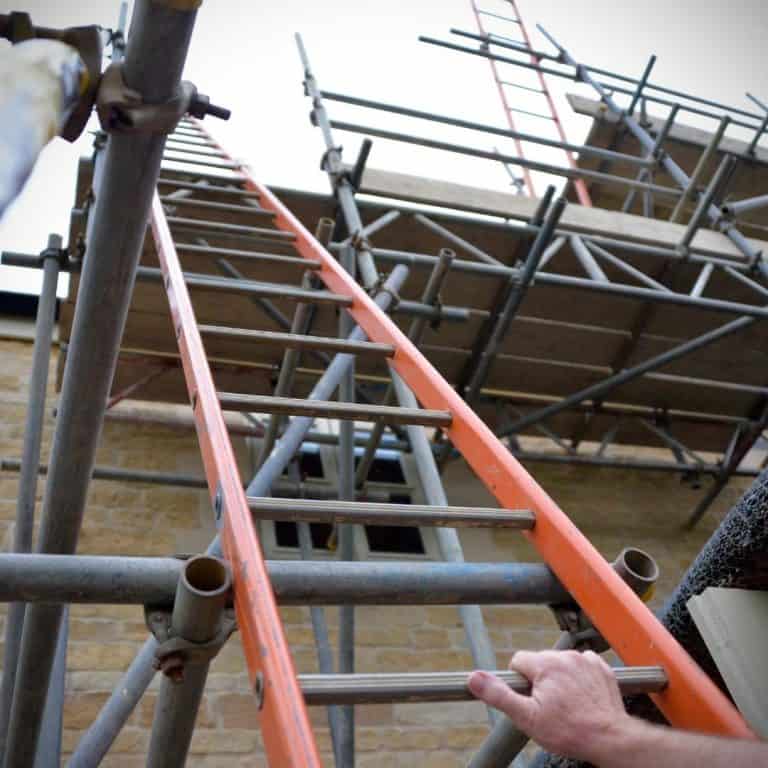
Elite Scaffolding, based at Thorpe Arch Trading Estate, spent three weeks scaffolding St Edward’s Catholic Church’s imposing west tower, allowing essential work to be carried out.
The structure, complete with buttresses, was finished in 1867 and culminates in a pyramid shaped ashlar roof and a finial. The base of the tower is open and has massive round arches open on three sides, making a very grand entrance to the church.
The Catholic church, located in the village of Clifford, near Boston Spa, West Yorkshire, was established to serve the growing population of Irish workers who came to work in the local flax mill in the 1830s, and was constructed of ashlar limestone with a green slate roof.
The eight-month programme of work see extensive repairs to the tower, masonry, gutters and windows.
Other works include replacing the lightening conductor’s fixings, repairing fissures running through stone which require pinning to prevent further movement, replacing and repointing cement joints, replacing high-level iron bars, and pressure cleaning window ledges.
Spencer Cassidy, Elite Scaffolding’s Managing Director, said: “After successfully completing high-profile projects at Ripley Castle, Knaresborough Castle, and Allerton Castle, this is the latest heritage building project that we have been involved with.“It took our team three weeks to fully scaffold the 30m tower, allowing the experts to carry out their work in complete safety.“This is another significant project for us, and we are delighted to be playing our part in helping restore this prominent structure, one that dominates the local skyline. It also demonstrates our expertise in scaffolding historic and listed buildings.”
As the year edges closer to an end, and before we pack up and close for the traditional Christmas break we take a look back at what most attracted your attention during 2022.Daniel Norton, Founder/Editor of Scaffmag
The last twelve months have been another busy news-filled year for the scaffolding industry as ScaffMag continues to keep you updated with what’s going on. Whether on desktop, mobile, tablet or in our quarterly magazine available in digital and print, we have you covered.
During the holiday season, we will update the site with any major breaking stories but our full news service will be back on 4 January 2023.
We would like to take this opportunity to wish all our valued readers, subscribers and the thousands of social media followers from around the world a very safe and Merry Christmas and a happy new year.
10
NASC’s recently revised flag-ship scaffolding safety guidance – SG4:22: Preventing Falls in Scaffolding Operations is now available as a free download to all.
NASC members were initially allowed free access to the safety guidance – featuring 60 pages of detailed scaffolding sector analysis and safety guidance, with 95 key figures and illustrations – last week.
Now NASC has said having had a chance to digest this, SG4:22 has been made available as a free download on the NASC website to everyone in the industry.
Acting NASC Managing Director, Dave Mosley said: “Our primary objective as the UK’s ‘go-to’ scaffolding and access industry trade body for best practice guidance is to make the scaffolding industry safer – through our safety and technical publications we help set the industry standard – not just for our members, but the entire scaffolding sector.“By allowing SG4:22 to be downloaded free to all in the industry, NASC is making the industry safer – one scaffold at a time.”
The key changes in SG4:22 are:
The removal of obsolete technology.
The inclusion of case studies highlighting accident and enforcement learning.
The embracing of new technology (e.g., drones and 3D modelling).
Updates to reflect changes brought in with TG20:21 (such a TG20 loading bays).
The inclusion of modular system scaffolding as well as traditional tube and fitting.
Additional safety guidance on working on beams.
Hazards, risks and control measures required when working on fragile roofs.
Improved Safe System of Work (SSOW) for temporary roofs and the prevention of falls.
For now, the NASC states that current SG4:15YOU booklets can still be issued to scaffolders – alongside a tool box talk on the key changes, until SG4:22 booklets become available in early 2023.
SG4:22 Management Guide is available to download as a PDF from the NASC website now.
National construction charity Band of Builders (BoB) is gearing up for an increase in use of its new mental health text service during the festive period – following new figures that indicate that 5,583 people died by suicide in Britain during the last year.
The charity launched the service in October as part of its annual Big Brew campaign so that tradespeople, contractors and their families can text BOB to 85258 at any time to get much-needed help. BoB is expecting to see a spike in usage over Christmas and into the new year – and it wants to encourage people from across the construction community not to suffer in silence.
Peter Cape, the Big Brew lead at Band of Builders, says that Christmas is always a stressful period at the best of times – but this year it is compounded by additional pressures such as the cost-of-living crisis and sky-high energy bills.
“Band of Builders is making a simple appeal this Christmas to everyone involved in the construction industry to ask for help if they are suffering with mental health issues,” he said. “We’re asking scaffolders, roofers, electricians, builders and everyone else in construction, or their families, who are concerned about their mental health to take that all-important first step and text BOB to 85258.“Our text service team are trained to respond to the full spectrum of mental health issues, including abuse, addiction, anger issues, anxiety, bereavement, bullying, depression, loneliness, personality disorders, relationship issues, self-harm, trauma, work-related stress and even suicidal thoughts.“ONS figures used as part of the Big Brew campaign – which is sponsored by Big Red Construction – suggest that UK construction sector workers are nearly three times as likely to die by suicide than their counterparts in other industries, and the suicide rate of UK construction workers is estimated to be as high as two people every day.”
The appeal is especially important, as figures being reported in The Times newspaper suggest that last year, 5,583 people died by suicide in Britain.
Peter added that the sole aim of the Big Brew has been to make it as easy as possible for tradespeople and contractors to take the first step and reach out. Last year’s campaign raised enough money to fund a counselling service specifically for the construction industry for two years.
“The new text service has been a welcome addition to the counselling service – which means we can offer different routes by which tradespeople can get much-needed help and support.”
This year, CITB has paid out over £5m more in grants and supported nearly 700 more employers compared to the same period in 2021.
CITB data has revealed that almost 12,500 businesses have been supported in the form of grants, with £54.6m paid out to date (Apr – Nov 2022), and more than half paid to small or micro businesses.
The CITB Grants Scheme provides grants for employers in the construction industry that deliver day-to-day training for their workforce. There are several areas whereby businesses can apply for grants, including apprenticeships, short courses, and qualifications.
The data also shows early signs of a pattern forming, as apprenticeships continue to be the highest-used area of grants so far. Following a boost in grant funding for apprenticeships, £37.4m has been paid out since April, amounting to 68.5% of the total grant spend this year.
CITB’s Construction Skills Network (CSN) report, released earlier this year, revealed that approximately 50,000 additional workers will be required every year to meet demand by 2026. This highlights how recruitment and developing a highly skilled workforce will be by far the construction industry’s biggest challenges moving forward.
As a response to employer feedback, CITB has been working on simplifying the grant application process, with the aim of supporting even more businesses through the Grants Scheme in the new year. As part of this, a new one-page PDF form is now available on the CITB website.
Tim Balcon, CITB Chief Executive, said: “The impact the Grant Scheme has been able to provide in just the last six months is fantastic! Looking at the comparison to last year’s grant spend shows just how valuable the funding is to employers, and we’re incredibly proud to continue supporting the industry to make sure they are equipped with the right skills and people to meet demand.“The scheme is in place for all eligible employers who are registered with CITB, and we hope that the new application approach will encourage even more people to come forward and benefit from the funding. If you would like more information about becoming registered and claiming a grant, please do get in touch and speak to one of our advisers.”
To find out more about how you can receive support, visit the Grants and Funding page.
Mohed Altrad the billionaire owner of the Altrad Group has been handed an 18-month suspended jail term after he was found guilty of rugby-related corruption.
Mohed the French scaffolding giant who according to Forbes is worth 3.3 billion was found guilty along with French Rugby Federation president Bernard Laporte of corruption in the award of rugby shirt sponsorship deals to Altrad.
It was alleged that Mohed had conspired with Bernard Laporte to make his company the official front-of-shirt sponsor for the French national rugby team in exchange for a €180,000 payment in 2017.
Judges in Paris found the pair guilty and gave Mohed an 18-month suspended sentence and a €50,000 fine, Laporte received a two-year suspended prison sentence and €75,000 fine.
Both men have denied any wrongdoing, while Mr Altrad’s lawyer said his client will consider whether to appeal the verdict over the coming days.
“Mohed Altrad never intended to illegally obtain any favours from Bernard Laporte,” Altrad’s lawyer said in a statement published by Bloomberg.
“The Altrad group is neither concerned nor impacted by this ruling and Mohed Altrad will continue to invest his time and energy in management missions for his group, its employees and partners.”
Altrad sponsors both the French rugby union national team and the All Blacks, and also owns Montpellier rugby club. In 2015 Mohed Altrad became the first Frenchman to win the World Entrepreneur of the Year award.
Mohed was born into a Syrian tribe he moved to France as a 17-year-old with little money and studied hard to secure a PhD in Computer Sciences. He took the plunge with a partner in 1985 to buy a scaffolding manufacturer close to bankruptcy founding Altrad.
Over the years and following a string of acquisitions, the Altrad Group has become a huge player in construction, scaffolding and industrial services which has grown into a €4.5bn-turnover international group employing 62,000 people worldwide.
The NASC has launched SG4:22: Preventing Falls in Scaffolding Operations. This long-awaited, core NASC safety guidance document provides industry best practice for fall prevention when erecting tube & fitting and now also includes system scaffolding.
SG4:22 features 60 pages of detailed scaffolding sector analysis and safety guidance, with 95 key figures and illustrations, to bring it to life.
Initially the document is available to download as a PDF from the NASC ePortal, but handy A6 SG4 user guide booklets are in the pipeline. For now, the NASC states that current SG4:15YOU booklets can still be issued to scaffolders – alongside a briefing on the main changes to SG4 – until SG4:22 booklets become available in early 2023.
The key changes to SG4:22 are:
The removal of obsolete technology.
The inclusion of case studies highlighting accident and enforcement learning.
The embracing of new technology (e.g., drones and 3D modelling).
Updates to reflect changes brought in with TG20:21 (such a TG20 loading bays).
The inclusion of modular system scaffolding as well as traditional tube and fitting.
Additional safety guidance on working on beams.
Hazards, risks and control measures required when working on fragile roofs.
Improved Safe System of Work (SSOW) for temporary roofs and the prevention of falls.
Speaking about the launch of SG4:22, Acting NASC Managing Director, Dave Mosley said: “SG4 has long been one of the most important documents in the access industry, as such it is imperative that it receives a thorough review every 5 years. Since its introduction it has went a very long way in helping make our industry a safer place – for NASC members and non-members alike. It is a must-have document for anyone involved in working at height, scaffolding and access.”
SG4:22 Technical Author and Simian Managing Director, Simon Hughes added: “Having been involved with NASC for over 25 years, I am proud to be associated with NASC and particularly in the development of their flagship safety guidance.“Since the first edition of SG4, which was published well over two decades ago, the scaffolding industry and the standards that support it have seen significant development, as they seek to reflect technological advancements, modern working practices, and the lessons learned by industry.“NASC’s publications are widely respected as industry best practice the world over, and I am pleased to have had the opportunity to be involved in the review and production of this edition, which will hopefully to yield improved standards of safety.”
Suzannah Nichol MBE, Chief Executive Build UK provided the following foreword to the newly released SG4:22, which says: “The application of consistently high standards is key to both safety and productivity on construction projects. Scaffolding professionals provide temporary working platforms and other structures that are used throughout the construction sector and they often face significant risks in establishing safe temporary access and work environments for other workers. Specialist construction trades, such as scaffolders, perform a vital role in our supply-chain and we all rely upon current industry guidance to establish, and maintain, safe working practices that have become the benchmark for our members’ projects.
“Written by NASC and industry experts, over the years this guidance has challenged industry practices and has clearly demonstrated an impact in saving lives and preventing serious injury. All scaffolding operatives should hold a current CISRS card and be trained to SG4:22 Preventing Falls in Scaffolding Operations which sets the standard across the UK.”
SG4:22 Management Guide is available to download as a PDF from the NASC e-Portal now. Contact the NASC office for more details: Phone (+44) 20 7822 7400 or email [email protected].
The HSE is reminding employers of their responsibilities to keep workers safe as cold weather continues to affect large parts of the country.
Great Britain’s workplace regulator, the Health and Safety Executive, is stressing the importance of protecting workers during the cold weather. It comes as the Met Office has issued a level three cold weather alert until Thursday 15 December for large areas of the UK.
John Rowe, Head of Operational Strategy, said: “We’re calling on all employers to take a sensible approach during the cold weather we are experiencing. There are lots of jobs that will be more difficult in the current conditions. Most employers will recognise this and make appropriate accommodations for their staff. That is the right thing to do.“It’s also important employers ensure staff are working in a reasonable temperature. People working in uncomfortably cold environments are less likely to perform well and more likely to behave unsafely because their ability to make good decisions deteriorates.”
Temperatures in indoor workplaces are covered by the Workplace (Health, Safety and Welfare) Regulations 1992, which place a legal obligation on employers to provide a “reasonable” temperature in the workplace.
All employers are expected to ensure indoor workplaces are kept at a reasonable temperature. The Approved Code of Practice suggests the minimum temperature should normally be at least 16 degrees Celsius. If the work involves rigorous physical effort, the temperature should be at least 13 degrees Celsius.
John Rowe added: “Complying with the code of practice is the right thing for an employer to do. By maintaining a reasonable temperature, employers are likely to maintain the morale and productivity of their staff as well as improving health and safety.”
In a bid to boost capacity and increase the number of new scaffolders, CISRS has been awarded a CITB commission to help fund the development and training of 16 new scaffolding instructors within England and Wales.
CISRS hopes to make the job of a scaffolding instructor an attractive potential change of career for 16 qualified Scaffolders, to enable them to pass on their knowledge and experience to the next generation.
In particular, the training body is seeking scaffolders in the following UK regions, which have been identified as being most in need of support:
Wales
Southwest
Northwest
Midlands
Northeast – (Humber/North Yorkshire)
South Central (Hampshire, IOW, Berkshire, West Sussex, Buckinghamshire, Oxfordshire,
Surrey)
The 16 new scaffolding instructors will undoubtedly help new NASC President David Brown’s mission to boost numbers and upskill operatives within the scaffolding sector.
CISRS Scheme Manager and NASC Managing Director, David Mosley said: “CISRS will be making all efforts to ensure that these regions get the additional instructor numbers that they need. We have already met with several centres that are fully on board, looking to recruit, train and retain the potential new instructors. Qualifying a new scaffolding instructor can take a considerable time. We are very grateful to CITB for offering this support. CISRS will work closely with the providers to ensure that all relevant training, experience and assessment is given to new recruits to get them up to at least Part 1 approval status.”
“Scaffolding instruction is a great career option for those who love their work in the industry but are considering a change of direction. You can continue to be involved within the sector by sharing skills and experience and maintaining high standards of training and skills to the upcoming workforce.”
Interested scaffolding instructor applicants should, in the first instance contact CISRS by emailing [email protected] with details of where they are based and the regions, they would be interested in working in.
Please note that all applicants need to have held a CISRS Advanced or Scaffolder card for 10+ years.

 Spencer Cassidy, Elite Scaffolding’s Managing Director, said: “After successfully completing high-profile projects at Ripley Castle, Knaresborough Castle, and Allerton Castle, this is the latest heritage building project that we have been involved with.
“It took our team three weeks to fully scaffold the 30m tower, allowing the experts to carry out their work in complete safety.
“This is another significant project for us, and we are delighted to be playing our part in helping restore this prominent structure, one that dominates the local skyline. It also demonstrates our expertise in scaffolding historic and listed buildings.”