Donations roll in for TRAD’s Three Peaks charity walk

TRAD has already raised more than 50% of its fundraising target of £75K for the year as part of its 50th-anniversary appeal.
TRAD Group (‘TRAD’), one of the UK’s leading scaffolding and access companies, is just a week away from sending 30 of its people on a 26-mile trek across Yorkshire’s three highest peaks, to raise money for the company’s chosen charities for its 50th anniversary year. The 30 walkers taking on the 3 Peaks challenge are made up of all disciplines across the Group, ranging from Yard Staff to Directors who will be taking part for a common cause. The company has been collecting donations to support the walkers, and is delighted to have received donations from numerous Scaffolding companies from up and down the country. In addition, the team has received a single donation of £2,500 from Northern Gas and Power – this brings the total fundraising for this year to around £40,000 – more than halfway to TRAD’s target of £75,000 for the year. “It’s been absolutely amazing to have this support from the scaffolding and construction industry,” said Des Moore, CEO at TRAD. “These generous donations have been added to the money collected individually by our team of walkers, and by other events put on by TRAD Group staff – it’s an immense effort and I’m really proud to be part of this charity effort.” The walkers will be trekking the three peaks on Saturday October 9th, and all donations are still welcome. “We’d really love to get to our target before the end of the year,” said Des Moore, who will be walking the route along with other members of staff. “So we’d encourage anyone who wants to support the Royal British Legion, MIND and the MS Society to contribute to our fundraising if they can. With still over 1 week until we take on the challenge I’m hopeful we will receive plenty more significant contributions to help boost our donation pot! We are already over halfway of reaching our £30k target for this challenge and welcome donations from all to help us achieve our £30k goal for the three very worthy charities we are supporting this year”. Anyone wishing to donate can use this link: https://www.collectionpot.com/pot/275521/Bilfinger UK and Bilfinger Salamis set to merge creating €400M business

Breaking: Global engineering and industrial services company Bilfinger will create a new €400 million turnover business following the merger of its two core UK entities.
Warrington-based Bilfinger UK and Aberdeen-based Bilfinger Salamis will trade under the Bilfinger UK brand, creating one of the UK’s largest tier one contractors with 5,000 employees during peak periods and 14 onshore locations across the UK’s key industrial hubs. The merger will combine the onshore and offshore capabilities of the two businesses. It will position the company as a key contractor for delivering large renewable energy projects as the UK transitions to net-zero and expand the services and solutions it can provide to customers in oil and gas, food and beverage, chemical, utilities and pharmaceutical. The move will also support Bilfinger UK’s diversification and growth strategy as it targets new markets for its services. The business will be led by Sandy Bonner, executive president of the UK region for Bilfinger and managing director of Bilfinger Salamis. The merger will complete on 1st January 2022.
Scaffolding Association welcomes new apprenticeships service

The Scaffolding Association has welcomed a new government service that has been launched to help businesses create more apprenticeship opportunities.
Large businesses can now pledge funds to smaller businesses through a new online service making it easier for large employers that pay the Apprenticeship Levy to spend their levy funds. These employers had previously been able to transfer up to 25% of their annual levy pot to support other employers to take on apprentices. The new service will simplify the process for employers looking to transfer funds and businesses wanting to access funding. Figures provided to the industry trade body by HMRC earlier this month shows that businesses in the construction sector have contributed £315m in levy payments since the scheme started in April 2017 up to the end of June 2021. Robert Candy, Chief Executive of the Scaffolding Association said “The construction industry is suffering from significant skills shortages and apprenticeships can provide an excellent start for many seeking a career in the industry.” A recent report published by the Construction Industry Training Board (CITB) says that 37% of the construction workforce are over the age of 50 and estimates that 217,000 workers will need to be recruited into the industry over the next 5 years. Robert Candy added “Attracting a new generation of workers is critical but accessing funding for apprenticeships is only part of the problem. Training content must be relevant and embrace modern innovation and technology. Qualifications gained from apprenticeships must also be recognised to ensure individuals can access work upon completion.”Lighthouse helpline app launches insomnia support

The Lighthouse Club’s Construction Industry Helpline App now offers critical free Sleepstation support.
The Lighthouse Construction Industry Charity’s free Helpline App has now been upgraded with ‘Sleepstation’, an NHS approved service aimed at improving support with insomnia and poor sleep health. The confidential and clinically proven support is being provided completely free of charge by the charity and is in response to callers to the charity’s 24/7 helpline reporting difficulties with sleeping due to emotional, financial or other physical wellbeing issues. Whilst most of the restrictions relating to Covid-19 have been lifted, many are still struggling with transitioning back to ‘normality’ or dealing with major life changes as a result. This in turn can impact on a good sleep pattern and so the addition of this extra help offers yet another lifeline to those that need it. A good night’s sleep helps us deal with stress, improves resilience and optimises our immune system but with a fifth of all work related illness in construction due to stress, anxiety and depression, it is unsurprising that many are struggling. Sleepstation is a clinically validated sleep improvement programme that looks at all the underlying reasons why people aren’t sleeping. Known as cognitive behavioural therapy for insomnia (CBTi) this approach has been proven to combat even the most severe insomnia and shown to be far superior to pharmaceutical interventions in both short and long-term management of sleep issues in adults of all ages. Dedicated support teams deliver a holistic plan dependant on the issues identified and sleep issues can be improved significantly with just four sessions. What Sleepstation offers:- An understanding of what is normal and what constitutes sleep deprivation
- A personal sleep assessment and expert analysis
- Confidential advice and reports
- Support from an expert team who offer personal advice.
Budding scaffolder Todd Scanlon wins more awards
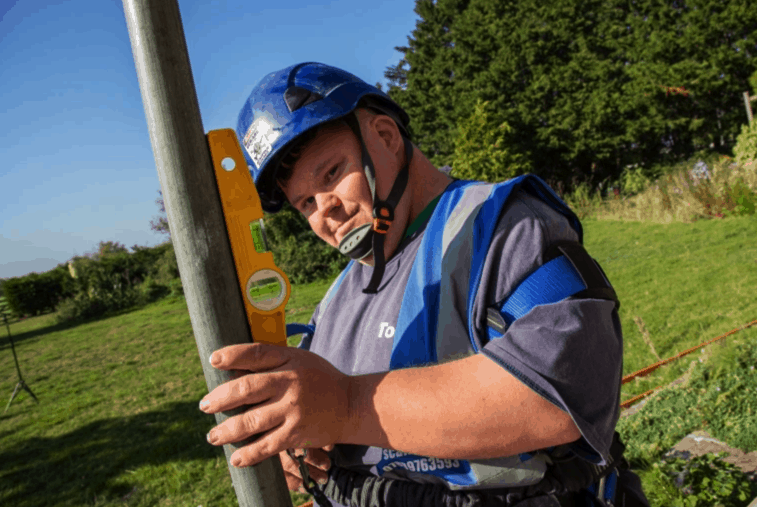
A budding scaffolder with Downs Syndrome has been named Achiever of the Year at the Constructing Excellence South West (CESW) Awards.
The awards were held at The Marriott City Centre Hotel in Bristol on 17 September are recognised across the South West built environment as the biggest and brightest celebration of best practice. 32-year-old Todd Scanlon who is currently striving to become a fully qualified scaffolder won the Achiever of the Year award in recognition for his excellent contribution to the South West Built Environment sector. Scanlon who works for Coles Scaffolding Ltd in Swindon has been said to be a ‘model employee, that is strong, dedicated and always on time. His boss Martyn Coles has been guiding Todd and championing him every step of the way since he started with the company three years ago. However, Todd is no stranger to winning awards or the limelight, in 2019 Todd was awarded the accolade of Apprentice of the Year by On The Tools and has been featured in many TV interviews with mainstream media. Speaking to Access Point about the award, Todd’s boss Martyn Coles who accepted the award on his behalf explained that it came as a surprise: “We didn’t know that Todd had been nominated, he was just invited down for the ceremony, which unfortunately he couldn’t attend so I went instead. I still didn’t know anything about it, it wasn’t until about two awards out that someone told me that I will be receiving the award on Todd’s behalf.” Martyn Facetime called Todd so that he could be a part of the ceremony via his mobile phone.
Worker falls from scaffolding at Trafford Centre

A contractor has been fined nearly £20,000 after a worker fell 15ft from a scaffolding tower in the Trafford Centre, Manchester.
The TA Knox Shopfitters Ltd employee suffered multiple fractures from the fall that happened on 24 October 2019. Manchester Magistrates Court heard that he was working from a tower scaffold at the front of the Footasylum Store in the Trafford Centre, Manchester, when the scaffold moved throwing him off balance. He fell back against the safety rail of the scaffold, which gave way and he fell fifteen feet to the ground. The employee suffered ten fractured ribs, a fractured shoulder and a collapsed lung. An investigation by the HSE found that the safety rail had not been fixed in place correctly, causing it to give way when the employee fell against it. It also found that the tower scaffold had not been erected by somebody with the appropriate skills, knowledge and training. If the edge protection had been suitable and sufficient and the tower was constructed by somebody competent to erect tower scaffolds, the incident could have been prevented, says the HSE. TA Knox Shopfitters Ltd of Hollingworth Road, Bredbury, Stockport pleaded guilty to breaching the Health and Safety at Work etc. Act 1974. The company was fined £18,000 and ordered to pay costs of £4,623. Speaking after the hearing, HSE inspector Seve Gomez-Aspron said: “Falls from height remain one of the most common causes of work-related fatalities and severe injuries in this country. The risks associated with work at height are well known. This incident could so easily have been avoided by ensuring that suitable and sufficient edge protection had been used and qualified people had been on site to erect a tower scaffold.”Scaffolding stands out at Armed Forces careers event
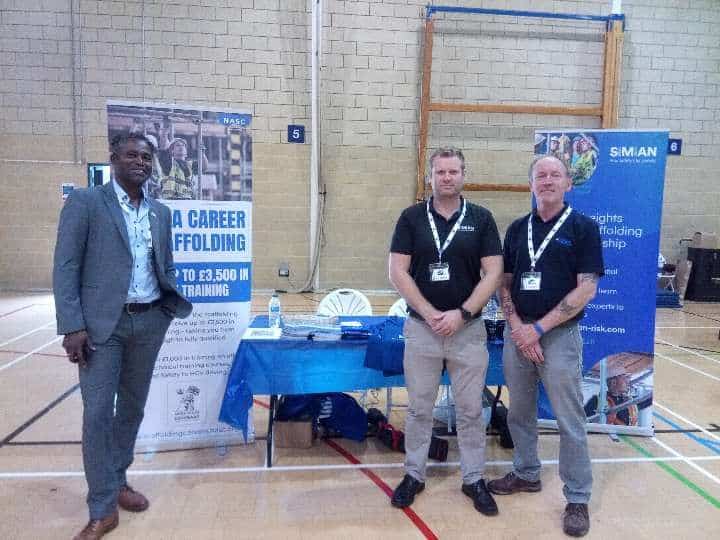
Members of the Armed Forces were introduced to some of the outstanding opportunities that await them on civvy street within the scaffolding industry at a military careers event last week.
Scaffolding trade association the NASC saw more than 100 current service personnel stop at its stand at the British Forces Resettlement Services (BFRS) event at Tidworth Leisure Centre. All were greeted by NASC’s Training and Recruitment Officer Henry Annafi and representatives from NASC Contractor members Severnside Scaffolding Ltd and S & K Scaffolding Ltd, also attending was NASC Information member SIMIAN. Henry said: “It was great to see such interest and enthusiasm shown by so many serving Armed Forces personnel. Many of these people had little or no knowledge of what the scaffolding industry can offer them but were very receptive to what we had to share with them. “They were very impressed by the structured and progressive nature of the CISRS scheme – and the NASC’s Armed Forces Training Fund, which will fully cover the costs of retraining and qualifying as a scaffolder – along with the variety of the work, camaraderie and earning potential. “Whilst at the event S & K Scaffolding immediately set up interviews with three candidates and more than 40 jobseekers took our NASC Careers information away with them, which is a very positive response. I’m optimistic that many of these will take be seeking to take up positions in our industry in the near future. “I’d like to thank each of the members who gave up their time to represent the NASC and the scaffolding industry at this event, it is imperative that scaffolding employers engage in events such as this one, in order to promote the sector and inform the wider labour market us of the many vacancies we are looking to fill. “Our efforts would have been far less effective without their support. We now look forward to the BFRS virtual careers fair on Tuesday 28 September.”JR Scaffold Services provide circular access solutions on historic Mausoleum

One of Scotlands largest scaffolding providers has revealed how the firm erected a 24m-high circular scaffold around the Hamilton Mausoleum in preparation for major repairs.
JR Scaffold Services, a division of the JR Group has erected a full perimeter scaffold structure including a huge circular/radial scaffold around the dome of the building ahead of restoration works.
The scaffold, which was supplied on behalf of Go Wright Ltd, will stand erected until 2022, upon completion of planned stone restoration and lead replacement works.
Project Scotland reports that following a campaign from the Hamilton Mausoleum Trust, South Lanarkshire Council pledged to invest thousands into repairing the historic building.
They later commissioned repair work to combat water ingress and reverse signs of wear and tear.
Located in Hamilton, South Lanarkshire, Scotland, the Hamilton Mausoleum was the resting place of the family of the Dukes of Hamilton.
Built-in the grounds of the now-demolished Hamilton Palace, it’s high stone used to hold the record for the longest echo within any man-made structure in the world, taking 15 seconds for the sound of a slammed door to fade.
In recent years the Mausoleum has hosted modern and classical music performances and art installations.
JR Scaffold Services worked with Historic Scotland to erect the scaffolding project in a way that would protect the building and its history.
Speaking to Project Scotland John Jack, contracts manager at The JR Group, said: “We’re proud to be playing a part in the restoration of the Hamilton Mausoleum – one of the country’s most iconic buildings that holds a fascinating history.
Over a four-week period, we built a scaffold structure around the entire perimeter of the building including the dome, along with a full-height loading bay, staircase and hoist bay. The scaffold will allow for important works to preserve the Hamilton Mausoleum, which has been showing signs of water ingress.
“JR Scaffold Services worked closely with Historic Scotland throughout this process to ensure that the building and its features were protected. Vital repair works have now begun and when completed will breathe new life into the landmark, helping to safeguard its future.” New Makita XGT Impact Wrenches