Fulcrum Offering Perfect Balance for CISRS Training

One of the UK’s major training organisations is ready to deliver a package of first-class CISRS courses.

An impressive Centre in Flintshire, North Wales is now fully geared up to cater for what will be a high demand for quality industry training from leading experts in the field. Clients in the North of the principality and North-West England will certainly benefit from the service Fulcrum provides. Director, Jen Wood, explained: “We have been planning this move for a while but Covid delayed things slightly, so we are extremely pleased to finally be opening our first CISRS Core Scheme Centre. Our main aim is to provide quality training at a reasonable price.”  Fulcrum Scaffold Training & Safety Ltd provides health, safety and training nationally to the construction, nuclear, petrochemical and power generation industries. They offer a range of services and are specialists in scaffolding with vast experience in health, safety, training and assessment. In terms of CISRS their courses will include
  • CISRS Part 1 tube and fitting and system
  • CISRS COTS
  • CISRS Scaffold System Product Training for all types of system
  • CISRS Basic Access System Erector
  • CISRS Basic Scaffold Inspection
  • CISRS Supervisor
  • CISRS System Inspection
  • Scaffolder Rescue
  • TG20 Update
  • Anchor Tie Installation
The company are aiming to deliver a part 2 course in the next six months along with CPD. They’ll also be offering a CITB Site Safety Plus and NOCN Site-right course. Jen added: “We had a very short lead-in time to get the Centre up and running and we couldn’t have done it without every member of the team at Fulcrum pulling together to get it done” “Overall, our industry experience, combined with expert knowledge, means we are not limited to health, safety and training. It also enables us to provide support to our clients to gain accreditations from awarding bodies such as NOCN, CITB, CISRS, City & Guilds, Pearsons Edexcel, as well as meeting quality standards such as Matrix.” CISRS Auditor Trevor Donaghue said: “It’s great to be opening a new core scheme centre after such uncertain times. The staff and management at Fulcrum have a wealth of experience of delivering and administering CISRS training, and we wish them all the best for the future. I am sure the increased capacity will be warmly welcomed by scaffolders and contractors in the region and surrounding areas.” It’s another example of how the training standard bar is being pushed ever higher to keep improving the quality of workmanship in the field to unprecedented levels. More information is available at www.fulcrumscaffoldsafety.com along with contact details – their experts are waiting for your call.

Coventry Scaffolding moves up in the world with Mercedes-Benz

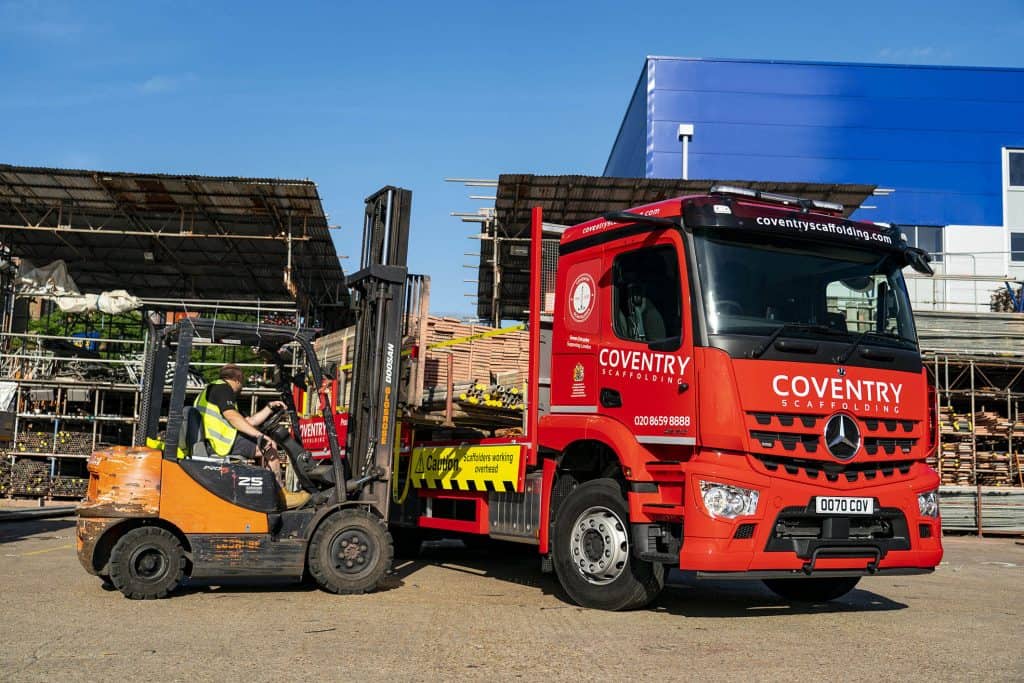
It’s been a long time coming but after more than 70 years in business Coventry Scaffolding has commissioned its first Mercedes-Benz truck, a 26-tonne Arocs supplied by Dealer Sparshatt Truck & Van.

Despite its name the family-owned company is based in South London, and undertakes much of its work in and around the capital. The only scaffolder in London to hold a Royal Warrant, it has worked on many of the city’s most prestigious buildings including – in 1968 – all 170 feet of Nelson’s Column, in Trafalgar Square. The latest addition to the Coventry Scaffolding fleet has a ClassicSpace L-cab with 320mm engine tunnel, which means the driver sits relatively low. This, together with the enhanced visibility provided by its MirrorCam technology, means the Arocs already meets the three-star Direct Vision Scheme (DVS) standard without which, by 2024, trucks will not be granted the Safety Certificate that permits them to operate in Greater London. MirrorCam is Mercedes-Benz Trucks’ revolutionary replacement for conventional mirrors. In Direct Vision terms, the benefits of the compact, camera-based system have nothing to do with how much more the driver can see behind, and everything to do with what they cannot see in front – the large mirror housings that create blind spots which get bigger as distance from the truck increases. Coventry Scaffolding’s new six-wheeler also came with an occasional, fold-down bunk that doubles as a four-man bench seat. This allows the operator to transport a crew as well as the boards, tubes and fittings carried on its platform body, which is by Fred Smith & Sons, of West Bromwich. After more than 70 years in business Coventry Scaffolding has commissioned its first Mercedes-Benz truck, a 26-tonne Arocs A 2530L model with 220 kW (300 hp) 7.7-litre in-line six-cylinder engine, the Arocs is the subject of a flexible and cost-effective Agility plan from Mercedes-Benz Finance. Agility offers all the benefits of conventional hire purchase with a balloon payment – including low monthly repayments – but provides customers with a variety of options at the end of the term. Coventry Scaffolding was established in 1950 by Patrick Hanifan, who chose the name because of its association with the post-World War II rebuilding work being carried out at the time in the Midlands city – he later contemplated changing this to one that evoked a sense of London, but never did so as the business continued to go from strength-to-strength. One of London’s largest independent scaffolding companies, Coventry Scaffolding has been managed since Patrick’s retirement in 1992 by his sons Perry and Paul. It runs a fleet of 13 trucks in which two other brands hold sway – in addition to its new Mercedes-Benz, the line-up comprises four tractor units, six 18-tonners and a pair of 7.5-tonners. Coventry Scaffolding initially approached Sparshatt Truck & Van because it was interested in acquiring a new, DVS-compliant tractor unit. The 26-tonne Arocs had the right cab and had been pre-built with a scaffold body for sale from stock, so Sales Executive Shaun O’Hara drove this vehicle to the operator’s premises in Bell Green, for Perry and Paul Hanifan to see. They liked the rigid so much that they bought it there and then, and have since ordered an Actros 1843 tractor unit. Due for delivery in September, it will have a 2.3 m-wide (the narrower of the two widths available) ClassicSpace L-cab with 320 mm engine tunnel – this specification, together with MirrorCam, means this vehicle will attract four Direct Vision stars. Re-painted in Post Office red – complete with colour-coded bumper – at Sparshatt Truck & Van’s own bodyshop in Sittingbourne, the Arocs wears a specially designed livery that celebrates the seven decades over which Coventry Scaffolding has been trading. Perry Hanifan recalled: “We wanted a stand-out vehicle on which to highlight our 70th anniversary milestone and Sparshatt’s truck fitted the bill perfectly. I’m a Mercedes-Benz car driver so Shaun didn’t have to sell the brand to me – it looks fantastic.” He continued: “Image is all well and good, but we’re running a business, so the Arocs had to stack up from an operational point of view too. Not only are we looking forward to benefiting from the reliability and durability for which Mercedes-Benz products have long been renowned, but the truck also came with a full complement of safety technology and the three-star DVS rating that our established chassis supplier couldn’t offer.” Driver Gary Hiley has certainly taken to MirorCam, and is equally enthusiastic about the radical Multimedia Cockpit, which has replaced traditional switchgear with stylish and intuitively operated twin screens.
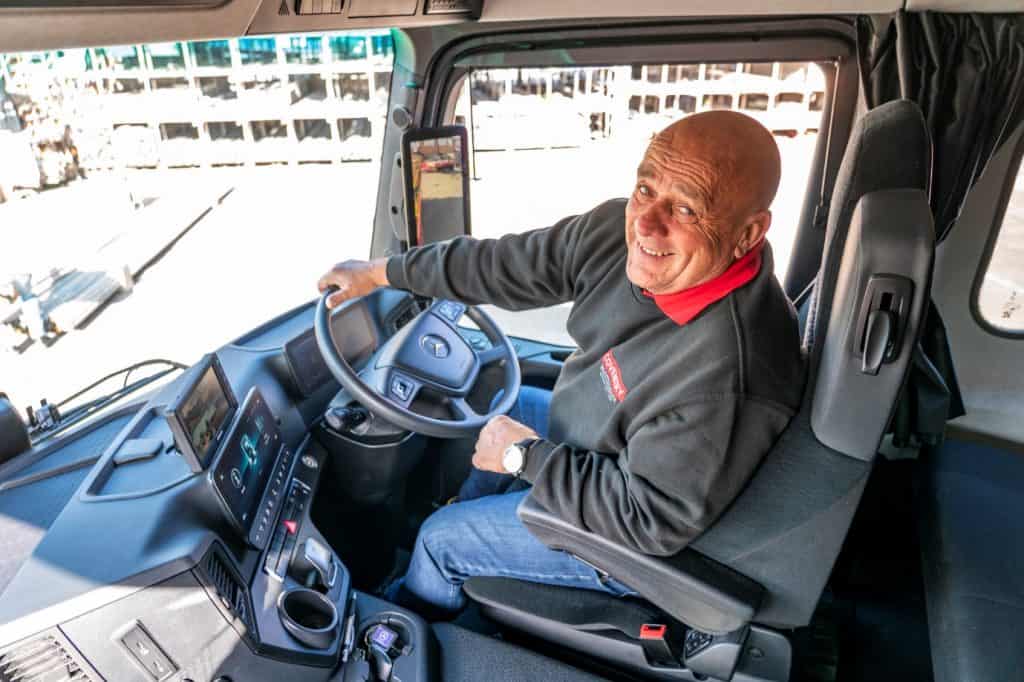
Happy in his work: Gary Hiley says his Mercedes-Benz Arocs is “the best truck I’ve ever driven – by a mile!”
“I know older drivers who don’t fancy all the new technology but to my mind they’re just stuck in their ways,” he said. “I’m 62 and over the years have done many different driving jobs, from container work and general haulage, to skips, bulkers, and even a fire engine. So I’ve had crash ’boxes, and I’ve had splitters, the lot really. All of which means that I like to think I know a bit about the job now, and I reckon this is the best truck I’ve ever driven – by a mile!” He continued: “MirrorCam is unreal. The visibility is great when I’m reversing and there are hardly any blind spots when looking ahead. What’s more, because the cameras are mounted on the roof and therefore that bit higher, I no longer have to worry anything like as much about getting a mirror knocked off, particularly by a passing single-deck bus, when I’m working in town. “As for the new dash, it’s absolutely wicked. Thanks in part to a very good handover by the Dealer it took no time at all for me to get used to it. It’s really modern and everything I need comes easily to hand, so what’s not to like! It’s an outstanding truck, and I’m a man who’s very happy in his work.” The vehicle is now being inspected and maintained under a Mercedes-Benz Complete Service Contract at the purpose-built Dartford Dealership that Sparshatt Truck & Van opened in 2019, following an investment of more than £2 million. “We’re still at an early stage in the relationship but first impressions of the Dealer are entirely positive,” added Perry Hanifan. “Shaun’s service in particular, has been first class. He’s more than just a salesman… he can drive a truck, and he understands the demands of the job, particularly here in London. “Every time I’ve asked Shaun for a piece of information or a price he’s come back to me straight away, while he’s also arranged for the truck to be painted and our livery applied. I couldn’t have asked for more.”

Dare to be different: we are all different, so let’s embrace it!

0

There’s no doubt about it: increasing diversity in the construction industry in general and the scaffolding trade in particular, makes a positive difference, explains Des Moore, TRAD Group CEO and NASC President (2017-19)

  In fact, it significantly improves commercial performance, increases innovation and collaboration and boosts both productivity and brand reputation. And in today’s world, where there is a long pipeline of works, a shortage of skilled staff and an expectation that suppliers take their responsibility seriously, it’s more important than ever that we make our industry an attractive option for everyone – whether on-site or office-based. Our industry should be open to everyone who wants to work in it. And to me, it makes no difference who those people are. In fact, I’ve been actively involved in encouraging women, LGTBQIA+, ex-military and ex-prison and those who feel marginalised by society, to think about the scaffolding industry as an option for them.

All walks of life welcome

Not long before the pandemic struck, TRAD hosted a seminar called All walks of life welcome. It was incredibly well attended, showing that companies are taking their diversity responsibilities seriously and not just paying lip service. TRAD is committed to giving everyone a chance within a tolerant and supportive workplace – and we think this should be the norm, not unusual. And there’s still much to do. Our strength lies in our differences, not our similarities. And our different experiences of life means we can bring a lot of learning to those we work with – as colleagues and to our clients for the benefit of all. But in order to maintain – and preferably to speed up – progress, there are two clear things that all companies in the industry need to commit to: Make the industry more attractive to applicants – we need to make more of the role models we already have for diversity in the industry. The more common it is to see someone who looks like you in construction, the more likely you are to consider it as an option. Let’s work together to promote construction and scaffolding as an industry for anyone. And industry that supports its own to succeed and an industry that’s a safe space for all. Look at our ways of working – we are a traditional industry with a traditional approach. But over the past 12 months or more, we’ve seen that construction can still work with people working remotely, working different hours and managing different processes. We should be retaining that flexibility for all our people, helping them to make good choices about work-life balance. Supporting people’s home circumstances means greater productivity at work. It’s our responsibility as business owners and managers to make sure that our workplaces are welcoming, flexible and accommodating
“Encouraging more women into construction is something I actively promoted during my period as President of the NASC – and I am delighted that I was succeeded as President by Lynn Way.”

Tackling gender inequality

For example, we shouldn’t assume that, because we are seen as a traditionally male-dominated industry, women aren’t welcome. Or aren’t talented. Or can’t deliver value. In my experience, it’s the exact opposite. At TRAD, where I have been for over 30 years now, it has always been one of my objectives to balance the business and ensure that anyone who wants to work with us can: currently, 40% of our Board is made up of women; 60% of our Group support office and 25% of our scaffolding business staff are women, and we have female depot heads and sales representatives in our other TRAD companies. Encouraging more women into construction is something I actively promoted during my period as President of the NASC – and I am delighted that I was succeeded as President by Lynn Way. I wanted to see more women to come into the industry in the first place, and I wanted them to see that they can see there is a career path for them. Together with TRAD, the NASC sponsored the ‘Inspire me’ campaign, which hosted a number of roadshows around the country to highlight the barriers that women might face when they come into the industry, and how we can all work together to change things.

What can we do?

  • All leaders must buy in – equality and diversity doesn’t happen by itself. It takes an understanding from the leadership team that promoting a diverse workforce will bring quantifiable business benefits. That understanding must be translated into real and genuine public commitment by the Board or senior leadership team to improve the diversity of the workforce.
  • We must challenge assumptions – unconscious bias exists, and it can have a negative effect on your business across all functions, from recruitment to promotions. You can run training and workshops that help your people to see where that unconscious bias exists and learn how to think more openly, looking for talent, skill and attitude from all candidates and employees.
  • Measure progress – measuring your progress helps to prove success. Whether you do this by publishing your own gender pay gap statistics and committing to reducing any gaps you have; or you have a target for diversity on your leadership teams or your board, it helps to be able to show how far you have come.
I’m proud of the work we have done at TRAD to bring in talented, skilled, dedicated and creative and diverse people to our teams. It has undoubtedly changed our business for the better, and given our apprentices and management trainees great role models to look up to. We must keep challenging the traditional outlook, championing construction as a career option for anyone and everyone if we are to succeed as a sector in the future. This article was first published in the ScaffMag Magazine Issue 13

Scaffolder hits overhead power line

A specialist glasshouse contractor has been fined more than £330,000 after a scaffolder came into contact with an 11kV overhead power line.

Beverley Magistrates’ Court heard that on 3 December 2018, a subcontractor scaffolding worker was unloading some scaffolding tubes near power cables in Willerby, Hull, when one of the tubes caught the overhead line. The scaffolder sustained burns to his leg and foot and was hospitalised. An investigation by the HSE found that the site was very muddy, and operatives were unable to park their vehicles on-site near the work area, meaning they had to move the materials onto the site by hand. There were also inadequate controls on site to warn of the overhead cables. Cambridge Glasshouse Company Limited of East Yorkshire pleaded guilty to breaching the Electricity at Work Act 1989. The company was fined £333,333 and ordered to pay costs of £1,235. Speaking after the hearing, HSE inspector Sarah Robinson said: “The company should have planned the work to mitigate the risks and had better signage and controls around the site for overhead cables.

“This was a very serious incident and could have easily been fatal.”

Accelerate Rules to Offset Construction Pingdemic, says CLC

0

Construction Industry leaders have called for an acceleration of rules relaxing requirements for COVID-19 self-isolation for double-vaccinated workers.

On August 16 the regulations on self-isolation will be relaxed across the economy, when anyone who has been double-jabbed will be able to continue to work if they are notified that they have been a contact of someone that has COVID-19. But ahead of the change, construction businesses from merchants to manufacturers and consultants to contractors are being severely hampered as staff are having to stay home after being identified as a contact of a COVID-19 case, even if they are fully vaccinated. The issue is further exacerbating existing difficult trading due to materials and staff shortages. The Construction Leadership Council proposes that the 16 August relaxation be brought forward as soon as is possible. The move would incentivise workers to get vaccinated, while alleviating pressures on the delivery of vital construction projects and maintenance of national infrastructure. Construction continues to widely implement the Site- and Branch Operating Procedures to continue to operate safely. CLC co-chair Andy Mitchell said: “We have reports from across the industry of plants, sites and offices having to wind down activities as staff have been asked to isolate. This is putting very significant pressure on the sector, risking project delivery and even the viability of some firms. “Where staff are already fully vaccinated, and recognising that such people will be free to work from 16 August anyway, we are asking the Government to bring forward this date for essential industries like construction, ensuring that the industry doesn’t grind to a halt”

Scaffolder and Roofer Sentenced After Fatal Fall from Height

An unqualified scaffolder and roofer have been sentenced following a fatal fall from a scaffold ladder access at a two-storey terraced house in Wimbledon.

Southwark Crown Court heard that on 26 November 2018, Philip Drinkwater and Anthony Bradley were working on the roof, which was accessed using a ladder and scaffold that had been erected by Dean Glen. Later that day, Mr Drinkwater asked his co-worker, Mr Glen, to help him move some slates up onto the roof using an electric hoist. While he was carrying out this operation, he fell approximately six metres through a gap, which was adjacent to the hoist and landed on the ground where he died almost immediately. An HSE investigation found that Mr Glen had erected the scaffold leaving a 1.17m gap in the edge protection at the ladder access point without fitting a scaffold gate. Mr Glen had erected the scaffold when not fully qualified to do so and it did not comply with industry standards or legal requirements. Mr Drinkwater was in charge of the roof work, which he allowed to proceed despite the gap and unsafe ladder access. He lacked the training to manage health and safety on the site and failed to appoint a suitably qualified scaffolder to erect the scaffold. Philip Drinkwater (trading as Prestige Roofing) in New Malden pleaded guilty to breaching the Health and Safety at Work etc Act 1974. He was fined £5,000 and ordered to pay costs of £6,318. Dean Glen (trading as DDP scaffolding) in Horley pleaded guilty to breaching the Health and Safety at Work etc Act 1974. He was fined £5,000 and ordered to pay costs of £6,318. Speaking after the hearing, HSE inspector Kevin Smith: “The tragedy of this incident was that it was totally avoidable. “Preventative measures were inexpensive and required little time or effort. Reducing the size of the opening in the guard rails and installing a self-closing scaffold gate would have stopped this man from falling to his death. A scaffold gate costs around £40 and only takes a few minutes to install. “Those involved in scaffolding and roof work on smaller sites need to be aware of the potentially devastating consequences of failing to put basic safeguards in place.”

NASC withdraw support for TG20:13

0

Technical support for TG20:13 will be withdrawn from Tuesday 12 October.

Six months after the launch of TG20:21 the NASC say it will no longer be possible to activate, move or reset a licence for its older software TG20:13. The online wind map functionality will also be removed from TG20:13. For now, the NASC say users will still be able to produce compliance sheets for scaffolds that do not use the wind map and it will still be possible to use the simplified ‘offline’ wind map. Scaffolders wishing to continue to produce TG20 compliance sheets with data drawn from the online wind map function will need to purchase a TG20:21 licence, available in one-, three- and five-year subscriptions. The five-year subscription, which costs 20% less than buying a one-year subscription and renewing each year, is a limited-time offer so users are encouraged to buy now to receive this saving. The TG20:13 eGuide software is being formally withdrawn as the software platform it was developed on, Adobe Air, is no longer supported or maintained by Adobe. During the lifetime of TG20:13, it has been necessary to update the software when third party platforms that TG20:13 is reliant upon, such as Google Maps, were changed. After Tuesday 12 October, no further updates to TG20:13 will be made. Terry Roberts, Software Development Manager at CADS, which develops TG20 on behalf of the NASC, said: “We have taken the opportunity to not only refresh the technology that the TG20 eGuide is developed on, but also to substantially improve its presentation and clarity, with interactive 3D graphics that clearly illustrate the TG20 compliance features of the scaffold. “Now that the TG20:21 eGuide is available on the Cloud via the NASC ePortal, it is more accessible than ever, whether you are working on site, at the office or at home, and on a wider variety of devices that now includes Apple iPhones and iPads in addition to Windows, Mac and Android devices.” TG20:21 retains the user-friendly look and feel of TG20:13, but includes a number of revisions to make the process of producing compliant scaffolding – in accordance with the European standard BS EN 12811 – even simpler, and incorporates a wider range of scaffolding types. Additions include exterior birdcages, tube and fitting mobile towers, tube and fitting loading bays without beams, and tied independent scaffolds with three inside boards. TG20 compliance sheets are now double-sided, with an illustration and principal compliance criteria on the front, and detailed compliance criteria listed on the reverse. Users can access TG20:21 – including the associated and updated Operational and Design Guides – via the NASC ePortal. Robin James, NASC Managing Director, said: “The TG20 compliance criteria and good practice guidance have been significantly updated for TG20:21 and the NASC strongly recommends that all those involved in the procurement, supply and use of scaffolding follow the latest guidance.”  

Millcroft Secures Scaffolding Package for TfL Whitechapel Project

0

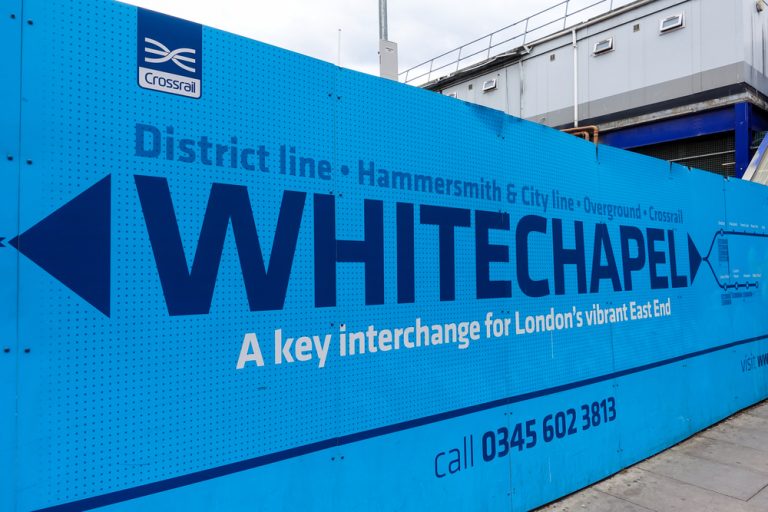
Scaffolding contractors Millcroft has won a significant project with TfL (Transport for London) at Whitechapel Station.

The two-year project will see Millcroft deploy enabling works for a maintenance and upgrade programme involving retail and residential properties owned by TfL adjacent to the District and Hammersmith & City lines at Whitechapel. Millcroft has specialist expertise in complex projects across infrastructure, heritage and commercial sectors. Scaffmag understands the firm secured the project following a competitive tender after delivering the initial design consultancy work for TfL, which informed the Conceptual Design Statement (CDS). The TfL approved scaffolding company with an enviable track record in the rail sector, including current Crossrail infrastructure at Paddington and HS2 works at Euston, Millcroft will begin the project by erecting a 150 metres long x 8 metres high screen between the properties and the live London Underground lines. Work on the screen will be restricted to weekend possessions and involve installation of a scaffold frame for a monoflex screen. Once the screen has been installed, Millcroft say they will erect the scaffolding required for access and safety for the refurbishment programme, which will involve works to the facades, windows and roofs. Installation and adaptations to the scaffolding will be phased to meet the main contractor’s requirements during the two-year programme and the Millcroft team will collaborate with the contractor to finalise the design and agree the schedule. Billy Jones, managing director of Millcroft, commented: “We have been involved in this project since the very earliest stage, when our in-house engineering team provided guidance on the design requirements. We’re delighted to be building on our relationship with TfL and our reputation in the rail sector with this project and look forward to completing the screen within the next month.”

Enigma Doubles its Workforce on the UK’s Largest Freeport

0

Enigma Industrial Services has boosted its workforce on Teesworks – the UK’s largest Freeport after a series of contract wins.

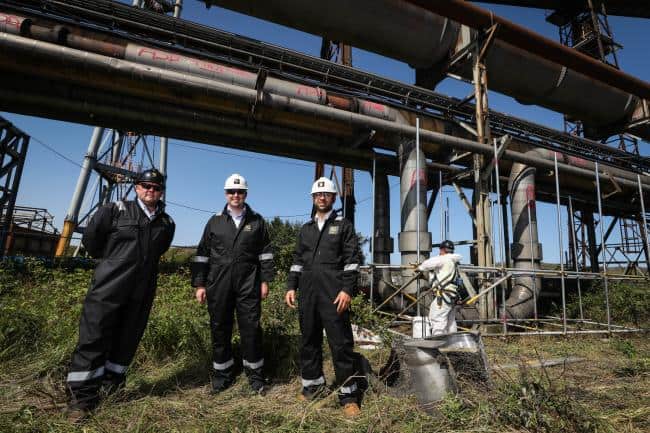
The multiservice company has been on Teesworks for four years providing scaffolding, insulation and painting services on a number of projects across the site. Recent work includes providing internal scaffold access for the remediation of Steel House, focusing on the removal of asbestos.
According to the Northen Echo the firm has now won a new £450,000 contract to remain at Teesworks for 12 months, and its presence there has already led the team taking on more work with other businesses on the site. Enigma is currently erecting scaffolding at the South Bank Coke ovens and, thanks to these successes, in the past four weeks it has increased the number of its workers on site from four to eight. It has also signed up Stockton-based training provider Northern Safety to upskill the company’s new starters giving them the skills they need to help with the redevelopment of Teesworks. Enigma Industrial Services General Manager Kayvon Azadi said: “We’re thrilled to continue to be part of this massive regeneration project, which will bring real positive change for generations to come with new opportunities. It’s been really interesting watching how the site has developed in the four years we’ve been working there and are incredibly privileged to be able to help it evolve further. “We’re proud to employ local people and are delighted we’ve been able to grow our workforce to get more people permanently based on the Teesworks site and take on these new projects. “We’re passionate about supporting local businesses and using the brilliant supply chain that exists in the region and our work at Teesworks has meant we can do that, as we progress on to bigger things.” Tees Valley Mayor Ben Houchen said: “We’re grateful to have Enigma and its skilled specialists on-site, helping our team and other contractors as we ramp up Teesworks’ transformation faster than ever. This will get the site investor-ready as early as possible, make sure we take full advantage of all the opportunities. “Enigma’s help has been invaluable over the years on a range of projects, and so it’s a no-brainer to award them a new contract to keep them on the site, ensuring their experience is put to good use. “It’s fantastic to see other companies at Teesworks are noticing Enigma’s hard work and signing them up too. It’s down to all of this that it’s been able to go on and increase the boots on the ground, backing another great local training provider in the process.” Teesworks is the UK’s largest Freeport and has been set up to promote the economic growth and commercial development of the Tees Valley by converting assets in the South Tees area into opportunities for business investment and economic growth. It covers around 4,500 acres of land to the south of the River Tees and includes former SSI steelworks site as well as other industrial assets. The area has river access and includes the deep-water port of Teesport, England’s largest exporting port.

Feeling the heat: Tips for working in hot weather

Alex Minett, Head of Product & Markets at CHAS, shares some tips for working well in hot weather.

While temperatures have been variable in the UK this summer, the UK’s ten warmest years on record have all occurred since 2002 and overall, the world is hotting up; the highest temperature ever recorded on earth was observed in Death Valley on June 9th 2021, where it reached of 54.4°C. With extreme hot spells often arriving with little warning, employers and employees alike must be ready to recognise and manage the risks.

Be educated about sun protection

Alex Minett, Head of Product & Markets at CHAS
The potential for skin damage and skin cancer from unprotected exposure to the sun’s ultraviolet (UV) rays is one of the better understood hot weather hazards, yet according to the Royal Marsden NHS Foundation Trust, skin cancer is rising faster than any other common cancer. It’s therefore essential that outdoor workers understand the risks and know how to stay protected. All skin types are susceptible to damage, but people with red or fair hair and light coloured eyes and those with many moles are at increased risk. The good news is that skin cancer is almost entirely preventable and several measures can be taken to stay safe when working in the sun. These include: Keeping t-shirts and tops on, wearing a hat that covers areas vulnerable to sunburn – such as the ears and back of the neck, staying in the shade where possible, using a high factor sunscreen of SPF 15+ and checking skin regularly for unusual spots or moles. For more see: www.hse.gov.uk/pubns/indg337.pdf

Be alert to heat-related illnesses

As temperatures rise so does the risk of suffering heat-related illnesses, commonly referred to as heat stress. Heat stress can include relatively minor issues like heat cramp and heat rash along with more severe conditions such as heat exhaustion and heatstroke. Treating heat exhaustion quickly can reverse the effects but a blood temperature rise above 39.5°C can turn into heatstroke, which is a medical emergency. Regular training can help workers to recognise and respond to the signs of heat-related illnesses.

Consider control measures

Several control measures can reduce the risks associated with working in the heat. These include scheduling work for cooler times of day and alternating tasks to avoid sustained periods of outdoor work. It’s also a good idea to provide shade where possible and consider window tints for vehicles operating in direct sunlight. Increasing the frequency of breaks during hot spells and providing shaded or air-conditioned rest areas with access to water can also be helpful.

Provide protection

Covering up with long-sleeved cool clothing, wearing hard hat neck shades or legionnaires hats with a flap and brim to protect the ears and neck and using high-factor sunscreen can all help guard against sunburn while breathable safety footwear can ensure workers stay comfortable and protected. Some workers may appreciate cooling vests that can be ice-cooled like ice packs and cooling bandanas, towels and wraps. When it comes to sunglasses, look for the European CE mark, which indicates a safe level of protection. Ideally sunglasses should be close fitting and wrap around to prevent solar UVR entering around the edges and don’t forget to make sure they’re compatible with other PPE.

Create a sun protection policy

Sun protection policies are commonplace in countries such as Australia, where they have a large number of sunny days and a high UV index but as temperatures rise in the UK, they are also becoming more popular. A sun protection policy could include any of the measures set out above as well as providing details of any training schedules and pledging a commitment to review your approach regularly. The charity skin.org offers a free Sun Safe Workplaces accreditation scheme which involves creating and uploading a sun protection policy as a written document that records why and how the solar UVR risk is to be managed. www.skcin.org/ourWork/sunSafeWorkplaces.htm To find out more about how CHAS can help ensure high standards of health and safety throughout your supply chain, visit chas.co.uk