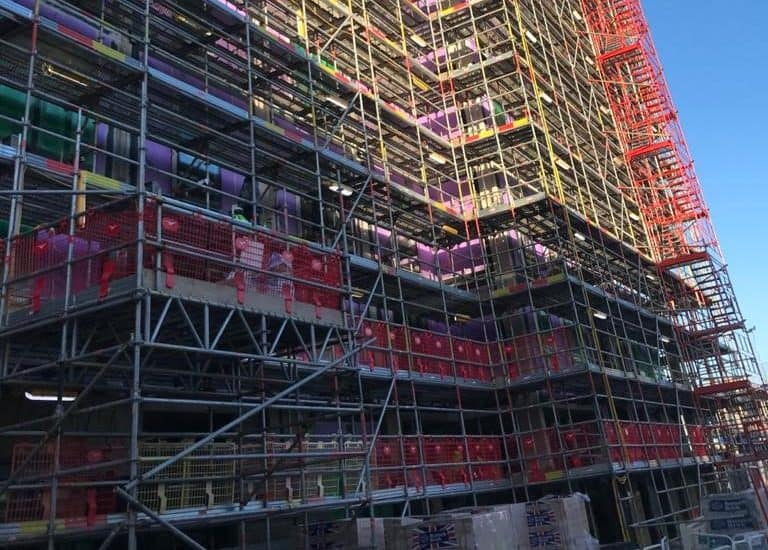
TRAD Scaffolding has shared an update on its South-East London project for Wates Residential where its senior onsite Blackhat supervisors are core to their service offering.
TRAD Scaffolding was appointed by the client Wates Residential to provide the scaffolding access solution on their Park East, Erith project late last year.
The scope was identified through collaborative early planning during 2019 and has provided an excellent showcase for its Plettac Metrix equipment, the company said.
In fact, 1,500 tons of it will have passed through the site upon completion!
TRAD scaffold said their client was particularly keen to use the very adaptable & aesthetically impressive modular system on Park East after successfully using it on several previous projects with TRAD.
The Park East regeneration is a £95 million development in Erith, being delivered with housing association Orbit, in partnership with the London Borough of Bexley.
The project will see 320 new homes built, of which 80% will be for affordable rent and the remaining 20% for shared ownership in order to accommodate a mixed tenure community.
TRAD Scaffolding Managing Director Peter McShane commented “With Trad Scaffolding HQ being only a couple of miles away, it is particularly pleasing to be able to contribute in the great regeneration work being carried out by Wates and its partners within the local area.”
Peter added, “We have also been keen to take the opportunity to support Wates along the way in several charitable events during the build and very pleased with their help & support to place some of our young apprentices and upcoming black hats of the future on this organised & well-run site under the supervision of our onsite team.”
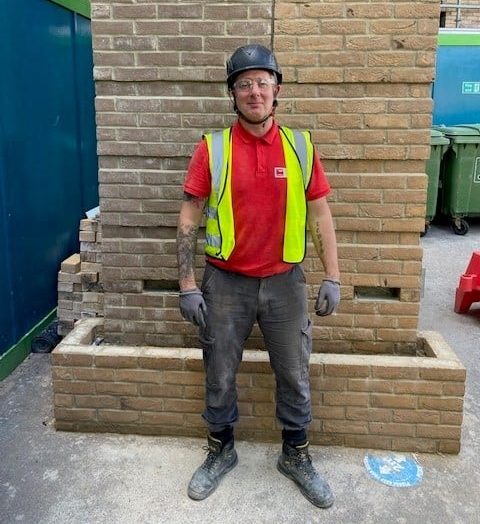
The project which is almost at the conclusion of the scaffold erection phase is being very ably led & supervised by Trad’s very experienced and long-standing onsite BlackHat foreman John Gardner.
TRAD’s Blackhat Supervisor John Gardner
TRAD has told Scaffmag, John has been with the company for 17 years and has managed a large team of operatives throughout the build, he has also collaborated very closely with the Wates site team to ensure safety, quality & build programmes are met with equal importance.
TRAD Senior Operations Manager Darren Clinton commented “The Client specifically requested John our lead Foreman to supervise this project on behalf of TRAD having worked with him in the past.”
Darren added, “John is one of a number of long-standing TRAD Blackhat site supervisors with well over 10 years’ service & form a seamless extension of our office-based management teams, they have been integral to the companies’ professional output for many years.”
With a scaffold package value in excess of £2m the project is well on the way to completion which is expected in 2023, the entire Trad team involved are very proud to be a part of the local residential regeneration.
You can find out more about our Plettac Metrix system scaffolding or other scaffolding & safety products by visiting the Trad UK website – www.traduk.co.uk
Nearly half (49%) of UK tradespeople experience mental health problems due to work-related issues, a new study has found.
The research, commissioned for Mental Health Awareness Week (May 10th-16th) by IronmongeryDirect, the UK’s largest supplier of specialist ironmongery, found that nearly three in five (58%) experience some form of mental health problem, such as stress, anxiety or depression, at least once a week.
Money worries cause the most stress, with 38% of tradespeople blaming financial situations for giving them anxiety.
Other issues, such as tensions with customers (31%) and suppliers (29%), are also major causes of concern for tradespeople.
The 10 issues which cause the most stress for tradespeople:
Finances (38%)
Tensions with customers (31%)
Tensions with suppliers (29%)
High workload (26%)
Tensions with business partners (26%)
Job security (21%)
Doing the best job for customers (12%)
Making mistakes (11%)
Abuse from customers (6%)
Lack of work (5%)
Female tradespeople (57%) are significantly more likely to experience work-related mental health problems than their male counterparts (41%).
Additionally, the main causes of stress and anxiety differ between the genders, with women more likely to feel stressed due to finances (39%) and tensions with business partners (29%), whilst men are more affected by high workloads (39%) and tensions with suppliers (37%).
When it comes to age, middle-aged tradespeople experience the most work-related related mental health issues. Nearly three in five (57%) tradies aged between 45-54 report stress and anxiety due to work.
Bricklayers are the most likely tradespeople to experience mental health problems, with a shocking 73% admitting to dealing with issues such as stress and anxiety. In contrast, surveyors (18%) are the trade least likely to have poor mental health.
The trades which are most and least likely to have mental health issues are:
Bricklayer (73% say they have them)
Joiner (62%)
Builder (57%)
Electrician (51%)
Plumber (50%)
Carpenter (49%)
Landscaper (42%)
Painter/decorator (36%)
Plasterer (22%)
Surveyor (18%)
When dealing with mental health problems, nearly half (48%) of tradespeople said they choose to talk to friends and families about their issues. Less than a third (32%) choose to seek counselling, while more than a quarter (28%) take medication.
The research also found that a similar number (29%) do not feel comfortable talking to people close to them about their mental health. Furthermore, more than a third (34%) do not know how to access support services.
As part of the attempt to raise awareness of mental health amongst tradespeople, IronmongeryDirect is partnering with Mind, and will also donate £5,000 to the charity for its vital services.
Emma Mamo, Head of Workspace Wellbeing at Mind, said: “We know that issues like stress, anxiety and depression are common in all workplaces, but that there are some sectors where poor mental health is even more prevalent, including construction. “Because men generally find it more difficult to talk about how they’re feeling, in male-dominated industries such as construction, employees are often less willing and able to open up about their mental health and ask for support. This can be problematic because mental health problems often become worse if left untreated, and the consequences can be fatal. “We’re pleased to be working with IronmongeryDirect during Mental Health Awareness Week to launch our ‘Mental Health in the Trades’ report highlighting the scale of poor mental health across the sector, and urging employers within construction to create cultures where employees can speak openly and honestly about their mental health.”
Marco Verdonkschot, Managing Director at IronmongeryDirect, said: “It’s shocking and saddening to see that mental health problems are so widespread in the industry. “We feel that it’s vital for the stigma of mental health to be removed from the industry, and whilst we understand it can be difficult to open up, we encourage all tradespeople to talk about their problems. Whether this is with friends and family, your employer, or professional counsellors, speaking about your problems can often be the first step to addressing them.”
For the 2021 report of mental health in the trades industry, visit: https://www.ironmongerydirect.co.uk/research/mental-health-in-the-trades/
TIS (NGA) Ltd, have opened a new Rope Access Training School in Billingham, Stockton-on-Tees.
The new bespoke training facility has been designed to ensure that all aspects of rope access techniques required to complete works in the field can be trialled in a life-like environment, as well as offering a quality classroom environment.
The training centre is fully IRATA (Industrial Rope Access Trade Association) approved and all individuals successfully completing the training courses will receive the appropriate IRATA certification.
The company hopes to train eight learners every week, and have welcomed its first learners this week at the new facility.
Speaking to the Northern Echo, TIS Operations Director Kevin Heilbron said: “The first 18 months of trading has been predominantly as a rope access company. However, In September last year, I teamed back up with an old partner Gary King with a view to extend the portfolio of services provided to current and new clients to incorporate multi-discipline services.“Now we provide rope access, scaffolding, painting, insulation, fire protection and rescue services.“The strategy is to replicate a company we were previously involved in that was highly successful, Opus Industrial Services.“We have taken the core service of rope access and expanded because it’s what clients want. Clients don’t want a single discipline company any more they want a contractor who offers a portfolio of services.”
Managing Director Gary King said: “With all my years’ experience in the industry, and with the knowledge I have gained through building previous training centres, we have been able to produce by far the best facility I have ever been associated with or seen.”
The Lighthouse Construction Industry Charity is launching their hard-hitting and poignant ‘Help Inside the Hard Hat’ campaign to coincide with Mental Health Awareness Week.
The campaign aims to raise awareness of mental wellbeing issues in our industry and more importantly, how our workforce can reach out for help.
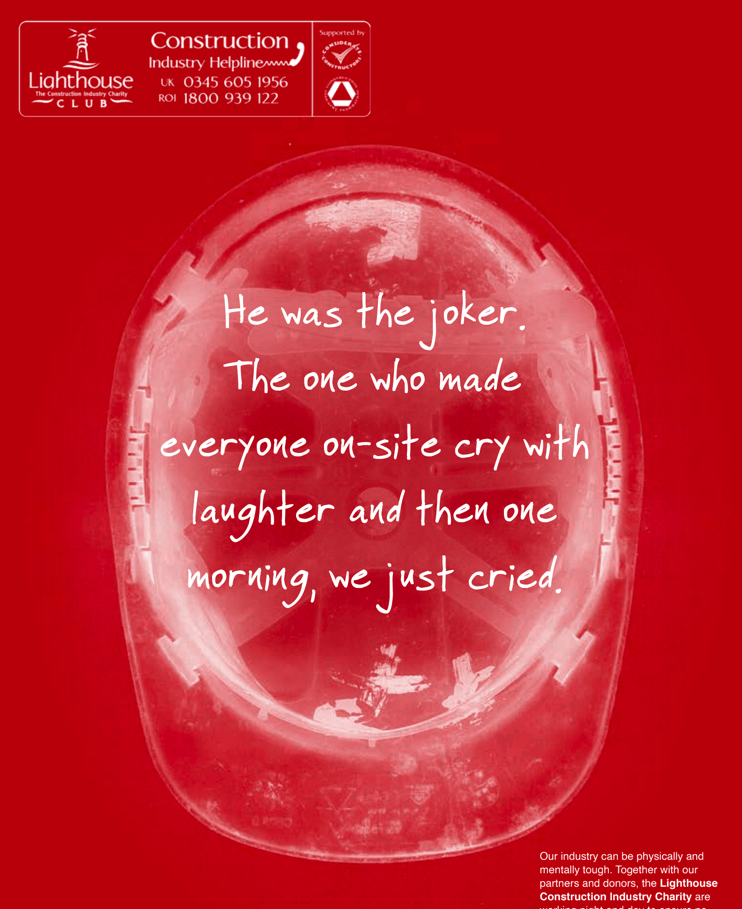
This is a campaign to get construction talking and it addresses the perception that construction workers are often seen as being ‘hard’ on the outside; always ready with a quip or keeping up with the alpha male image on-site or at work. But research shows that simply isn’t true and the charity deals first hand with the results of not addressing issues ‘inside the hard hat’. The vibrant posters and hoardings deliver four thought-provoking quotes;
“He was our big mouth – he’d always have an answer for everything, except for why he should still be here”“He was the last off-site every day, then one night he left us way too early”“He was such a polite lad; it didn’t make sense when he left without saying goodbye”“He was the joker. The one who made everyone on-site cry with laughter and then one morning, we just cried”
All of the campaign resources are available to download free of charge from the charity’s website so that everyone can get involved with helping inside the hard hat. There are a variety of poster sizes to choose from and companies can add their logo to show they are proudly supporting the campaign.
For those companies that want to ‘go large’ with their support, artwork suitable for hoardings and site buildings can also be provided free of charge.
The Help Inside the Hard Hat campaign was created by London agency And Rising who stepped forward to support the charity after hearing about mental health issues in the industry. Darius Rodrigues, Creative at And Rising said, “We were staggered by the statistic that every single working day, a construction worker takes their own life and this really pulled at the team’s heartstrings. We wanted to do everything that we could, to not only help the Lighthouse Club raise awareness and address the enormity of the issue, but also to showcase all the fantastic work that is being done by the charity to support construction workers in crisis.”
The campaign is also being supported by the Considerate Constructor’s Scheme who are despatching free posters to all registered sites and also including free posters with all of the charity’s Construction Industry Helpline Packs.
Bill Hill said, “We want to deliver a message of hope and reassure our construction community that ‘we’ve got their back’ and that we are working tirelessly to ensure that no construction worker or their family is alone in a crisis. We really want the industry to get behind this campaign so that our workforce knows about all of the resources we have available to help inside the hard hat. If construction workers don’t know we are here then we can’t help them. This is all about removing the stigma of talking openly about emotional wellbeing and encouraging people to start a conversation by checking that their workmates are OK. This one simple action could make all the difference to someone and could even save a life. We also want to say a huge thank you to the fantastic team at And Rising who worked so hard to pull this campaign together for us, we would not have been able to achieve this without their help. A big thank you also goes out to the team at CCS who are helping us get this important message out to construction sites.”
Bill Hill added ”For the first time ever we’re also encouraging the industry to share our messaging, not just within the boundaries of a site but on external hoardings too, Covid-19 has brought the mental health agenda to the fore and so the timing is right to share our important message with a wider audience and create a sense of community with the general public; the same public that uses the schools, hospitals, roads etc that our construction workforce work hard to deliver in often very difficult circumstances.
“I’m a 6 ft 3, an ex-rugby player with a face like a kicked-in biscuit tin – I’m not the sort of person you expect to stand up and talk about this. But if one person working in construction can take something from this, then it’ll help.”
That’s the message of Andy Stevens, a self-employed builder and broadcaster who is now an outspoken advocate for the Lighthouse Club – the construction industry charity. He’s passionate about the need for mental health support in construction, and speaks openly of his own struggles.
CITB & The Lighthouse Club
CITB is working with Lighthouse Club to provide the support that the industry needs. This collaboration has trained almost 5,000 mental health first aiders in the construction sector, who have already helped around 6,300 people.
Recent research by CITB showed that almost all construction workers have experienced stress in the last year, and over a quarter have experienced suicidal thoughts. The UK construction industry also has a disproportionately high number of workplace suicides.
“This has got to stop, as there’s too many people who are struggling.”
The 45-year-old father of two, from Surrey, said his struggles can be traced back to when he was physically abused as a child.
“I was used as a punchbag, the cane and belt would often come out. At the time when you’re tiny, you don’t know any different, you think that’s normal.”
Several years ago he faced a storm of problems, including workplace stress, a failing marriage, and faltering relationships, only identifying himself as the common denominator. He followed a friend’s suggestion to attend a trauma centre, and was diagnosed with post-traumatic stress disorder (PTSD), depression and anxiety dating back to that childhood abuse. This diagnosis and acknowledging his problems was the beginning of Andy’s road to recovery.
“In my opinion, mental health problems are the same as an addiction – until you admit you have a problem, you can’t do anything about it.”
Continued family problems saw Andy’s mental health deteriorate further, as did involvement with the police from which he was never charged.
“I didn’t drink, I don’t smoke, I don’t do drugs, but one day I just awoke in hospital with the mental health team. Apparently, I’d called a number and the ambulance had got there just in time, but the whole thing is a blank for me. I woke up from this haze and asked the doctors what was going on.”
Andy had tried to take his own life.
“I’m certainly a whole lot better now, but most people who met me wouldn’t know I’ve had these problems. I still have sh*t days, and you do have dark thoughts coming back. It doesn’t take much to bring it all back, there are still triggers, and especially not seeing people during lockdown has been particularly difficult.”
Solace was found in an unexpected place for Andy – a cocker spaniel puppy bought for his two children, aged seven and eight.
“She’s probably one of the main reasons I’m still here. I hadn’t realised at the time, but they pick up on the scent when you have a bad day, and are immediately jumping on you, cuddling up and licking you, just being a loving companion.”
Andy identifies one of the chief reasons for mental health struggles in construction is the large number of people in the industry who are self-employed. A CITB initiative will look help resolve this by providing accessible and consistent mental health support across all levels of the industry.
“I’ve had no training in running a business, managing tax returns, negotiating contracts, and if you’re not prepared for it then construction can be brutal. One thing complex PTSD does is screw up your brain, so if staff don’t show up or gear is late to arrive, something simple like an email can take days to do. Finding support in the workplace is impossible – I’ve no idea what’s out there.”
Andy believes that while larger organisations have well-established mental health support, smaller companies and sole traders do not know how to access the support they need, while working in a culture that makes it difficult to talk about such things. CITB’s new initiative involves plans to standardise mental health support to ensure that it is consistently available across an eclectic industry.
“The vast majority of tradespeople will be self-employed at some point, and so those coming through need the support to prepare for that. I still struggle to run a business sometimes, as you don’t know how to do it all, training for this needs to be put in place.“Big firms have the time, money and resources to do it well, though the average Micro/SME with a small number of staff doesn’t. One day I had a twenty-eight-year-old brickie come in and tell me he was ending it that night. He’d been caught cheating and speeding and couldn’t see a way out, but I took the time to sit and chat with him. We need a proper body where people like that can get the mental, physical and financial support and advice that they need.“Construction is 7% of the country’s GDP, we’re such a big part of the economy without a proper body to look after us. We’re seen as the ones that failed at school who go to work, dig holes, and get dirty for a living. That’s a British class problem, as you’re not viewed that way when you work in construction abroad.“When you have mental health problems, it’s something that never fully goes away. I’ve had 14 rugby operations but that is nothing compared to the pain mental health can bring, and the difference with mental health is that you can’t see it. You can have a great run, but then a tiny trigger sets you back. It’s still talked about like it’s not real, and nobody knows how to cope or deal with it.“Construction is still a largely male industry, and you’re not going to have a 6ft 4 skinhead who’s covered in tattoos come to work and say ‘Lads, I’m struggling’. Until we can have that, it will just keep spiralling out of control. Covid has been horrible, and work used to be an escape for some.”
Andy sees the biggest job being to engage with SMEs and ensure they buy into any support scheme, so that people with mental health problems are supported rather than dismissed. Ensuring access across the plethora of companies involved in construction is a key goal of CITB and its partners.
“You’re so busy on a job that you don’t have the time to research it. You’re up at 6am, loading the van, picking someone up, going to work, there until 4pm, go and look at a job, then go and price it up, respond to emails, and suddenly its 11pm and you haven’t eaten yet. You go to bed, get up and repeat. There needs to be the support for these small tradespeople so they know where they can go.“These people are undervalued, and have a lot more to give than just building your homes and offices. People may be discounted from support groups because they’re covered in sand and cement, plaster, tile adhesive etc, because their Sunday best is jeans and a T-shirt, but these are the people we need offering support from their shared experience. These hard workers are the backbone of the construction industry”
CITB’s research acknowledged that while there is a plethora of mental health support initiatives in the industry, there is no standardised approach, and uptake of a scheme is usually measured rather than its impact. By having a fresh, industry-wide approach, CITB will look to work with businesses to ensure that the mental health support that workers need is available for all.
Get the support needed
The Lighthouse Club has been delivering charitable support to the construction industry since 1956, delivering emotional and financial support to families in crisis. If you would like to apply for financial or wellbeing support you can either call their 24/7 confidential Construction Industry Helpline for help now (on 0345 605 1956 in the UK, and 1800 939 122 in Ireland) or submit your application online by clicking here.
Samaritans offers a safe place for you to talk any time you like, in your own way – about whatever’s getting to you. The charity won’t judge you or tell you what to do, but will listen to you. Whatever you’re going through, call free any time, from any phone, on 116 123.
Skills and staff retention have always been big issues for the scaffolding sector. With scaffolding companies competing for qualified and experienced scaffolders, there has been a reluctance to invest in training for fear another company will benefit from all that time and effort when they poach members of staff. And the more companies that fish for experienced people from their competitors rather than training their own, the shallower the talent pool becomes.
One company that has always actively swum against that tide is Millcroft.
Managing director, Billy Jones explains: “We have always been committed to training all personnel and bringing new apprentices into the team each year. For us, training has not only delivered a very skilled and experienced team; it’s also nurtured a very loyal and customer-focused team made up of people who have a pride and a passion for what we do. “In that way, training not only benefits our business and our clients, it also benefits our industry and our community, because it ensures we create opportunities and provide rewarding careers. So when our Head of HSEQ, Mike Wright, suggested we consider the Government’s new Kickstart scheme, I was eager to get Millcroft involved.”
Kickstart is a Government initiative to provide paid work placements and training for young people aged 18-25 who are not in employment education or training (NEET). It aims to create opportunities for those worst affected by the economic impact of the pandemic and allows employers to connect with a potential talent pool that will offer them additional resources during the recovery.
“The aims of the scheme really complement what we already try to achieve with training and employee development here at Millcroft,” Mike Wright explains.
“We have our own training centre and every member of the team has a personal training and development plan. We also have a recruitment policy that focuses on the person, not just the qualifications on their CV. So much of developing the right team is recruiting people with a positive attitude, a willingness to learn and an ability to work well with others, taking pride in their role. That’s what we’re looking for with our Kickstart trainees.”
Millcroft will hire 12 Kickstart trainees in total; six this year and six next year in a variety of site and office-based roles. The recruitment process for this year’s cohort is now complete, with six successful trainees now in position for the year.
It was The NASC that initially signposted Millcroft to the Kickstart scheme and the organisation’s training officer, Henry Annafi, is delighted by how much the company has embraced the initiative.
“Kickstart is exactly the sort of programme the scaffolding sector needs to attract more talent into the industry and develop a training culture,” Henry explains. “There is often a disconnect between perceptions of the scaffolding sector amongst young people and the diverse roles available thanks to opportunities for career development that a company like Millcroft can offer.“By getting involved in Kickstart, Millcroft is not only creating work experience and training opportunities for 12 young people, they are also showcasing the industry and encouraging both other companies and other young people to consider how we can put training front and centre of the sector in the future.”
Like the Millcroft team, Henry is also keen to highlight the social value benefits of the Kickstart scheme. “Often young people feel qualifications and academic achievement are the only way their success will be measured,” he says, “but in the real world, we also need practical skills, teamwork and a good worth ethic. Companies like Millcroft that invest in training young people, are helping to create sustainable communities and offering the first step on a career ladder that is varied and rewarding.”“The Kickstart scheme is a great way to help us recruit young people who perhaps hadn’t thought about a career in the sector before,” Mike adds. “We need to increase diversity in the scaffolding industry and consider our future skill requirements, including digital systems and design processes, alongside core competencies such as health and safety. There is no such thing as a typical recruit for us, what we want to see is young people who are eager to learn and willing to invest in their own development.”“The best part for us,” Billy adds, “is showing people the complexity and variety of what we do. Our team is immensely proud to be in the scaffolding sector and we’re excited about passing that pride on to our new generation of trainees.”
A team of scaffolders have raised more than £1500 for the Captain Tom Foundation.
Scaffolders from Total Access Scaffolding based in Suffolk decided to design and build a giant 100 out of scaffolding for the Captain Tom challenge.
Thousands of people across the country have been getting involved in charity challenges to celebrate what would of been Sir Tom’s 101st birthday.
On 6 April 2020, Captain Sir Tom Moore set out round his garden to thank our NHS heroes. One hundred laps later, he’d raised an incredible £38.9 million for the NHS Covid-19 appeal.
As part of the Captain Tom 100 campaign, people are being encouraged to create their own charity challenge themed around the number 100.
It could be literally anything, like a 100 keepy-uppies, walking 100 steps on your hands or telling 100 jokes. For Total Access Scaffolding, it was building a huge 100 out of scaffolding tubes and fittings.
Andy Smith, director of Total Access Scaffolding said: “It would have been Sir Tom’s 101st birthday on April 30.“As he gave so much of his life fighting for his country and helping others we at Total Access Scaffolding thought the least we could do was to try to give back to his and his family’s charities.”We can’t bake or sew so we decided to build the figure 100 out of scaffolding.”
The scaffolding took five members of their team a day to build and takedown. Smith designed the structure and how to erect the 100 in tube and fittings.
“I had to create a design of how I wanted it to look before any building started,” he said.
Once his team erected the figure, they posed for a quick picture in front of it before dismantling it.
So far, more than £1,500 has been raised from the team’s scaffolding project. Smith added: “At present, we are still awaiting the final donations to arrive and will be in touch with the final amount.”
A construction company has been fined after putting its workers at significant risk of a fall from height while working on a roof in Blackpool.
A Magistrates’ Court in the town heard how on two occasions, in July 2019, two employees of Ron Richardson Construction Ltd were observed waterproofing a flat roof at fifth-floor level in Harrow Place, Blackpool close to an unprotected edge without the means to prevent a fall.
The workers were not being monitored and had accessed the roof to do the work as they were unable to carry out the task from below with the equipment, which had been provided for them.
Enforcement Notices had previously been served against the company for work at height failures at the same site.
HSE Investigation
An investigation by the HSE found that the company had not followed its own procedures and was not sufficiently supervising the work.
Suitable edge protection to prevent a fall from height was not provided and the workers had not been given sufficient training in working safely on roofs.
Ron Richardson Construction Limited based in Blackpool pleaded guilty to breaching The Work at Height Regulations 2005. They were fined £18,000 and ordered to pay costs of £3,342.
Speaking after the hearing HSE inspector Christine McGlynn said: “The dangers here could have been mitigated with adequate planning and supervision of the work undertaken.“Companies should be aware that HSE will not hesitate to take appropriate enforcement action against those that fail to heed advice and continue to breach health and safety legislation.”
The Health & Safety Executive has joined forces with the Construction Leadership Council to encourage the whole industry to start a conversation about employee stress.
The past 12 months have placed unprecedented strains on workers as companies have adopted new ways of working in response to the pandemic. This builds on some of the already recognised stresses of working in the complex construction working environment. The Health & Safety Executive has moved to make sure that every business has the support it needs to look after its employees. It has published Talking Toolkit; a guide on how to prevent work-related stress in construction. Now the Construction Leadership Council is encouraging all businesses from across the industry to put their guide into the hands of their teams, inspiring better conversations to identify and manage stress for construction employees. HSE chief inspector of construction Sarah Jardine said: “We have worked with industry partners to develop the toolkit, which specifically homes in on the particular work–related stress challenges that may be experienced by those working in construction. Stress, depression and anxiety are the second biggest cause of ill–health in the sector, so tackling them offers the chance to make a real difference to thousands working in the sector”Construction Leadership Council co–chair Andy Mitchell said “While the industry has made an outstanding effort to protect employees from the effects of the pandemic in the last year, it is all too clear that workers continue to be at risk from work–related stress. The Talking Toolkit offers free, practical help developed by experts to help release pressure from the workplace. The CLC strongly encourages everyone to pick up a copy.”
The latest information from Builders’ Conference shows that both the number and value of contracts awarded in April have decreased for the first time this year.
Industry experts at Build UK are hoping that this was just a blip in the road due to the Easter break and that the continued easing of coronavirus restrictions over the coming weeks will drive the economic recovery and see construction activity increase again.
According to data from Builders’ Conference, the number of contracts awarded in April was 548, a 12% decrease compared to March (621), bringing to an end a three-month run of increases since the start of the year. It is also 12% lower than the average number of contracts awarded each month in the year prior to coronavirus (621 between April 2019 and March 2020).
Value of Contracts Declines
The value of contracts awarded in April was £5.7 billion, a decrease of 38% compared to the previous month (£9.2 billion), and the first time since December that it has not exceeded the monthly average of £6.0 billion between April 2019 and March 2020. 67% of all the contracts awarded by value were in the private sector. There were 210 housing projects worth a total of £2.3 billion which represented 40% of the total value. There were also 21 road projects worth £949 million (13%) and 49 office projects with a total value of £581 million (10%).England accounted for 80% of the value of contracts, 42% of which were in London and the South East. Wales represented 11% of the total this month, thanks to a £590 million contract to extend the A465 in Merthyr Tydfil to two lanes in both directions.
Lack of Tender Opportunities
The number of tender opportunities available in April was 455, which was a 21% decrease compared to March (574). It is also 41% below the monthly average of 768 projects available for tender pre-coronavirus between April 2019 and March 2020. At present, there are just 291 tender opportunities available until the end of June 2021, according to Builders’ Conference.
We use cookies on our website to give you the most relevant experience by remembering your preferences and repeat visits. By clicking “Accept”, you consent to the use of ALL the cookies.
This website uses cookies to improve your experience while you navigate through the website. Out of these, the cookies that are categorized as necessary are stored on your browser as they are essential for the working of basic functionalities of the website. We also use third-party cookies that help us analyze and understand how you use this website. These cookies will be stored in your browser only with your consent. You also have the option to opt-out of these cookies. But opting out of some of these cookies may affect your browsing experience.
Necessary cookies are absolutely essential for the website to function properly. These cookies ensure basic functionalities and security features of the website, anonymously.
Cookie
Duration
Description
cookielawinfo-checbox-analytics
11 months
This cookie is set by GDPR Cookie Consent plugin. The cookie is used to store the user consent for the cookies in the category "Analytics".
cookielawinfo-checbox-functional
11 months
The cookie is set by GDPR cookie consent to record the user consent for the cookies in the category "Functional".
cookielawinfo-checbox-others
11 months
This cookie is set by GDPR Cookie Consent plugin. The cookie is used to store the user consent for the cookies in the category "Other.
cookielawinfo-checkbox-necessary
11 months
This cookie is set by GDPR Cookie Consent plugin. The cookies is used to store the user consent for the cookies in the category "Necessary".
cookielawinfo-checkbox-performance
11 months
This cookie is set by GDPR Cookie Consent plugin. The cookie is used to store the user consent for the cookies in the category "Performance".
viewed_cookie_policy
11 months
The cookie is set by the GDPR Cookie Consent plugin and is used to store whether or not user has consented to the use of cookies. It does not store any personal data.
Functional cookies help to perform certain functionalities like sharing the content of the website on social media platforms, collect feedbacks, and other third-party features.
Performance cookies are used to understand and analyze the key performance indexes of the website which helps in delivering a better user experience for the visitors.
Analytical cookies are used to understand how visitors interact with the website. These cookies help provide information on metrics the number of visitors, bounce rate, traffic source, etc.
Advertisement cookies are used to provide visitors with relevant ads and marketing campaigns. These cookies track visitors across websites and collect information to provide customized ads.
 TRAD Scaffolding Managing Director Peter McShane commented “With Trad Scaffolding HQ being only a couple of miles away, it is particularly pleasing to be able to contribute in the great regeneration work being carried out by Wates and its partners within the local area.”
Peter added, “We have also been keen to take the opportunity to support Wates along the way in several charitable events during the build and very pleased with their help & support to place some of our young apprentices and upcoming black hats of the future on this organised & well-run site under the supervision of our onsite team.”
The project which is almost at the conclusion of the scaffold erection phase is being very ably led & supervised by Trad’s very experienced and long-standing onsite BlackHat foreman John Gardner.
TRAD Scaffolding Managing Director Peter McShane commented “With Trad Scaffolding HQ being only a couple of miles away, it is particularly pleasing to be able to contribute in the great regeneration work being carried out by Wates and its partners within the local area.”
Peter added, “We have also been keen to take the opportunity to support Wates along the way in several charitable events during the build and very pleased with their help & support to place some of our young apprentices and upcoming black hats of the future on this organised & well-run site under the supervision of our onsite team.”
The project which is almost at the conclusion of the scaffold erection phase is being very ably led & supervised by Trad’s very experienced and long-standing onsite BlackHat foreman John Gardner.



 The Help Inside the Hard Hat campaign was created by London agency And Rising who stepped forward to support the charity after hearing about mental health issues in the industry. Darius Rodrigues, Creative at And Rising said, “We were staggered by the statistic that every single working day, a construction worker takes their own life and this really pulled at the team’s heartstrings. We wanted to do everything that we could, to not only help the Lighthouse Club raise awareness and address the enormity of the issue, but also to showcase all the fantastic work that is being done by the charity to support construction workers in crisis.”
The campaign is also being supported by the Considerate Constructor’s Scheme who are despatching free posters to all registered sites and also including free posters with all of the charity’s
The Help Inside the Hard Hat campaign was created by London agency And Rising who stepped forward to support the charity after hearing about mental health issues in the industry. Darius Rodrigues, Creative at And Rising said, “We were staggered by the statistic that every single working day, a construction worker takes their own life and this really pulled at the team’s heartstrings. We wanted to do everything that we could, to not only help the Lighthouse Club raise awareness and address the enormity of the issue, but also to showcase all the fantastic work that is being done by the charity to support construction workers in crisis.”
The campaign is also being supported by the Considerate Constructor’s Scheme who are despatching free posters to all registered sites and also including free posters with all of the charity’s 
 Andy identifies one of the chief reasons for mental health struggles in construction is the large number of people in the industry who are self-employed. A CITB initiative will look help resolve this by providing accessible and consistent mental health support across all levels of the industry.
“I’ve had no training in running a business, managing tax returns, negotiating contracts, and if you’re not prepared for it then construction can be brutal. One thing complex PTSD does is screw up your brain, so if staff don’t show up or gear is late to arrive, something simple like an email can take days to do. Finding support in the workplace is impossible – I’ve no idea what’s out there.”
Andy believes that while larger organisations have well-established mental health support, smaller companies and sole traders do not know how to access the support they need, while working in a culture that makes it difficult to talk about such things. CITB’s new initiative involves plans to standardise mental health support to ensure that it is consistently available across an eclectic industry.
“The vast majority of tradespeople will be self-employed at some point, and so those coming through need the support to prepare for that. I still struggle to run a business sometimes, as you don’t know how to do it all, training for this needs to be put in place.
“Big firms have the time, money and resources to do it well, though the average Micro/SME with a small number of staff doesn’t. One day I had a twenty-eight-year-old brickie come in and tell me he was ending it that night. He’d been caught cheating and speeding and couldn’t see a way out, but I took the time to sit and chat with him. We need a proper body where people like that can get the mental, physical and financial support and advice that they need.
“Construction is 7% of the country’s GDP, we’re such a big part of the economy without a proper body to look after us. We’re seen as the ones that failed at school who go to work, dig holes, and get dirty for a living. That’s a British class problem, as you’re not viewed that way when you work in construction abroad.
“When you have mental health problems, it’s something that never fully goes away. I’ve had 14 rugby operations but that is nothing compared to the pain mental health can bring, and the difference with mental health is that you can’t see it. You can have a great run, but then a tiny trigger sets you back. It’s still talked about like it’s not real, and nobody knows how to cope or deal with it.
“Construction is still a largely male industry, and you’re not going to have a 6ft 4 skinhead who’s covered in tattoos come to work and say ‘Lads, I’m struggling’. Until we can have that, it will just keep spiralling out of control. Covid has been horrible, and work used to be an escape for some.”
Andy identifies one of the chief reasons for mental health struggles in construction is the large number of people in the industry who are self-employed. A CITB initiative will look help resolve this by providing accessible and consistent mental health support across all levels of the industry.
“I’ve had no training in running a business, managing tax returns, negotiating contracts, and if you’re not prepared for it then construction can be brutal. One thing complex PTSD does is screw up your brain, so if staff don’t show up or gear is late to arrive, something simple like an email can take days to do. Finding support in the workplace is impossible – I’ve no idea what’s out there.”
Andy believes that while larger organisations have well-established mental health support, smaller companies and sole traders do not know how to access the support they need, while working in a culture that makes it difficult to talk about such things. CITB’s new initiative involves plans to standardise mental health support to ensure that it is consistently available across an eclectic industry.
“The vast majority of tradespeople will be self-employed at some point, and so those coming through need the support to prepare for that. I still struggle to run a business sometimes, as you don’t know how to do it all, training for this needs to be put in place.
“Big firms have the time, money and resources to do it well, though the average Micro/SME with a small number of staff doesn’t. One day I had a twenty-eight-year-old brickie come in and tell me he was ending it that night. He’d been caught cheating and speeding and couldn’t see a way out, but I took the time to sit and chat with him. We need a proper body where people like that can get the mental, physical and financial support and advice that they need.
“Construction is 7% of the country’s GDP, we’re such a big part of the economy without a proper body to look after us. We’re seen as the ones that failed at school who go to work, dig holes, and get dirty for a living. That’s a British class problem, as you’re not viewed that way when you work in construction abroad.
“When you have mental health problems, it’s something that never fully goes away. I’ve had 14 rugby operations but that is nothing compared to the pain mental health can bring, and the difference with mental health is that you can’t see it. You can have a great run, but then a tiny trigger sets you back. It’s still talked about like it’s not real, and nobody knows how to cope or deal with it.
“Construction is still a largely male industry, and you’re not going to have a 6ft 4 skinhead who’s covered in tattoos come to work and say ‘Lads, I’m struggling’. Until we can have that, it will just keep spiralling out of control. Covid has been horrible, and work used to be an escape for some.”
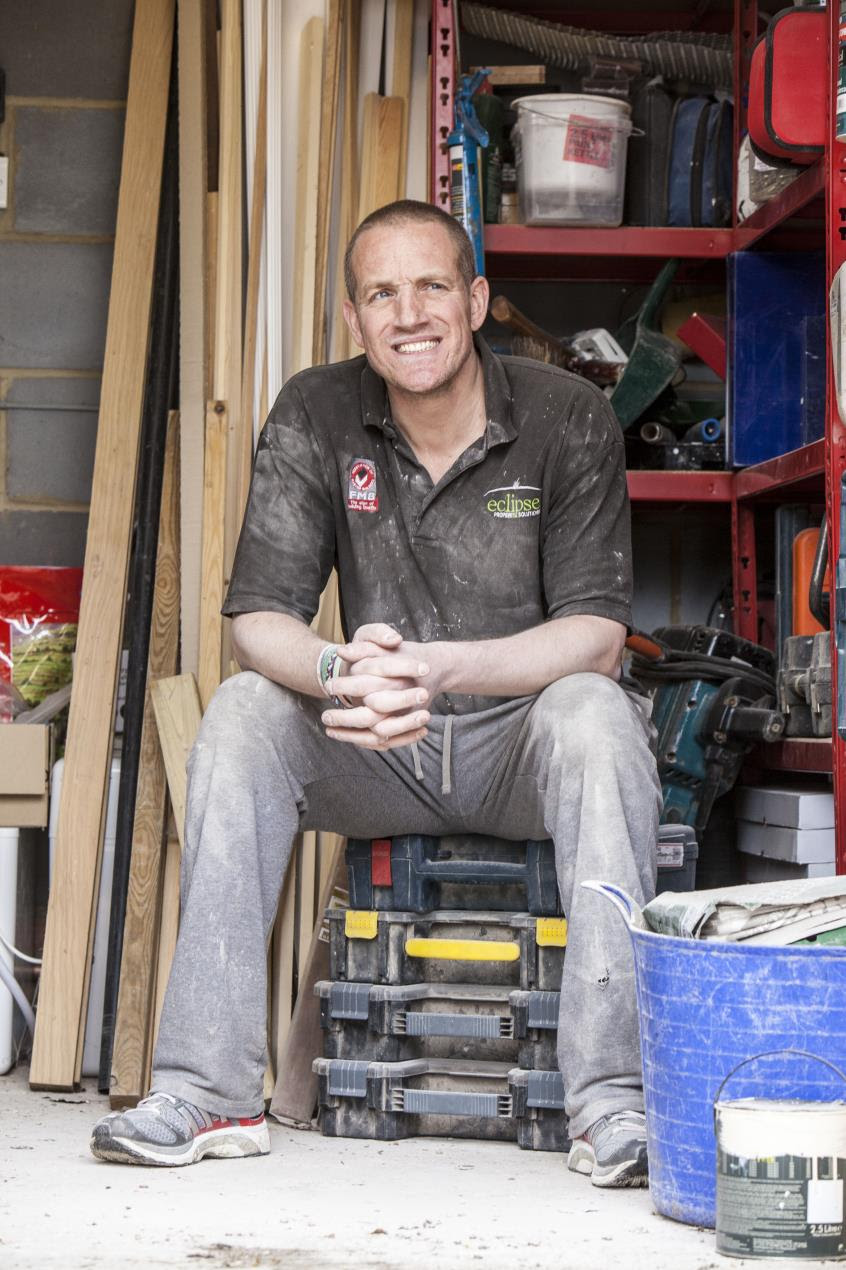 Andy sees the biggest job being to engage with SMEs and ensure they buy into any support scheme, so that people with mental health problems are supported rather than dismissed. Ensuring access across the plethora of companies involved in construction is a key goal of CITB and its partners.
“You’re so busy on a job that you don’t have the time to research it. You’re up at 6am, loading the van, picking someone up, going to work, there until 4pm, go and look at a job, then go and price it up, respond to emails, and suddenly its 11pm and you haven’t eaten yet. You go to bed, get up and repeat. There needs to be the support for these small tradespeople so they know where they can go.
“These people are undervalued, and have a lot more to give than just building your homes and offices. People may be discounted from support groups because they’re covered in sand and cement, plaster, tile adhesive etc, because their Sunday best is jeans and a T-shirt, but these are the people we need offering support from their shared experience. These hard workers are the backbone of the construction industry”
CITB’s research acknowledged that while there is a plethora of mental health support initiatives in the industry, there is no standardised approach, and uptake of a scheme is usually measured rather than its impact. By having a fresh, industry-wide approach, CITB will look to work with businesses to ensure that the mental health support that workers need is available for all.
Andy sees the biggest job being to engage with SMEs and ensure they buy into any support scheme, so that people with mental health problems are supported rather than dismissed. Ensuring access across the plethora of companies involved in construction is a key goal of CITB and its partners.
“You’re so busy on a job that you don’t have the time to research it. You’re up at 6am, loading the van, picking someone up, going to work, there until 4pm, go and look at a job, then go and price it up, respond to emails, and suddenly its 11pm and you haven’t eaten yet. You go to bed, get up and repeat. There needs to be the support for these small tradespeople so they know where they can go.
“These people are undervalued, and have a lot more to give than just building your homes and offices. People may be discounted from support groups because they’re covered in sand and cement, plaster, tile adhesive etc, because their Sunday best is jeans and a T-shirt, but these are the people we need offering support from their shared experience. These hard workers are the backbone of the construction industry”
CITB’s research acknowledged that while there is a plethora of mental health support initiatives in the industry, there is no standardised approach, and uptake of a scheme is usually measured rather than its impact. By having a fresh, industry-wide approach, CITB will look to work with businesses to ensure that the mental health support that workers need is available for all.

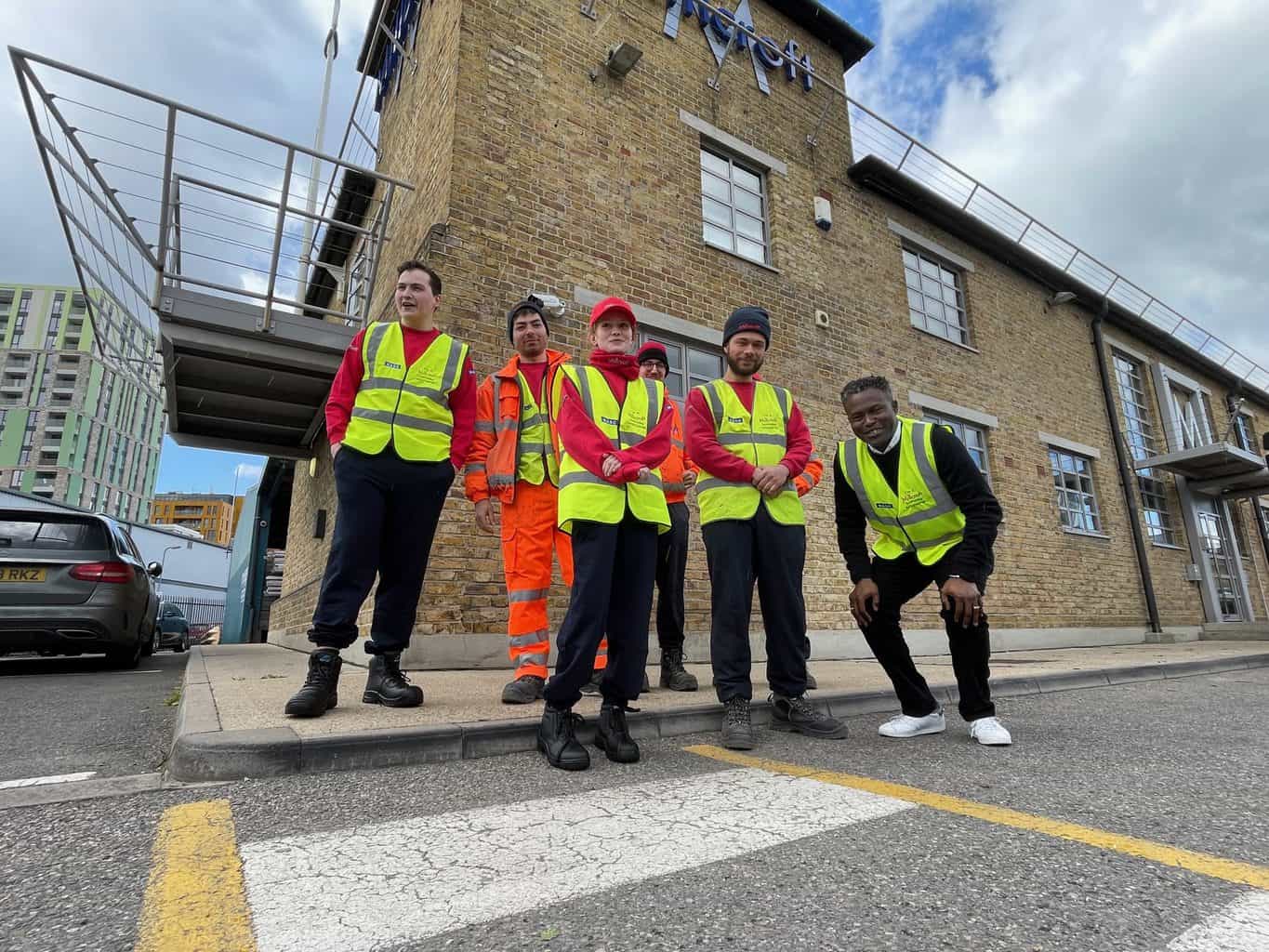 Like the Millcroft team, Henry is also keen to highlight the social value benefits of the Kickstart scheme. “Often young people feel qualifications and academic achievement are the only way their success will be measured,” he says, “but in the real world, we also need practical skills, teamwork and a good worth ethic. Companies like Millcroft that invest in training young people, are helping to create sustainable communities and offering the first step on a career ladder that is varied and rewarding.”
“The Kickstart scheme is a great way to help us recruit young people who perhaps hadn’t thought about a career in the sector before,” Mike adds. “We need to increase diversity in the scaffolding industry and consider our future skill requirements, including digital systems and design processes, alongside core competencies such as health and safety. There is no such thing as a typical recruit for us, what we want to see is young people who are eager to learn and willing to invest in their own development.”
“The best part for us,” Billy adds, “is showing people the complexity and variety of what we do. Our team is immensely proud to be in the scaffolding sector and we’re excited about passing that pride on to our new generation of trainees.”
Like the Millcroft team, Henry is also keen to highlight the social value benefits of the Kickstart scheme. “Often young people feel qualifications and academic achievement are the only way their success will be measured,” he says, “but in the real world, we also need practical skills, teamwork and a good worth ethic. Companies like Millcroft that invest in training young people, are helping to create sustainable communities and offering the first step on a career ladder that is varied and rewarding.”
“The Kickstart scheme is a great way to help us recruit young people who perhaps hadn’t thought about a career in the sector before,” Mike adds. “We need to increase diversity in the scaffolding industry and consider our future skill requirements, including digital systems and design processes, alongside core competencies such as health and safety. There is no such thing as a typical recruit for us, what we want to see is young people who are eager to learn and willing to invest in their own development.”
“The best part for us,” Billy adds, “is showing people the complexity and variety of what we do. Our team is immensely proud to be in the scaffolding sector and we’re excited about passing that pride on to our new generation of trainees.”