Lyndon SGB provides access solutions on one of the UK’s largest scaffolding projects
National scaffolding and access contractor Lyndon SGB is supplying complex access solutions on one of the most prestigious and largest scaffolding projects in the country.
Announced today the four-year contract will see Lyndon SGB provide a multitude of scaffolds on the £330 million ‘Our Town Hall’ renovation of the iconic Manchester Town Hall.
The vast refurbishment of the Grade 1-listed Victorian gothic revival landmark built in 1877 aims to restore the building to its former glory and involves extensive repair work internally and externally, by main contractor Lendlease.
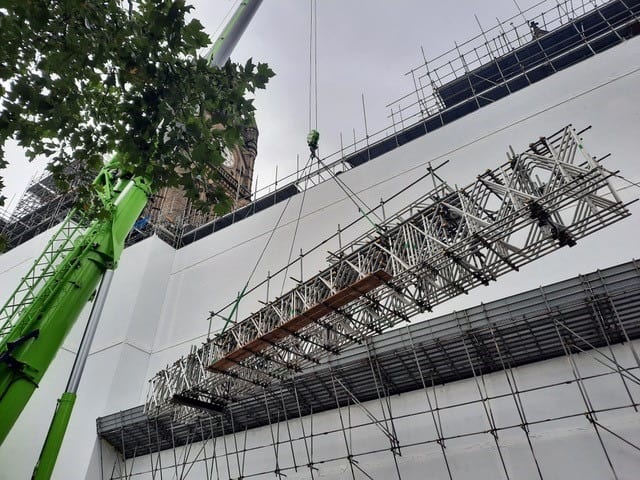
Lyndon SGB is the chosen scaffolding and access contractor, providing millions of pounds of in-house designed scaffolding and access solutions across the project, including large independent scaffolds, crash decks, a bespoke 90m clock tower scaffold, 34 chimney stacks/saddles and 8,000m2 of temporary roofing weather protection across the site.
More than 50 Lyndon SGB scaffolding operatives will be working on the UK’s largest commercial scaffolding project – currently under strict COVID-19 secure protocols during lockdown.
In addition, as part of the KPI (Key Performance Indicators) for the scaffolding program, a dozen apprenticeships will be launched on the project over the life of the contract.
Lyndon SGB say there are already seven apprentices in the Construction Industry Scaffolders Record Scheme and in-house training schemes, with three already operational on site and a further four working in the firms new single scaffolding depot in Manchester. All are employed full-time and working hard in their training, while preparing for college sessions run by learning provider The Growth Company.

Lucas Findlay, 17, from Blackley, said: “Being an apprentice provides the skills and support in order to provide myself with a stable career in scaffolding. I have started at the bottom and the progression I can see ahead of me seems limitless.
The opportunity to learn on the job on such a high-profile project shows the quality of training and trust we are given. I didn’t realise the extent of the challenges of building the scaffolding around such a building, until I saw it for myself and I am pleased to be a part of it.”
Mark Davies, 24, from Collyhurst, said: “Working on the Our Town Hall project is an amazing learning experience, with the opportunity to get up close and personal to one of the oldest buildings in the city.
I have walked past this building so many times over my lifetime without appreciating the details, including what it is like inside. From working in the Great Hall, checking out the views over the city and admiring all the statues, the whole project leaves you in awe.”
Councillor Nigel Murphy, deputy leader of Manchester City Council, said: “Creating opportunities for local young people to build firm foundations for future professional careers across a range of trades is a key goal of the Our Town Hall project and will be an important part of its legacy for the city.
“This is a building which has served Manchester for more than 140 years and through this once-in-a-lifetime scheme, it will continue to play an integral role at the heart of our civic life for generations to come.”
Lyndon SGB Managing Director, Stuart Robinson added: “We are incredibly proud to have secured the scaffolding and access provision on this incredibly important national building renovation. Few firms in the UK could have been selected for such an enormous, complex and highly skilled project.”
Kevin Fitzpatrick, Lyndon SGB Operations Director, said “The newly-operational single scaffolding depot at Manchester is perfectly placed to provide a slick, safe and efficient service on this enormous and iconic project.”
Lyndon SGB North West Regional Manager, Jon Cooke, added: “This is a once in a lifetime opportunity to demonstrate our unique and unrivalled skills, we deliver projects like Our Town Hall because we have the ability to deliver on programme and on budget.”
Lendlease Group’s David Cadiot said: “Our Town Hall is in the top 2% of important historical structures in the UK, we need and must have a supply chain that can deliver, that is why we chose Lyndon SGB.”
Covid lockdown causing some CISRS card renewal problems
It’s been uncovered that some scaffolders are finding it difficult to renew their CISRS cards due to the Covid lockdown but CISRS says, ‘don’t panic!’
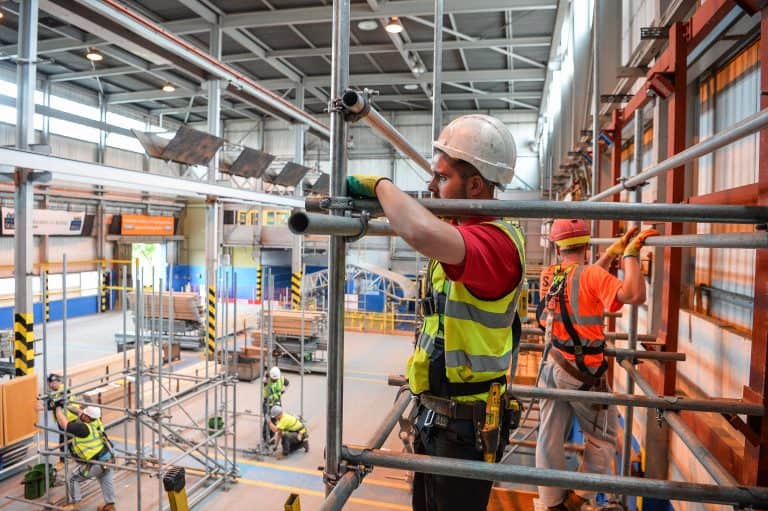
With around half of the CISRS registered scaffolding training centres across the UK temporarily closed due to the coronavirus pandemic, a number of scaffolders are experiencing problems booking CPD courses to renew their CISRS cards.
Many of whom have recently contacted Scaffmag concerned with the ongoing training situation. One scaffolder based in Scotland that contacted us is struggling to find employment because of it.
“My card expired in August last year but I am unable to book to complete my CPD. I am looking for work at the moment but every time a potential employer enters my details into the database it says my card has expired, so I don’t get the job,” he said.
We reached out to CISRS to get their take on the situation: “Some scaffolders may be experiencing problems depending if local centres are open or not but they do not need to panic,” says Dave Mosley CISRS Scheme Manager.
“The centres that have been closed are reviewing their position constantly. And the majority of them originally suggested that they would reopen week commencing 22nd February, so by the end of the month we could have a lot more capacity but obviously that depends upon what the Government says at the time, which may have some effect on their decision.”

The mandatory two-day CPD/refresher course is a key element required to renew Part 2 Scaffolder and Advanced cards but booking CPD courses is not an issue for centres that are open, claims CISRS.
The courses are running regularly they say but that depends on where the scaffolders are located in the country. In some areas training centres that are open have CPD courses available at the end of February early March onwards.
However, CISRS has stressed that it is important to book any courses required well ahead of time wherever possible. And those training establishments that have stayed open are running with reduced capacity with strict COVID precautions.
Employers Need To Show Leniency
For those that are finding it difficult to renew cards that have expired CISRS has urged contractors, employers and those responsible for site access and card checking procedures to show leniency towards these scaffolders.
Laura Weekes at CISRS said: “We are asking employers and contractors to accept any recently expired CISRS cards expired due to this and previous lockdown situations. We are always happy to speak with employers to confirm this if they get in touch.”
CISRS Helpline Number: 0844 815 7223 Email: [email protected]
Construction continues steady recovery
The UK construction industry has hit the ground running according to information from construction data provider Builders Conference.
Their latest data shows that the number of construction contracts awarded in January increased, following the traditional slowdown in December. However, with another national lockdown now in place, the effects of the coronavirus restrictions continue to be felt and both the number and value of contracts remain below pre-pandemic levels, according to Build UK’s State of Trade for Construction. The number of contracts awarded in January was 551, a 53% increase compared to December (360) and the second highest result since April 2020 when the first lockdown was still in place. It is still 11% lower than the average number of contracts awarded each month in the year prior to coronavirus (621 between April 2019 and March 2020) and 17% lower than in January 2020 (666), although this was a particularly strong month.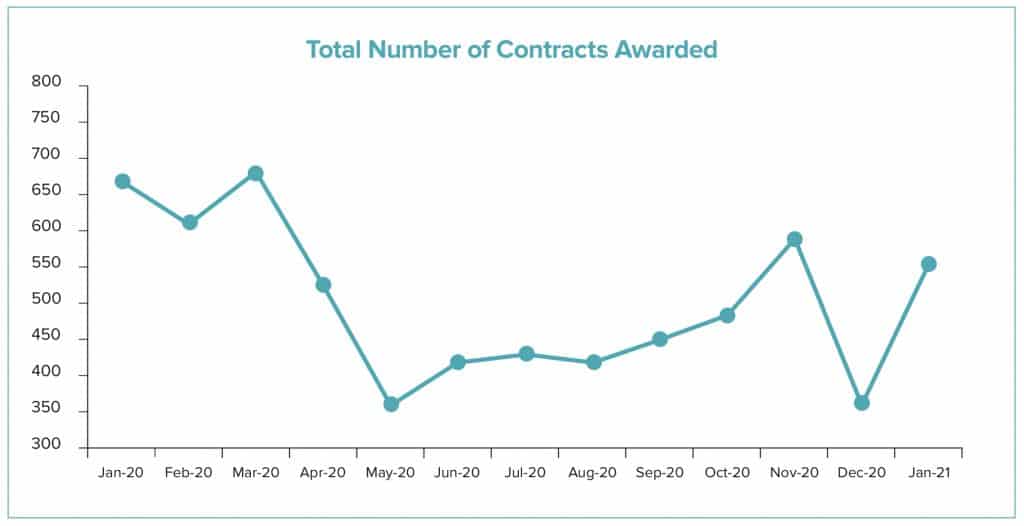
Value of Contracts Holds Up
The value of contracts awarded in January was £6.2 billion. Whilst this is almost 50% down on the previous month, the £12.2 billion worth of contracts recorded in December included two large rail projects worth a combined £8.5 billion. In a positive sign for the industry, the value in January is 3% higher than the monthly average of £6.0 billion between April 2019 and March 2020, although it remains 21% lower than January 2020 (£7.8 billion). 70% of all the contracts awarded by value were in the private sector. Almost half were housing (188 projects worth a total of £2.9 billion), including a £940 million contract to build 2,500 homes on the Teviot Estate in Poplar, East London. There were also 24 road projects worth £962 million (15%) and 110 education projects with a total value of £823 million (13%). 93% of the contracts were in England, with London leading the way with 31% and the Midlands recording 16%.Lack of Tender Opportunities
The number of tender opportunities in January was 366, down from 419 in December. This is 52% below the monthly average of 768 projects available for tender between April 2019 and March 2020. It is also 53% lower than January 2020 (786). At present, there are just 276 tender opportunities available until the end of April 2021, according to Builders’ ConferencBalfour Beatty awarded £32m NHS job

Balfour Beatty has announced that it has been awarded a £32 million contract to build a new, world-class Ophthalmology and Orthopaedic health facility in Inverness on behalf of NHS Highland.
This latest contract award will see Balfour Beatty construct the 8,305 square-metre National Treatment Centre, including 24 inpatient rooms, five operating theatres, clinics and outpatient departments. In addition, the company will build minor operation and procedure rooms, consulting rooms, a café, children’s play area and office support rooms. The new facility will provide elective orthopaedic surgery and full ophthalmology services to surrounding communities, helping to reduce the waiting times for patients across the Highlands. Supporting Balfour Beatty’s sustainability target to positively impact one million people by 2040 and improve the prosperity and wellbeing of communities, the team will collaborate with NHS Highland to provide work experience placements and employment opportunities for local college and university students. Hector Macaulay, Regional Managing Director of Balfour Beatty’s UK Construction Services business in Scotland & Ireland, said: “We are proud to be collaborating with NHS Highland to deliver a world-class National Treatment Centre that will improve the experience of patients through improved services and facilities. “This contract award is testament to our expertise and experience in delivering high-quality, complex hospital facilities, having most recently lead the delivery of the landmark NHS Louisa Jordan hospital as part of our efforts to tackle COVID-19, and are currently delivering two new community hospitals in Aviemore and Broadford.” Deborah Jones, Director of Strategic Commissioning, Planning and Performance for NHS Highland, said: “NHS Highland are delighted to be working with Balfour Beatty again in developing this critical new facility which will deliver critical elective treatment for people in the Highlands and surrounding areas.” Early works commenced in Summer 2020 with completion scheduled for 2022. At peak construction, the project will employ a workforce of 300, as well as several work experience placements.Phoenix adds to its team with drive for UK growth

Scaffolding, brickwork, and drywall contractor, Phoenix is expanding its UK reach with the appointment of several new team members.
Well respected industry professionals Pav Bains, Jim Chandler, Wayne Addison, Neil Weston, Raj Bains and Steve Gates are joining Phoenix, with more appointments pending. Previously all had worked for Bedford based Irvine-Whitlock. Christian Watson, managing director at Phoenix, welcomed the new appointments as the business looks to boost its £15 million turnover with expansion into London and the Home Counties. “Our reputation for high-quality work, exemplary H&S compliance and solid client relationships has already established Phoenix as a strong player north of the Watford Gap. “We are delighted to welcome such experience into the business with the addition of these key industry players and now have the perfect platform to handle projects in the Capital and beyond.” Operating from its Derbyshire and Northamptonshire offices, Phoenix is well established in large parts of the North and Midlands, providing services to key leaders in the construction industry. The new appointments will work alongside the existing team and bring their experience gained across works such as St. Pancras International and Arsenal FC’s Emirates Stadium, to new projects for Phoenix across Greater London and the South East. “As a business we have always focused on delivering a quality service to our clients and I know that this ethos is shared by our new appointments,” said Christian. “This targeted expansion plan is just the first element of our wider plan to develop Phoenix as a national player and our expanded team will bring our co-ordinated service in brickwork, scaffolding and drywalling to projects further south.”CITB starts search for new boss

The CITB is on the lookout for a new £150,000-a-year Chief Executive.
Sarah Beale, the current CEO of the CITB since 2017, exits the role this autumn after tendering her resignation towards the end of last year. The role was advertised today with an annual salary of £150,000 and has a deadline of 7 March for applications. CITB said, “the purpose of the role is to maximise the value of the Levy, provide inclusive and inspirational leadership of CITB, and deliver strong organisational performance against agreed business plans.” The appointee will also represent the organisation at senior levels of the UK government and the devolved governments of Scotland and Wales and work with industry to secure and maintain support. Peter Lauener, Chair of CITB who is leading the appointment process, said: “This appointment comes at a critical time for the construction industry. Employers are recovering from the economic effects of the pandemic and need practical support to ensure their immediate skills needs are met. In addition, we have longer-term challenges like the Government’s 2050 Net Zero target to fight climate change, the move towards digital skills and the need to recruit workers to support home-building and infrastructure growth.” “The new CEO will be one of the driving forces behind meeting these skills challenges and making sure that CITB is responsive to the changing needs of construction employers across England, Scotland and Wales. “It’s a brilliant job for the right person and we expect a strong field of candidates.” For more information about the role, click here.PERI UP scaffolding reaches new heights

The combined height of the PERI UP Flex 75 access stair towers currently supporting UK construction projects now exceeds the 1km mark, claims PERI.
To give you some perspective, if all the PERI staircases were stacked on top of each other they would make a tower taller than the Burj Khalifa, the world’s tallest building.
The stair towers are being used to provide access solutions on a range of construction projects across the UK.
According to the firm their staircases are on projects that span from Scotland, where the towers are enabling access to the slipform rig on the Haymarket regeneration project in Edinburgh, to the South of England, where PERI UP is providing access to steel embedment plates and reinforcement around the reactor buildings on Hinkley Point C.
The PERI UP Flex 75 stair tower is just one of the access scaffolds from PERI’s system scaffolding range, which has been designed for flexibility, speed and most importantly, safety on site.
PERI UK’s Business Development Manager (PERI UP), Charles Stratford says: “The PERI UP stair towers have many benefits that apply across all sectors, especially where working at height is involved. Through the design of the system, neither speed nor safety has been compromised. Minimum components enable fast installation, better product utilisation for our customers coupled with multiple unlimited height offerings.
The inherent feature of the gravity lock really demonstrates the fact that ‘safety first’ does not have to be a time-intensive concept. It’s self-securing, so once our ledger is inserted into our rosette the wedge head drops by the force of gravity to ensure there’s no movement.”

PERI says its systems are only part of the package and having the right people in place is just as important to successfully deliver the modern access and shoring requirements that sites demand.
Charles adds: “The recent growth in our UK scaffolding division only strengthens our offer across all construction sectors. Whether our customers are building a high-rise tower or Britain’s newest power plant, they will receive support from start to finish through the likes of our skilled scaffolding sales engineers, a dedicated design team, and expert on-site support.”
100 Trainees benefit from new Swansea scaffolding centre

More than 100 learners have passed through the CITB’s new Welsh scaffolding centre in its first three months.
The £1.5 million scaffolding centre, at the Construction Wales Innovation Centre in Swansea, has both trained students looking to move into the sector and provided a temporary staff welfare hub during the Covid-19 pandemic. Gareth Wyn Evans, Centre Manager from the Construction Wales Innovation Centre, said: “CWIC’s activities have already supported hundreds of employers in the construction industry across Wales. Our unique partnership is delivering world-class training and bespoke programmes for this hugely important sector to the Welsh economy. “The new scaffolding academy provides access to leading facilities and expertise and it now gives welsh employers the confidence to develop their employees and to recruit new entrants into the industry.” Gareth Williams, CITB’s standards and qualifications policy manager for Wales, said: “This new centre provides training for the essential skills needed to fulfil the ambitious programme of development that due to be completed in Wales over the next few years. The construction industry in Britain needs a quarter of a million new recruits in the next five years, and with scaffolding being among those critical skills, this centre will help to meet that need, also ensuring that students can train locally rather than having to cross the border to England. “The centre opened during the pandemic, and with construction a key sector it was important that CITB, CWIC and our partners maintain training and continued preparing people for a career in the industry. Despite the lockdown, there have been a lot of applicants to train and plenty of enquiries from people looking to pursue a rewarding career in construction.”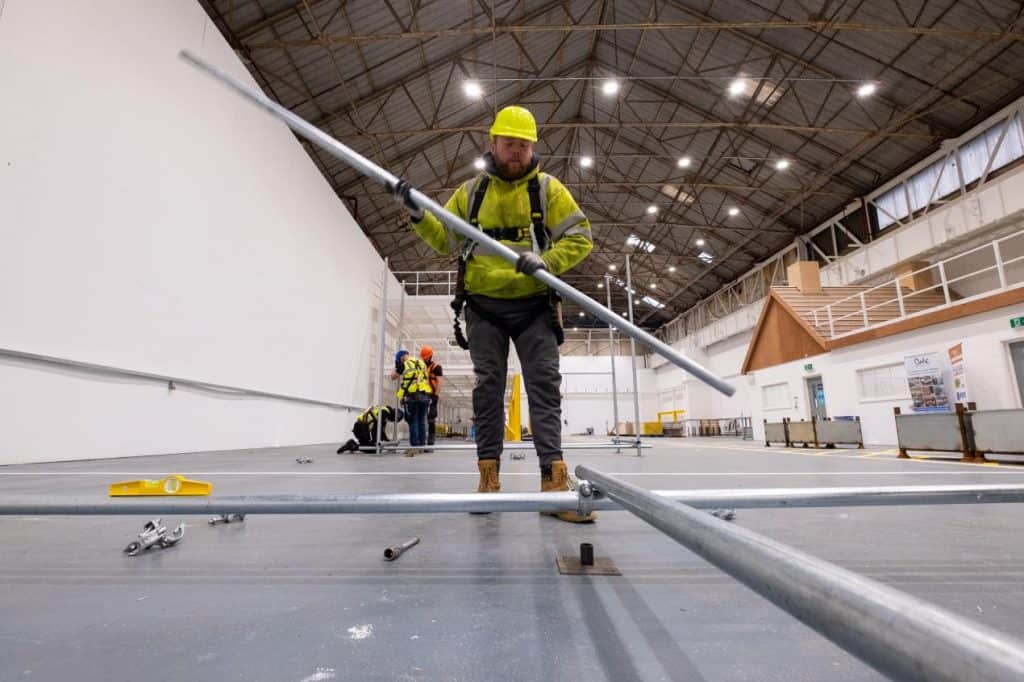 Prior to opening, the centre acted as a staff administration and welfare hub for the Swansea Bay Field Hospital, being fitted with welfare pods to allow staff some welcome space to eat and rest while providing critical healthcare at the height of the Coronavirus pandemic.
Since opening in October, some 27 apprentices have completed their studies at the centre, along with 36 students looking to further their studies in the field. With many more students currently working towards their commercial scaffolding qualifications, it is expected that around 350 students will pass through the centre in its first year.
Prior to opening, the centre acted as a staff administration and welfare hub for the Swansea Bay Field Hospital, being fitted with welfare pods to allow staff some welcome space to eat and rest while providing critical healthcare at the height of the Coronavirus pandemic.
Since opening in October, some 27 apprentices have completed their studies at the centre, along with 36 students looking to further their studies in the field. With many more students currently working towards their commercial scaffolding qualifications, it is expected that around 350 students will pass through the centre in its first year.
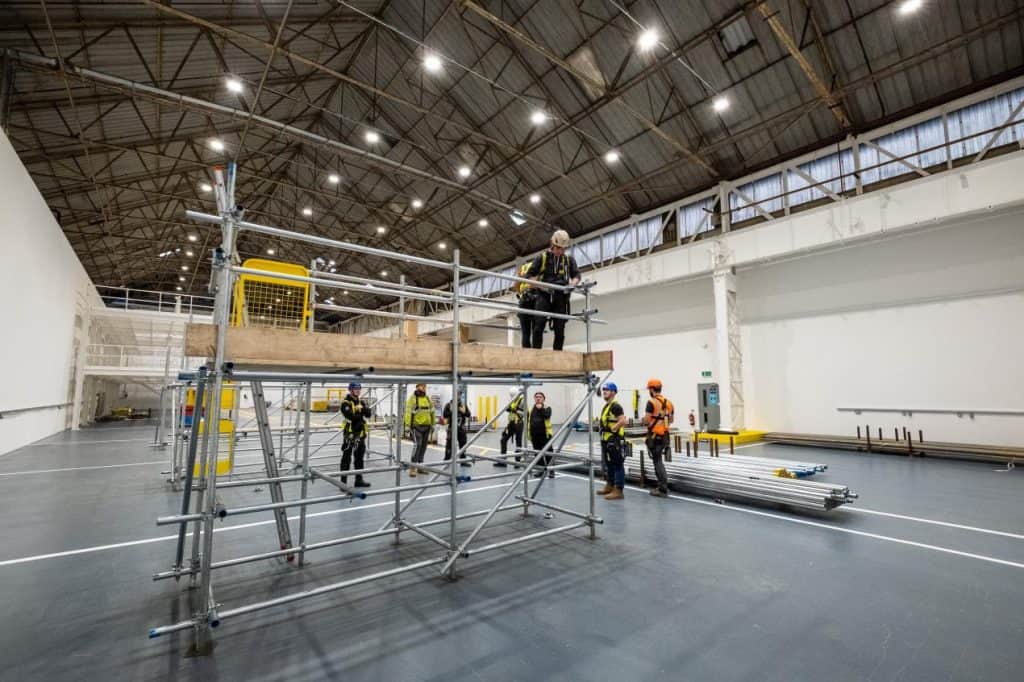 While the centre is currently for the training of apprentices and professional continuing their development, this Spring will see the launch of a “Get into Scaffolding” initiative which will support those looking to change careers, including those who have lost their jobs due to the Covid-19 pandemic, with funded training and work opportunities.
200 Jobs secured as Bilfinger wins Stanlow Refinery contract