Former Mace Operations Director joins Lyndon SGB as its new Managing Director.
Stuart Robinson has joined Lyndon SGB as Managing Director
Stuart Robinson has joined Lyndon SGB as Managing Director with effect from 1st June. He takes over the role from Rob Lynch who is stepping down at the end of June after 20 years.
Stuart joins the business after 15 years with construction firm Mace and before that Taylor Woodrow. He has a wide experience of civil engineering projects and large scale developments across the globe including major retail and office schemes in Bahrain, casinos in Macau, the 2012 London Olympics, leading Mace’s consultancy business in India and most recently Tiffany’s 5th Avenue flagship store in New York and Heathrow’s expansion programme.
Stuart Robinson said that “I am definitely joining at an interesting time, but I am very excited by the massive potential. Lyndon SGB has some great foundations; I have been impressed by the commitment to safety and the wellbeing of everyone we come into contact with. Our plan is to make Lyndon SGB the scaffolding contractor of choice on a national basis. Our ability to offer all types of scaffolding while being supported by mast climbers and our market leading hoist provider, Taylor’s Hoists, means we can provide clients with a unique integrated service.”
Rob Lynch has said, “Although I am sad to be going, I am absolutely sure that the business is in safe hands, Stuart and the team have all the skills to make the business the UK market leader in scaffolding, I wish them all the very best.”
BrandSafway purchased Lyndon Scaffolding and Taylor’s Hoists in January 2019 combining the businesses with SGB to create a truly national access provider, Lyndon SGB.
Scaffolding safety suppliers Leach’s are doing their bit to protect the NHS during the pandemic.
Leach’s has donated the very latest, anti-virus air cleaner from manufacturer MAXVAC Switzerland to St. Thomas’ NHS Hospital, London.
St. Thomas’ was chosen by the company after a survey asking which NHS hospital Leach’s customers would like to see receive a free MAXVAC MEDI 25 air cleaner, which normally costs around £5,000.
Leach’s COO, Stephen Rees-Williams said: “We had been looking for an opportunity to do something good to support the NHS and its patients during this crisis. When we saw this new Medi 25 air cleaner with virus sterilizer from MAXVAC, it just made so much sense to donate one. It’s something that can provide lasting value and protection as it has been designed specifically to help prevent the spread of viruses and bacteria on an industrial scale.NHS workers are the front line of defence against the virus and we are proud to support them and help keep them and their patients safe. It is important that patients and visitors feel confident about coming into hospital when they need to and we believe the MEDI air cleaner can help with that.”
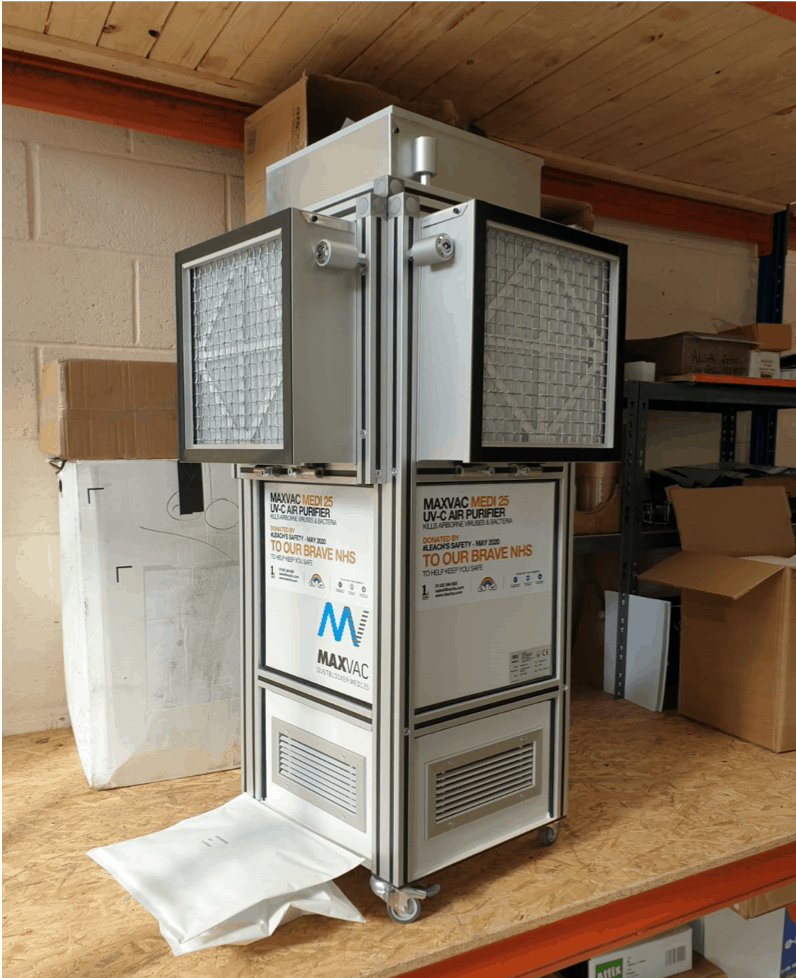
The MAXVAC MEDI 25 is a powerful commercial air cleaner that does more than filter out harmful dust. It also sterilises the air, destroying bacteria and viruses. How? By using powerful UV-C lamps that destroys their DNA. This advanced germicidal technology is completely safe, with the powerful UV-C lamps concealed deep within the air cleaner.
The MEDI is portable too so it can easily be moved from ward to ward depending where the need is greatest — something which is particularly important now as hospitals rapidly adapt to the changing needs of the current pandemic.
Designed for any public space, such as waiting rooms, the MAXVAC MEDI continually sucks air through large HEPA filter screens which remove up to 99.995 % of dust and microparticles larger than 0.01µm, leaving the naked bacteria and virus spores nowhere to hide as they pass through the UV-C sterilizer that destroys their DNA , rendering them harmless.
Leach’s also distributed another MAXVAC air cleaner to a different NHS hospital but this is the first donation of this kind with specific anti-viral technology.
Safety supplier JSP has produced a hard-hat with a cough guard specifically for the construction industry, to help stop the spread of infections.
The firm has developed the helmet-mounted cough guard to reduce the likelihood of any exhaled airborne droplets contacting the wearer’s face.
It also stops the wearer from touching their eyes and face, which is how infections are often spread.
The plastic cough guard is designed to fit the JSP Evolution range of safety helmets and leaves the helmet accessory slots free for fitting helmet-mounted ear defenders. It is also compatible with the JSP range of respiratory products.
Wearing the cough guard does not remove the need to wear safety eyewear or goggles where appropriate, as it is not classed as personal protective equipment as defined by the EU PPE Regulation 2016/425 and does not meet the requirements of EN166 (including splash protection or impact protection).
A scaffolding structure has collapsed in suspicious circumstances in a town in Scotland.
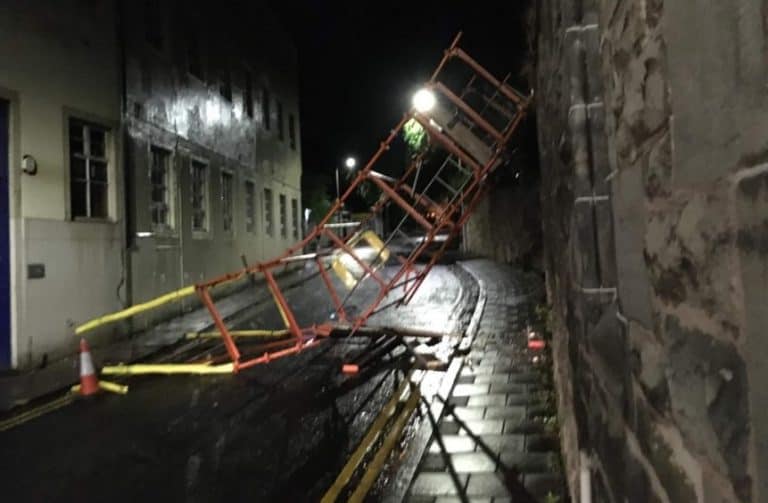
According to reports, the scaffolding collapse happened in the early hours of Wednesday morning. It fell onto buildings on the other side of a narrow road in Kirkcaldy.
No one was injured in the collapse but the scaffolder who erected the job is convinced it was sabotaged to attack his Edinburgh-based firm Blair Scaffolding.
Speaking to local newspaper The Courier Blair Dryburgh said: “It’s absolutely crazy, you work hard to build a business to provide for your family and for your employees then someone sabotages your business like this.”
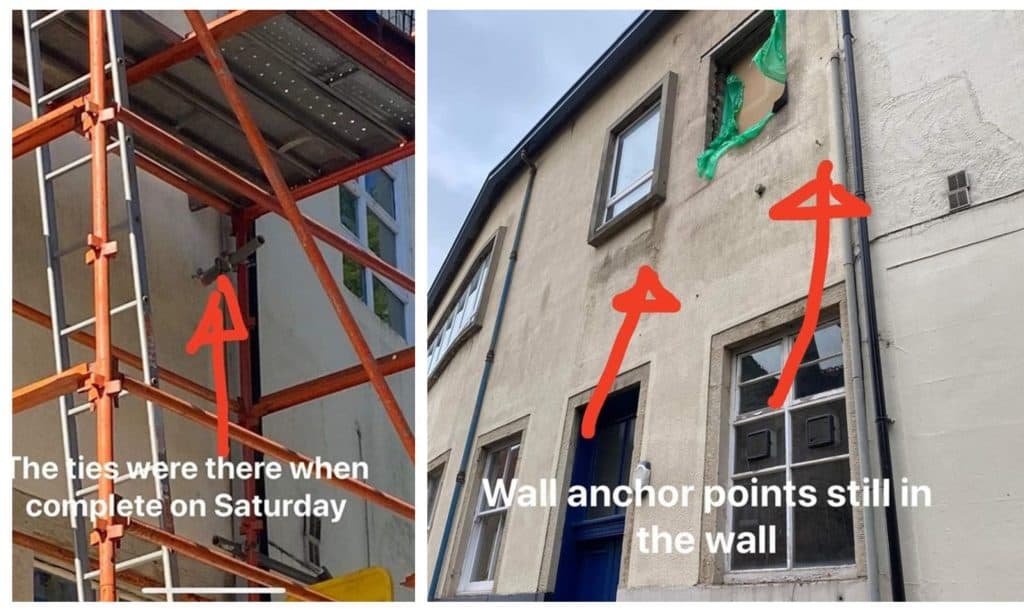
The scaffold came down during high winds but the scaffolder said it was impossible that this was the cause and has evidence to show that the job was tied in.
Evidence that the scaffold was tied in when first erected / Image credit: thecourier.co.uk
“We drill into the wall and fix anchors to it,” he said.
“Someone has taken the butts out that tie that together and adjusted the outside legs. The jacks had been dropped by about six inches.
“They’ve tied a bit of rope to the top and pulled it over, They must have stood in the church grounds opposite, as the rope was still over that side.”
Blair said his team, who are fully qualified and insured, build a number of scaffolds a day, and on rare occasions, the wind has been known to lift boards but had damaged this scaffold in such a way.
The Courier reported that the collapse is believed to have happened at around 1am and the road was closed until the scaffolding was removed later in the morning.
PERI UK has released a series of free product demonstration videos to help its customers adhere to the latest social distancing guidance from the CLC and NASC.
Recognising the construction industry has a vital part to play in an economic recovery, PERI UK has released a series of free product demonstration videos on its website as part of its 4-step customer support plan.
As more sites continue to reopen, PERI has been quick to adapt its products and services to ensure sites operate safely and efficiently, despite a reduced workforce.
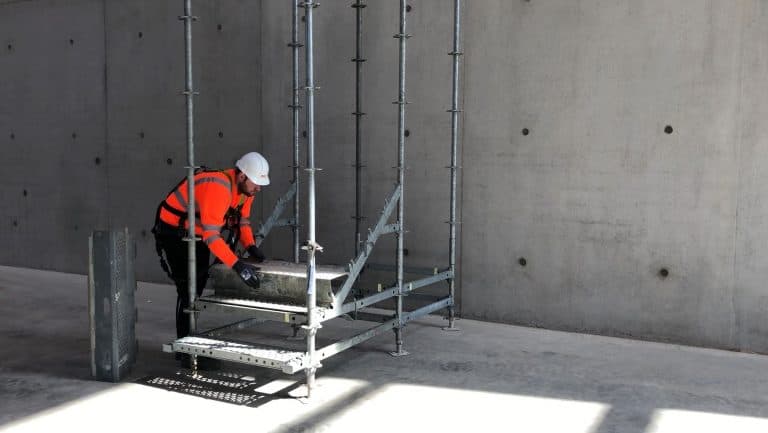
The new videos guide scaffolders on how they can erect PERI UP scaffolding systems in line with the latest Site Operating Procedures and guidelines from CLC and NASC.
Each video features step-by-step demonstrations and detailed explanations provided by the company’s scaffolding supervisor, Mark Holmes, so scaffolders can assemble these systems safely under supervision.
Crucial safety measures, such as two-metre distances, can be observed using PERI’s scaffolding systems, as the videos demonstrate how they can be erected by just one scaffolder.
Currently, the demonstration videos feature the company’s most commonly used and versatile scaffolding systems, such as the PERI UP Flex Stair 75 and PERI UP Flex Stair 100, which can be used to provide temporary building access or as reinforcement scaffolding respectively.
The product demonstration videos will not be replacing the company’s valuable on-site support services, but will instead enhance PERI’s existing offer and help sites maintain construction output during a time it is needed most.
Managing Director for PERI UK, Alasdair Stables said: “We are determined to support our customers and help them keep their sites operational whilst working safely and efficiently. The current situation means that we cannot continue to work in the way we are all used to.A key focus for PERI at this time is to help customers adapt to the CLC’s Site Operating Procedures for the construction sector and to maintain the best possible efficiency on-site with whatever restrictions may be required.” Part of this approach is to make sure our sales and technical teams remain available to help with any challenges on-site, and in addition, our site demonstrators can provide web or site-based support for products being used on site.”
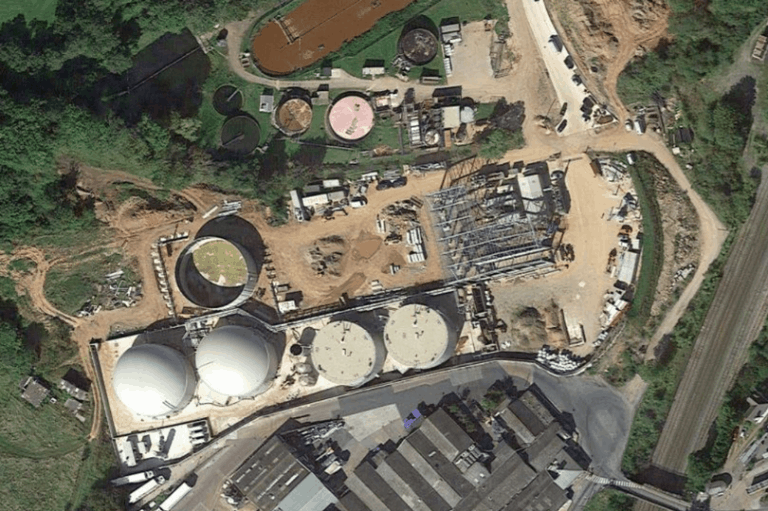
A man has been killed in an incident involving a cherry picker at the Willand Biogas site near Cullompton, Devon.
The workman aged 34, was working from the platform along with a workmate on Monday when they came into contact with an overhead power line. The man died at the scene from injuries suffered from the electric shock, while his colleague was taken to hospital for assessment but was not seriously injured.
South Western Ambulance Service sent multiple resources to the Willand Biogas site including land air and other specialist paramedic teams.
A statement from the Devon and Cornwall Police said: “Police were called to Station Road, Willand Industrial Estate, at around 9.50am on Monday 1 June, with reports that two men operating a cherry picker had been injured when it collided with an overhead electricity cable. A 34-year-old man was pronounced dead at the scene and a 32-year-old man was taken to hospital for assessment. The deceased’s next of kin have been informed.”
A spokesperson for Willand Biogas said: “We were very sorry to learn of the tragic death of a contractor on site. Our thoughts and sympathies are with the friends and family of the deceased at this difficult time. The attaining and maintaining of the highest standards of health and safety management is a priority for Willand Biogas and we will be cooperating with the ongoing investigation by the Health and Safety Executive to the fullest possible extent. In view of that ongoing investigation, it is not appropriate for us to comment further at this stage.”
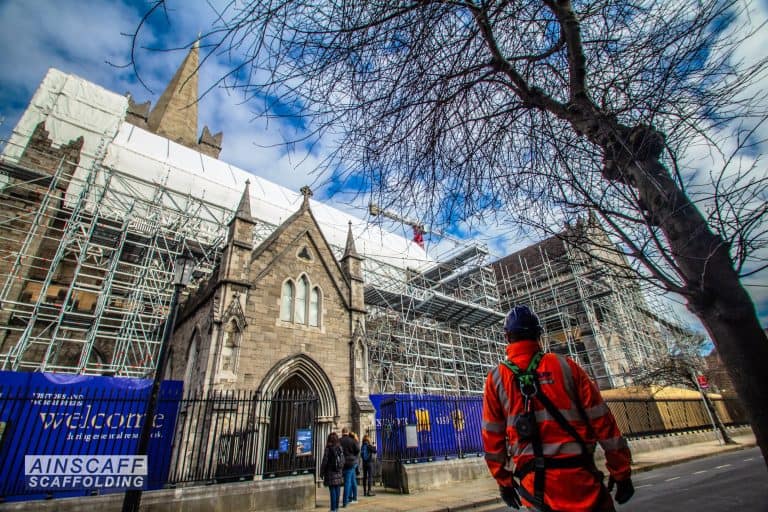
Slate roof repairs on the 800-year-old St Patrick’s Cathedral in Dublin have called for a scaffold and weather protection system that takes full account of the historic importance of the building.
Ireland’s oldest church, St Patrick’s Cathedral dates back to 1220, its currently undergoing the replacement of 19th-century roof slates and is benefitting from the combined scaffolding expertise of Ainscaff Scaffolding – working for main contractor Clancy Construction – and the performance of Layher Ltd.’s Allround scaffolding and lightweight roof systems.
After a year in the planning, the installation above the nave features scaffolds either side of the cathedral to support a series of multiple-beam clusters from which further scaffolding then rises to the temporary roof. Simon Ainscough, Director at Ainscaff, highlights the particular issues that have had to be addressed at the site –
“As so often with buildings of this type, the key factors that we have to accommodate are restrictions on tying-in to the fabric and both the movement and positioning of equipment through often tight spaces and alongside very valuable and irreplaceable structures and artefacts, and the Layher equipment provides key gains in each case,” he says. By way of example, he points out that the celebrated organ alone is valued at some £2 million.
“Key benefits of the Layher system include optimised handling due to its lightweight construction and the fact that it requires markedly fewer components than, for example, a tube and fitting alternative,” he says. He adds that because Layher Allround features a built-in rosette connection system, the risks of clamps, for example, falling or being left at site is minimised.
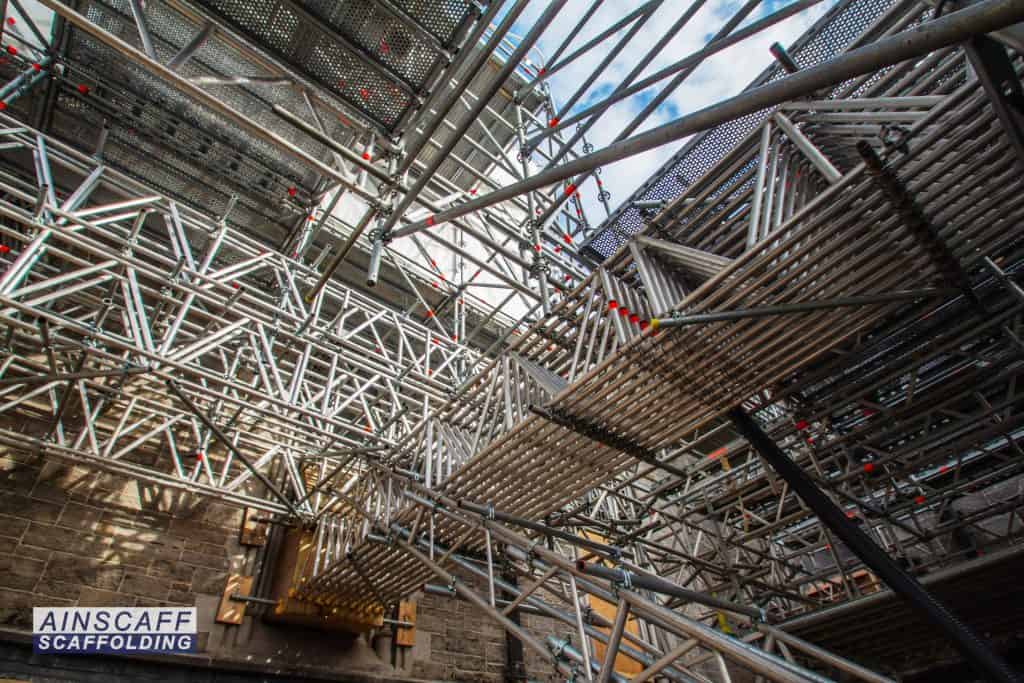
At the heart of the installation Layher’s, Ainscaff’s and Clancy’s design teams have developed a highly innovative scaffold and beam support structure to address the fact that tying-in was not possible.
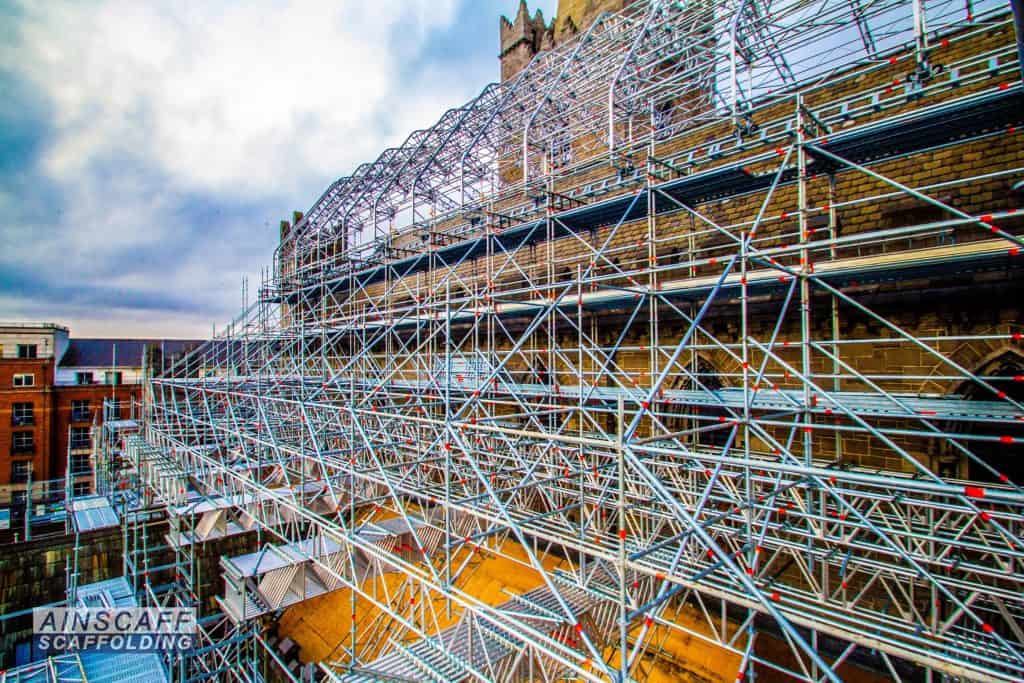
“We created clusters, each of 11 Layher 750 beams, which were clamped to the walls before extending some eight metres externally through 14 windows along both sides of the building,” continues Simon Ainscough. “These were then fixed to the external support scaffolds to provide a base from which further structural elements rise to support the temporary roof.”
The design effectively bridges – and, therefore, avoids loading onto – lower roof areas which run alongside the nave while also helping to ensure an important door access area remains open. At the same time, the external support scaffold, which extends down to ground level, provides the optimum structure for the installation of a material loading bay and access stair system.
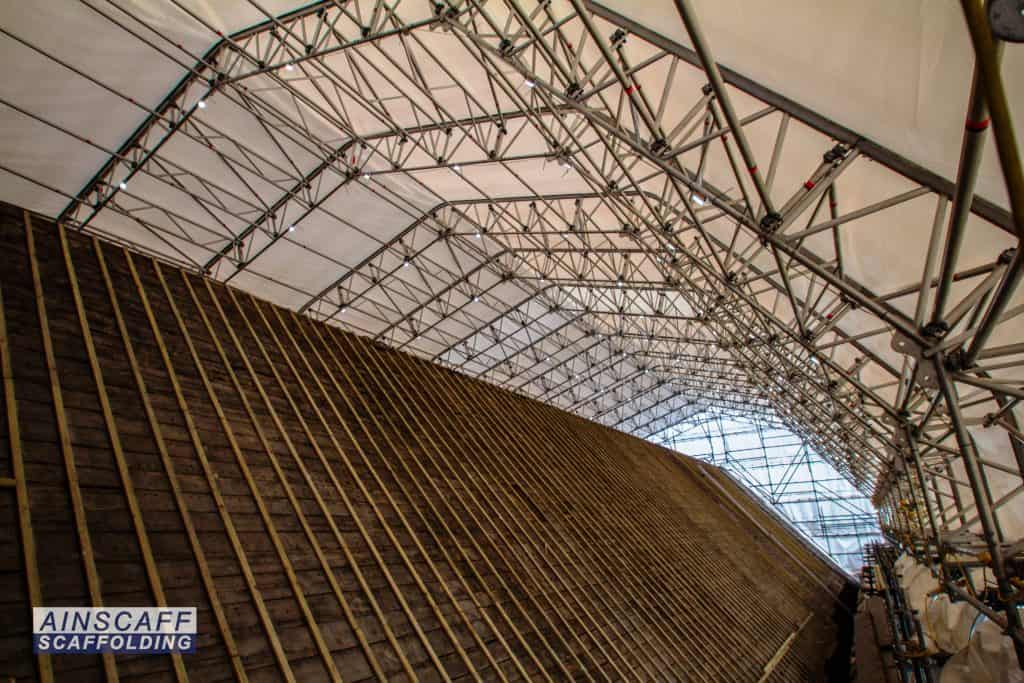
“The temporary roof itself features our Keder XL lightweight design which not only minimises loads and optimises handling, but can also be built to reach fully over the apex of the building without further support,” says Sean Pike, Layher Ireland’s Managing Director. He points out that a total roof span of some 18 metres is achieved.
The bay-by-bay construction of the Layher temporary roof structure has meant that the limitations of only having one crane on site were sufficient for the installation. “We could only lift from one end of the cathedral so we built rails onto the top of the support scaffold upon which Layher’s mobile roof system wheels were then located,” continues Simon Ainscough. “As each bay was craned into position and sheeted, it was then rolled along and fixed to create space for the following frame.” The roof sheets were then pulled into position through the integrated roof beam top chord Keder tracks – the whole scaffold and roof installation being completed in just four months by 14 scaffolders including, significantly, five apprentices.
With fireproof steel decking throughout and, importantly, cross-bracing only required on the top lift as part of the means of securing the roof structure to the scaffold – which allows clear walkways for the movement of both men and materials – the Layher scaffold system brings clear gains to such an important and iconic structure. The simplification of handling even helped the unloading of materials at site which had to be undertaken during the night to avoid traffic restrictions in the city centre location.
“This is a major project in every sense – not just because of its importance and specific structural characteristics, but also the amount of scaffolding and roof system material that has been used,” concludes Simon Ainscough. He points out that some 4.5 km of ledgers, 1.8 km of beams and 3.4 km of standards have all been deployed for what is only the first phase of the roof refurbishment programme. Now that the new roof over the nave is complete, using slate from the same quarry that supplied the cathedral 150 years ago, attention has moved onto phase two – repairs to the transept roof – with the final phase three to follow.
“It is a high-quality installation which demonstrates the suitability of our equipment together with Ainscaff’s and Clancy’s skills in the field of conservation,” concludes Sean Pike. “The structure provides safe, clear access and also creates the ideal, naturally-lit working environment for the roofing trades, yet impacts as little as possible on the continuing function of St Patrick’s Cathedral below.”
The National Access and Scaffolding Confederation (NASC) has launched a new Design Membership category focused exclusively on scaffolding design.
The new membership is open to UK-based scaffold designers and if minimum NASC requirements are met businesses can attain membership.
NASC has said these requirements relate to competence that includes a combination of qualifications and experience.
Previous to the new category many design firms attained NASC Information Member status. These companies have been given the opportunity to transfer over to the new design category in July.
According to the NASC website, businesses will have to part with £800+VAT per calendar year for the new membership subscription.
Robin James, NASC Managing Director, said: “The new NASC Design membership category provides greater recognition for scaffolding designers than was previously provided through the general NASC Information Membership category.“By setting design-specific criteria we have also ensured that NASC Design Membership is valued by the scaffolding industry – seen as a mark of quality and expertise, in the same way that NASC Full Contracting and NASC Full Non-Contracting membership is.”
James Attridge, NASC Technical Committee chair, added: “By appointing an NASC approved Design member, scaffolding contractors can be confident that these companies have the relevant experience, qualifications and Professional Indemnity insurance cover to carry out the project in hand.”
The Construction Leadership Council (CLC) has laid out its post-coronavirus rescue plan for the construction industry.
Called the Roadmap to Recovery, the plan has three phases which will be carried out over the next two years.
Construction leaders hope that within the two years the industry could bounce back more professional, productive and profitable.
The three-phase plan starts with the Restart phase, which will run for the next three months that aims to increase output, maximise employment and minimise disruption.
Next will be the Reset phase which according to the plan will be implemented within three to twelve months. Under this phase, the industry will be asked to increase demand, up productivity and strengthen the supply chain.
The final Reinvent phase which will run in year two will see the industry transform by adopting digital and manufacturing technologies. It will also deliver better value with collaboration and partnership.
A CLC task force is now engaging with Government to test how the plan’s proposals might be delivered.
Construction Leadership Council joint chair Andy Mitchell said: “The unprecedented challenge of coronavirus calls for unprecedented solutions. I am delighted by the way the industry has collaborated at pace to develop this plan, targeting those interventions that will help the industry get back on its feet as quickly as possible. We hope that everyone will take the opportunity to read the plan and consider the part you can play in its delivery.”
To download the Road to Recovery plan click here
Construction union Unite has sent an open letter to the Construction Leadership Council (CLC), warning that the organisation’s site operating procedures (SOP) are placing workers at risk.
Since the COVID-19 pandemic began the various versions of the CLC’s operating procedures have acted as a template for safe site operation with the latest version of the SOP, (version 4) published last week.
The union has said it is primarily concerned about the section which deals with Work Planning to Avoid Close Working which states: “If you are not able to work while maintaining a two-metre distance, you should consider whether the activity should continue.” It goes on to say “that management should minimise the frequency and time workers are within two metres of each other.”
Social distancing vital
Unite has called for site work to be planned in a way that allows social distancing to be maintained with appropriate protection for workers on the very rare occasions when this is not possible and working within two metres of each other cannot be avoided.
However, the SOP version four says: “Workplaces should not encourage the precautionary use of extra PPE to protect against Coronavirus (COVID-19).” The union says that it will not support any guidance that could deny construction workers the appropriate PPE.
PPE concerns
In the open letter to the CLC, Unite construction officer Jerry Swain states: “The SOP could and should be revised to explicitly state that the job should not be undertaken without appropriate PPE, which of course would include masks.”
Unite also raises a similar concern about more than one person travelling together in a work vehicle and says that if two metre social distancing cannot be maintained then “workers should be supplied with an appropriate mask which must be worn”.
CLC vital role
Commenting, Jerry Swain said: “Since the pandemic began, the CLC has become the go to place for construction sites trying to operate and keep workers safe.“It is essential that the information in the site operating procedures is clear, comprehensive and complete. As the procedures are currently written, the health of workers is placed at risk.“Unite has been constructive in the development of these procedures throughout and has fed its views into the CLC. It is imperative that the CLC ends the confusion and republishes revised procedures.“No one should be required to work within two metres of someone else on a construction site and on the extremely rare occasion when this is simply not possible then the full appropriate PPE must be issued. It is also essential workers are fully trained in the safe usage of this equipment.“Our industry is under the spotlight; now is the time for the CLC to show leadership and do the right thing by workers. I truly hope, for the sake of our workers’ health and the battle against the spread of this virus that Unite receives a positive response from the CLC.”
We use cookies on our website to give you the most relevant experience by remembering your preferences and repeat visits. By clicking “Accept”, you consent to the use of ALL the cookies.
This website uses cookies to improve your experience while you navigate through the website. Out of these, the cookies that are categorized as necessary are stored on your browser as they are essential for the working of basic functionalities of the website. We also use third-party cookies that help us analyze and understand how you use this website. These cookies will be stored in your browser only with your consent. You also have the option to opt-out of these cookies. But opting out of some of these cookies may affect your browsing experience.
Necessary cookies are absolutely essential for the website to function properly. These cookies ensure basic functionalities and security features of the website, anonymously.
Cookie
Duration
Description
cookielawinfo-checbox-analytics
11 months
This cookie is set by GDPR Cookie Consent plugin. The cookie is used to store the user consent for the cookies in the category "Analytics".
cookielawinfo-checbox-functional
11 months
The cookie is set by GDPR cookie consent to record the user consent for the cookies in the category "Functional".
cookielawinfo-checbox-others
11 months
This cookie is set by GDPR Cookie Consent plugin. The cookie is used to store the user consent for the cookies in the category "Other.
cookielawinfo-checkbox-necessary
11 months
This cookie is set by GDPR Cookie Consent plugin. The cookies is used to store the user consent for the cookies in the category "Necessary".
cookielawinfo-checkbox-performance
11 months
This cookie is set by GDPR Cookie Consent plugin. The cookie is used to store the user consent for the cookies in the category "Performance".
viewed_cookie_policy
11 months
The cookie is set by the GDPR Cookie Consent plugin and is used to store whether or not user has consented to the use of cookies. It does not store any personal data.
Functional cookies help to perform certain functionalities like sharing the content of the website on social media platforms, collect feedbacks, and other third-party features.
Performance cookies are used to understand and analyze the key performance indexes of the website which helps in delivering a better user experience for the visitors.
Analytical cookies are used to understand how visitors interact with the website. These cookies help provide information on metrics the number of visitors, bounce rate, traffic source, etc.
Advertisement cookies are used to provide visitors with relevant ads and marketing campaigns. These cookies track visitors across websites and collect information to provide customized ads.



 The MAXVAC MEDI 25 is a powerful commercial air cleaner that does more than filter out harmful dust. It also sterilises the air, destroying bacteria and viruses. How? By using powerful UV-C lamps that destroys their DNA. This advanced germicidal technology is completely safe, with the powerful UV-C lamps concealed deep within the air cleaner.
The MEDI is portable too so it can easily be moved from ward to ward depending where the need is greatest — something which is particularly important now as hospitals rapidly adapt to the changing needs of the current pandemic.
Designed for any public space, such as waiting rooms, the MAXVAC MEDI continually sucks air through large HEPA filter screens which remove up to 99.995 % of dust and microparticles larger than 0.01µm, leaving the naked bacteria and virus spores nowhere to hide as they pass through the UV-C sterilizer that destroys their DNA , rendering them harmless.
Leach’s also distributed another MAXVAC air cleaner to a different NHS hospital but this is the first donation of this kind with specific anti-viral technology.
The MAXVAC MEDI 25 is a powerful commercial air cleaner that does more than filter out harmful dust. It also sterilises the air, destroying bacteria and viruses. How? By using powerful UV-C lamps that destroys their DNA. This advanced germicidal technology is completely safe, with the powerful UV-C lamps concealed deep within the air cleaner.
The MEDI is portable too so it can easily be moved from ward to ward depending where the need is greatest — something which is particularly important now as hospitals rapidly adapt to the changing needs of the current pandemic.
Designed for any public space, such as waiting rooms, the MAXVAC MEDI continually sucks air through large HEPA filter screens which remove up to 99.995 % of dust and microparticles larger than 0.01µm, leaving the naked bacteria and virus spores nowhere to hide as they pass through the UV-C sterilizer that destroys their DNA , rendering them harmless.
Leach’s also distributed another MAXVAC air cleaner to a different NHS hospital but this is the first donation of this kind with specific anti-viral technology. 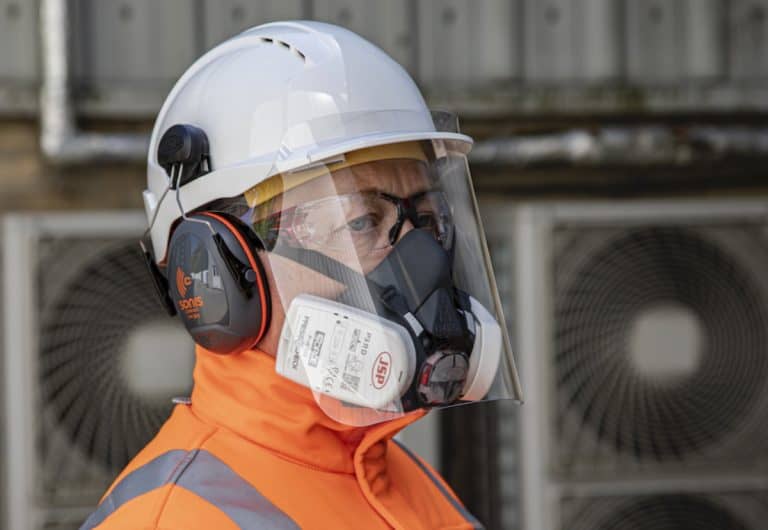
 At the heart of the installation Layher’s, Ainscaff’s and Clancy’s design teams have developed a highly innovative scaffold and beam support structure to address the fact that tying-in was not possible.
“We created clusters, each of 11 Layher 750 beams, which were clamped to the walls before extending some eight metres externally through 14 windows along both sides of the building,” continues Simon Ainscough. “These were then fixed to the external support scaffolds to provide a base from which further structural elements rise to support the temporary roof.”
The design effectively bridges – and, therefore, avoids loading onto – lower roof areas which run alongside the nave while also helping to ensure an important door access area remains open. At the same time, the external support scaffold, which extends down to ground level, provides the optimum structure for the installation of a material loading bay and access stair system.
“The temporary roof itself features our Keder XL lightweight design which not only minimises loads and optimises handling, but can also be built to reach fully over the apex of the building without further support,” says Sean Pike, Layher Ireland’s Managing Director. He points out that a total roof span of some 18 metres is achieved.
At the heart of the installation Layher’s, Ainscaff’s and Clancy’s design teams have developed a highly innovative scaffold and beam support structure to address the fact that tying-in was not possible.
“We created clusters, each of 11 Layher 750 beams, which were clamped to the walls before extending some eight metres externally through 14 windows along both sides of the building,” continues Simon Ainscough. “These were then fixed to the external support scaffolds to provide a base from which further structural elements rise to support the temporary roof.”
The design effectively bridges – and, therefore, avoids loading onto – lower roof areas which run alongside the nave while also helping to ensure an important door access area remains open. At the same time, the external support scaffold, which extends down to ground level, provides the optimum structure for the installation of a material loading bay and access stair system.
“The temporary roof itself features our Keder XL lightweight design which not only minimises loads and optimises handling, but can also be built to reach fully over the apex of the building without further support,” says Sean Pike, Layher Ireland’s Managing Director. He points out that a total roof span of some 18 metres is achieved.
 The bay-by-bay construction of the Layher temporary roof structure has meant that the limitations of only having one crane on site were sufficient for the installation. “We could only lift from one end of the cathedral so we built rails onto the top of the support scaffold upon which Layher’s mobile roof system wheels were then located,” continues Simon Ainscough. “As each bay was craned into position and sheeted, it was then rolled along and fixed to create space for the following frame.” The roof sheets were then pulled into position through the integrated roof beam top chord Keder tracks – the whole scaffold and roof installation being completed in just four months by 14 scaffolders including, significantly, five apprentices.
 With fireproof steel decking throughout and, importantly, cross-bracing only required on the top lift as part of the means of securing the roof structure to the scaffold – which allows clear walkways for the movement of both men and materials – the Layher scaffold system brings clear gains to such an important and iconic structure. The simplification of handling even helped the unloading of materials at site which had to be undertaken during the night to avoid traffic restrictions in the city centre location.
“This is a major project in every sense – not just because of its importance and specific structural characteristics, but also the amount of scaffolding and roof system material that has been used,” concludes Simon Ainscough. He points out that some 4.5 km of ledgers, 1.8 km of beams and 3.4 km of standards have all been deployed for what is only the first phase of the roof refurbishment programme. Now that the new roof over the nave is complete, using slate from the same quarry that supplied the cathedral 150 years ago, attention has moved onto phase two – repairs to the transept roof – with the final phase three to follow.
“It is a high-quality installation which demonstrates the suitability of our equipment together with Ainscaff’s and Clancy’s skills in the field of conservation,” concludes Sean Pike. “The structure provides safe, clear access and also creates the ideal, naturally-lit working environment for the roofing trades, yet impacts as little as possible on the continuing function of St Patrick’s Cathedral below.”
With fireproof steel decking throughout and, importantly, cross-bracing only required on the top lift as part of the means of securing the roof structure to the scaffold – which allows clear walkways for the movement of both men and materials – the Layher scaffold system brings clear gains to such an important and iconic structure. The simplification of handling even helped the unloading of materials at site which had to be undertaken during the night to avoid traffic restrictions in the city centre location.
“This is a major project in every sense – not just because of its importance and specific structural characteristics, but also the amount of scaffolding and roof system material that has been used,” concludes Simon Ainscough. He points out that some 4.5 km of ledgers, 1.8 km of beams and 3.4 km of standards have all been deployed for what is only the first phase of the roof refurbishment programme. Now that the new roof over the nave is complete, using slate from the same quarry that supplied the cathedral 150 years ago, attention has moved onto phase two – repairs to the transept roof – with the final phase three to follow.
“It is a high-quality installation which demonstrates the suitability of our equipment together with Ainscaff’s and Clancy’s skills in the field of conservation,” concludes Sean Pike. “The structure provides safe, clear access and also creates the ideal, naturally-lit working environment for the roofing trades, yet impacts as little as possible on the continuing function of St Patrick’s Cathedral below.”