CPA's revised construction outlook points to further weakness in housing and refurbishment, according to Roofing Today's report on the Autumn forecasts.
At 21, John Trayfoot blacked out on a roof and fell 8 metres through a skylight into a Brighton timber yard. Now managing director of M R Scaffolding, he starts his company's safety sessions with that story, and with a question: why do experienced people who know the risks still cut corners?
CPA's revised construction outlook points to further weakness in housing and refurbishment, according to Roofing Today's report on the Autumn forecasts.
At 21, John Trayfoot blacked out on a roof and fell 8 metres through a skylight into a Brighton timber yard. Now managing director of M R Scaffolding, he starts his company's safety sessions with that story, and with a question: why do experienced people who know the risks still cut corners?
CPA's revised construction outlook points to further weakness in housing and refurbishment, according to Roofing Today's report on the Autumn forecasts.
At 21, John Trayfoot blacked out on a roof and fell 8 metres through a skylight into a Brighton timber yard. Now managing director of M R Scaffolding, he starts his company's safety sessions with that story, and with a question: why do experienced people who know the risks still cut corners?
CPA's revised construction outlook points to further weakness in housing and refurbishment, according to Roofing Today's report on the Autumn forecasts.
At 21, John Trayfoot blacked out on a roof and fell 8 metres through a skylight into a Brighton timber yard. Now managing director of M R Scaffolding, he starts his company's safety sessions with that story, and with a question: why do experienced people who know the risks still cut corners?
A Scaffolding firm based in Hampshire has been able to expand after securing a Government-backed loan.
Jarrett Scaffolding has secured a £50,000 discounted rate loan through NatWest as part of the Government’s Funding for Lending scheme.
The scaffolding firm was set up by Jay Pinnells who wanted to grow the company by taking on bigger contracts and stocking up on more materials, the Government-backed loan has also enabled him to add another heavy goods vehicle to his fleet and three new scaffolders.
Mr Pinnells was recommended to the bank by his accountant Daleep Pandey and was assisted by Annie Cains at the NatWest Southampton office
Mr Pinnells said:
“Without NatWest we wouldn’t have been able to expand”.
“Annie was absolutely fantastic; she is highly professional and methodically helped us through every step of the loan application.
“Annie is a pleasure to work with and as our business manager she continues to be on hand to offer advice and help with any queries.”
Annie added: “I’m so pleased we’ve been able to support Jay and his business, helping him towards his business ambitions. I’m looking forward to working with him to help him continue the success of his business.”
The 48.3 Scaffold Design team are delighted to unveil their new look website.
Since 48.3 Scaffold Design started trading three and half years ago, their image and logo has evolved. The orange branding has always featured in their website even from the start, and now not only does their new website look clean and striking with its bold white headlines on dark blue imagery but still features the 48.3 Scaffold Design corporate ‘Orange’ ensuring they don’t forget their roots!
Ben Beaumont, Founder and Managing Director at 48.3 Scaffold Design told ScaffMag:
“The new expanded website reflects the growth 48.3 have achieved over the last 12 months particularly. We really wanted our reputation for quality and service to be reflected in our website, and we feel the new design does this perfectly. Our design team will grow to six in January 2014, and all our members will be fully competent design engineers or technical design draughtsmen.
We strive to be the best and pride ourselves on offering an innovative tailor made service to our clients. We offer a dedicated team who provide a fast and efficient turnaround on projects, delivering cost effective and efficient solutions. The website has allowed us to showcase our design service and highlight the details that set 48.3 apart from our competition”.
The details are:
Their clients enjoy a design turnaround of 5-7 working days, guaranteed no greater than 10 working days!
They meet agreed deadlines, if they don’t they will do the design for FREE!
They can save you up to £1250 a month! – with there sliding scale of design fees, mean the more work they do for you, the more you will save.
They provide a ‘Fast Track’ scaffolding design service for time critical projects ensuring a guaranteed start within 24 hours!
The new website incorporates a new ‘About Us’ page where you can meet the team and read about the 48.3 Mission, Vision and Values which provide the driving motivation to the delivery of our design service”.
These days everyone is ‘on the go’ and it was important for them to make sure the website was responsive, this means whether you are viewing them on your Mac, laptop or mobile, the pages of the website can adapt to suit the size of your screen.
In addition their portfolio pages and news pages have been completely redesigned allowing them to showcase their designs and news in the best and most effective way, plus they have an interactive ‘Contact us’ page featuring a grab and drop map as well as a link to their Google + page. In addition all their social media sites such as Facebook, LinkedIn and Twitter (@483ScaffDesign) have been rebranded too!
Visit their new website at www.483scaffolddesign.com
Northamptonshire shoppers were forced to run for safety as a scaffold collapsed and fell some 20 metres towards them, a court has heard.
Nobody was hurt, but several people required treatment for shock as a result of the incident at the Willow Place Shopping Centre in Queen’s Square, Corby on 17 August 2012.
Local firm Desborough Scaffolding Limited, of Desborough, was prosecuted today (16 December) by the Health and Safety Executive (HSE) after an investigation established that the scaffold was structurally unsound.
Northampton Magistrates’ Court was told that debris netting had been fitted to the scaffolding tubes, but in high winds on the day it acted as a sail and caused the structure to pull away and apart – sending metal poles and other materials raining to the ground below. The falling scaffold smashed through shop canopies below and also pulled down signs. Several businesses were forced to close while the clean-up took place and the area was made safe. The incident was captured on CCTV.
The HSE investigation found the scaffold had not been erected in a way to ensure it would remain stable, and had not been designed by a competent person to ensure it had adequate strength and rigidity for the purpose and environment it was to be used in.
Desborough Scaffolding Limited, of Stoke Albany Road, Desborough, were fined £16,000 and ordered to pay £4,678 in costs after pleading guilty to single breaches of the Work at Height Regulations 2005 and the Construction (Design and Management) Regulations 2007.
Speaking after the hearing, HSE Inspector Sam Russell said:
“It was sheer luck that no-one was seriously injured or killed as a result of this totally preventable incident.
“Scaffolding erected to an approved design by competent persons should be able to withstand high wind loads without failing.
“This case highlights the requirement of following prescribed industry designs and manufacturers’ instructions. The company’s failure to do so put innocent workers and members of the public at significant risk.”
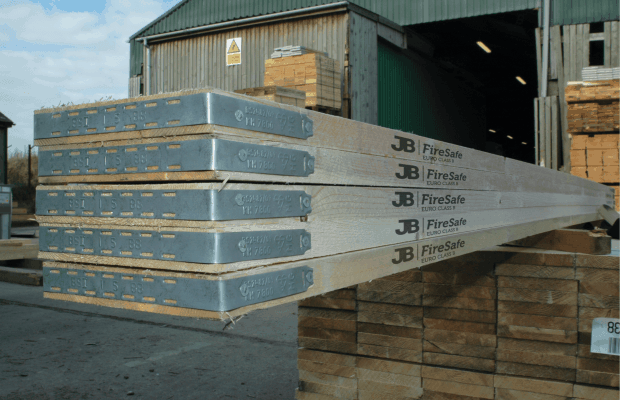
There are no second chances with scaffold boards; whether it is grading them during manufacture or fire treating after it’s vital that the specification is both correct and adhered to. The consequences of failure are serious either to health or safety. There is a greater awareness for the use of fire treated timber scaffold boards. There are invariably used offshore within the North Sea Oil and Gas industries, with London Underground and increasingly within construction.
John Brash takes this risk seriously; for many years its scaffold boards have carried the kitemark symbol of quality with licence number and dual graded to ensure board performance.
Christian Brash comments:
“All manufacturing has always been carried out within our ISO 9001 system. To ensure the highest standards are consistently met the WPA (Wood Preserving Association) has developed its Benchmark accreditation for timber treatments. John Brash has been the first to be awarded this for the fire retardant treatment of scaffold boards.
“This is an important certification for us. We’ve heavily invested in our treatment plant to deliver a quality service within exceptional lead times to our customers. The WPA benchmark scheme is important to anyone buying treated timber to ensure the product is fit for purpose. WPA benchmark, in conjunction with the kitemark scheme for grading, ensures total peace of mind for the client. This sits very nicely alongside our approvals for use within London Underground where we have demonstrated we meet all their quality and identification requirements. ”
For further information on JB Firesafe specifications and the fire retardant treatment of scaffold boards read the technical article.
Competent Scaffolder will now be Qualified Scaffolder after regulations review.
ScaffMag has been informed by sources that the National Access & Scaffolding Confederation (NASC) has managed to persuade government bigwigs to replace the terminology ‘Competent’ or ‘Competence’ with ‘Qualified’ in the next updated Working at Height Regulations.
Although no official announcement from the NASC has been published as yet, The NASC are reportedly very happy with the outcome.
The battle began back in January 2012 after a government report by Professor Löfstedt on the review into existing Health and Safety legislation. One recommendation by Professor Löfstedt was to review the Work at Height Regulations by 2013. The NASC reacted with its own recommendation in shining light on one particular ‘grey’ area in the use of the terminology ‘competent’ and ‘competence’ which occur frequently throughout the current legislation.
These terms were both ambiguous and open to interpretation. This non-specific terminology has resulted in different interpretations and hence different standards of safety protocol – yet these terms are also at the ‘heart’ of the regulations. The NASC recommended that this terminology be replaced by the term ‘qualified’ (as already adopted in the gas fitting industry).
The work at height industry, including scaffolding can demonstrate clearly and accurately that an individual is ‘qualified’ by the fact that he or she has completed suitable training, which includes theoretical, practical and on site experience – the aptitude of the Scaffolder to continue to carry out his/her skilled works is also challenged every five years to ensure continued compliance.
Image source: CISRS
A building worker suffered life-changing injuries in a fall after a colleague loosened a scaffolding guardrail which later gave way, a court has heard today (9 Dec).
The 42-year-old self-employed labourer from Bristol, who does not wish to be named, broke his back after falling nearly three metres to the ground at the building site in Cheddar. He remains unable to work and may never be to carry out manual labour again.
The incident was investigated by the Health and Safety Executive (HSE), which prosecuted the building worker for safety failings.
Taunton Magistrates’ Court was told that a fellow builder, David Dix, 52, was also working on the construction site at a care home in Tweentown on 30 January 2013. Mr Dix loosened a scaffold guardrail to try and resolve a problem he had encountered.
However Mr Dix failed to tighten it up properly again. Shortly afterwards, the other worker was emptying a muck bin when the guardrail gave way and he fell 2.8 metres to the ground.
David John Dix, of Cambrook Close, Camerton, near Bath, pleaded guilty to breaching Section 8 of the Health and Safety at Work etc. Act 1974. He was ordered to pay £700 compensation to the injured party.
After the hearing, HSE inspector Sue Adsett, said:
“What happened that day could easily have been avoided and will affect the injured man for the rest of his life. Scaffolding should only be altered by scaffolders, but David Dix took it upon himself to adjust some scaffolding when he was not authorised to do so, with disastrous consequences.
“He had no ulterior motive – like most construction workers he was simply trying to get on with the job when a problem arose that he was trying to overcome. The consequences of the incident have had a huge impact upon him as well.
“I hope this case makes construction workers stop and think before putting themselves and their colleagues at risk by altering scaffolding on building sites.”
A variety of access, formwork and shoring systems from Harsco Infrastructure (formerly SGB) were used to construct a new £205 million state-of-the-art Energy from Waste plant in Ardley, North Oxfordshire.
Harsco designed and supplied the formwork required for the creation of 24m deep reinforced waste bunker which will accommodate up to 5,000 tonnes of waste. The bunker is being constructed using a combination of Harsco’s LOGIK®60 wall formwork panel system, MULTIFORM climbing brackets to create access platforms, and lightweight GASS® aluminium shoring. The GASS® system is being used to provide safe working access for the creation of the numerous intermediate concrete floor slabs that will be included inside the waste bunker.
Other products and services supplied include EXTRAGUARD™ edge protection system, to ensure maximum site safety, plus DU-AL™ and Mk II Soldier aluminium beams to create a variety of structures for wall and soffit support. These were complemented by Harsco’s CUPLOK® which was used to create temporary staircases up to 24m in height.
“As on previous projects where we have worked with Harsco, their expertise and great range of products and systems have come together to create an excellent solution to our needs. We have a sole supplier agreement with Harsco for formwork and falsework requirements and have recently been working with them on other waste-related projects in Lincoln, Shropshire and Stafford,” says John Holmes, Senior Works Manager, Clugston Construction Ltd.
When complete in 2014 the plant will be able to process 300,000 tonnes of non-recyclable waste per year – sufficient to divert at least 95% of Oxfordshire’s residual municipal waste away from landfill disposal. It will also be able to generate up to 24 MW of electricity – enough to power some 38,000 homes.
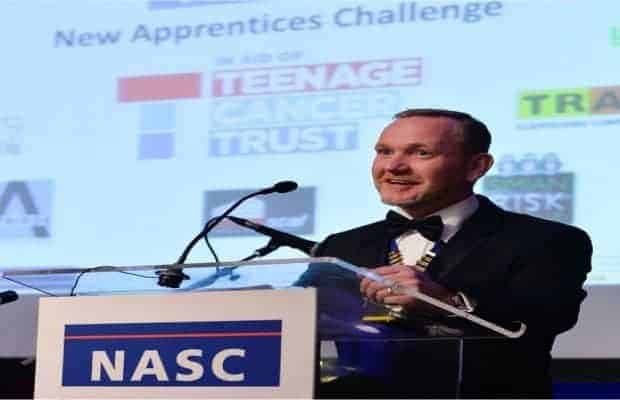
The new NASC President, Kevin Ward has challenged it’s members to create a minimum of 400 new scaffolder apprentices during his two-year term.
Mr Ward who was a former scaffolding apprentice himself unveiled his apprentice scheme at the NASC AGM in Bristol on November 22nd, and also revealed that The Teenage Cancer Trust would be a beneficiary of this challenge, as each new apprentice will generate a £100 donation from participating NASC member companies. If the target is met during Mr Ward’s two-year term as NASC President, this will mean the charity will receive a minimum donation of £40,000 from its members.
Mr Ward said:
“Apprentices are the lifeblood of our industry and we must lead from the front by setting the right example for others to follow, both within the scaffolding industry and also for the wider construction sector. As a former apprentice myself, I know we will be creating superb career opportunities for at the very least 400 young people, whilst also raising funds for an incredibly worthy charity in The Teenage Cancer Trust. It is a win-win for all – a real no brainer!“The creation of at least 400 new scaffolding apprentices during the next two year period should be a straight forward commitment for NASC members to fulfil. After all, the members themselves will ultimately be long-term beneficiaries.“CISRS Scheme Manager, Dave Mosley and I would like to hear from any member company which struggles to find a placement with a suitable approved training provider for any of its new apprentices and we will do whatever we can to help them out.”
Robin James, NASC’s Managing Director said:
“We are very excited about the President’s bold apprenticeship scheme and will be working hard with our members to assist them, so we can reach the goal of over 400 new scaffolding apprentices in two years, and raise over £40,000 for The Teenage Cancer Trust.”Dave Mosley added: “Introducing young people to a career in scaffolding is at the core of the work of the CISRS and we are happy to support the new President’s initiative which will benefit the industry and a fabulous charity in equal measure.”
The NASC’s President’s scheme also has the backing of the Minister for Skills and Enterprise, Matthew Hancock MP – after NASC President, Kevin Ward wrote to the Prime Minister to inform him of the challenge.
Mr Hancock said: “I am delighted that you are announcing your commitment to Apprenticeships at the beginning of your Presidency. Apprentices are at the heart of the Government’s drive to equip people of all ages with the skills employers need to grow and compete. Research shows Apprenticeships are good for people, good for the economy and help employers build a loyal and competent workforce. We rely on employers offering opportunities, so I welcome your support of the Apprenticeships programme in making this new commitment.”And Michelle Aucott, Regional Fundraiser for The Teenage Cancer Trust added: “We are very excited with the plan you have proposed. We would like to thank you and the NASC membership for supporting The Teenage Cancer Trust.“This amount of money will make such a difference to the lives of teenagers and young adults that have been affected by cancer. We rely on donations like yours to fund our vital work and help transform the lives of young people with cancer.”
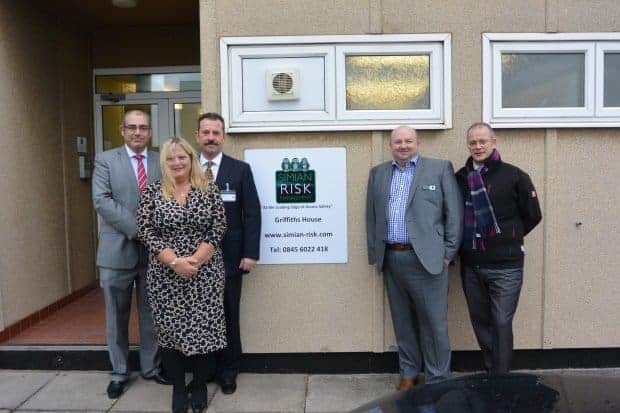
From the left: Simon Hughes, Fiona Sennett, Terry Sennett, Ian Fyall and Layher UK MD Sean Pike.
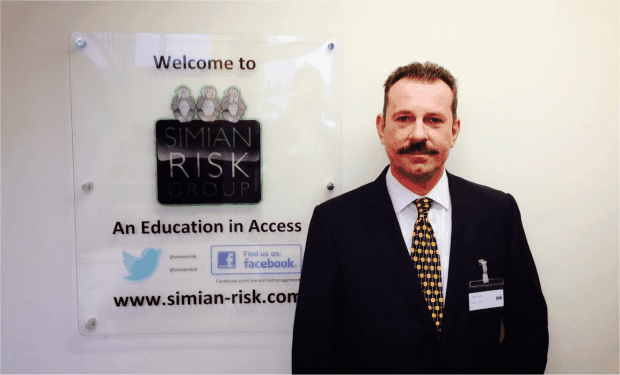
ScaffMag get’s a exclusive interview with industry expert Terry Sennett after being unveiled as the latest addition to the successful Simian team.
Scaffmag was in Warrington Friday 29th November 2013, to cover The Simian Risk Group’s annual Open Day event. Featuring an introduction and update session on last week’s launching of TG20:13 by the NASC, at its AGM in Bristol.
During the day we caught up with Terry and Fiona Sennett, who had just been unveiled by Simian Directors Ian Fyall & Simon Hughes, as the latest members selected to join their successful Simian team. Terry & Fiona will be taking up permanent positions overseas for the company within the UAE. As part of Simian’s continuing commitment and investment to its successful and rapidly expanding International service provision.
ScaffMag: – “Terry, this has been a hectic 12-months for you, since leaving your company Modus Access to pursue a new career. What were the reasons behind this change? Moving from Contract Installation to industry Training arenas couldn’t have been easy”?
Terry: -” The change was born from necessity. I could no longer accept my company’s operatives returning from industry training courses, stating they had learned very little and in some cases, nothing at all! I attended the last of my own practical training courses in 1991, which was the CITB Advanced course. The three courses I attended, provided the underpinning knowledge and skill sets required for a successful career within our industry”.
“During the last two decades of managing my companies, I took on the personal development of its employees. So continuously training staff in-house presented no concerns for me changing professional roles. Those operatives consistently installed the most complex and full range of tube and fitting structures to the relevant exacting standards of the industry. Regardless of the introduction of SG4, TG20, CDM, BS: 5975, WAHR’s, BS EN 13374 etc, the companies service provisions remained compliant, profitable and most importantly sustainable. Throughout this period of time, employees returned from various training courses with the same negative opinions. So what was being taught in the training centres of today and who exactly was teaching it? It certainly didn’t seem relevant to tasks and projects that my companies were undertaking.
I also belatedly came to the conclusion that these training courses were adding very little value to my business, except the obtaining of scheme cards for PPQ (Pre Qualification Questionnaire) and auditing, accreditation purposes. I needed to go back into the centres to find out……….”
ScaffMag: – “I see, so you decided that the only way to truly evaluate the quality and effectiveness of the training being received, not only by your own employees but for others within our industry was to actually spend time working for and with the training providers! What was your experience and what did you learn during this time”?
Terry: – “Suffice to say I rapidly obtained answers to those aforementioned questions I raised. A standard, ledger, transom and brace remained the same from 1991. Similarly a 2-bay x l-lift independent structure still requires the structural components to be configured, using the exact same physical/mechanical techniques and procedure. What has changed are the additional legislative demands and industry best practise requirements, that impact on the processes we now need to adopt during the planning, installation and dismantling processes.”
“The duration of today’s industry operative courses remain no different from those of yesteryear. Apart from the inclusion of SG4 within erecting and dismantling processes, the physical methods and processes of configuring components have altered little and remain the maximum time consuming elements within the operative courses. Management courses are commonly 2-day durations for the Basic/Advanced Inspection and 5-days for the Supervisors course. Since 1991, much has changed within our industry, focusing on the processes, procedures and planning of work projects. Compliancy remains a mandatory requirement as always, but “how” compliancy is achieved has become a much more complex, time consuming and expensive consideration for the industry.
“Everything that can be counted does not necessarily count; everything that counts cannot necessarily be counted” is a concept taught to us by one of the world’s most brilliant and inspirational minds. Many of us seem to have forgotten this lesson.”
ScaffMag: – “So what elements do you think are missing, or not adequately addressed within today’s training course content and delivery techniques”?
Terry: – “There seems to be very little creativity within most of the training centres of today. Indeed most course content, material and teaching methods have altered very little during the passage of time, but our industry most definitely has in certain critical areas. Teaching/Instructing methods are now heavily over reliant on technology, for instance there is a PowerPoint presentation for almost every element of theoretical course content. Is this necessary and is it the most “effective” way of passing relative industry knowledge and information to all candidates”?
‘Of course not’, Trainers and Instructors are taught the wide variety of methods at their disposal and each individual method’s level of effectiveness within professional teaching courses such as PTLLS. Individual Trainer/Instructor standards differ enormously, just as they do amongst relative scaffolding contractors. There are so many factors behind those differences, such as: – previous and relative industry experience, individual knowledge, commitment to Continual Professional Development, (CPD) motivational drivers & so on.”
ScaffMag: – And those missing training elements Terry?
Terry: – “An excellent question and one we can only hope to answer by looking through the Client Telescope! The views and outlooks vary, dependent on which end of the telescope is used.”
“One view is magnified, which is usually our own wants, considerations and desires. From a training providers view point this may well be simply to sell more courses, at a cheaper unit cost than their competitors. This business model demands overheads are kept low. Therefore little investment can be made in developing course material, quality trainers/instructors or training centre resources and learning materials.”
“When the telescope is viewed from the opposite end a very different picture and outlook appears. From a client’s viewpoint they will demand training courses that ultimately add value to their business. They require industry knowledge delivered to their attending operatives, which is relative and specific to their professional undertakings. This training must be delivered by the best trainers/instructors available, to ensure the client’s respective goals are achieved. The respective course material must be the most up to date available, considering the individual resources, equipment and respective work tasks that the client’s operatives are using and undertaking, both today and tomorrow, not yesteryear.”
“Throughout my professional life I have been committed to looking through both ends of the telescope, which demands that solutions are created to consider both viewpoints. I am currently working with other like-minded professionals on producing those innovative training courses and delivery methods, which address those existing, missing knowledge elements.”
ScaffMag: – “We look forward to receiving the details of these new bespoke courses next year and I am sure our readers will be too. Now Terry, why The Simian Group and the relocation to Dubai in particular”?
Terry: – “The Simian Group have an ambitious, committed and passionate team driving them forwards. Their pioneering approach and consistency of standard in both the UK and Overseas training and consultancy markets, has propelled them to the forefront of this particular industry sector. The two Directors communicated the exciting future visions and plans that they for the Group both here in the UK and overseas. Including the specific roles that they had identified as being vital, to continuing the success of the Group’s UAE and Middle East service provision to its clients.
“Simian’s ethos is centred round one of the organisations mottos, of recognising talent and improving it. Fiona and I were offered the opportunity to join Simian Skill’s high achieving team and we didn’t hesitate in accepting it”!
“The key element for me is that the Directors are all creative, compared to stylists. They do not simply take others work and ideas to rehash it and then repackage them as their own. They challenge conventional thinking and have enquiring minds, in where the most important part of a problem is the question mark (?) at the end of the sentence! This ethos promotes and demands that all at Simian look through the Client’s Telescope at every opportunity, which of course provides the perfect professional environment for the Group’s clients, to have their individual & specific needs catered for.”
ScaffMag: – “Earlier in the week came the announcement that Dubai had been the city selected to host the 2020 World Expo Event. Obviously this was positive news for Simian Skill”?
Terry: – “That announcement was tremendous news for the whole of Middle East region, who are certainly taking on a prominent position in their ability of hosting the world’s most prestigious events. The 2020 World Expo event in Dubai being closely followed by Qatar’s hosting of 2022 football World Cup. In particular Dubai will feel the positive effects from the huge financial investment generated by the winning of the 2020 World Expo, over the next 7-years. This will benefit the whole of UAE region and of course its diverse array of business organisations operating with its logistical boundaries.”
“There are exciting times ahead for all UAE businesses, including the construction and subsequent training industries. Simian Skill has identified the need for its clients, to have an ever- present and always available, professional source of contact in the region. Thus providing immediate support and assistance for their respective service provisions, whenever and wherever it is required. This is simply a continuation of the Group’s ambition, commitment and investment in the UAE and Middle East regions.”
ScaffMag: – “Thanks for your time Terry and of course ScaffMag wishes you, Fiona and Simian all the very best for the future overseas. One final question what’s your opinion of this Simian Open Day event and the launch of TG20:13”?
Terry: – “From the opening of the presentation to the theme of Queen’s “One Vision” to the final QA session conclusion, a highly professional and slick delivery was achieved. The team ethic was demonstrated by each respective company Director, taking the responsibility to passionately address the attendees, regarding updates and developments in each of their respective areas of the Group’s service provision. The live demonstration of TG20:13 being well received and was very insightful, as was the broader instruction and operational information delivered on the new industry guidance suite.”
“TG20:13 looks to be an excellent addition to our industries best practice procedures. The live demonstration of Rescue Techniques to be employed with client Rescue Plans was an excellent feature and of course my own particular favourite of the Layher stand was equally well attended. Aluminium Tower installation & dismantling demonstration proved an interesting feature also.”
“A superb event delivered by a passionate team with plenty of “skin in the game!” Well done to all involved & we cannot wait to contribute to the team effort.”
“Finally, Dan it’s been a pleasure talking with you & hopefully you will accept our invitation to join us in Dubai in the near future. I can promise an interesting insight into Simian Skill’s unique International service provision.”
ScaffMag finally got its first look at the eagerly awaited TG20:13 and the revolutionary eGuide… we wasn’t disappointed.
Simian Risk TG20:13 launch event
ScaffMag was invited to attend Simian Risk’s training facility in Warrington, on arrival guest were offered tea or coffee and bacon butties with the promise of a hog roast for afters. Squeezing into the packed seminar room, industry professionals were greeted by Simian Risk’s MD’s Simon Hughes and Ian Fyall.
Simon Hughes who is widely recognised as one of the UK’s leading scaffolding safety advisors kicked off the presentation on the new guidance. The new TG20:13 will take the form of four distinctive guides, including two new easy to follow colour illustrated books and the amazing new software known as the eGuide.
eGuide
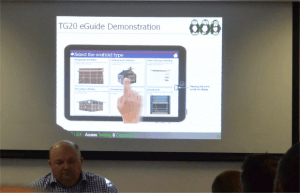
Ian Fyall gave a live demo of the revolutionary eGuide, developed by the very talented guys at CADS. The software, like magic automatically calculates a scaffold design as the user is building the job on the screen. The user is able to build many different types of structures using the software including, Independent Scaffolding, Putlog scaffolding, Lift shaft towers and even Chimney stack scaffolding.
Once finished the user is able to print out or email a TG20:13 compliance sheets proving the scaffold to be erected doesn’t need a costly time-consuming engineer’s design. The eGuide runs on desktop, laptop and tablet computers.
NASC members will get one free copy of the suite; Non-members will be able to purchase the new guidance from the NASC website at the cost of around £1,000 from January/February 2014
Many people presume this new guidance will have a knock on effect within the scaffold design industry, in a previous ScaffMag article we spoke to one of the most prevalent scaffold design company’s in the UK 48.3 Scaffold Design Ltd for a comment on the new TG20:13 documents and eGuide and how it will affect the industry.
Managing Director, Ben Beaumont from 48.3 Scaffold Design Ltd said:
“The new revision of TG20 looks like a considerable improvement; the hard work CADS and the NASC working group have put in will be of benefit to everyone in the industry and will no doubt turn into a worldwide benchmark for scaffolding with tube & fittings.
48.3 Scaffold Design Ltd are in full support of this new document – a document of this scope is overdue and desperately needed within our industry. The new range of standard designs will ease the burden on scaffolding design engineers in the UK. Most busy design engineers are not spending their time designing loading bays, short bridging sections or towers. Yes, we all design them, but generally as part of bigger schemes and projects. When these items are the only aspect of scaffolding that should be designed on a smaller site they often go undesigned! TG20:13 will now provide a solution to this problem; the standard designs will mean the scaffolds that often ‘slip through the net’ can be erected by a competent scaffolder to the compliant TG20:13 design.
The new ‘e-guide’ looks like it will be a really useful tool for scaffolding contractors. It provides a quick scaffold selection process which results in a concise and effective document to demonstrate the suitability of the scaffold and list key erection criteria.”
Other speakers on the day included: Dave Randles, Dave Abraham and Keith Squires.
Afterwards
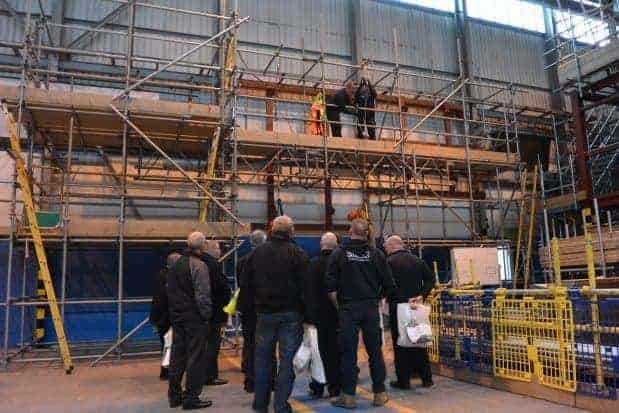
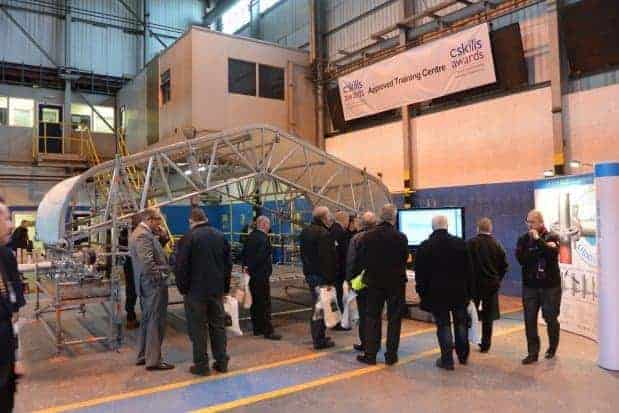
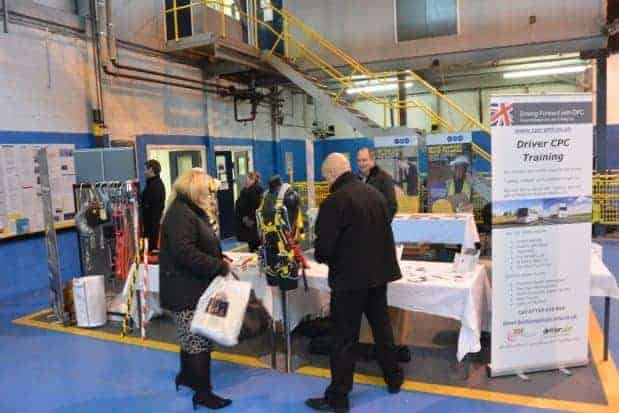
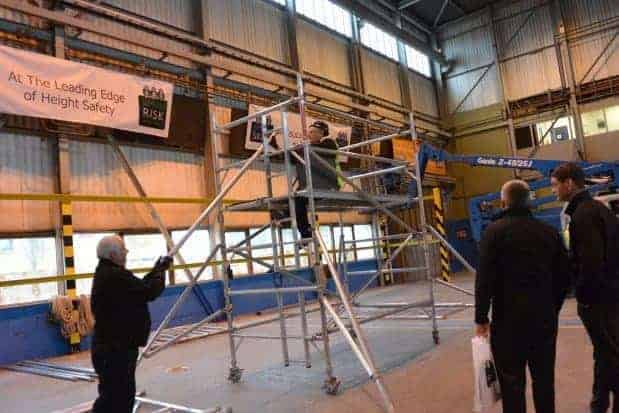
On leaving the warmth of the seminar room 15,000 Sq feet of training goodness greeted us as we entered the practical training area. Here we saw practical demonstrations of Scaffolder Rescue, PASMA training and some innovative access products. Also in the training area stalls had been erected by businesses promoting their wares that included SmartScaffolder,Leaches and Layher UK.
Guests watch Simian’s Scaffolders Rescue demonstration.Layher’s impressive lightweight allround systemGuest’s visiting the Leach’s stall.PASMA demonstration.






 ScaffMag: – “So what elements do you think are missing, or not adequately addressed within today’s training course content and delivery techniques”?

 able to build many different types of structures using the software including, Independent Scaffolding, Putlog scaffolding, Lift shaft towers and even Chimney stack scaffolding.
Once finished the user is able to print out or email a TG20:13 compliance sheets proving the scaffold to be erected doesn’t need a costly time-consuming engineer’s design. The eGuide runs on desktop, laptop and tablet computers.
NASC members will get one free copy of the suite; Non-members will be able to purchase the new guidance from the
able to build many different types of structures using the software including, Independent Scaffolding, Putlog scaffolding, Lift shaft towers and even Chimney stack scaffolding.
Once finished the user is able to print out or email a TG20:13 compliance sheets proving the scaffold to be erected doesn’t need a costly time-consuming engineer’s design. The eGuide runs on desktop, laptop and tablet computers.
NASC members will get one free copy of the suite; Non-members will be able to purchase the new guidance from the