The industry’s newest and possibly the biggest ever dedicated scaffolding and access conference and expo has released further details about the groundbreaking event.As previously reported, the NASC-organised ScaffEx24 conference and expo will be held at the Belfast International Conference Centre on November 29th and is poised to become the UK’s premier annual scaffolding event, according to the trade body.One of the most significant revelations is that ScaffEx24 will be open and entirely free to the entire scaffolding and access sector, regardless of membership status. The NASC is extending a warm welcome to professionals from all corners of the industry, emphasising the event’s inclusivity.The NASC also unveiled an impressive conference lineup that will run concurrently with the scaffolding and access exhibition. Distinguished thought leaders will delve into four pivotal topics: Scaffolding Clients & Procurement, Training & Education, Business Development, and Health & Safety. NASC has announced that a new speaker participating in the conference will be revealed each month in the lead-up to the event, adding to the excitement surrounding the conference program.To facilitate access to information and updates, a dedicated ScaffEx website is on the verge of launch, and a ScaffEx app is currently in development, as NASC CEO Clive Dickin shared in a recent webinar. These digital resources aim to streamline the attendee experience, providing easy access to schedules, exhibitor information, and real-time updates.
The Future of ScaffEx
Dickin also unveiled his ambitious vision for the future of ScaffEx. “ScaffEx24 is just the beginning, a stepping stone. This year, we have focused on the core suppliers providing tube fittings, systems, ancillary products, and various consumables within the scaffolding sector. Looking ahead to 2025 and beyond, we are already exploring venues such as G-Mex, the NEC, and Excel in London to elevate ScaffEx to the next level.”Dickin elaborated on the expansion plans, saying, “When I say ‘next level,’ I mean that ScaffEx will evolve to encompass the entire working environment of the scaffolding sector. It won’t just be about suppliers; it will encompass vehicles, elevated work platforms, ropes, hoists, and every facet of the industry. ScaffEx24 is laying the foundation for the long-term future of ScaffEx, with ScaffEx25, ScaffEx26, and beyond poised to be hosted at major exhibition centres, truly taking this event to the next level.”ScaffEx24 is set to redefine the scaffolding and access industry, offering a platform for professionals to network, learn, and shape the future of the sector. With its inclusivity, diverse content, and future expansion plans, ScaffEx is undoubtedly on the path to becoming a pivotal event in the scaffolding industry’s calendar.
The Construction Industry Scaffolders Record Scheme (CISRS) has announced significant changes to its rules that will impact individuals seeking CISRS Operative Training Scheme (COTS) cards and related qualifications.
Effective from March 1, 2024, these changes aim to streamline the training process and ensure that operatives receive comprehensive industry training before taking on scaffold-related roles.
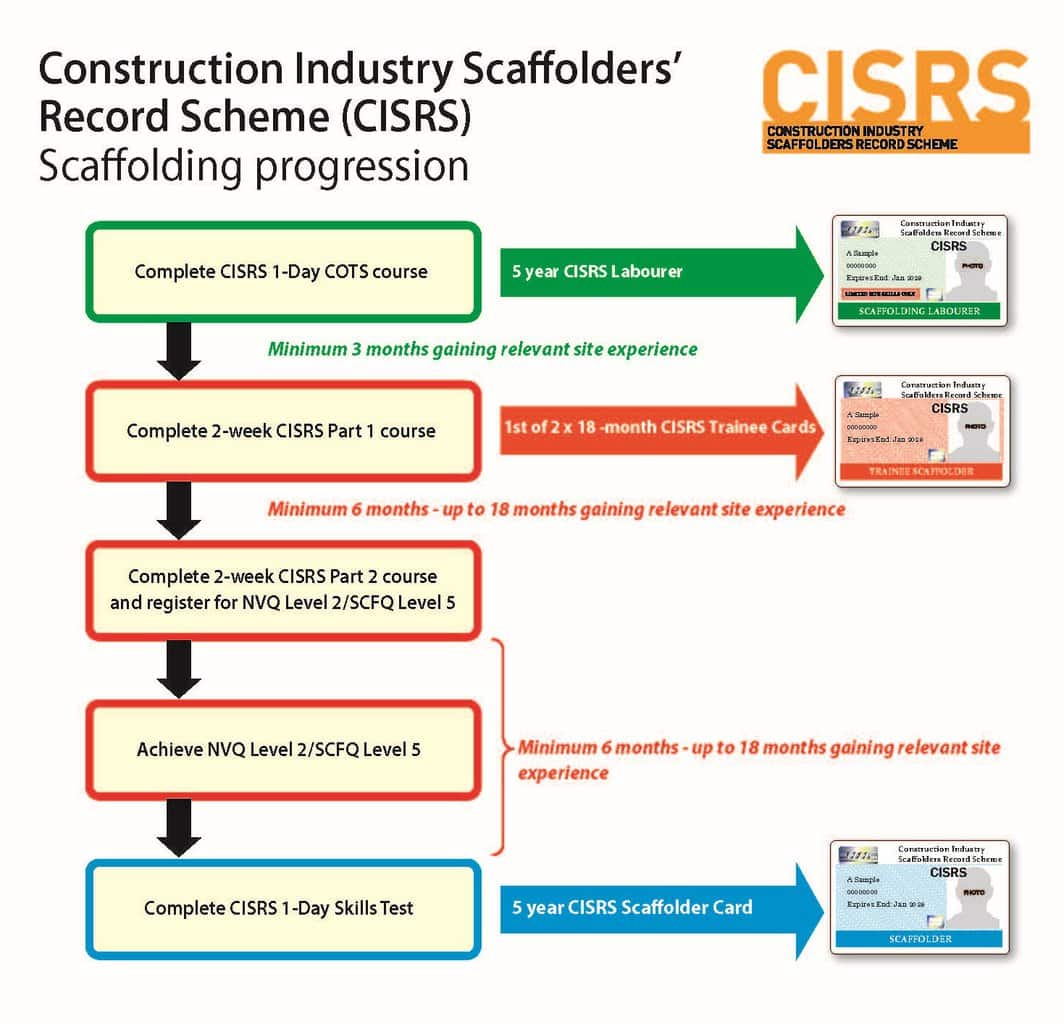
Under the new rules, delegates attending a CISRS Operative Training Scheme (COTS) course will only be eligible to apply for a CISRS Labourer card upon completion. This marks a shift from the previous system, which allowed operatives to apply for a Trainee Scaffolder card after completing the COTS course.
An initial 18-month CISRS Trainee Scaffolders card will only be issued upon completing a CISRS Part 1 course. This alteration ensures that all operatives holding the Trainee card have received industry-recognised training in essential scaffold tasks, including erecting and dismantling various scaffold structures such as towers and birdcages. They will also gain knowledge of industry guidelines and best practices, including SG4, SG6, TG20, Risk Assessment, Method Statements, and material selection.
This change grants operatives a full three years (two consecutive 18-month cards) to accumulate on-site experience, complete the Part 2 course, achieve S/NVQ2 certification, and pass a skills test. The previous system forced individuals to complete all necessary training and gain experience within the 18-month lifespan of their first Trainee card if they applied for it immediately after the COTS course.
One notable adjustment is the reduction of the required time for holding a Labourer card before attending the Part 1 course, which has been lowered from 6 months to 3 months. While some have expressed concerns that this could expedite the training and assessment process, CISRS emphasises that this is a minimum requirement designed to accommodate individuals with prior informal experience. The Labourer’s card has a validity period of 5 years, allowing ample time for candidates to progress through the initial stages of formal CISRS training.
Dave Mosley, Managing Director of CISRS, commented on these changes, saying, “Following these changes to the scheme rules, CISRS will monitor industry feedback from Training Providers, delegates, and employers to ensure that the Part 1 content remains relevant and achievable. We want people to take advantage of the full life cycle of both trainee cards and, as such, will also keep an eye on the timescales that most operatives are taking to complete the required training, experience, and assessment.”
Devonport Royal Dockyard and Kaefer Limited Face Charges Under Health and Safety ActA scaffolder’s serious injury on board the Royal Navy ship HMS Bulwark has resulted in charges against Devonport Royal Dockyard and Kaefer Limited. The incident, which occurred on April 11, 2023, has led to legal proceedings under the Health and Safety at Work Act 1974, as announced by the Office for Nuclear Regulation (ONR).The incident unfolded at the Devonport Royal Dockyard in Plymouth, where the Royal Navy ship HMS Bulwark was undergoing maintenance. A scaffolder working on the warship suffered severe injuries after falling approximately 15 feet (4.5 meters) into a tank during his duties.The ONR, the United Kingdom’s independent nuclear regulator, initiated an investigation into the incident due to the location of the accident. Although HMS Bulwark had no nuclear components on board, the fall transpired within a nuclear-licensed site, prompting the regulatory body to take action.The emergency response to the incident was swift, with firefighters, paramedics, a Hazardous Area Response Team, and a critical care car rushing to the scene.The Devonport Royal Dockyard, which is a part of Babcock, and Kaefer Limited, the scaffolding firm involved in the work, have both been charged in connection with the incident. While Babcock operates on-site as one of the dockyard’s operators, the Ministry of Defence confirmed that the court case does not pertain to them.In response to the charges, Babcock emphasized its commitment to the safety of all personnel working on their sites, stating that health and safety was an “absolute priority.” However, the company refrained from making further comments, citing ongoing legal proceedings.Kaefer Limited, headquartered in Jarrow, Tyne and Wear, echoed this sentiment, asserting that the safety of its employees was its foremost concern. The company fully cooperates with authorities in the ongoing investigation and disclosed that it had conducted its own internal investigations into the incident.The legal proceedings stemming from the scaffolder’s fall are set to commence with the first hearing scheduled at Plymouth Magistrates’ Court on March 27, 2024. The outcome of the court case will determine the accountability and repercussions for the parties involved in this unfortunate incident aboard HMS Bulwark.
CISRS is set to take to the road to promote and celebrate apprenticeship value and livelihoods during National Apprentice Week 2024.National Apprentice Week (NAW) is just around the corner, with the 17th annual celebration of apprenticeships scheduled for Monday, February 5th, to Sunday, February 11th, 2024. This week-long event aims to shine a spotlight on the value, benefits, and excellent career opportunities that apprenticeships offer. To mark this occasion, CISRS (Construction Industry Scaffolders Record Scheme) is joining forces with accredited training providers across the UK to promote and celebrate apprenticeships.In line with their tradition, CISRS representatives will visit various accredited scaffolding apprentice providers throughout the country during NAW. These visits provide an excellent opportunity for CISRS to engage with current cohorts of scaffolding apprentices and contribute to the celebration of apprenticeships.CISRS representatives will be visiting a total of 8 scaffolding apprentice providers during NAW 2024. These visits will include stops at:
3t and NETA in the North East
Training 2000, Total People, and Siman in the North West
NCC South and Simian/LASC in the South East
Construction College Midlands in Birmingham
In addition to these visits, several of the accredited training providers will be hosting various events, workshops, job fairs, and open days in the coming weeks, all in support of National Apprentice Week:Training 2000, located in Blackburn, will be hosting two apprentice evenings on Wednesday, January 31st, from 4:30 pm to 7:30 pm, and Thursday, February 1st, from 4:30 pm to 7:30 pm. These events are open to anyone interested in learning more about apprenticeships in the scaffolding sector. You can find more information on their website at Training 2000 Events.SIMIAN is organizing career progression sessions for their scaffolding apprentices across all their facilities in the UK. They will also be inviting over 130 school children to their “Jobfest” event at the Simian/LASC centre in Leytonstone on Tuesday, February 6th, from 11 am to 2 pm. For more details, you can visit Simian’s website.NETA on Teesside will host an Apprentice Open evening on Thursday, February 8th, from 5 pm to 7 pm. This event promises to provide valuable insights into apprenticeships in the scaffolding industry. For registration and additional information, visit the Eventbrite page.Dave Mosley, Managing Director of CISRSDave Mosley, Managing Director of CISRS, expressed the importance of supporting events that promote careers within the scaffolding sector. “It is essential that CISRS continues to support events that promote careers within the scaffolding sector,” he said.“If you are an employer or a recently qualified scaffolding apprentice, it would be great for you to get involved with these events or similar local initiatives. Alternatively, if you do currently employ or work alongside scaffolding apprentices, use NAW as an opportunity to check in with them and see how they are progressing along their training and career pathways.”National Apprentice Week 2024 promises to be an exciting and informative event for all those interested in apprenticeships in the scaffolding industry.
Event organisers of Scaffchamp 2024 have announced the official date for teams from around the world to register for this year’s championship.The Baltic Scaffolders Association (BSA), the driving force behind the Scaffolders Championship, dubbed ScaffChamp, has been working tirelessly to make the 2024 edition a remarkable experience for participants and spectators alike.ScaffChamp 24 is scheduled to take place from May 24th to 25th, 2024, in Vilnius, Lithuania.
Teams registration opens on February 1st at 12:00 EET (+2 GMT). Registration will be available only from the https://scaffchamp.com/ website.
Event organisers announced that ScaffChamp 24 will have space for 18 teams this year. As always, it will be on a first-come, first-served basis, ensuring that early registrants secure their spots in the competition.A spokesperson for BSA said: “This is your team’s chance to shine among the best in the business. With only 18 slots available, it’s not just about competing; it’s about proving your mettle, pushing boundaries, and joining a league of extraordinary scaffolders. Don’t just watch from the sidelines – be a part of the action!”The highlight of ScaffChamp 23 was the intense competition among fifteen international teams, who had to erect and dismantle a specially designed Layher Allround scaffold structure as quickly and safely as possible.The Swedish team, Kaefer AB, set a new record with a remarkable time of 59 minutes and 1 second. Lithuanian teams Globalita and Hotrema secured the second and third positions, respectively, showcasing their scaffolding expertise.
Simian International is making it easier for CISRS Scaffolders to keep their UK card status in the UAE with new CPD programs.Simian International, a leading provider of scaffolding training and safety solutions, is making it easier for CISRS Scaffolders and Advanced Scaffolders working overseas to maintain their UK card status by offering the UK CPD (Continuing Professional Development) program at their state-of-the-art facility in Musaffah, Abu Dhabi, United Arab Emirates (UAE).The move comes in response to the growing number of UK expatriates working and residing in the UAE and the wider Gulf Cooperation Council (GCC) regions keen on keeping their CISRS UK card up-to-date. Returning to the UK for CPD requirements can be impractical for cardholders, making Abu Dhabi a much more convenient option.While UK CPD courses have been conducted overseas in the past, Simian International and CISRS hope to make them a regular fixture in the training calendar. If successful, this initiative could potentially expand to include other training providers and regions.Ian Fyall, Managing Partner at Simian International, stated, “We have delivered Scaffolder CPD outside the UK on an ‘as and when’ required basis. We do have the capacity to carry these out several times a year and would be happy to do so to meet demand if required.”Dave Mosley, Managing Director of CISRS, highlighted the significance of this offering for Scaffolders and Advanced Scaffolders working in the UAE, especially those in the Oil, Gas, and Energy sectors, often serving in supervisory and management roles. “We are very pleased that they see the value in their qualifications and feel it is a positive move to help them keep their UK CISRS status without the time and expense of traveling back home,” he said. “It’s a case of informing people that this option is available, and we hope by letting them know it will increase demand and thus trigger more course availability.”The next UK CPD course is scheduled for February 18th and 19th, 2024. Limited spaces are still available, so interested individuals are encouraged to secure their spots as soon as possible.For further information and booking inquiries, please visit Simian International’s website or contact them directly.
Skilled construction workers celebrate victory as GMB Union negotiates a significant pay increase.In a major breakthrough for thousands of skilled construction workers across the UK, a potentially crippling strike set to impact energy sites nationwide has been called off after workers overwhelmingly accepted a generous pay offer. The GMB Union, representing the interests of these dedicated workers, announced the successful resolution on January 19, 2024, putting an end to weeks of tension and uncertainty.Over 3,000 workers stationed at vital energy facilities, including Stanlow, Fawley, Valero, Grangemouth, Mossmorran Oil Refineries, and the Sellafield Nuclear Facility, had previously voted in favour of industrial action as they sought to secure better compensation for their hard work.However, today’s historic announcement has seen these workers embrace a pay deal representing a significant win for their cause. The new agreement, which spans two years, delivers an impressive pay increase of more than 17 per cent.Under the National Agreement for the Engineering Construction Industry (NAECI) terms, the workforce will enjoy an immediate boost to their income, with an extra 11.3 per cent increase slated for 2024. This will be followed by an additional 5.5 per cent increase in 2025. Furthermore, the deal incorporates improvements in sick pay and other allowances, adding substantial financial security for these dedicated workers.Charlotte Brumpton-Childs, GMB National Officer, expressed her satisfaction with the outcome, “These skilled workers have fought valiantly for the pay rise they so richly deserve. In the face of mounting inflation and the erosion of their wages, they united in solidarity and successfully secured this truly remarkable deal. They should take great pride in their unwavering commitment to their cause.”
Statom Group, a leading construction contractor, has announced a substantial investment of £5.4 million in state-of-the-art equipment from PERI.This strategic move solidifies Statom Group’s construction capabilities. It contributes to the company’s growth strategy, which includes tackling more extensive and complex building projects and expanding into new regions across the UK.This investment builds upon Statom Group’s previous collaborations with PERI in 2020 and 2022, bringing the total value of PERI systems in their depot to an impressive £14 million. Statom Group’s commitment to integrating PERI systems into their operations has proven to be fruitful, resulting in reduced material costs and shorter site delivery lead times.The acquisition includes a range of cutting-edge equipment, such as the SKYDECK, TRIO, PERI’s climbing formwork, and PERI UP scaffolding, with a combined worth of £400,000. These additions to their inventory will enable Statom Group to respond swiftly to project demands and consistently meet project deadlines.Stan Nikudinski, Managing Director of Statom Group, elaborated on the decision, saying, “The high-quality and streamlined design of PERI systems was the main driver behind our decision to invest. The selected products enhance our ability to deliver, even on projects with intricate requirements or complex logistical challenges.”PERI UK’s Sales Manager, Nick Mills, expressed gratitude for Statom Group’s continued trust in their products and services. Mills stated, “We would like to express our gratitude to Statom Group for their continued trust in PERI; it has been a pleasure to collaborate with the team on a range of projects. We are thrilled to be able to continue contributing to the business’s growth journey with the support of our products, services, and expertise in temporary works. This investment is another testament to our ability to tailor solutions, adapt to changing requirements, and our unwavering commitment to building long-term partnerships with our customers.”
Canterbury City Scaffolding Ltd, a Kent-based scaffolding company, has been slapped with a substantial fine, and its director has received a suspended prison sentence following a tragic incident where a scaffolder suffered a severe 11,000-volt electric shock. The incident has raised concerns about the safety of workers near high-voltage power lines and the importance of meticulous planning to prevent such accidents.On November 29, 2021, Steven Gilmore, a 36-year-old scaffolder working for Canterbury City Scaffolding Ltd, was involved in erecting a temporary roof scaffold at an open-air drinks depot in Snow Hill, Crawley, West Sussex. The company had been contracted by Drinks Warehouse UK Ltd to build the structure to provide shelter during the winter months.Tragedy struck when Gilmore inadvertently made contact with a live 11kV power line while lifting a six-meter scaffold tube. This contact resulted in an electric shock that caused him to fall over five meters to the ground, leading to a severe leg injury and life-changing electrical burns to both hands, which he will never fully recover from.A subsequent investigation by the Health and Safety Executive (HSE) revealed alarming safety lapses by Canterbury City Scaffolding Ltd and its director. They had failed to conduct a proper risk assessment for the high-risk job of assembling the temporary roof scaffold near a high-voltage line. Additionally, despite being aware of the proximity of the temporary roof scaffold to the 11kV line, neither the scaffold contractor nor its director consulted UK Power Networks (Network Operator) to ascertain line voltage and safe clearance distances.Moreover, while overseeing the scaffold assembly, the director permitted his team to use six-meter-long metal scaffold tubes at near-vertical angles within striking distance of the high-voltage line without taking any precautions to prevent injury.HSE Inspector Susie Beckett said, “This scaffolder’s injuries were life-changing and could have been fatal. This incident could have been avoided if this high-risk scaffold job had been properly planned, including seeking free advice from the Network Operator on what precautions to take, and then implementing those well-established precautions to prevent accidental contact with the overhead line.”In a court hearing at Brighton Magistrates’ Court on September 22, 2023, Canterbury City Scaffolding Ltd pleaded guilty to breaching the Health and Safety at Work etc. Act 1974. Director Ian Pepper, aged 48, also pleaded guilty to an offence under Section 37(1) of the same Act. Sentencing for the case was adjourned until January 15, 2024.The court subsequently imposed a £50,000 fine on Canterbury City Scaffolding Ltd. In the case of Ian Pepper, he was sentenced to 18 weeks in prison, although the sentence was suspended for 12 months. Pepper was further ordered to complete 200 hours of unpaid work and 20 rehabilitation activity requirement days as part of his punishment.
Chester and Flintshire-based scaffolding company opens a new US base and secures contracts for offshore wind farm substations in the USA and Taiwan.BGB Scaffolding Group, a renowned scaffolding company headquartered in Chester and Port of Mostyn, Flintshire, has taken a significant step towards the global expansion of its operations. The company has opened a new base in Providence, Rhode Island, USA, and Taichung City, Taiwan, in addition to securing contracts for the construction of the first two offshore wind farm sub-stations in the USA and Taiwan. This development reflects BGB’s commitment to renewable energy and its role in supporting the worldwide transition to cleaner sources of power.Last year marked the commencement of construction on the first two offshore substations in the United States. Simultaneously, BGB completed the construction phase of Taiwan’s first large-scale far shore offshore windfarm, as well as the world’s largest operational single windfarm, Ørsted’s Hornsea 2, which contributes to power more than 1.4 million homes in the UK. These achievements have solidified BGB’s reputation as a global player in the renewable energy sector.The company has secured contracts and framework agreements that will support its growth and development in the foreseeable future. In a press release, Managing Director Ben Badham emphasised the importance of developing apprenticeships in collaboration with education providers. BGB aims to provide young individuals in the region with opportunities to acquire key skills while working on an international scale.Ben Badham also highlights the company’s commitment to upskilling local labour and supporting the economy, both in Wales and, in the long term, Taiwan and beyond.
Role in Offshore Wind Energy
BGB’s partnership with the multinational renewable energy giant Ørsted has strengthened, further cementing the company’s position as a leader in the global green energy revolution. This growth aligns with the UK Government’s pledge to generate 30% of green electricity from offshore energy sources by 2030.Ben Badham said, “Our growth, both in the UK and overseas, is in line with government targets and reflects our commitment to training the next generation of multi-disciplined technicians, particularly for offshore renewable energy contracts, and upskilling local workers while improving infrastructure in the areas we are based in.”BGB’s expansion into the United States is a noteworthy milestone, as they are involved in the Vineyard and Ørsted’s South Fork commercial-scale offshore windfarms, the first two such projects in the country.BGB Scaffolding Group is a multi-disciplinary operation, and Ben Badham’s vision for the company to double in size has materialised over the last 18 months. However, the company’s primary focus remains on providing apprentices with a platform to excel in the industry.Jamie Hargrave, a Rhyl native who has been with BGB for five years, exemplifies the company’s commitment to training and development. He encourages others to explore opportunities with the company and says that “anything is possible” with the proper support and dedication.BGB Project Manager Charmaine Papasarafi emphasises the opportunities for long-term infrastructure development in the clean energy industry, reflecting the company’s dedication to supporting the sector in the US, Taiwan, and worldwide.BGB Scaffolding Group’s expansion and its vital role in the renewable energy revolution highlight the increasing importance of offshore wind energy in the global transition to sustainable power sources.

 NASC has announced that a new speaker participating in the conference will be revealed each month in the lead-up to the event, adding to the excitement surrounding the conference program.
To facilitate access to information and updates, a dedicated ScaffEx website is on the verge of launch, and a ScaffEx app is currently in development, as NASC CEO Clive Dickin shared in a recent webinar. These digital resources aim to streamline the attendee experience, providing easy access to schedules, exhibitor information, and real-time updates.
NASC has announced that a new speaker participating in the conference will be revealed each month in the lead-up to the event, adding to the excitement surrounding the conference program.
To facilitate access to information and updates, a dedicated ScaffEx website is on the verge of launch, and a ScaffEx app is currently in development, as NASC CEO Clive Dickin shared in a recent webinar. These digital resources aim to streamline the attendee experience, providing easy access to schedules, exhibitor information, and real-time updates.
 Dickin also unveiled his ambitious vision for the future of ScaffEx. “ScaffEx24 is just the beginning, a stepping stone. This year, we have focused on the core suppliers providing tube fittings, systems, ancillary products, and various consumables within the scaffolding sector. Looking ahead to 2025 and beyond, we are already exploring venues such as G-Mex, the NEC, and Excel in London to elevate ScaffEx to the next level.”
Dickin elaborated on the expansion plans, saying, “When I say ‘next level,’ I mean that ScaffEx will evolve to encompass the entire working environment of the scaffolding sector. It won’t just be about suppliers; it will encompass vehicles, elevated work platforms, ropes, hoists, and every facet of the industry.
ScaffEx24 is laying the foundation for the long-term future of ScaffEx, with ScaffEx25, ScaffEx26, and beyond poised to be hosted at major exhibition centres, truly taking this event to the next level.”
ScaffEx24 is set to redefine the scaffolding and access industry, offering a platform for professionals to network, learn, and shape the future of the sector. With its inclusivity, diverse content, and future expansion plans, ScaffEx is undoubtedly on the path to becoming a pivotal event in the scaffolding industry’s calendar.
Dickin also unveiled his ambitious vision for the future of ScaffEx. “ScaffEx24 is just the beginning, a stepping stone. This year, we have focused on the core suppliers providing tube fittings, systems, ancillary products, and various consumables within the scaffolding sector. Looking ahead to 2025 and beyond, we are already exploring venues such as G-Mex, the NEC, and Excel in London to elevate ScaffEx to the next level.”
Dickin elaborated on the expansion plans, saying, “When I say ‘next level,’ I mean that ScaffEx will evolve to encompass the entire working environment of the scaffolding sector. It won’t just be about suppliers; it will encompass vehicles, elevated work platforms, ropes, hoists, and every facet of the industry.
ScaffEx24 is laying the foundation for the long-term future of ScaffEx, with ScaffEx25, ScaffEx26, and beyond poised to be hosted at major exhibition centres, truly taking this event to the next level.”
ScaffEx24 is set to redefine the scaffolding and access industry, offering a platform for professionals to network, learn, and shape the future of the sector. With its inclusivity, diverse content, and future expansion plans, ScaffEx is undoubtedly on the path to becoming a pivotal event in the scaffolding industry’s calendar. 
 This change grants operatives a full three years (two consecutive 18-month cards) to accumulate on-site experience, complete the Part 2 course, achieve S/NVQ2 certification, and pass a skills test. The previous system forced individuals to complete all necessary training and gain experience within the 18-month lifespan of their first Trainee card if they applied for it immediately after the COTS course.
One notable adjustment is the reduction of the required time for holding a Labourer card before attending the Part 1 course, which has been lowered from 6 months to 3 months. While some have expressed concerns that this could expedite the training and assessment process, CISRS emphasises that this is a minimum requirement designed to accommodate individuals with prior informal experience. The Labourer’s card has a validity period of 5 years, allowing ample time for candidates to progress through the initial stages of formal CISRS training.
Dave Mosley, Managing Director of CISRS, commented on these changes, saying, “Following these changes to the scheme rules, CISRS will monitor industry feedback from Training Providers, delegates, and employers to ensure that the Part 1 content remains relevant and achievable. We want people to take advantage of the full life cycle of both trainee cards and, as such, will also keep an eye on the timescales that most operatives are taking to complete the required training, experience, and assessment.”
This change grants operatives a full three years (two consecutive 18-month cards) to accumulate on-site experience, complete the Part 2 course, achieve S/NVQ2 certification, and pass a skills test. The previous system forced individuals to complete all necessary training and gain experience within the 18-month lifespan of their first Trainee card if they applied for it immediately after the COTS course.
One notable adjustment is the reduction of the required time for holding a Labourer card before attending the Part 1 course, which has been lowered from 6 months to 3 months. While some have expressed concerns that this could expedite the training and assessment process, CISRS emphasises that this is a minimum requirement designed to accommodate individuals with prior informal experience. The Labourer’s card has a validity period of 5 years, allowing ample time for candidates to progress through the initial stages of formal CISRS training.
Dave Mosley, Managing Director of CISRS, commented on these changes, saying, “Following these changes to the scheme rules, CISRS will monitor industry feedback from Training Providers, delegates, and employers to ensure that the Part 1 content remains relevant and achievable. We want people to take advantage of the full life cycle of both trainee cards and, as such, will also keep an eye on the timescales that most operatives are taking to complete the required training, experience, and assessment.”