The TRAD Group has presented a cheque for £35,000 to Anthony Nolan, the Group’s chosen charity for 2022 in memory of the late John Paterson.
Having originally set a target of ‘£22k for 2022’, the company has been delighted by the generosity of its workforce, customers, suppliers and others in the industry, taking the total to well over that target.
This year’s charity campaign has been in memory of John Paterson, a much-loved figure within the industry, and a director at TRAD for many years. John and his wife Jane were supported by Anthony Nolan when John was ill, and have been involved with many of TRAD’s fundraising events.
Anthony Nolan is the charity that makes lifesaving connections between people with blood cancer and incredible strangers ready to donate their stem cells. Alongside this they also fund ground-breaking research, and provide the best post-transplant care – something that can make a huge difference to the lives of those living with blood cancers and disorders. The best donors are aged 16-30, and young men are really needed to come forward as they only make up 18% of the register but provide 55% of the stem cell donation. TRAD’s fundraising will help the Trust to recruit new donors and support families.
“We rely on fundraising to help us with all the important work we do – from research to family support,” said Bianca Joyce (Head of Corporate Partnerships) from Anthony Nolan.
“We are delighted with this exceptional fundraising from TRAD Group, which will make a real difference to our work, and shows how highly regarded John was among his friends and colleagues.”
TRAD organised a number of key fundraising events, including the Surrey Three Peaks Challenge, the Great North Run and a golf day at Gleneagles – John’s home club. Alongside these events, all TRAD’s depots and offices organised ongoing fundraising events to help beat the target.
“John was such a personality in TRAD and in the wider industry,” said Des Moore, CEO at TRAD Group.
“He is still sorely missed in the company and we all have stories and happy memories of our time with him. It has been an honour to spend this year supporting Jane and fundraising for the charity that gave them both so much help. I want to thank all the TRAD teams, customers, suppliers and others who so generously donated to our campaign this year.”“Anthony Nolan supported John and I through our toughest times,” commented Jane Paterson. “It has meant so much to me and our families that TRAD has raised so much money in his memory. He would be bowled over by the kind words, support and fundraising from all his friends at TRAD, and I can’t thank them enough.”
With the 2022 NASC Ball & Awards just around the corner, we look at who is up for a possible award at the highly anticipated event in London.
The huge annual scaffolding event which is taking place at Westminster Bridge Park Plaza Hotel, London on Friday 18 November showcases the very best scaffolding projects, processes, products and personnel.
After weeks of careful consideration by the NASC Awards judging panel, comprising experienced construction industry professionals, the shortlist for this year’s NASC Awards has been confirmed.
NASC Awards Shortlist
Apprentice of the Year
Louie Peebles (JMAC Scaffolding Ltd)
Lee Benson (Lyndon SGB)
Trenai Munnings (Lyndon SGB)
Mason Gill (SRK Scaffolding Ltd)
Health and Safety (Large)
Actavo UK Ltd
Bilfinger UK Ltd
Connect Scaffolding Ltd
KAEFER Ltd
Health and Safety (Small)
Chris Sedgeman Scaffolding Ltd
MR Scaffolding Services Ltd
Shield Services Group Ltd
Innovation of the Year
Benchmark Scaffolding Ltd – Benchmark App
Layher Ltd – Twix Beam
Lyndon SGB – QuickDeck
PERI Ltd – Evotop
NASC President’s Award (this year celebrating members’ sustainability and environmental achievements)
GKR Scaffolding Ltd
JFE Attridge & Sons Ltd
Liddiard Scaffolding Ltd
Tubes Scaffolding Ltd
Project of the Year (Large)
Bilfinger UK (Claymore CAP)
Enigma Industrial Services Ltd (Cameron House, Loch Lomond)
KAEFER Ltd (Hinkley Point C)
PHD Modular Access Ltd (HMS Victory, Portsmouth)
Project of the Year (Medium)
Apex Scaffolding (Exeter) Ltd (Wheal Betsy, Mary Tavy)
Chris Sedgeman Scaffolding Ltd (Geevor Tin Mine, Pendeen)
Connolly Scaffolding Ltd (The Printworks, Manchester)
JDC Scaffolding (Annexe Building, Smithfield)
Project of the Year (Small)
Infrastructure Site Services Ltd (Swaithe Viaduct Refurbishment)
Shield Services Group Ltd (Prince Charles Hospital, Merthyr Tydfil)
SAY Scaffolding (Northern) Ltd (Hull Maritime Museum)
TR Scaffolding (Bristol) Ltd (M5, J11 Golden Valley)
Workers based at ExxonMobil’s ethylene plant in Mossmorran, Scotland are set to take part in an industrial action ballot which could threaten production.
Around 200 Unite members are employed on construction engineering maintenance contracts. The workforce is split between Altrad, Bilfinger, and Kaefer.
The ballot which open yesterday (14 November) and closes on 28 November is a dispute over the level of bonus payments under the NAECI (National Agreement for the Engineering Construction Industry) agreement which covers the workers.
The contractors are seeking to secure the maximum bonus of £2.37 an hour under the terms of the NAECI agreement to offset rampant inflation rate which now stands at 12.6 per cent (RPI). The employers, however, have to date refused to pay the bonus.
Record profits
In October, US oil giant ExxonMobil released its third quarter result showing record earnings of nearly £17.3bn ($20bn).
Unite general secretary Sharon Graham said: “Energy companies like ExxonMobil are making record profits of hundreds of billions, yet there is apparently no money available for hard-pressed workers, who are essential to the Mossmorran plant operations.”
“Unite’s members are determined to fight for what they deserve especially when and they we see major corporations fanning the flames of rampant profiteering. Our workers will be receiving Unite’s unflinching support.”Disruption expected
Due to the nature of the work undertaken by the construction workers any industrial action will result in disruption and delays to the operations at Mossmorran.
Bob MacGregor, Unite industrial officer, added: “Unite’s members working for Altrad, Bilfinger, and Kaefer at the Mossmorran plant are angry at being denied what they are owed and deserve under the terms of the NAECI agreement. Any strike action will be entirely of the employers’ own making due to their penny-pinching. They have had every chance to resolve this dispute through negotiation but have chosen not to do so.”
Last month, Unite members contracted by Kaefer based at Shell’s Mossmorran plant resolved a separate dispute over pay.
Altrad has secured a 2-year contract to support the final construction and commissioning phase of the Tyra II gas production platform located 225km off the west coast of Denmark.
The multidiscipline services contract will represent over 600,000 manhours supporting the hook-up campaign.
Altrad will deliver a range of safety-critical support services including project management, planning and co-ordination, scaffolding, rope access, protective coatings and insulation services, to enable the safe and efficient commissioning of the platform.
Peter Hughes, Altrad’s Executive Vice President of Business Development & Strategy said, “We are delighted to have secured this latest contract with TotalEnergies, which builds upon our successful strategic relationship that spans back over several decades. We look forward to working collaboratively with TotalEnergies to deliver, what will be one of the world’s most advanced natural gas facilities”.
Once operational, the Tyra redevelopment will meet a dual objective: to build a state-of-the-art facility offering heightened safety and wellbeing for its teams, and to revitalise its production and export capacity at lower emissions, which will ensure continued gas supply contributing to the energy security of Denmark and the EU for decades to come.
The award of this contract will significantly increase Altrad’s team in Denmark and the new talented people will be valued and encouraged to develop fulfilling careers, Altrad said.
Jens Moerk – CEO of Altrad Services A/S added, “We are extremely pleased to have been awarded this contract by TotalEnergies, which will be delivered in a value enhancing manner – using a combination of our local resources and facilities – and the skills and experience of the wider Altrad Group.”
The revised Scaffolder Apprenticeship Standard ST0359 and End Point Assessment Plan have been released for industry consultation, says CISRS.
After many months of meetings and working committees, the Scaffolding Trailblazer Group has completed its review of the Scaffolding apprenticeship standard and EPA.
The Group made up of Scaffolding Employers, Training Providers, End Point Assessment Organisations, IFATE and CISRS representation has confirmed that they are now happy with the revised content, as such it is now time to consult with the wider industry.
CISRS hopes that the new standard could attract increased funding levels, which would encourage more providers to take up the delivery of apprenticeships, or for existing providers to increase their apprentice training capacity.
The Institute for Apprenticeships and Technical Education (IFATE) has released the revised Scaffolder Apprenticeship Standard ST0359 and End Point Assessment Plan for industry consultation today.
Tony Barry, CISRS Compliance Manager said “CISRS, as part of the trailblazer scaffolder standard working group, we have been tasked with circulating the revised standard to the wider scaffolding industry. We have alerted NASC, ANSC and SA directly and have also contacted Scaffmag to help us spread the word. You will find further information on how to comment at the CISRS website.”
The documents are available to comment at: – https://cisrs.org.uk/to leave comments: – https://www.smartsurvey.co.uk/s/6WDY45/This information will also be available on the IFATE website for industry review.
The consultation will close Friday 25th November 2022.
JR Scaffold Services, a division of the JR Group and one of Scotland’s largest scaffolding providers, has completed two major scaffolding structure projects to assist in a full refurbishment and fit-out of two buildings on Buchanan Street in the heart of Glasgow.
The Paisley-based business constructed scaffolds at two sites on the high street in the city centre for Cosmos Projects, who required the scaffolding at Number 69 Buchanan Street and at a smaller project at Number 91 Buchanan Street.
At Number 69 Buchanan Street, around 2,500 square metres of scaffold was required to a height of 24m for 10-week project to provide Cosmos Projects access to all windows and the upper exteriors of the building for refurbishment and maintenance, as well as internal and external fit-out at the project. A small part of Mitchell Lane was also required to access elevated part of the building.
The smaller project at Number 91 Buchanan, required 500 square metres of scaffold required to a height of around 16 metres, including debris netting and roof edge protection for 8 weeks, carried out and erected in conjunction with the project at Number 69.
JR Scaffold Services worked closely with Cosmos Projects to ensure the safety of all pedestrians and protect both historic buildings, as well as keeping within all city centre construction guidelines.
The project is the first collaboration between Cosmos Projects and the team at JR Scaffold Services.
John Jack, Contract Manager at The JR Group, said: “Any scaffolding project in the city centre will always bring its own challenges and difficulties, including delivery of materials and ensuring we can erect structures safely. However, we were proud to work closely with Cosmos Projects to ensure that we could complete both projects on time and as safely and efficiently as possible.“We initially surveyed both locations before passing these findings to the estimating department. Scaffold engineers were then required to produce full design drawings for each job, due to the exterior balcony sections of the buildings. When erected at Number 91, we faced this challenge using Cuplok system scaffold along with some beam sections, helping to keep weight off some of these balcony spaces.”“Due to the location on one of Glasgow’s most populated high streets, we also wanted to ensure that the job looked good visually, especially at Number 69. To do this, we made use of the Plettac Metrix system scaffold, which creates a neat and tidy scaffold when complete to enable us to complete the works quickly and professionally on Buchanan Street site.”
Founded in Govan in 1995, and now based in Paisley, The JR Group started as a scaffolding business and has grown to become one of Scotland’s largest building and construction firms – employing around 200 staff. The JR Group has a proven track record of delivering outstanding projects for leading UK housebuilders, registered social landlords and private clients across Scotland and the North of England.
NASC’s Returning Citizens scheme gained new supporters and greater prominence last week when the trade body was invited to deliver a presentation at HMP Belmarsh the most secure prison in the country.
NASC Training Officer, Henry Annafi, was joined by Lukasz Rozpiorski of PHD at the invitation of the Prison Employment Lead, Michelle Molver. Having been introduced to each other through a recent stakeholder event and following subsequent virtual meetings Michelle suggested arranging a visit to discuss career opportunities across the NASC membership and the wider scaffolding industry with a selected audience of interested prisoners.
Henry brought along VR headsets to provide the inmates with an immersive scaffolding experience. This was in fact the first time that a VR headset had been permitted in a HMP within the UK, making it a historic event for HMP Belmarsh, the prison service and of course, the NASC.
Lukasz relayed to the group his experience of being a former Returning Citizen himself and how scaffolding had been the vehicle for him to change his life, culminating in his current role as site manager.
Lukasz commented, “It was an amazing day and I’m so blessed to be able to share my experience with these lads. I can’t wait to do more of this work and I’m incredibly grateful to PHD for allowing this opportunity to change people’s lives.
The attendees were very enthusiastic and asked a lot of questions about the industry. The presentation culminated with each prisoner having an opportunity to wear the VR headset, which went down a storm.
Michelle said “I am still on cloud 9 after yesterday and so are all the lads. Everyone had such a great time (none more than me I think) and it was the first of many milestone moments we will achieve through working together.”
During a tour of the prison Henry and Lukasz met a number of staff, including the Governor, Jenny Louis, who warmly welcomed the possibility of future activities and events.
Henry Annafi said “It’s always a genuine honour and privilege to be given such opportunities and the fact that this was the first time an HMP has permitted VR headsets on site is humbling. It’s also a clear testament to the esteem in which Michelle is held and the amazing work she does. Our thanks go out to the guys as well and they a credit to Michelle, the prison and themselves. We can’t wait to go back”.
A job interview for the first Returning Citizen from Belmarsh will occur on Monday 14th November, at PHD Access.
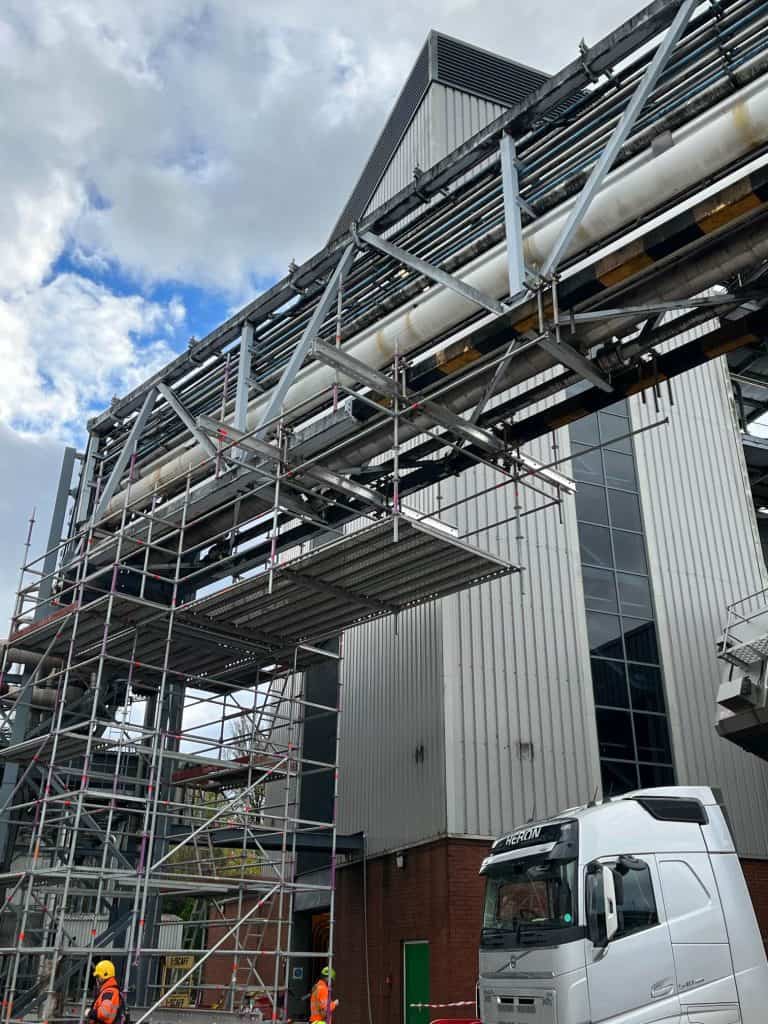
I-Scaff Access Solutions Ltd has become the first UK scaffolding contractor to use Layher’s brand new TwixBeam on a project in Scotland.
Launched by Layher UK just last week the ground-breaking multifunctional TwixBeam is already playing a major role on an ongoing pipe bridge project at a Whisky Distillery in Central Fife, Scotland.
Working for IFP-Scotland, scaffolders from I-Scaff have started to erect a full-access scaffold and encapsulation to a pipe bridge on the Whisky Distillery site for grit blasting and painting.
“The pipe bridge spans 28 meters and requires full unrestricted vehicle access below 24-7/365 days of the year,” says Ross Brown Director of I-Scaff Access Solutions Ltd.
“The TwixBeam is so simple to use, The Layher all-round simply integrates into the central channel of the TwixBeam. We are using the standard Layher rosette within the standard to support the scaffold within the centre of the TwixBeam which means no additional attachments are required,” Ross said.
The TwixBeam is the latest innovation to come from the world’s largest system scaffolding manufacturer. Made from high-grade aluminium the two-piece multifunctional beam is low-weight, easy to dismantle and incredibly strong.
Credit: I-Scaff
Ross added, “This is the 3rd pipe bridge we have carried out on site and as always we try to utilise Layher where possible – The other 2 have been able to come from the ground with large cantilever bridged sections to ensure roads remain open- This one was different with a large 28m span over a main HGV route so a different approach was required.” “The next phase is 24m over a river which will be a slightly different challenge as we are utilising MEWPS to install the TwixBeams at the moment, But I’m looking forward to that part as it keeps the brain working and shows our clients how experienced we are in this field when we come up with many different approaches to access.”
SIMIAN – One of the UK’s leading scaffolding and construction training specialists is celebrating 17 years in business this month.
Since opening in 2005 by founders SIMon Hughes and IAN Fyall, SIMIAN has rapidly grown to become one of the UK’s leading training and consultancy organisations.
From its initial centre in Warrington, SIMIAN has grown as a business and expanded both in scope and geographically. The business now has many centres across the UK including London, Llangefni, Hertfordshire and Weston-Super-Mare.
In recent years the training firm has taken its expertise beyond scaffolding and into the wider construction industry, covering a number of areas including roofing, lead sheeting, green skills and much more.
SIMIAN’s Managing Director Simon Hughes said on its website:
“I couldn’t be prouder of where the business has come from to where we are today. We have worked tirelessly to ensure that the scaffolding and construction industries become a safer place both for the workforce and the wider general public. I can say with confidence that we have made a big difference through our training, consultancy, and inspection services for businesses across the UK. But our work isn’t done! Not only are we continually training the next generation of professionals to join the industry in the best possible position by utilising best practice methods, but we are also working alongside the wider construction industry to build our training portfolio outside of scaffolding, and to ensure green skills are adopted to enable construction to successfully reach its goal of net zero by 2050.”
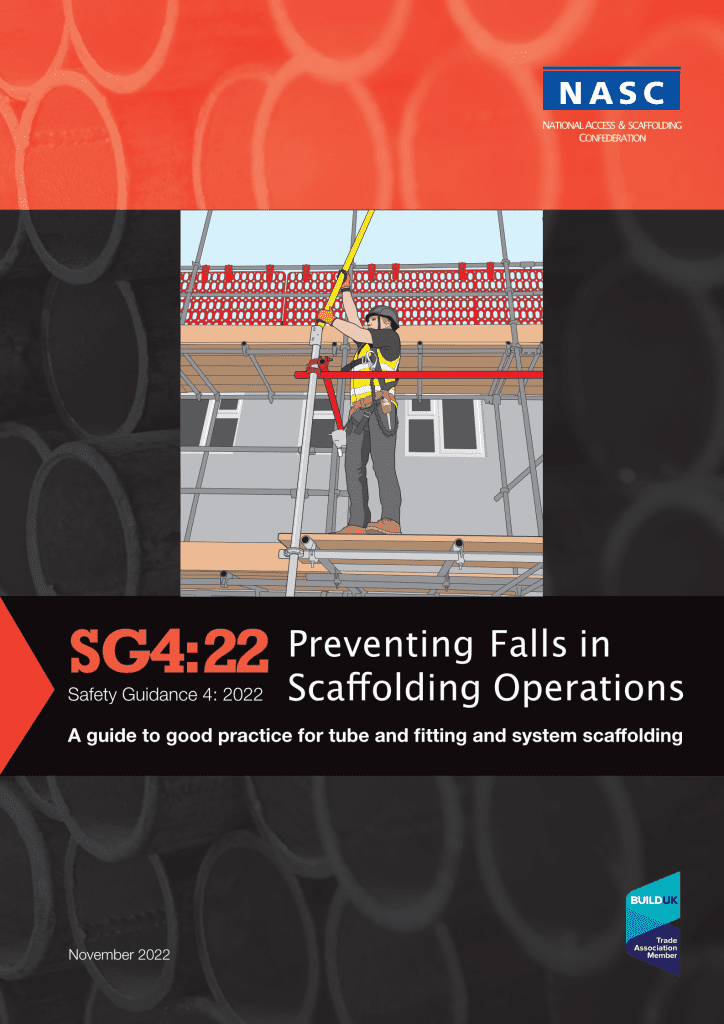
Ahead of the launch of the 2022 revision of SG4, Scaffmag spoke with Alan Harris about the guidance and what we can expect to see in NASC’s flagship guidance note.Alan HarrisAlan Harris is the chair of the National Access and Scaffolding Confederation (NASC) Health and Safety Committee and also heads up the working party tasked with the revision and update of the NASC’s flag-ship safety guidance note SG4:22 ‘Preventing Falls in Scaffolding Operations’. Like most of the volunteers that give up their time to support the confederation, Alan is the owner and managing director of a scaffolding contractor, Pro-Fix Access Limited based in Titchfield, Hampshire, and is very much an operational scaffolding contractor.Does the guidance need updating?
One of the ongoing aims of the NASC is to ensure its guidance remains current and reflects the needs of, not only its membership, but the wider access and scaffolding industry. As an objective we try to ensure all of our safety guidance is reviewed and where necessary updated at least every 5 years. We also made a commitment to the Health and Safety Executive to continually review industry practices and ensure the guidance remains current. This review started back in 2019 and has unfortunately been delayed through the pandemic.
The aim of the review is to ensure that the guidance features methods of work and equipment that reflects current industry good practice. The working party have considered accident learning, legal cases, enforcement action, good industry practices and new technology for fall prevention and protection.
To ensure the guidance remains current, obsolete products and methods of working that are no longer in common use have been removed. New sections have been introduced or further guidance provided to protect scaffolders and support employers in establishing safe systems of work.
How has accident learning influenced this revision of SG4?
Sadly, we are still seeing fatalities and life-changing injuries in our trade as a result of falls from height and many of these tragic accidents are absolutely avoidable. As a result of fatal accidents to scaffolders since the last revision particularly, we have added specific guidance for working on traditional temporary roofs erected in situation and working on or near fragile surfaces.
We have updated the guidance with some new case studies, although some of the original case studies remain as they are still very powerful lessons, that should not be forgotten.
You have worked your entire career in the access trade, how has SG4 changed the industry, in your experience?
Having worked for the biggest scaffolding contractors through to owning my own SME scaffolding business, I have experienced most aspects of our industry, from large industrial sites through to town and street works. Over the last 20 years I have seen a major difference and increase in professionalism by our trade. I am pleased to see the gap between the professional scaffolding contractors, who are trying to do the right thing and, let’s say, the others, grow significantly and is now becoming a chasm. I genuinely believe that SG4 has played a significant part in changing the culture of our industry and raising the standards of safety. The accident statistics within the NASC membership speak for themselves and we have seen an 87% reduction in the number of falls since 1999 and that is despite an increase of nearly 50% in the number scaffolders working for our members.
Of course, you don’t have to look very far in many of our towns and cities to see examples of unsafe practice. So, as an industry we can’t rest on our laurels and the confederation and other industry stakeholders, like the Construction Industry Scaffolders Record Scheme (CISRS), still need to keep promoting good practice. Our clients now have a heightened awareness of scaffolding industry good practice through the publication of guidance such as SG4 and often play a major part in changing attitudes towards unacceptable risk taking by scaffolders. The marketplace for scaffolding contractors who ignore good practice is gradually getting smaller, in my opinion. And as a business owner the frustrations of losing work to competition who cut every corner in the book is still a factor but is getting smaller.
What can our readers expect to see changed in the forthcoming edition of SG4?
When we set out on this revision and assembled a representative group to oversee the processes, the consensus of opinion in the group was that, SG4 is working and would potentially be a light-touch revision. Although the main guidance remains principally the same, we were surprised how much had actually changed in a relatively short period of time since the last revision in 2015. I believe that is a reflection of how industry practices are evolving and how scaffolders are embracing the most effective methods of working, innovation and seeking to improve.
NASC has yet again entrusted the writing of the guidance to Simon Hughes of SIMIAN, as technical author. As chair of the working party, overseeing the revision, I would be pleased to explain some of the key changes and new guidance we are hoping to introduce.
Embracing Technology
The guidance continues to follow the principles set out in the hierarchy of prevention and protection embodied in the Work at Height Regulations 2005. The best way to prevent falls is avoid work at height altogether. Unfortunately, by virtue of the fact that someone has decided to employ a scaffolding contractor, this usually means the opportunity to avoid work at height has been missed. However, we continue to see innovation by scaffolding contractors and designers enabling modular building and therefore avoiding more complex work at height. However, for the majority of the industry work at height can’t be avoided and is an inherent part of our trade.
One area that has seen an opportunity for avoiding work at height is through the use of technology. The use of drones, digital mapping and 3D modelling of buildings is making surveying and temporary works engineering more accurate and much safer.
Fragile Surfaces
Following two fatal accidents involving scaffolders falling through fragile roofs, we have expanded the guidance for working on or near fragile surfaces. This includes information for employers and scaffolders for assessing and controlling the risks associated with potentially fragile surfaces.
System Scaffolding
Since the inception of SG4, the guidance has recommended that suppliers and manufacturers of proprietary system scaffolding are responsible for providing instructions for the safe erection and use of their products. NASC has recommend that the principles of prevention and protection in SG4 should be adopted by the manufacturers. One area of concern that the working party were asked to consider was the installation and removing of system decking on partially boarded structures. This edition will include guidance on systems of work for handling decking whilst avoiding the need to climb the structure relying solely on personal fall protection equipment (safety harnesses).
Updated for Technical Guidance
The guidance has been updated to reflect changes brought about by the revised NASC technical guidance TG20 last year. Examples include updated illustrations such as TG20 loading bays.
Working with Beams
Scaffolders continue to innovate and devise safer methods of working, one area where we reflected industry good practice are examples of safer working with beams. The revised guidance includes more applications for working with beams using temporary boarding and collective protection, including the erection of gantry scaffolds.
Temporary Roofs
The HSE continue to support the working party and have provided input throughout the process. One area of particular concern raised by the authority was related to the construction of traditional temporary roofs, following fatal falls from height during these scaffolding operations. SG4 now includes some basic principles that should be embodied into the design of such temporary roofs and planning of safe systems of work by scaffolders.
Other additions to guidance include the benefits of using climbing type helmets in scaffolding operations and guidance for third party contractors installing sheeting to scaffolding structures.
When are we likely to see the new SG4 launched and when will our readers see the guidance in full?
We are close to completing the management guide and work has starter on the pocketbook user guide. Following feedback from the NASC Council, it is hoped that the recent changes will be ratified and then we can start the process of seeking support from the HSE with a foreword. We are aiming for completion and publication in time for the NASC AGM in November.
Following the launch, the management guide will be added to the suite of guidance notes accessed through the NASC ePortal. Hardcopies of the guidance will be available to purchase via the NASC.
This article was first published in the ScaffMag Magazine Issue 17
We use cookies on our website to give you the most relevant experience by remembering your preferences and repeat visits. By clicking “Accept”, you consent to the use of ALL the cookies.
This website uses cookies to improve your experience while you navigate through the website. Out of these, the cookies that are categorized as necessary are stored on your browser as they are essential for the working of basic functionalities of the website. We also use third-party cookies that help us analyze and understand how you use this website. These cookies will be stored in your browser only with your consent. You also have the option to opt-out of these cookies. But opting out of some of these cookies may affect your browsing experience.
Necessary cookies are absolutely essential for the website to function properly. These cookies ensure basic functionalities and security features of the website, anonymously.
Cookie
Duration
Description
cookielawinfo-checbox-analytics
11 months
This cookie is set by GDPR Cookie Consent plugin. The cookie is used to store the user consent for the cookies in the category "Analytics".
cookielawinfo-checbox-functional
11 months
The cookie is set by GDPR cookie consent to record the user consent for the cookies in the category "Functional".
cookielawinfo-checbox-others
11 months
This cookie is set by GDPR Cookie Consent plugin. The cookie is used to store the user consent for the cookies in the category "Other.
cookielawinfo-checkbox-necessary
11 months
This cookie is set by GDPR Cookie Consent plugin. The cookies is used to store the user consent for the cookies in the category "Necessary".
cookielawinfo-checkbox-performance
11 months
This cookie is set by GDPR Cookie Consent plugin. The cookie is used to store the user consent for the cookies in the category "Performance".
viewed_cookie_policy
11 months
The cookie is set by the GDPR Cookie Consent plugin and is used to store whether or not user has consented to the use of cookies. It does not store any personal data.
Functional cookies help to perform certain functionalities like sharing the content of the website on social media platforms, collect feedbacks, and other third-party features.
Performance cookies are used to understand and analyze the key performance indexes of the website which helps in delivering a better user experience for the visitors.
Analytical cookies are used to understand how visitors interact with the website. These cookies help provide information on metrics the number of visitors, bounce rate, traffic source, etc.
Advertisement cookies are used to provide visitors with relevant ads and marketing campaigns. These cookies track visitors across websites and collect information to provide customized ads.











 What can our readers expect to see changed in the forthcoming edition of SG4?
When we set out on this revision and assembled a representative group to oversee the processes, the consensus of opinion in the group was that, SG4 is working and would potentially be a light-touch revision. Although the main guidance remains principally the same, we were surprised how much had actually changed in a relatively short period of time since the last revision in 2015. I believe that is a reflection of how industry practices are evolving and how scaffolders are embracing the most effective methods of working, innovation and seeking to improve.
NASC has yet again entrusted the writing of the guidance to Simon Hughes of SIMIAN, as technical author. As chair of the working party, overseeing the revision, I would be pleased to explain some of the key changes and new guidance we are hoping to introduce.
Embracing Technology
The guidance continues to follow the principles set out in the hierarchy of prevention and protection embodied in the Work at Height Regulations 2005. The best way to prevent falls is avoid work at height altogether. Unfortunately, by virtue of the fact that someone has decided to employ a scaffolding contractor, this usually means the opportunity to avoid work at height has been missed. However, we continue to see innovation by scaffolding contractors and designers enabling modular building and therefore avoiding more complex work at height. However, for the majority of the industry work at height can’t be avoided and is an inherent part of our trade.
One area that has seen an opportunity for avoiding work at height is through the use of technology. The use of drones, digital mapping and 3D modelling of buildings is making surveying and temporary works engineering more accurate and much safer.
What can our readers expect to see changed in the forthcoming edition of SG4?
When we set out on this revision and assembled a representative group to oversee the processes, the consensus of opinion in the group was that, SG4 is working and would potentially be a light-touch revision. Although the main guidance remains principally the same, we were surprised how much had actually changed in a relatively short period of time since the last revision in 2015. I believe that is a reflection of how industry practices are evolving and how scaffolders are embracing the most effective methods of working, innovation and seeking to improve.
NASC has yet again entrusted the writing of the guidance to Simon Hughes of SIMIAN, as technical author. As chair of the working party, overseeing the revision, I would be pleased to explain some of the key changes and new guidance we are hoping to introduce.
Embracing Technology
The guidance continues to follow the principles set out in the hierarchy of prevention and protection embodied in the Work at Height Regulations 2005. The best way to prevent falls is avoid work at height altogether. Unfortunately, by virtue of the fact that someone has decided to employ a scaffolding contractor, this usually means the opportunity to avoid work at height has been missed. However, we continue to see innovation by scaffolding contractors and designers enabling modular building and therefore avoiding more complex work at height. However, for the majority of the industry work at height can’t be avoided and is an inherent part of our trade.
One area that has seen an opportunity for avoiding work at height is through the use of technology. The use of drones, digital mapping and 3D modelling of buildings is making surveying and temporary works engineering more accurate and much safer.

 What can our readers expect to see changed in the forthcoming edition of SG4?
When we set out on this revision and assembled a representative group to oversee the processes, the consensus of opinion in the group was that, SG4 is working and would potentially be a light-touch revision. Although the main guidance remains principally the same, we were surprised how much had actually changed in a relatively short period of time since the last revision in 2015. I believe that is a reflection of how industry practices are evolving and how scaffolders are embracing the most effective methods of working, innovation and seeking to improve.
NASC has yet again entrusted the writing of the guidance to Simon Hughes of SIMIAN, as technical author. As chair of the working party, overseeing the revision, I would be pleased to explain some of the key changes and new guidance we are hoping to introduce.
Embracing Technology
The guidance continues to follow the principles set out in the hierarchy of prevention and protection embodied in the Work at Height Regulations 2005. The best way to prevent falls is avoid work at height altogether. Unfortunately, by virtue of the fact that someone has decided to employ a scaffolding contractor, this usually means the opportunity to avoid work at height has been missed. However, we continue to see innovation by scaffolding contractors and designers enabling modular building and therefore avoiding more complex work at height. However, for the majority of the industry work at height can’t be avoided and is an inherent part of our trade.
One area that has seen an opportunity for avoiding work at height is through the use of technology. The use of drones, digital mapping and 3D modelling of buildings is making surveying and temporary works engineering more accurate and much safer.
What can our readers expect to see changed in the forthcoming edition of SG4?
When we set out on this revision and assembled a representative group to oversee the processes, the consensus of opinion in the group was that, SG4 is working and would potentially be a light-touch revision. Although the main guidance remains principally the same, we were surprised how much had actually changed in a relatively short period of time since the last revision in 2015. I believe that is a reflection of how industry practices are evolving and how scaffolders are embracing the most effective methods of working, innovation and seeking to improve.
NASC has yet again entrusted the writing of the guidance to Simon Hughes of SIMIAN, as technical author. As chair of the working party, overseeing the revision, I would be pleased to explain some of the key changes and new guidance we are hoping to introduce.
Embracing Technology
The guidance continues to follow the principles set out in the hierarchy of prevention and protection embodied in the Work at Height Regulations 2005. The best way to prevent falls is avoid work at height altogether. Unfortunately, by virtue of the fact that someone has decided to employ a scaffolding contractor, this usually means the opportunity to avoid work at height has been missed. However, we continue to see innovation by scaffolding contractors and designers enabling modular building and therefore avoiding more complex work at height. However, for the majority of the industry work at height can’t be avoided and is an inherent part of our trade.
One area that has seen an opportunity for avoiding work at height is through the use of technology. The use of drones, digital mapping and 3D modelling of buildings is making surveying and temporary works engineering more accurate and much safer.
 Fragile Surfaces
Following two fatal accidents involving scaffolders falling through fragile roofs, we have expanded the guidance for working on or near fragile surfaces. This includes information for employers and scaffolders for assessing and controlling the risks associated with potentially fragile surfaces.
System Scaffolding
Since the inception of SG4, the guidance has recommended that suppliers and manufacturers of proprietary system scaffolding are responsible for providing instructions for the safe erection and use of their products. NASC has recommend that the principles of prevention and protection in SG4 should be adopted by the manufacturers. One area of concern that the working party were asked to consider was the installation and removing of system decking on partially boarded structures. This edition will include guidance on systems of work for handling decking whilst avoiding the need to climb the structure relying solely on personal fall protection equipment (safety harnesses).
Updated for Technical Guidance
The guidance has been updated to reflect changes brought about by the revised NASC technical guidance TG20 last year. Examples include updated illustrations such as TG20 loading bays.
Working with Beams
Scaffolders continue to innovate and devise safer methods of working, one area where we reflected industry good practice are examples of safer working with beams. The revised guidance includes more applications for working with beams using temporary boarding and collective protection, including the erection of gantry scaffolds.
Temporary Roofs
The HSE continue to support the working party and have provided input throughout the process. One area of particular concern raised by the authority was related to the construction of traditional temporary roofs, following fatal falls from height during these scaffolding operations. SG4 now includes some basic principles that should be embodied into the design of such temporary roofs and planning of safe systems of work by scaffolders.
Other additions to guidance include the benefits of using climbing type helmets in scaffolding operations and guidance for third party contractors installing sheeting to scaffolding structures.
When are we likely to see the new SG4 launched and when will our readers see the guidance in full?
We are close to completing the management guide and work has starter on the pocketbook user guide. Following feedback from the NASC Council, it is hoped that the recent changes will be ratified and then we can start the process of seeking support from the HSE with a foreword. We are aiming for completion and publication in time for the NASC AGM in November.
Following the launch, the management guide will be added to the suite of guidance notes accessed through the NASC ePortal. Hardcopies of the guidance will be available to purchase via the NASC.
This article was first published in the ScaffMag Magazine Issue 17
Fragile Surfaces
Following two fatal accidents involving scaffolders falling through fragile roofs, we have expanded the guidance for working on or near fragile surfaces. This includes information for employers and scaffolders for assessing and controlling the risks associated with potentially fragile surfaces.
System Scaffolding
Since the inception of SG4, the guidance has recommended that suppliers and manufacturers of proprietary system scaffolding are responsible for providing instructions for the safe erection and use of their products. NASC has recommend that the principles of prevention and protection in SG4 should be adopted by the manufacturers. One area of concern that the working party were asked to consider was the installation and removing of system decking on partially boarded structures. This edition will include guidance on systems of work for handling decking whilst avoiding the need to climb the structure relying solely on personal fall protection equipment (safety harnesses).
Updated for Technical Guidance
The guidance has been updated to reflect changes brought about by the revised NASC technical guidance TG20 last year. Examples include updated illustrations such as TG20 loading bays.
Working with Beams
Scaffolders continue to innovate and devise safer methods of working, one area where we reflected industry good practice are examples of safer working with beams. The revised guidance includes more applications for working with beams using temporary boarding and collective protection, including the erection of gantry scaffolds.
Temporary Roofs
The HSE continue to support the working party and have provided input throughout the process. One area of particular concern raised by the authority was related to the construction of traditional temporary roofs, following fatal falls from height during these scaffolding operations. SG4 now includes some basic principles that should be embodied into the design of such temporary roofs and planning of safe systems of work by scaffolders.
Other additions to guidance include the benefits of using climbing type helmets in scaffolding operations and guidance for third party contractors installing sheeting to scaffolding structures.
When are we likely to see the new SG4 launched and when will our readers see the guidance in full?
We are close to completing the management guide and work has starter on the pocketbook user guide. Following feedback from the NASC Council, it is hoped that the recent changes will be ratified and then we can start the process of seeking support from the HSE with a foreword. We are aiming for completion and publication in time for the NASC AGM in November.
Following the launch, the management guide will be added to the suite of guidance notes accessed through the NASC ePortal. Hardcopies of the guidance will be available to purchase via the NASC.
This article was first published in the ScaffMag Magazine Issue 17