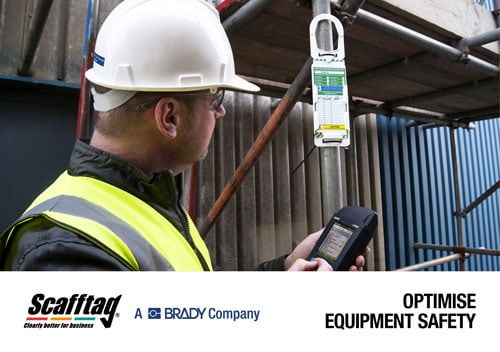
All construction sites pose risks to workers. It is here that 20.9% of fatal workplace accidents in the EU take place. To avoid costly accidents with unfit construction equipment, Scafftag proposes a highly customisable tag with holder and insert that can help increase legal compliance, workplace safety and inspection efficiency.Comply with equipment safety regulations
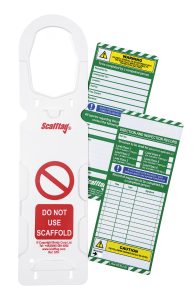
Scafftags’ Visual Tagging solutions help companies comply with PUWER and WAHR on equipment safety and inspection. With Visual Tagging, inspection results are shared at the point of use, on the equipment itself. Tags are available for almost any tool or equipment, including but not restricted to, ladders, scaffolds, drills, vehicles, anchor-points, harnesses and handrails. At all times, users will be able to see when the equipment was last inspected or is next due. All inspection records are kept on removable inserts which can serve for inspection record keeping, a requirement of the Regulations.
Avoid workplace accidents and delays
When properly used and applied on the equipment itself in plain view, Scafftags’ Visual Tagging can always communicate the latest equipment status to anyone who wants to use a specific piece of equipment. Inspection records on the tag’s insert will show when equipment was considered fit for use. When equipment fails inspection, the inspector can remove the insert to show a clear ‘Do not use’ message on the tag’s holder. In this way, Scafftag solutions help prevent costly workplace accidents resulting from the use of unfit equipment.
Highly efficient equipment inspections
Every Scafftag holder and / or insert can include best practice inspection procedures on the equipment that needs inspection. Both the holders and removable inserts are highly customisable and can support the standardisation of evolving equipment inspection procedures. A QR code can also be printed on the inserts or holders to activate a digital inspection flow via smartphones and Safetrak software (with RFID Technology), complete with inspection planning management and automatic inspection report generation.
Discover a wide range of tools and equipment you can immediately increase compliance for in our free guide.
Download the free guide “Optimise equipment safety” now >>Scafftag – A Brady Business[email protected]
Tel 0845 089 4060
www.scafftag.co.uk
CITB is investing £90,000 to fund a pilot scheme which will provide mental health support for apprentices from the start of their construction industry careers.
Optima UK Ltd will train further education construction tutors to be Mental Health First Aiders so they can support construction apprentices during their learning. Apprentices will also be given mental health awareness training in bite-size four-hour sessions. This will mean the apprentices have the knowledge and education during learning, at the start of, and throughout, their career in construction. There will also be one-to-one support.
The team at Optima UK are all set to go and will begin training both instructors and apprentices in September. The courses will be run by trainers accredited by Mental Health First Aid England and deliver 29 courses, all with 16 delegates, to hubs of colleges across the UK.
In the space of a year, they will have trained 464 tutors and 464 apprentices, as well as offered one-to-one support to around 100 apprentices.
The CITB investment comes after a study compiled by the Lighthouse Construction Industry Charity and CITB, highlighted the toll poor mental health is taking.
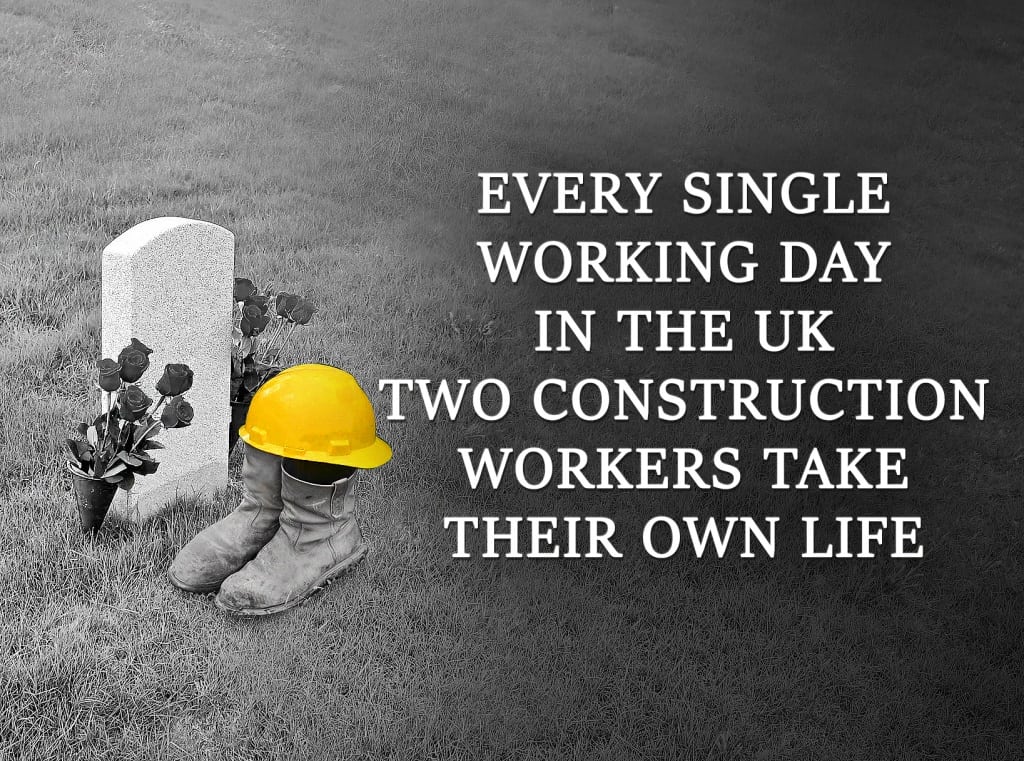
Research showed 26% of construction workers had experienced suicidal thoughts and 91% felt overwhelmed. Tragically, two construction workers take their own lives each day.
CITB CEO Tim Balcon, said: “We need to make sure everyone is at ease talking about their mental health and this comes down to a culture of making it OK to speak up… giving apprentices the confidence to do that from day one, will hopefully make them feel supported in the industry. When staff are supported and happy in their work, and in my view, they will stay in the industry longer.”
It has already been proven that having an open approach to mental health as a core value in your firm can save lives. At scaffolding firm CASS UK, a culture of mental health support played a major role in giving two young staff members the confidence to come to the aid of a vulnerable person they realised had climbed up on scaffolding on a site they were working on in Exeter.
Karl and Kieran (pictured below) were quickly aware that something was not as it should be when they saw someone trying to climb the scaffold. They stopped what they were doing and took the time to speak to this individual who was obviously troubled. They managed to talk him down and stayed with him until help arrived.
Kieran said: “We knew that what we were seeing wasn’t normal, and there was no doubt that we wanted to help this young man. We didn’t see it as being an act of kindness or wanted any credit for what we did, we just didn’t want this person to do anything that we could stop or help with.
Karl said: “We are aware of the rise in mental health especially in the construction industry and we wouldn’t hesitate to help anyone again in this situation.”
Tim Balcon added: “CITB funding with help foster this positive attitude to mental health from day one of your construction career and we don’t expect everyone to be hero like these two young men but the knowledge it is good to talk will foster a healthy attitude and in turn save lives.”
Larraine Boorman, CEO of Optima UK, said: “Optima is so proud to be involved in this ground-breaking project.
“The CITB is to be congratulated, first for its research into a major issue in the industry, and secondly for then taking action by launching this pilot project. As we can see, the statistics show there is a real problem in the sector, but with the right training, education, and support, we can make a real difference to people’s lives.”
This UK-wide pilot scheme will aim to understand how mental health education and support can contribute to improved retention for individuals during their apprenticeship in construction, as well as reducing their likelihood of experiencing mental health issues.
Working with CITB, Optima UK will be rolling out an awareness campaign aimed at colleges, tutors, and apprentices, with materials based around the questions, Are We Ok? Are You OK? Look out for the campaign launching week commencing 12th September 2022.
CITB has already partnered with Laing O’Rourke, the Lighthouse Club and Samaritans to train 8,000 mental health first aiders in the workplace making mental health information and support, accessible and relatable to small and medium construction employers.
Two contractors and two people have been sentenced after an 18-year-old worker was crushed to death in a manhole while working on a house-build construction site in Boston, Lincolnshire.
P & R Plant Hire (Lincolnshire) Limited, D. Brown (Building Contractors) Limited, Brent Woods and Darrell Tripp were all fined following the death of Josh Disdel.
In July 2018 Mr Disdel, and another worker, both employed by P & R Plant Hire (Lincolnshire) Limited, had been tasked with clearing debris from manholes at a house-build construction site at White Bridges, Boston.
While work was taking place, Mr Disdel’s colleague was asked if he could move the works van to allow another vehicle to pass. However, he was not aware that Mr Disdel was lying on the road with his head and torso in a manhole, directly in front of the van.
As the vehicle moved forwards one of the wheels entered the top of the manhole contacting Mr Disdel. Mr Disdel was then taken to hospital but later died as a result of serious crush injuries.
An investigation by the Health and Safety Executive (HSE) found that neither the Principal Contractor, D. Brown (Building Contractors) Limited, nor the groundworks sub-contractor, P & R Plant Hire (Lincolnshire) Limited, had ensured that the work was planned in such a way to ensure that workers were not exposed to risks to their health and safety.
Brent Woods, a manager within P & R Plant Hire (Lincolnshire) Limited for approximately 10 years, sent employees to carry out the task without a risk assessment or method statement in place despite having previously produced such information in the past.
In addition, workers had not been trained to work in a road, had not been provided with any equipment to ensure the work was carried out safely and had not been provided with any instruction on any safety measures to be used at site.
Yestrerday (September 6) at Lincoln Crown Court, Darrell Tripp, a site manager for D. Brown (Building Contractors) Limited for approximately four years, having worked in the construction industry for about 40 years, did not carry out a site induction of Josh Disdel and failed to carry out suitable checks to ensure the workers had the relevant training. Mr Tripp also failed to ensure there was a safe system of work in place of whether there were adequate control measures.
D. Brown (Building Contractors) Limited of Seas End Road, Spalding, were found guilty of contravening the Health and Safety at Work etc Act 1974. They were fined £300,000 and ordered to pay costs of £15,765.92
P & R Plant Hire (Lincolnshire) Limited of Station Road, Cambridgeshire, pleaded guilty to contravening the Health and Safety at Work etc Act 1974. The company was fined £24,000 and ordered to pay costs of £2,264.87.
Brent Woods of North Parade, Holbeach, Spalding was found guilty of contravening the Health and Safety at Work etc Act 1974. He was sentenced to 18 weeks imprisonment suspended for two years and ordered to complete 200 hours of community service and pay costs of £1200.
Darrell Tripp of Broadgate Lane, Deeping St James, Peterborough was found guilty of contravening the Health and Safety at Work etc Act. He was sentenced to eight weeks imprisonment suspended for two years and ordered to pay costs of £1200.
Speaking after the hearing, HSE inspector Mark Welsh said: “This was a completely avoidable incident, caused by a multitude of failures by both companies and both of the individuals who appeared in court.“All of the defendants failed to adequately plan the work to identify the risks, failed to ensure that the individuals carrying out the work were trained and competent to do so, and failed to ensure a safe system of work was in place and followed.“The result was the tragic loss of life of a young man who was looking forward to a bright future.”
Ahead of World Suicide Prevention Day on Saturday, Lighthouse Club CEO, Bill Hill explains why the thinks the day should be scrapped, what the charity is doing to make suicide preventable and how important it is for the industry to stand together and make life-saving changes.
World Suicide Prevention Day is just around the corner and we will see a huge amount of activity and publicity to help raise awareness of the issues surrounding such a hugely sensitive subject. It is good news that the construction industry in particular gets behind such campaigns but for those that know me, they will be aware that I have voiced my opinions that such days should be scrapped. Controversial I know. Don’t get me wrong, of course we need to raise awareness of the issues, but for us, its world suicide prevention day EVERY DAY.
Working in construction can be extremely rewarding but also has its challenges. Over 87% of the workforce is male and over 50% of the sector is made up of self employed, agency staff or on zero hour contract workers. This means that it’s not always easy to get the message of support to those that need it the most and that was evidenced in our research with Caledeonian University published last July.
The research identified that the number of suicides in construction rose from 26 to 29 per 100,000 in the four years to 2019 and there was no change in the fact that those in the construction industry were three times more likely to take their own life compared to other sectors
But the findings also showed differences between certain occupational groups. In summary, those working in non-manual occupations, such as managers and professionals, had lower rates of suicide compared to the unskilled workforce such as labourers. More worrying was that the statistics only went up to the end of 2019. We are now interrogating the data up to the end of 2021 to identify any shifts and benchmark against our previous findings. Sadly, with the impact of the Covid pandemic as a backdrop, I’m not optimistic that the rates will have dropped,
That said, the research findings galvanised our efforts to make sure we reach those who are most vulnerable. We’re already providing a huge range of proactive and reactive resources that can be accessed free of charge by any worker or their family employed in construction or allied trades, this includes the self employed, subcontractors or agency workers. But we’re always looking for ways to improve and extend our support and that has seen the recent introduction of our text support service and we’ve also increased our network of Lighthouse Beacons that offer a safe space for people to share issues.
Again, in response to the need to ensure we reach the ‘boots on the ground’ our Help Inside the Hard Hat campaign has recently taken to the road and so far we’ve visited over 70 construction sites and builders’ trade outlets across the country with many more in the diary. This helps us reach some of our most vulnerable workers, including the trades and contractors who have nowhere else to turn to for support. It’s vitally important that we get our message in at grass roots level so we made a conscious decision to ensure that our team are from the trades and they are able to share their lived experiences with poor mental health in a down to earth and relatable way.
We know that by simply having a conversation with people, our onsite team are already making a life changing and life saving impact. We have spoken with 20 workers who said that they were on the verge of taking their own lives but as a result of opening up to our team they have been given immediate and life saving support. That’s 20 lives saved along with preventing all the grief and heartache experienced by the family, friends and colleagues of those who feel that they have no other option but to permanently check out of life. It is truly humbling to know that we can have this impact.
To raise awareness of the difficult subject of suicide we’re also launching our new Suicide Awareness Courses on 9th September. The courses will help to gain a greater understanding of the common reasons and causes of suicide and the signs to look out for if you think somebody is experiencing suicidal thoughts. It will also help to develop the skills and confidence needed to approach and start a conversation with a suicidal person.
All our hard work as a charity, together with companies in the industry to improve our workforce wellbeing really is making a difference. We published our 2021 Impact Report last month and we know that we helped 2777 families, an increase of 23% on the previous year. That support ranged from emotional and physical wellbeing through to requests for financial assistance to help feed families and pay bills. But whatever the ‘presenting problem’, we can be certain that bubbling right under the surface is a huge amount of anxiety, stress and worry which can quickly spiral out of control. 31% of calls handled by our case workers directly mentioned a mental health problem and 233 families were provided with professional counselling.
However, I don’t see this as a negative, it means that people are actually reaching out for support rather than suffering in silence and this is a positive change in behaviour.
I can’t stress enough that the emphasis needs to be very much on collaborative working to ensure welfare and wellbeing is central to cultural change within our industry so that the stigma of poor mental health is eradicated.
There is no doubt that there is still much work to be done and as well as a legal responsibility, we all have a collective moral responsibility to ensure that mental health in our industry is treated with the same importance and respect as physical safety for both our current and future generations.
If you or anyone you know is struggling, you can reach out for free and confidential support now.
24/7 Construction Industry Helplines; 0345 605 1956, (UK) 1800 939 122 (ROI)Text HARDHAT to 85258 (UK) 50808 (ROI)Via our websiteRegister for Suicide Awareness Courses
The company’s target of £22k for 2022 has already been beaten, as runners prepare for their next challenge.
TRAD Group, one of the UK’s leading scaffolding companies, is extending its charity target for the year, after its original amount of £22,000 was reached over the summer.
This year, the company is raising money for the Anthony Nolan Trust, in memory of its much-loved and very popular former director, John Paterson.
People from across TRAD have taken part in a wide range of events so far this year – from the Surrey Three Peaks Challenge in April, to Tough Mudder competitions and events at individual depots. And now seven runners are taking part in the Great North Run, which takes place on Sunday 11th September.
“We are absolutely delighted with how supportive everyone – inside TRAD and beyond – have been for our charity appeal this year,” says Des Moore, CEO at TRAD Group.
“John was an extremely popular figure in the industry, and we have had such a positive response to raising money in his memory. It has been really heart warming to see not just the financial response, but the real connection that donors have with John.”TRAD Former Director John Paterson who sadly died last year.
The Great North Run is the second-largest half marathon in the world, with around 60,000 runners taking part. TRAD’s runners have been training hard and are all running under the Anthony Nolan Trust banner.
Later in the year, the company is hosting a golf day at Gleneagles, which was John Paterson’s home club, and there will be more depot-based fundraising to see if the company can top an extended total of £30,000 for the year.
“Last year, we raised £75,000 as part of our 50th anniversary celebrations,” adds Des Moore. “To have already beaten our target for John this year is incredible, and we are so grateful to our staff, our customers and our suppliers, who are so very supportive of all our efforts.”If you would like to make a personal or corporate donation, just visit: https://www.justgiving.com/fundraising/tradgroup
Scaffolding trade body the NASC has bolstered its in-house scaffolding expertise through the appointment of Steve Kearney as its H&S Manager.
According to the national trade body, Kearney will be working closely with its Health and Safety Committee to further improve scaffolding safety standards across the sector. He will also be on hand to answer any H&S questions its members might have.
Kearney brings with him more than 40 years’ experience in the scaffolding industry and has held a variety of roles including Scaffolder, H&S Manager and HSEQ Director of the TRAD Group. He has also served on the NASC’s Health and Safety Committee since 2012.
He is a Chartered member of the Institute of Occupational Health and Safety (CMIOSH), a Member of the International Institute of Risk and Safety Management (MIIRSM), an Incorporated member of the Institute of Builders (ICIOB) and an Associate member of the Institute of Environmental Management (AIEMA).
Speaking about his new role within the NASC, Kearney said: “I’m very excited to take on the role of NASC H&S Manager and looking forward to joining the executive team and helping the NASC to further improve the quality of our H&S provision.“I’ve seen how the NASC works – and the good it does for its members and the industry as a whole – from my time on the H&S Committee. It’s an absolute honour to join the UK’s premier scaffolding trade body.”
Robin James, NASC Managing Director, added: “We are delighted to welcome Steve into the NASC executive team fold. His experience and enthusiasm are unparalleled. Additionally, we have long admired his work ethic and commitment to pushing the industry forward.“We’re sure he will be a great addition to the team.”
Scaffolders and other offshore trades working in the North Sea are set to take unofficial strike action on Thursday.
Crews of offshore workers employed by energy services firms Wood, Bilfinger and Stork are calling for workers to down tools at 1pm on 8 September. They are angry that their pay continues to decline while oil companies make sky-high profits.
According to reports, a group to coordinate the strikes has been set up. They are demanding that their pay be brought in line with that of onshore staff and are unhappy with the current Energy Services Agreement (ESA) calculation, given the surge in oil and gas prices in recent months.
The Offshore Oil and Gas Workers Strike Committee said, “The collapse of the Offshore Contractors Association (OCA) was nothing but a power grab by the oil companies.They decimated our terms and conditions then dressed up the new terms under the ESA as a game changer. Total and utter rubbish.The ESA is an agreement on minimum pay and conditions covering 5,000 offshore workers agreed between the GMB, Unite and the RMT unions and 14 employers. Its purpose is to maintain “stability and certainty on a substantive cost element for the industry and investors”.
Workers were offered a 3 percent pay rise from July. The statement added, “Since 2001 our wages have been hit extremely hard. We are currently around 22-23 percent behind inflation with our wage.“We have had derisory pay offers which give us nothing but the equivalent of a hard slap in the face.”“The wildcat strikes that are being talked about and planned are a result of years of inaction from the unions and our employers and have made us feel like we can only get things done by taking things into our own hands. “We provide the energy to keep everyone’s lights on yet seem to be the last to have our say. The time for action is now.”
North-West-based scaffolding firm, Teal Scaffold continue a strong year of growth after securing a contract with clients, Sovini Construction on their £19m social housing development.Teal Scaffold who are part of The Sovini Group is set to deliver a bespoke access solution service to support their client’s largest development to date, building over 145 affordable homes.
Clients Sovini Construction are seeking to create thriving and inclusive communities through its development framework. With an aim to combat high housing costs, through the delivery of good quality, affordable homes – they will deliver over 1,000 new homes within the next five years.
Teal Scaffold, secured the substantial contract in July and have started work on the nine-acre development the final week in August.
Located in Netherton, Bootle, the project will provide employment opportunities to local work-at-height professionals.
The scaffold will be erected to a full height, to create a safe, compliant structure with multiple configurations with additional safety precautions enabling multiple tradesmen to work on the new build apartment block.
Commenting on the contract announcement, Anita Harrison-Carroll, Managing Director of Teal Scaffold said: “We are incredibly proud to be supporting our partners Sovini Construction on the Groups largest social housing project to date. This project demonstrates the breadth and depth of Teal’s offering, and our ability to handle ever-larger projects”.
Steve Parrington, Managing Director of Sovini Construction added: “As proud partners of The Sovini Group we are delighted to be able to utilise the groups full supply chain. We have witnessed Teal Scaffold’s expertise and industry knowledge first hand, so it was a no-brainer to bring them aboard for this major project with us”.
Operating regionally from its Knowsley headquarters, Teal Scaffold are set to continue their monumental growth with plans to expand, adding a second base to their portfolio.
Head of Operations at Teal Scaffold, Dan McGregor added: “It is a pleasure to be involved in Sovini Constructions largest development to date. We are thrilled to add them to the long list of new projects and clients we have secured since our inception to the industry in 2018. This project has created opportunities for our local colleagues to develop their expertise, whilst also tackling the social housing shortage within the ever-growing city of Liverpool. Our growth across the North-West continues, and is a testament to the quality, expertise, and industry knowledge of our workforce. We look forward to seeing the development take shape over the coming months”.
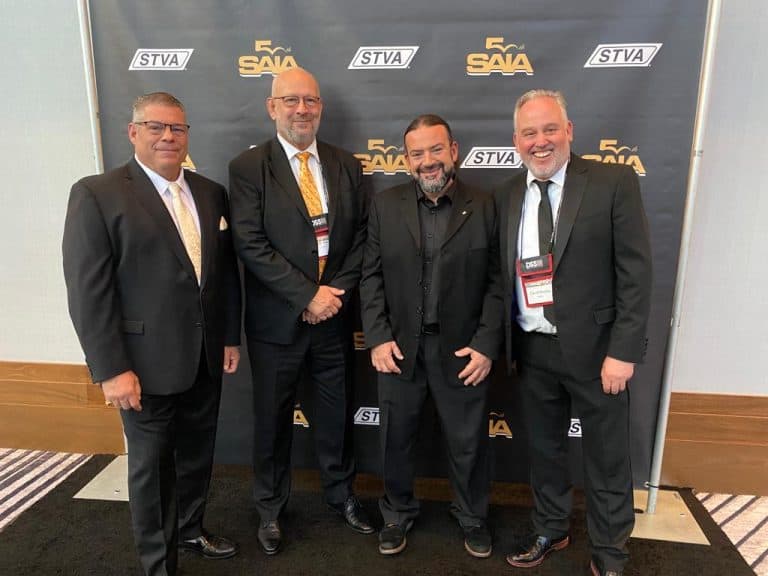
UK scaffolding and access trade body the NASC & CISRS have recently attended the Scaffolding Access Industry Association (SAIA) Convention & Exposition in Boston, USA.
The NASC’s involvement in the development of a European minimum standard for scaffold inspection was lauded at the global scaffolding event that was held from August 21 – 25 at the Omni Boston Hotel.
During the four-day event, Gier Ghule, President of the European Scaffolding Confederation (UEG) on which the NASC sits, delivered a presentation on safety and training standards in Europe and the work the Confederation is doing to promote standardisation across member countries.
David Mosley, NASC Director of Training and CISRS Managing Director, attended the convention, one of the largest gatherings of scaffold and access industry professionals in the world.
He said: “It was a great event and an excellent opportunity to meet with members of the SAIA and other organisations, make new acquaintances, look for common ground, share ideas and hopefully work more closely in the future.“Conferences like this enable delegates to advance skills, gain new knowledge, discuss issues specific to scaffold and access, learn about the latest industry innovations, and collaborate with peers.“We’re proud of the ways in which the NASC and CISRS contribute to a safe and compliant scaffolding industry in the UK, and jointly with UEG in Europe, and were delighted to share this with other convention attendees whilst also remaining open to learning from them how we might further improve our outputs and activities in the future.”
During his time at the convention, David met with incoming SAIA President Tracy Dutting-Kane and Immediate Past President Mike Paladino and hopes to keep these new lines of communication between the NASC and SAIA open.
In the spirit of cooperation, copies of NASC guidance and CISRS scheme literature have been sent to the SAIA offices in USA.
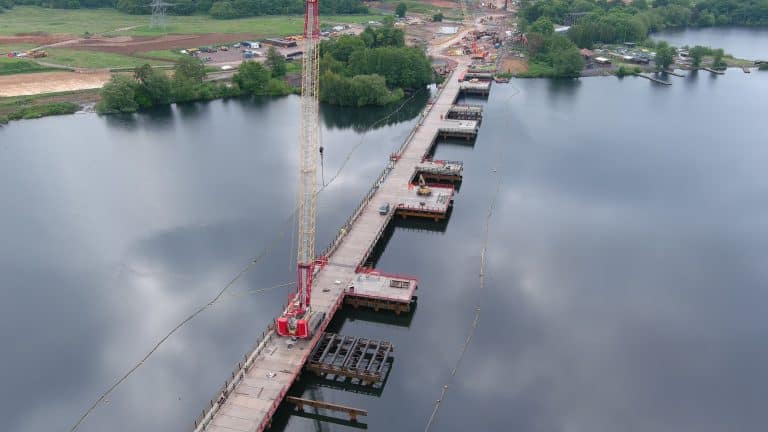
Specialist scaffolding contractor, Millcroft, has begun scaffolding works to support the construction of the piers for the Colne Valley Viaduct – a project being delivered by the Align joint venture (JV) as part of HS2 Phase One.
Once complete, the viaduct will be the longest railway bridge in the UK at 3.4 kilometres, passing over a series of lakes and waterways across the Colne Valley.
Deploying its specialist HS2 team for the project, Millcroft has already successfully handed-over the scaffolding on the first of ten piers of the viaduct; a project which is expected to finish in 2023.
In preparation for deployment, personnel at Millcroft completed a Safe Working in Water (SWIW) two-day course, delivered by Rescue 3 Europe, which provided classroom and swimming-pool based safety training, offering self and co-worker rescue capability techniques for working in water.
The Colne Valley Viaduct will stretch for more than two miles, carrying high-speed trains 10 metres above water. In this section of work within the Colne Valley, the Millcroft team had to work in boats to erect scaffolding. The viaduct itself is being constructed by the Align joint venture, comprised of Bouygues Travaux Publics, Sir Robert McAlpine, and Volker Fitzpatrick.
Senior Contracts Manager at Millcroft, Darren Hayward
Senior Contracts Manager at Millcroft, Darren Hayward, explains: “This is definitely a unique project – it’s not every day you see scaffolders working out of a boat! And on this particular job, the health and safety risks we are normally presented with were unusual – as operatives worked with life jackets on instead of harnesses.“Wearing a harness would in fact put their lives in danger if they were to fall into the water and become entangled within the straps, as it poses a drowning risk. We recognised the need for water training for this project as it was such a unique deployment for our team.”
The water training course included modules in identifying hazards, rescue tools, cold water considerations, lifejacket and buoyance aid safety.
As part of the project, a total of 1,000 concrete segments will form the deck of the 3.4 km viaduct, each one weighing up to 140 tonnes. The deck segments are supported by 56 piers resting on concrete piles, inserted up to 180ft (55m) into the ground.
The Millcroft team will be working on erecting 6 ft-high scaffolds around 11 of these piers for the viaduct. These particular piers house tower cranes and required additional construction to extend the jetties allowing for construction of walkway access to the cranes.
Darren continued: “This is a challenging project as we are working in different shifts on various dates to complete the piers on programme. Our in-house design team has been heavily involved to provide tailored solutions that meet exacting safety standards.“Our commitment to HS2 is growing and this unique project builds on our proud track record in working with the HS2 delivery partners, in this case the Align JV. We continue to deliver a flexible and responsive service to the client while keeping our people safe.”
We use cookies on our website to give you the most relevant experience by remembering your preferences and repeat visits. By clicking “Accept”, you consent to the use of ALL the cookies.
This website uses cookies to improve your experience while you navigate through the website. Out of these, the cookies that are categorized as necessary are stored on your browser as they are essential for the working of basic functionalities of the website. We also use third-party cookies that help us analyze and understand how you use this website. These cookies will be stored in your browser only with your consent. You also have the option to opt-out of these cookies. But opting out of some of these cookies may affect your browsing experience.
Necessary cookies are absolutely essential for the website to function properly. These cookies ensure basic functionalities and security features of the website, anonymously.
Cookie
Duration
Description
cookielawinfo-checbox-analytics
11 months
This cookie is set by GDPR Cookie Consent plugin. The cookie is used to store the user consent for the cookies in the category "Analytics".
cookielawinfo-checbox-functional
11 months
The cookie is set by GDPR cookie consent to record the user consent for the cookies in the category "Functional".
cookielawinfo-checbox-others
11 months
This cookie is set by GDPR Cookie Consent plugin. The cookie is used to store the user consent for the cookies in the category "Other.
cookielawinfo-checkbox-necessary
11 months
This cookie is set by GDPR Cookie Consent plugin. The cookies is used to store the user consent for the cookies in the category "Necessary".
cookielawinfo-checkbox-performance
11 months
This cookie is set by GDPR Cookie Consent plugin. The cookie is used to store the user consent for the cookies in the category "Performance".
viewed_cookie_policy
11 months
The cookie is set by the GDPR Cookie Consent plugin and is used to store whether or not user has consented to the use of cookies. It does not store any personal data.
Functional cookies help to perform certain functionalities like sharing the content of the website on social media platforms, collect feedbacks, and other third-party features.
Performance cookies are used to understand and analyze the key performance indexes of the website which helps in delivering a better user experience for the visitors.
Analytical cookies are used to understand how visitors interact with the website. These cookies help provide information on metrics the number of visitors, bounce rate, traffic source, etc.
Advertisement cookies are used to provide visitors with relevant ads and marketing campaigns. These cookies track visitors across websites and collect information to provide customized ads.
 All construction sites pose risks to workers. It is here that 20.9% of fatal workplace accidents in the EU take place. To avoid costly accidents with unfit construction equipment, Scafftag proposes a highly customisable tag with holder and insert that can help increase legal compliance, workplace safety and inspection efficiency.
Comply with equipment safety regulations
All construction sites pose risks to workers. It is here that 20.9% of fatal workplace accidents in the EU take place. To avoid costly accidents with unfit construction equipment, Scafftag proposes a highly customisable tag with holder and insert that can help increase legal compliance, workplace safety and inspection efficiency.
Comply with equipment safety regulations
 Scafftags’ Visual Tagging solutions help companies comply with PUWER and WAHR on equipment safety and inspection. With Visual Tagging, inspection results are shared at the point of use, on the equipment itself. Tags are available for almost any tool or equipment, including but not restricted to, ladders, scaffolds, drills, vehicles, anchor-points, harnesses and handrails. At all times, users will be able to see when the equipment was last inspected or is next due. All inspection records are kept on removable inserts which can serve for inspection record keeping, a requirement of the Regulations.
Avoid workplace accidents and delays
When properly used and applied on the equipment itself in plain view, Scafftags’ Visual Tagging can always communicate the latest equipment status to anyone who wants to use a specific piece of equipment. Inspection records on the tag’s insert will show when equipment was considered fit for use. When equipment fails inspection, the inspector can remove the insert to show a clear ‘Do not use’ message on the tag’s holder. In this way, Scafftag solutions help prevent costly workplace accidents resulting from the use of unfit equipment.
Highly efficient equipment inspections
Scafftags’ Visual Tagging solutions help companies comply with PUWER and WAHR on equipment safety and inspection. With Visual Tagging, inspection results are shared at the point of use, on the equipment itself. Tags are available for almost any tool or equipment, including but not restricted to, ladders, scaffolds, drills, vehicles, anchor-points, harnesses and handrails. At all times, users will be able to see when the equipment was last inspected or is next due. All inspection records are kept on removable inserts which can serve for inspection record keeping, a requirement of the Regulations.
Avoid workplace accidents and delays
When properly used and applied on the equipment itself in plain view, Scafftags’ Visual Tagging can always communicate the latest equipment status to anyone who wants to use a specific piece of equipment. Inspection records on the tag’s insert will show when equipment was considered fit for use. When equipment fails inspection, the inspector can remove the insert to show a clear ‘Do not use’ message on the tag’s holder. In this way, Scafftag solutions help prevent costly workplace accidents resulting from the use of unfit equipment.
Highly efficient equipment inspections
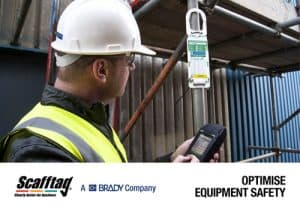 Every Scafftag holder and / or insert can include best practice inspection procedures on the equipment that needs inspection. Both the holders and removable inserts are highly customisable and can support the standardisation of evolving equipment inspection procedures. A QR code can also be printed on the inserts or holders to activate a digital inspection flow via smartphones and Safetrak software (with RFID Technology), complete with inspection planning management and automatic inspection report generation.
Discover a wide range of tools and equipment you can immediately increase compliance for in our free guide.
Download the free guide “Optimise equipment safety” now >>
Scafftag – A Brady Business
[email protected]
Tel 0845 089 4060
www.scafftag.co.uk
Every Scafftag holder and / or insert can include best practice inspection procedures on the equipment that needs inspection. Both the holders and removable inserts are highly customisable and can support the standardisation of evolving equipment inspection procedures. A QR code can also be printed on the inserts or holders to activate a digital inspection flow via smartphones and Safetrak software (with RFID Technology), complete with inspection planning management and automatic inspection report generation.
Discover a wide range of tools and equipment you can immediately increase compliance for in our free guide.
Download the free guide “Optimise equipment safety” now >>
Scafftag – A Brady Business
[email protected]
Tel 0845 089 4060
www.scafftag.co.uk 
 Kieran said: “We knew that what we were seeing wasn’t normal, and there was no doubt that we wanted to help this young man. We didn’t see it as being an act of kindness or wanted any credit for what we did, we just didn’t want this person to do anything that we could stop or help with.
Karl said: “We are aware of the rise in mental health especially in the construction industry and we wouldn’t hesitate to help anyone again in this situation.”
Tim Balcon added: “CITB funding with help foster this positive attitude to mental health from day one of your construction career and we don’t expect everyone to be hero like these two young men but the knowledge it is good to talk will foster a healthy attitude and in turn save lives.”
Larraine Boorman, CEO of Optima UK, said: “Optima is so proud to be involved in this ground-breaking project.
“The CITB is to be congratulated, first for its research into a major issue in the industry, and secondly for then taking action by launching this pilot project. As we can see, the statistics show there is a real problem in the sector, but with the right training, education, and support, we can make a real difference to people’s lives.”
This UK-wide pilot scheme will aim to understand how mental health education and support can contribute to improved retention for individuals during their apprenticeship in construction, as well as reducing their likelihood of experiencing mental health issues.
Working with CITB, Optima UK will be rolling out an awareness campaign aimed at colleges, tutors, and apprentices, with materials based around the questions, Are We Ok? Are You OK? Look out for the campaign launching week commencing 12th September 2022.
CITB has already partnered with Laing O’Rourke, the Lighthouse Club and Samaritans to train 8,000 mental health first aiders in the workplace making mental health information and support, accessible and relatable to small and medium construction employers.
Kieran said: “We knew that what we were seeing wasn’t normal, and there was no doubt that we wanted to help this young man. We didn’t see it as being an act of kindness or wanted any credit for what we did, we just didn’t want this person to do anything that we could stop or help with.
Karl said: “We are aware of the rise in mental health especially in the construction industry and we wouldn’t hesitate to help anyone again in this situation.”
Tim Balcon added: “CITB funding with help foster this positive attitude to mental health from day one of your construction career and we don’t expect everyone to be hero like these two young men but the knowledge it is good to talk will foster a healthy attitude and in turn save lives.”
Larraine Boorman, CEO of Optima UK, said: “Optima is so proud to be involved in this ground-breaking project.
“The CITB is to be congratulated, first for its research into a major issue in the industry, and secondly for then taking action by launching this pilot project. As we can see, the statistics show there is a real problem in the sector, but with the right training, education, and support, we can make a real difference to people’s lives.”
This UK-wide pilot scheme will aim to understand how mental health education and support can contribute to improved retention for individuals during their apprenticeship in construction, as well as reducing their likelihood of experiencing mental health issues.
Working with CITB, Optima UK will be rolling out an awareness campaign aimed at colleges, tutors, and apprentices, with materials based around the questions, Are We Ok? Are You OK? Look out for the campaign launching week commencing 12th September 2022.
CITB has already partnered with Laing O’Rourke, the Lighthouse Club and Samaritans to train 8,000 mental health first aiders in the workplace making mental health information and support, accessible and relatable to small and medium construction employers. 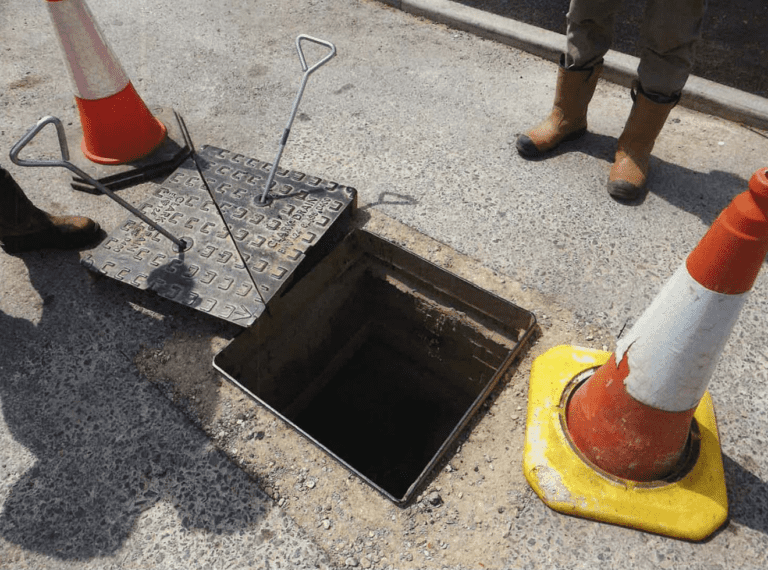

 That said, the research findings galvanised our efforts to make sure we reach those who are most vulnerable. We’re already providing a huge range of proactive and reactive resources that can be accessed free of charge by any worker or their family employed in construction or allied trades, this includes the self employed, subcontractors or agency workers. But we’re always looking for ways to improve and extend our support and that has seen the recent introduction of our text support service and we’ve also increased our network of Lighthouse Beacons that offer a safe space for people to share issues.
Again, in response to the need to ensure we reach the ‘boots on the ground’ our Help Inside the Hard Hat campaign has recently taken to the road and so far we’ve visited over 70 construction sites and builders’ trade outlets across the country with many more in the diary. This helps us reach some of our most vulnerable workers, including the trades and contractors who have nowhere else to turn to for support. It’s vitally important that we get our message in at grass roots level so we made a conscious decision to ensure that our team are from the trades and they are able to share their lived experiences with poor mental health in a down to earth and relatable way.
We know that by simply having a conversation with people, our onsite team are already making a life changing and life saving impact. We have spoken with 20 workers who said that they were on the verge of taking their own lives but as a result of opening up to our team they have been given immediate and life saving support. That’s 20 lives saved along with preventing all the grief and heartache experienced by the family, friends and colleagues of those who feel that they have no other option but to permanently check out of life. It is truly humbling to know that we can have this impact.
To raise awareness of the difficult subject of suicide we’re also launching our new Suicide Awareness Courses on 9th September. The courses will help to gain a greater understanding of the common reasons and causes of suicide and the signs to look out for if you think somebody is experiencing suicidal thoughts. It will also help to develop the skills and confidence needed to approach and start a conversation with a suicidal person.
All our hard work as a charity, together with companies in the industry to improve our workforce wellbeing really is making a difference. We published our 2021 Impact Report last month and we know that we helped 2777 families, an increase of 23% on the previous year. That support ranged from emotional and physical wellbeing through to requests for financial assistance to help feed families and pay bills. But whatever the ‘presenting problem’, we can be certain that bubbling right under the surface is a huge amount of anxiety, stress and worry which can quickly spiral out of control. 31% of calls handled by our case workers directly mentioned a mental health problem and 233 families were provided with professional counselling.
However, I don’t see this as a negative, it means that people are actually reaching out for support rather than suffering in silence and this is a positive change in behaviour.
I can’t stress enough that the emphasis needs to be very much on collaborative working to ensure welfare and wellbeing is central to cultural change within our industry so that the stigma of poor mental health is eradicated.
There is no doubt that there is still much work to be done and as well as a legal responsibility, we all have a collective moral responsibility to ensure that mental health in our industry is treated with the same importance and respect as physical safety for both our current and future generations.
If you or anyone you know is struggling, you can reach out for free and confidential support now.
24/7 Construction Industry Helplines; 0345 605 1956, (UK) 1800 939 122 (ROI)
Text HARDHAT to 85258 (UK) 50808 (ROI)
Via our
That said, the research findings galvanised our efforts to make sure we reach those who are most vulnerable. We’re already providing a huge range of proactive and reactive resources that can be accessed free of charge by any worker or their family employed in construction or allied trades, this includes the self employed, subcontractors or agency workers. But we’re always looking for ways to improve and extend our support and that has seen the recent introduction of our text support service and we’ve also increased our network of Lighthouse Beacons that offer a safe space for people to share issues.
Again, in response to the need to ensure we reach the ‘boots on the ground’ our Help Inside the Hard Hat campaign has recently taken to the road and so far we’ve visited over 70 construction sites and builders’ trade outlets across the country with many more in the diary. This helps us reach some of our most vulnerable workers, including the trades and contractors who have nowhere else to turn to for support. It’s vitally important that we get our message in at grass roots level so we made a conscious decision to ensure that our team are from the trades and they are able to share their lived experiences with poor mental health in a down to earth and relatable way.
We know that by simply having a conversation with people, our onsite team are already making a life changing and life saving impact. We have spoken with 20 workers who said that they were on the verge of taking their own lives but as a result of opening up to our team they have been given immediate and life saving support. That’s 20 lives saved along with preventing all the grief and heartache experienced by the family, friends and colleagues of those who feel that they have no other option but to permanently check out of life. It is truly humbling to know that we can have this impact.
To raise awareness of the difficult subject of suicide we’re also launching our new Suicide Awareness Courses on 9th September. The courses will help to gain a greater understanding of the common reasons and causes of suicide and the signs to look out for if you think somebody is experiencing suicidal thoughts. It will also help to develop the skills and confidence needed to approach and start a conversation with a suicidal person.
All our hard work as a charity, together with companies in the industry to improve our workforce wellbeing really is making a difference. We published our 2021 Impact Report last month and we know that we helped 2777 families, an increase of 23% on the previous year. That support ranged from emotional and physical wellbeing through to requests for financial assistance to help feed families and pay bills. But whatever the ‘presenting problem’, we can be certain that bubbling right under the surface is a huge amount of anxiety, stress and worry which can quickly spiral out of control. 31% of calls handled by our case workers directly mentioned a mental health problem and 233 families were provided with professional counselling.
However, I don’t see this as a negative, it means that people are actually reaching out for support rather than suffering in silence and this is a positive change in behaviour.
I can’t stress enough that the emphasis needs to be very much on collaborative working to ensure welfare and wellbeing is central to cultural change within our industry so that the stigma of poor mental health is eradicated.
There is no doubt that there is still much work to be done and as well as a legal responsibility, we all have a collective moral responsibility to ensure that mental health in our industry is treated with the same importance and respect as physical safety for both our current and future generations.
If you or anyone you know is struggling, you can reach out for free and confidential support now.
24/7 Construction Industry Helplines; 0345 605 1956, (UK) 1800 939 122 (ROI)
Text HARDHAT to 85258 (UK) 50808 (ROI)
Via our