Band of Builders charity appoints first CEO

Band of Builders has appointed its first Chief Executive Officer as part of ambitious plans to significantly increase the registered charity’s ability to help members of the UK construction industry who are battling illness or injury.
The fast-growing charity – which was founded in 2016 before becoming registered in 2019 – has appointed its former Chair of the Board of Trustees Gavin Crane into the newly created role as it looks to build on its solid foundations to expand its scope, reach and influence within the construction industry.
Mr Crane explained that his first challenge is to map out the strategy and direction of the charity for the next 5–10 years as it looks to build on its three cornerstones of providing practical support by completing projects, offering financial help to tradespeople facing hardship and making wellbeing services readily accessible to anyone in the construction industry who is in crisis.
“In its simplest form, the new CEO role will mean ensuring that more people support Band of Builders, so we can help more people,” said Mr Crane.
“It’s a very exciting time to be part of Band of Builders because the charity is gaining huge momentum, which is all down to the commitment of so many of our base of volunteers, who give their time generously to support the charity and its activities. It’s also down to the benefactors and sponsors who have given us significant financial support – in many cases making us their official charity partner.
“The board of trustees has ambitious plans for the growth of the charity, and the creation of this role is a huge statement of intent. I’m looking forward to being at the heart of taking Band of Builders to the next level.”
As well as being tasked with building more strategic partnerships and developing more fundraising opportunities, Mr Crane also has a wider-reaching ambition to be a positive voice on issues affecting the construction industry, such as apprenticeships, the skills gap, inclusion and gender discrimination.
His appointment comes at a time when the charity is working to complete a record-breaking 12 projects this year, is well underway with plans for its second annual Big Brew event this October (to highlight mental health within the construction industry and raise funds to expand on its recently launched wellbeing support service) and is bracing itself for a predicted rise in cases of requests for financial assistance if the cost of living crisis continues to bite.
He added: “I want to publicly thank everyone who helped Band of Builders get to this point, including all our volunteers and wider membership base, which is approaching 50,000 people. I’d also like to thank our sponsors and partners, including DeWALT, Jewson, Gibbs & Dandy, V12 Footwear, Talasey, Resideo and Haemmerlin. I’m very excited about what comes next, and I’m looking forward to more people becoming part of our charity and activities.”
The 38-year-old from Cambridgeshire has 20 years’ experience as a commercial landscaping contractor and first became involved with the charity in 2017, when he was the Project Lead on Band of Builders’ second project, from which he says: “I got the bug.”
He joined the admin team in 2017, continuing to be involved closely with the charity, from taking part in projects to building relationships with corporate partners and joining in fundraising activities. Mr Crane became a trustee of the fledgling board in 2018 and its Chair of Trustees in 2020, before stepping down from the role earlier this year and winding down his own contracting business to take up the position as CEO.
Away from work, he and partner Louise have recently taken on an allotment as a way to relax.
Hands On Experience Wins The Day For Essex Based Scaffolding Company

Essex based Scaffolding Access Ltd has succeeded in creating a rolling system temporary roof structure to help re-roof a major store in Newhaven.
The company utilised more than 25-years-experience in order to meet the challenge offered up by Best Demolition working to present the Summerfield store with a new contemporary look. They generally supervise projects within various specialist industries including Asbestos, Demolition, Hospitals, Airports and Social Housing.
AFIX UK and Scaffolding Access have had a long working relationship, but this was one of the most testing projects to date, taking into account a methodical and painstaking approach to get the job done on time.
Their brief was to both design and build a temporary roof structure that was a duo pitch roof 55m long by 50m span in the DESSA Uni roof system.
Technology may have a big hand to play in the modern scaffolding industry, but this project called on the whole project to be constructed by hand. Proof positive basic skills are still priceless in terms of what can be achieved with patience and clever planning.
 Jeff Satwick of Scaffolding Access told us: “The whole job came together from start to finish. The supply of the equipment from AFIX UK, the design work from DESSA, down to the scaffolding site team, who’s outstanding efforts delivered the job with time to spare. They have all done me proud.
We have become a significant contractor in the construction industry by growing in a controlled way, taking on staff who expand the depth of our technical expertise, whom we value appropriately and intend to keep. This policy has resulted in excellent relations with our growing list of high-profile clients and project completion times on – and often before – target.”
The Scaffold Access site team Geoff O’Brien and Joe Satwick told us: “Every job has its challenges, and this was no different, building a roof of this size by hand and on time was a serious task. We are glad it’s over the line and the client was very happy with the overall result of the project.”
Jeff Satwick of Scaffolding Access told us: “The whole job came together from start to finish. The supply of the equipment from AFIX UK, the design work from DESSA, down to the scaffolding site team, who’s outstanding efforts delivered the job with time to spare. They have all done me proud.
We have become a significant contractor in the construction industry by growing in a controlled way, taking on staff who expand the depth of our technical expertise, whom we value appropriately and intend to keep. This policy has resulted in excellent relations with our growing list of high-profile clients and project completion times on – and often before – target.”
The Scaffold Access site team Geoff O’Brien and Joe Satwick told us: “Every job has its challenges, and this was no different, building a roof of this size by hand and on time was a serious task. We are glad it’s over the line and the client was very happy with the overall result of the project.”

 Jeff Satwick of Scaffolding Access told us: “The whole job came together from start to finish. The supply of the equipment from AFIX UK, the design work from DESSA, down to the scaffolding site team, who’s outstanding efforts delivered the job with time to spare. They have all done me proud.
We have become a significant contractor in the construction industry by growing in a controlled way, taking on staff who expand the depth of our technical expertise, whom we value appropriately and intend to keep. This policy has resulted in excellent relations with our growing list of high-profile clients and project completion times on – and often before – target.”
The Scaffold Access site team Geoff O’Brien and Joe Satwick told us: “Every job has its challenges, and this was no different, building a roof of this size by hand and on time was a serious task. We are glad it’s over the line and the client was very happy with the overall result of the project.”
Jeff Satwick of Scaffolding Access told us: “The whole job came together from start to finish. The supply of the equipment from AFIX UK, the design work from DESSA, down to the scaffolding site team, who’s outstanding efforts delivered the job with time to spare. They have all done me proud.
We have become a significant contractor in the construction industry by growing in a controlled way, taking on staff who expand the depth of our technical expertise, whom we value appropriately and intend to keep. This policy has resulted in excellent relations with our growing list of high-profile clients and project completion times on – and often before – target.”
The Scaffold Access site team Geoff O’Brien and Joe Satwick told us: “Every job has its challenges, and this was no different, building a roof of this size by hand and on time was a serious task. We are glad it’s over the line and the client was very happy with the overall result of the project.” NASC Exhibits at Safety & Health Expo
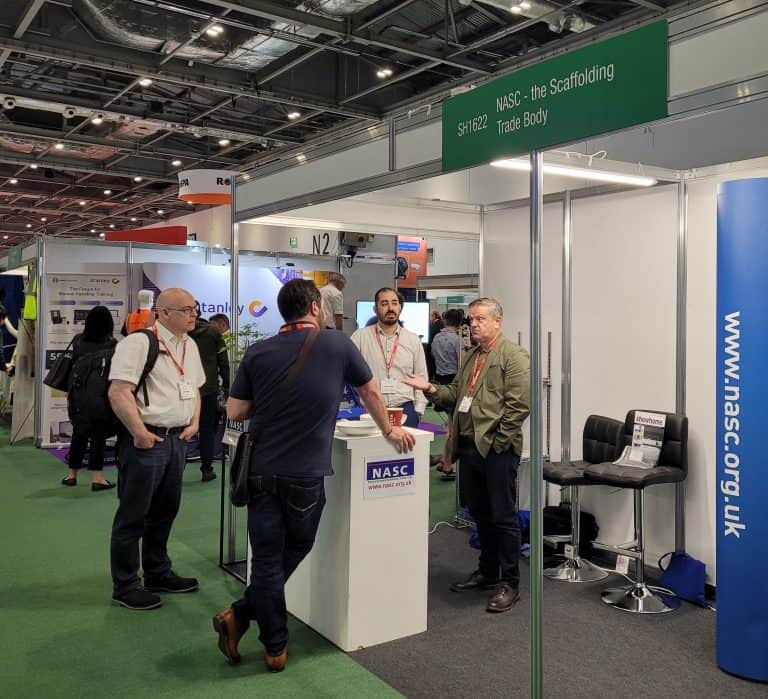
The NASC represented the scaffolding industry at the 2022 Safety & Health Expo, sharing industry best practice and advice with hundreds of health and safety professionals across the three-day London event.
NASC representatives gave out NASC guidance, NASC and CISRS site posters, digital copies of the latest NASC Safety Report and goodies such as NASC bags, pens and notepads while also answering any technical and health and safety questions visitors had.
Interest in NASC Information and Services & Ancillary Products membership was strong across the three days.
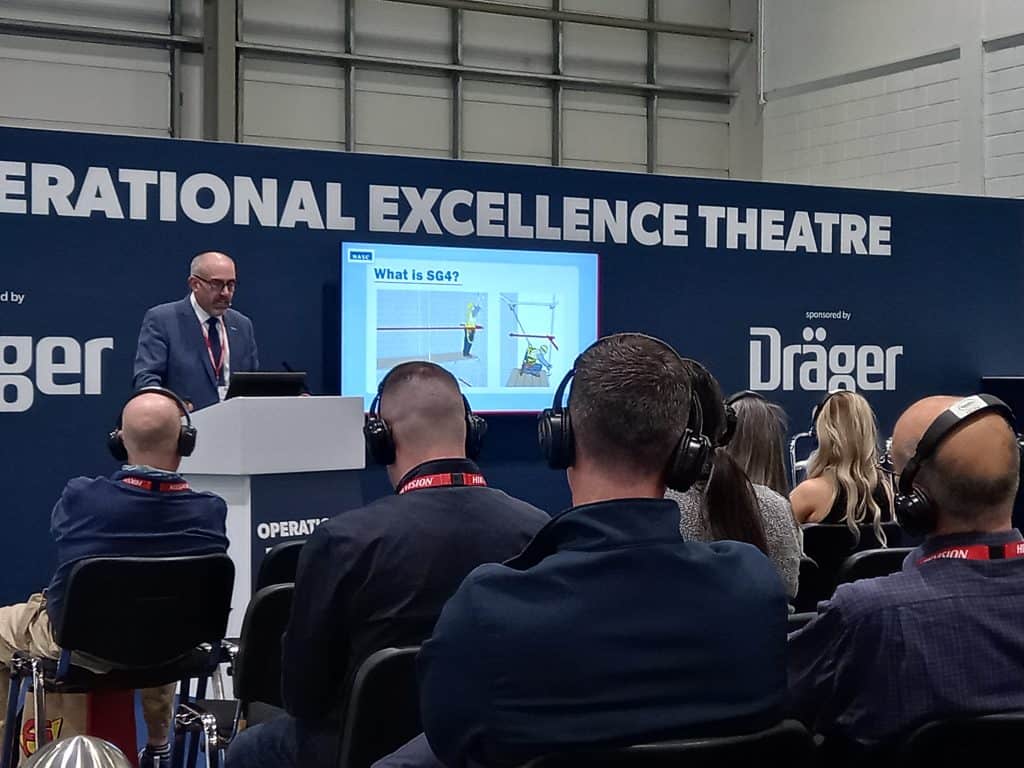
Delegates were also keen to learn more about the next iteration of SG4 Preventing Falls in Scaffolding Operations, which is due to be published this year, and many attended the SG4:22 presentation given by Simon Hughes, Director at SIMIAN and NASC Health and Safety Committee member, on the final day of the Expo.
Robin James, NASC Managing Director, said: “We always enjoy exhibiting at the Safety & Health Expo as it gives us a chance to re-connect with hundreds of health and safety professionals, disseminating the latest NASC guidance and information as well as answering any scaffolding industry questions visitors might have.
“My thanks go to the NASC members from Allen & Foxworthy, Pro-Fix Access, Midland Scaffolding Services, SIMIAN and TRAD Scaffolding Co that gave their time to represent the NASC across the three days and for all the visitors that stopped by our stand to speak with us.
“Exhibiting at the Expo helps us ensure vital health and safety scaffolding information is received and understood by those that need it, something that contributes to the excellent safety standards the industry has worked hard to establish and equally continues to work hard to maintain.”
 Robin James, NASC Managing Director, said: “We always enjoy exhibiting at the Safety & Health Expo as it gives us a chance to re-connect with hundreds of health and safety professionals, disseminating the latest NASC guidance and information as well as answering any scaffolding industry questions visitors might have.
“My thanks go to the NASC members from Allen & Foxworthy, Pro-Fix Access, Midland Scaffolding Services, SIMIAN and TRAD Scaffolding Co that gave their time to represent the NASC across the three days and for all the visitors that stopped by our stand to speak with us.
“Exhibiting at the Expo helps us ensure vital health and safety scaffolding information is received and understood by those that need it, something that contributes to the excellent safety standards the industry has worked hard to establish and equally continues to work hard to maintain.”
Robin James, NASC Managing Director, said: “We always enjoy exhibiting at the Safety & Health Expo as it gives us a chance to re-connect with hundreds of health and safety professionals, disseminating the latest NASC guidance and information as well as answering any scaffolding industry questions visitors might have.
“My thanks go to the NASC members from Allen & Foxworthy, Pro-Fix Access, Midland Scaffolding Services, SIMIAN and TRAD Scaffolding Co that gave their time to represent the NASC across the three days and for all the visitors that stopped by our stand to speak with us.
“Exhibiting at the Expo helps us ensure vital health and safety scaffolding information is received and understood by those that need it, something that contributes to the excellent safety standards the industry has worked hard to establish and equally continues to work hard to maintain.” Offshore scaffolders down tools on several North Sea platforms

Scaffolders and other maintenance workers on several North Sea platforms have staged unplanned strike action in an effort to force an increase in pay.
Workers on installations for some of the sector’s largest operators, including BP’s ETAP and Harbour Energy’s Judy, downed tools and caused widespread disruption with wildcat walkouts on Wednesday (18 May).
The strike has been described as a “wage revolution” by workers who believe they deserve a pay rise.
According to Energy Voice, the strikes were started by fabric maintenance staff on the TotalEnergies-operated Elgin platform and Safe Caledonia on Tuesday night.
Workers are seeking an increase to base rates of £7 per hour to help with the surge in inflation and the cost-of-living crisis.
Unions have said that they do not condone wildcat strike action, but are not surprised things have come to a head.
A BP spokesperson said the firm is monitoring the ongoing unplanned industrial action and liaising with the employing companies.
“Safety remains central to everything we do and we’re confident there’s no increased risk as a result of this action,” they said.
Bilfinger workers from several platforms have announced plans to down tools.
Bilfinger UK said it is working closely with its clients and employees to resolve the situation as soon as possible.
A spokesman said: “We understand that Bilfinger UK is one of a group of contractors with employees downing tools on assets in the North Sea. We are working closely with our clients and employees to resolve this as soon as possible.”
Construction workers protest over ‘derisory’ pay offer

The construction industry’s unprecedented skills shortage will worsen without a better deal, says GMB Union
Yesterday, construction workers were protesting a ‘derisory’ pay offer made by the Construction Industry Joint Council (CIJC).
Workers gathered outside a CIJC meeting in Central London in anger at an offer which is just over a third of today’s rampant 11 per cent inflation figure.
The CIJC is the largest agreement in the construction sector and governs the pay and conditions of around 500,000 workers (principally those in civil engineering and the biblical trades).
A pay claim was submitted by the joint trade unions in February, calling for a 10 per cent increase as well as radical improvements to sick pay and other benefits to bring them in line with other construction agreements.
The CIJC has so far failed to make an offer that comes anywhere near GMB members’ pay aspirations.
Charlotte Childs, GMB National Officer said:“The construction industry is facing an unprecedented skills shortage.
“Without meaningful improvements to the CIJC agreement, which sets out the minimum rates for all grades covered by the agreement, the shortage will likely worsen.
“The CIJC needs to show leadership in setting the appropriate rates for this highly skilled and highly motivated workforce – not this derisory offer.
“Our members are here today, ahead of pay negotiations to demonstrate the strength of feeling amongst the workforce.”
CITB to invest over £233m in British construction
With a strong focus on three core challenges for construction, CITB has published its Business Plan today (18 May), announcing it will be investing over £233m across Britain to support construction throughout 2022/23.
CITB’s investment plan responds to the estimated demand for an additional 50,000 workers every year and is primarily focused on securing construction’s talent pipeline. This year, the organisation will run and support a whole host of initiatives aimed not only at inspiring people outside of the industry to choose construction as their career, but also upskilling and retaining existing talent.
The three challenges set out by CITB are:

- Responding to the skills demands
- Developing the capacity and capability of construction training provision
- Addressing future skills needs.
Responding to the skills demands
Following the findings of the recent Rethinking Recruitment report, CITB’s plan details how it will invest in supporting apprenticeships and building bridges between further education and work to get more learners into construction. Initiatives such as SkillBuild, work experience, taster events, and the 350-strong STEM Ambassador network, aim to inspire more young people than ever to consider construction. In addition, CITB will collaborate with employers on the Go Construct website and promote the wide range of careers construction has to offer. Coinciding with efforts to get more people to think again about a construction career, CITB will create even more accessible routes into construction, focusing on apprenticeships, alongside on-site experiences, and future rollout of occupational traineeships. A total of £60.3m in direct grants will be available to employers who take on apprentices, supporting the industry to address its current and future need for a skilled workforce.
Developing the capacity and capability of construction training provision
As the industry recovers from the pandemic and demand for construction projects increases, CITB will make it easier to access the right training at a time and place that is right for them. CITB will:- Invest £25.9m in direct training delivery to enable the continuation of core skills training and training provision in niche and at-risk skills through CITB’s National Construction Colleges
- Support more than 300,000 Health Safety & Environment tests over the next year, ensuring there is good availability of tests in as many locations as possible, bringing assurance to employers that their workforce can keep themselves and those around them safe
- Offer enhanced grant support for priority skills such as Drylining apprentices and rainscreen cladding achievements.
Addressing future skills needs
Looking to the future, CITB’s plan sets out how it will address long-term challenges. The construction landscape is changing and issues such as net zero, digitisation and modern methods of construction are becoming increasingly important. CITB is investing £2.1m into research to better understand construction’s changing environment. This research will help focus CITB’s work on interventions that have the greatest impact, helping shape new training and standards development. Tim Balcon, CITB Chief Executive, said: “I am proud to be sharing my first business plan as Chief Executive at CITB, which sets out how CITB will approach its role in supporting industry going forwards. “While progress has been made, the construction industry has faced significant challenges in recent years, including inflation, rising fuel prices, the pandemic and Brexit, to name a few. In many ways the industry is still experiencing and feeling the impact of these events, which we know has shifted priorities greatly and pushed the demand for skills to the forefront. It’s essential now more than ever that efforts are focused on helping to alleviate those pressures and address the key needs of industry.” Read the full plan here.Coles Scaffolding Owner Nominated for Prestigious Award

The owner of Coles Scaffolding Contractors based in Swindon has been shortlisted for a National Diversity Award following his ground-breaking efforts.
Regular readers will know all about Todd Scanlon, the talented scaffolder with downs syndrome employed by Martyn Coles. This young man has been proving nothing should be a barrier in life given the wonderful opportunity provided by his mentor. Todd loves his role as a scaffolder and Martyn always goes the extra mile to support his professional development going forward.
Mr Coles has been a long-time advocate and supporter of Swindon Downs Syndrome Group, the DSA and WorkFit. He’s also a greatly experienced advanced scaffolder in his own right.
The businessman, well known throughout Wiltshire is passionate about both diversity and inclusion. Not just talking the talk, this popular figure believes fully in setting the best example to everyone not just in the scaffolding industry but across the board.
And to prove it, he employs a diverse and inclusive team, creating work opportunities for all kinds of people, including those with disabilities, individuals coming out of prison, or recovering from alcohol and drug addiction. In fact, anyone who has the required drive, skill and talent to succeed no matter what background they come from.
Martyn works tirelessly to support communities, including those with disabilities and mental health illnesses. Over the years, this heart-warming entrepreneur has raised thousands of pounds as an active trustee for Swindon Down’s Syndrome Group.
The group has been supporting people with Down’s syndrome, and their families since 1984. They now have more than 100 members ranging from children and adults with Down’s syndrome, their parents, carers and supporters in the local community.
Established in 2013, Martyn’s company are a small firm priding itself on being fast, reliable and compliant, with friendly and highly professional staff at its core. They specialize in all types of scaffolding from access towers, new builds and temporary roofs – not forgetting domestic and commercial scaffolding.
For Martyn it’s not just about running a successful business, it’s also about putting something back into the community, it’s just as important. This vibrant approach is winning him friends without question, but also setting others onto a path ready to transform the scaffolding industry here in the UK and hopefully beyond.
Those who have a presence on LinkedIn can search for Martyn to find out more about his incredible work. People across the scaffolding and access industry are being asked to offer their support by voting for Martyn. The deadline for votes is this Friday, May 20th.
Anyone can vote for Martyn by clicking on this link https://lnkd.in/eruGv6nN
His company hashtag #Nostigmahere
ITP expands presence in Leeds at another major renewal project

ITP’s Powerclad scaffold sheeting has been chosen to provide containment and protection throughout a landmark redevelopment in Leeds which will transform two of the city’s historic buildings into 17,490 sqm of student living space.
The £62m project is currently underway on Rossington Street, which will see the refurbishment of both Leonardo Printworks and Thoresby House alongside the construction of a new block.
Acquired by McLaren Properties, the Grade II listed Victorian buildings will provide contemporary accommodation with 476 rooms in a mix of studio and cluster apartments. The additional 11-storey property will be built on the existing car park and the site will boast a wide range of amenities, from student hub facilities to outdoor communal space.
Robertson Construction has been appointed as contractor for the Cartwright Pickard-designed scheme, which is set for completion by August 2023 for use in the following academic year. The new accommodation is located in the city’s Civic Quarter, ten minutes’ walk from the University of Leeds, Leeds Teaching Hospitals and Leeds Beckett.
ITP’s Powerclad Premium FR printed sheeting and Powerclad Standard FR unprinted sheeting were supplied to Crossway Scaffolding to provide an improved working environment with significant environmental and safety benefits.
Powerclad’s usage minimises weather-induced delays to projects, enhances site safety by preventing the fall of debris and improves the working area by reducing wind-chill factor and aiding heat retention. Powerclad FR sheeting is independently tested to achieve fire retardancy certification to all relevant standards including BS 7955, TS 62, TS 63 and Euroclass B-s1,d0 EN 13501-1.
Joanna Fearnehough, Commercial Assistant at Crossway Scaffolding, said: “Crossway Scaffolding are proud to have been appointed the contract by Robertson late in 2021, to provide scaffolding to Leonardo Building, Leonardo Printworks and Thoresby Building as well as the new build.
As sub-contractors, we were responsible for providing external fire retardant Powerclad 2.2M in 40M rolls. We contacted ITP to supply this as we usually do, and with next-day delivery our requirements were met immediately.
Crossway chose to use 2.2M sheeting to reduce gaps in the Powerclad, reducing weather impacts and increasing site-safety. ITP gave us draft images of what the printed sheeting would look like to give to the client and provided an excellent service throughout. We look forward to working with them on future projects.”
ITP Account Manager, Dave Gilmore, added: “ITP are very proud to be part of another high-profile development in Leeds, which will see a thoughtful reuse of two existing listed council buildings into well-designed student accommodation.
We are delighted to continue working in support of Crossway Scaffolding and we’re looking forward to seeing the completion of the buildings.”
LIFTBOT opens access to the digital world

Since receiving CE certification in December 2020, KEWAZO has delivered its robotic material hoist LIFTBOT to its customers throughout Europe.
While the German market leader Bilfinger arnholdt already relies on LIFTBOT since April 2021, now, and among others, Bilfinger UK as well as Altrad Services, with its facilities in the UK and Belgium, have followed suit.
In addition to LIFTBOT, the Munich-based startup also provides its Data Analytics platform KEWAZO ONSITE as part of its comprehensive solution. Operational data crucial for the construction progress and performance is collected via an array of sensors. This data is analyzed and displayed on KEWAZO ONSITE in real-time using an integrated LTE interface via a cloud-based infrastructure and services.
KEWAZO ONSITE focuses on three key metrics:
 Sebastian Dietrich, Project Manager of KEWAZO’s lead customer Bassenberg & Schwarting, appreciates the motivating character of KEWAZO ONSITE. Now Dietrich has a new way to set concrete targets for his site managers and scaffolders.
The project progress is communicated through automated WhatsApp notifications from KEWAZO ONSITE. In this way, all employees receive daily feedback on their performance and progress automatically and without additional effort.
To further increase motivation at work, KEWAZO is currently piloting a gamification concept, where scaffolders have the opportunity to compare their performance with each other and even with peers from other companies. Awards, in the form of gift cards and/or vouchers, will further serve as motivating incentives for outstanding achievements.
In the future, KEWAZO plans to expand its digital products and services. The data collected will soon, for example, be used to create the basis for automated project planning. Artificial Intelligence via Machine Learning will enable KEWAZO’s customers to use resources more efficiently as well as to enhance their logistics strategies.
https://www.kewazo.com/
This article was first published in the ScaffMag Magazine Issue 16
Sebastian Dietrich, Project Manager of KEWAZO’s lead customer Bassenberg & Schwarting, appreciates the motivating character of KEWAZO ONSITE. Now Dietrich has a new way to set concrete targets for his site managers and scaffolders.
The project progress is communicated through automated WhatsApp notifications from KEWAZO ONSITE. In this way, all employees receive daily feedback on their performance and progress automatically and without additional effort.
To further increase motivation at work, KEWAZO is currently piloting a gamification concept, where scaffolders have the opportunity to compare their performance with each other and even with peers from other companies. Awards, in the form of gift cards and/or vouchers, will further serve as motivating incentives for outstanding achievements.
In the future, KEWAZO plans to expand its digital products and services. The data collected will soon, for example, be used to create the basis for automated project planning. Artificial Intelligence via Machine Learning will enable KEWAZO’s customers to use resources more efficiently as well as to enhance their logistics strategies.
https://www.kewazo.com/
This article was first published in the ScaffMag Magazine Issue 16
- Efficiency: Weight transported, target height of the scaffold, and utilization rate.
- Internal factors: Status of individual LIFTBOT components such as motors, breaks, and battery.
- External factors: GPS, the worksite itself, and local weather conditions.
 Sebastian Dietrich, Project Manager of KEWAZO’s lead customer Bassenberg & Schwarting, appreciates the motivating character of KEWAZO ONSITE. Now Dietrich has a new way to set concrete targets for his site managers and scaffolders.
The project progress is communicated through automated WhatsApp notifications from KEWAZO ONSITE. In this way, all employees receive daily feedback on their performance and progress automatically and without additional effort.
To further increase motivation at work, KEWAZO is currently piloting a gamification concept, where scaffolders have the opportunity to compare their performance with each other and even with peers from other companies. Awards, in the form of gift cards and/or vouchers, will further serve as motivating incentives for outstanding achievements.
In the future, KEWAZO plans to expand its digital products and services. The data collected will soon, for example, be used to create the basis for automated project planning. Artificial Intelligence via Machine Learning will enable KEWAZO’s customers to use resources more efficiently as well as to enhance their logistics strategies.
https://www.kewazo.com/
This article was first published in the ScaffMag Magazine Issue 16
Sebastian Dietrich, Project Manager of KEWAZO’s lead customer Bassenberg & Schwarting, appreciates the motivating character of KEWAZO ONSITE. Now Dietrich has a new way to set concrete targets for his site managers and scaffolders.
The project progress is communicated through automated WhatsApp notifications from KEWAZO ONSITE. In this way, all employees receive daily feedback on their performance and progress automatically and without additional effort.
To further increase motivation at work, KEWAZO is currently piloting a gamification concept, where scaffolders have the opportunity to compare their performance with each other and even with peers from other companies. Awards, in the form of gift cards and/or vouchers, will further serve as motivating incentives for outstanding achievements.
In the future, KEWAZO plans to expand its digital products and services. The data collected will soon, for example, be used to create the basis for automated project planning. Artificial Intelligence via Machine Learning will enable KEWAZO’s customers to use resources more efficiently as well as to enhance their logistics strategies.
https://www.kewazo.com/
This article was first published in the ScaffMag Magazine Issue 16 Exclusive: Layher set to launch ground-breaking new beam at UK event
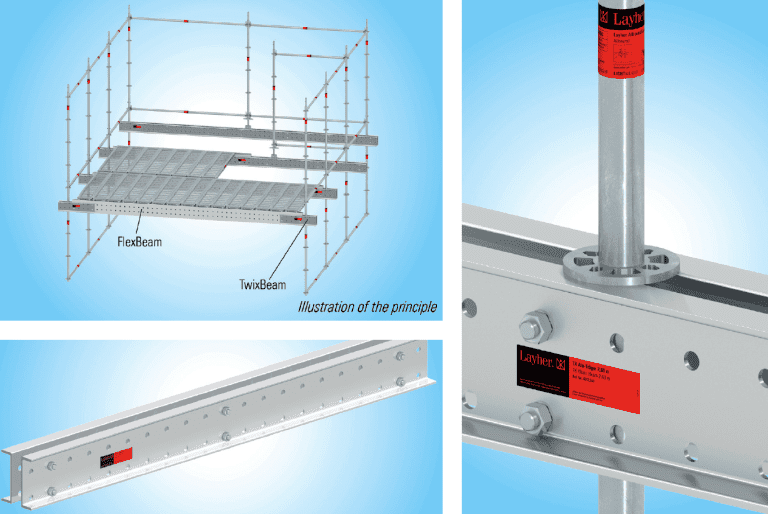
Layher the world’s largest system scaffolding manufacturer is poised to reveal a brand-new revolutionary beam at its UK open day in Letchworth later this year.
Layher system scaffolding users and customers in the UK are set to benefit from the launch of a ground-breaking new multifunctional beam named the ‘TwixBeam’.
The new two-piece beam which is rumoured to be named after a well-known chocolate bar is made entirely from high-grade aluminium and produced at the world-famous Layher Eibensbach factory near Stuttgart in Germany.
Scaffmag understands that bosses at Layher UK are planning to reveal the new TwixBeam at its invite-only open day later this year.
The hotly anticipated event which attracts hundreds of Layher system enthusiasts and customers alike will be the first Layher UK event since the Covid pandemic hit our shores in 2020.
The new TwixBeam that will be headlining the event is marketed as a low weight, easy to dismantle and incredibly strong beam that effortlessly integrates into the Layher Allround System.
It even works perfectly in tandem with the highly successful and incredibly versatile Flexbeam that launched in 2018.
Check out the promo video below highlighting the TwixBeam’s benefits and uses.
Weighing just 12kg/m the new smart multifunctional beam will be available in an array of lengths from 0.8m to an impressive 6.6m and will have more uses than you can shake a stick at.
According to sources, the TwixBeam will have umpteen uses for specialist scaffolding contractors including conventional scaffolding, industrial scaffolding/boiler scaffolds and shoring in combination with TG60.
Speaking about the new TwixBeam, Sean Pike Layher UK’s Managing Director said: “We are proud of our long standing reputation for being the innovators in the industry, and the new Twixbeam is testament to our commitment to our customers and finding new fields of business for them with these solutions parts”.