There’s no doubt about it: increasing diversity in the construction industry in general and the scaffolding trade in particular, makes a positive difference, explains Des Moore, TRAD Group CEO and NASC President (2017-19)
In fact, it significantly improves commercial performance, increases innovation and collaboration and boosts both productivity and brand reputation. And in today’s world, where there is a long pipeline of works, a shortage of skilled staff and an expectation that suppliers take their responsibility seriously, it’s more important than ever that we make our industry an attractive option for everyone – whether on-site or office-based.
Our industry should be open to everyone who wants to work in it. And to me, it makes no difference who those people are. In fact, I’ve been actively involved in encouraging women, LGTBQIA+, ex-military and ex-prison and those who feel marginalised by society, to think about the scaffolding industry as an option for them.
All walks of life welcome
Not long before the pandemic struck, TRAD hosted a seminar called All walks of life welcome. It was incredibly well attended, showing that companies are taking their diversity responsibilities seriously and not just paying lip service. TRAD is committed to giving everyone a chance within a tolerant and supportive workplace – and we think this should be the norm, not unusual.
And there’s still much to do. Our strength lies in our differences, not our similarities. And our different experiences of life means we can bring a lot of learning to those we work with – as colleagues and to our clients for the benefit of all. But in order to maintain – and preferably to speed up – progress, there are two clear things that all companies in the industry need to commit to:
Make the industry more attractive to applicants – we need to make more of the role models we already have for diversity in the industry. The more common it is to see someone who looks like you in construction, the more likely you are to consider it as an option. Let’s work together to promote construction and scaffolding as an industry for anyone. And industry that supports its own to succeed and an industry that’s a safe space for all.
Look at our ways of working – we are a traditional industry with a traditional approach. But over the past 12 months or more, we’ve seen that construction can still work with people working remotely, working different hours and managing different processes. We should be retaining that flexibility for all our people, helping them to make good choices about work-life balance. Supporting people’s home circumstances means greater productivity at work. It’s our responsibility as business owners and managers to make sure that our workplaces are welcoming, flexible and accommodating
“Encouraging more women into construction is something I actively promoted during my period as President of the NASC – and I am delighted that I was succeeded as President by Lynn Way.”
Tackling gender inequality
For example, we shouldn’t assume that, because we are seen as a traditionally male-dominated industry, women aren’t welcome. Or aren’t talented. Or can’t deliver value. In my experience, it’s the exact opposite. At TRAD, where I have been for over 30 years now, it has always been one of my objectives to balance the business and ensure that anyone who wants to work with us can: currently, 40% of our Board is made up of women; 60% of our Group support office and 25% of our scaffolding business staff are women, and we have female depot heads and sales representatives in our other TRAD companies.
Encouraging more women into construction is something I actively promoted during my period as President of the NASC – and I am delighted that I was succeeded as President by Lynn Way. I wanted to see more women to come into the industry in the first place, and I wanted them to see that they can see there is a career path for them. Together with TRAD, the NASC sponsored the ‘Inspire me’ campaign, which hosted a number of roadshows around the country to highlight the barriers that women might face when they come into the industry, and how we can all work together to change things.
What can we do?
- All leaders must buy in – equality and diversity doesn’t happen by itself. It takes an understanding from the leadership team that promoting a diverse workforce will bring quantifiable business benefits. That understanding must be translated into real and genuine public commitment by the Board or senior leadership team to improve the diversity of the workforce.
- We must challenge assumptions – unconscious bias exists, and it can have a negative effect on your business across all functions, from recruitment to promotions. You can run training and workshops that help your people to see where that unconscious bias exists and learn how to think more openly, looking for talent, skill and attitude from all candidates and employees.
- Measure progress – measuring your progress helps to prove success. Whether you do this by publishing your own gender pay gap statistics and committing to reducing any gaps you have; or you have a target for diversity on your leadership teams or your board, it helps to be able to show how far you have come.
I’m proud of the work we have done at TRAD to bring in talented, skilled, dedicated and creative and diverse people to our teams. It has undoubtedly changed our business for the better, and given our apprentices and management trainees great role models to look up to. We must keep challenging the traditional outlook, championing construction as a career option for anyone and everyone if we are to succeed as a sector in the future.
This article was first published in the ScaffMag Magazine Issue 13




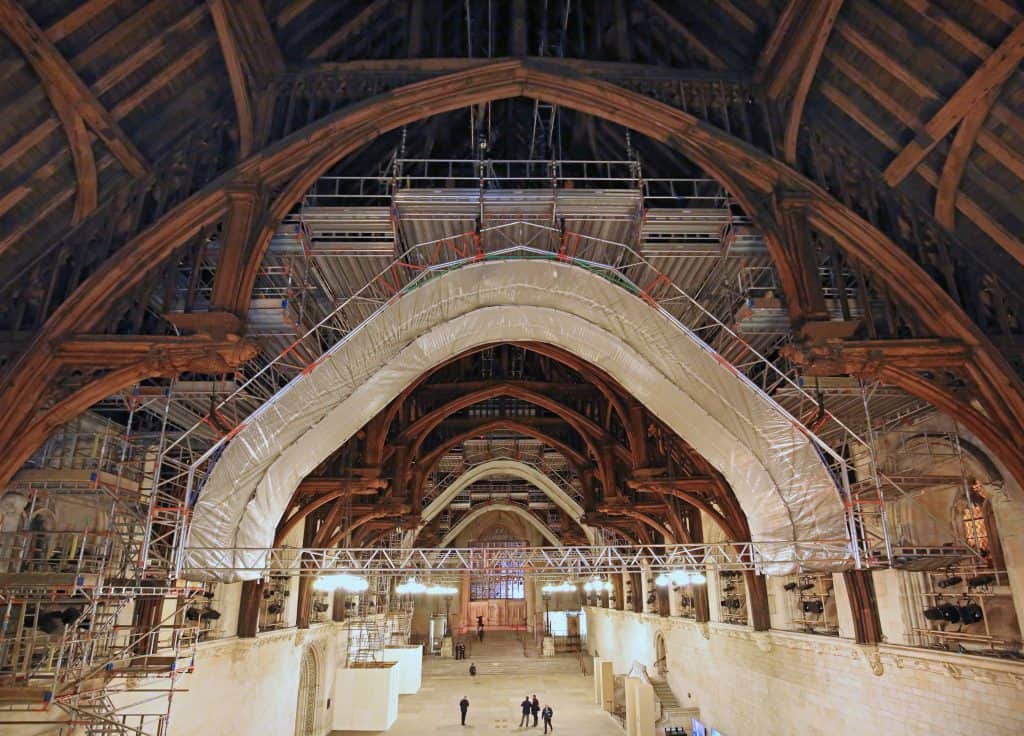 Hanging a scaffold by hoists & chains 28m in the air turned into a real labour of love for Rochester based Alltask, and they certainly rose to the challenge given what in real terms was such a complicated design brief. Liam Duffy, Contracts Director for Alltask Scaffolding, explained, “The scaffolding was in preparation for large-scale conservation and refurbishment work & quite rightly, great care had to be taken given the historical importance of such an iconic building. Liam also says, “Being involved in this project has been a privilege from start to finish for my entire team”.
The roof structure within Westminster Hall is comprised of 14 individual bays, 12 of these bays were suspended via Alltask purpose-built HAKI access rigs. However, the smaller bays at either end of the Hall had to be constructed from ground level, which presented another challenge as one of the criteria was to ensure that the scaffolds were as ‘invisible’ as possible. Achieving this with the suspended rigs wasn’t such a challenge, as when lifted into their highest position were barely visible from the hall floor. But, how do you hide a scaffold at ground level? Not a problem for Alltask, who created a printed screen fixed to the scaffold that mirrored the hall’s existing walls and features.
Hanging a scaffold by hoists & chains 28m in the air turned into a real labour of love for Rochester based Alltask, and they certainly rose to the challenge given what in real terms was such a complicated design brief. Liam Duffy, Contracts Director for Alltask Scaffolding, explained, “The scaffolding was in preparation for large-scale conservation and refurbishment work & quite rightly, great care had to be taken given the historical importance of such an iconic building. Liam also says, “Being involved in this project has been a privilege from start to finish for my entire team”.
The roof structure within Westminster Hall is comprised of 14 individual bays, 12 of these bays were suspended via Alltask purpose-built HAKI access rigs. However, the smaller bays at either end of the Hall had to be constructed from ground level, which presented another challenge as one of the criteria was to ensure that the scaffolds were as ‘invisible’ as possible. Achieving this with the suspended rigs wasn’t such a challenge, as when lifted into their highest position were barely visible from the hall floor. But, how do you hide a scaffold at ground level? Not a problem for Alltask, who created a printed screen fixed to the scaffold that mirrored the hall’s existing walls and features.
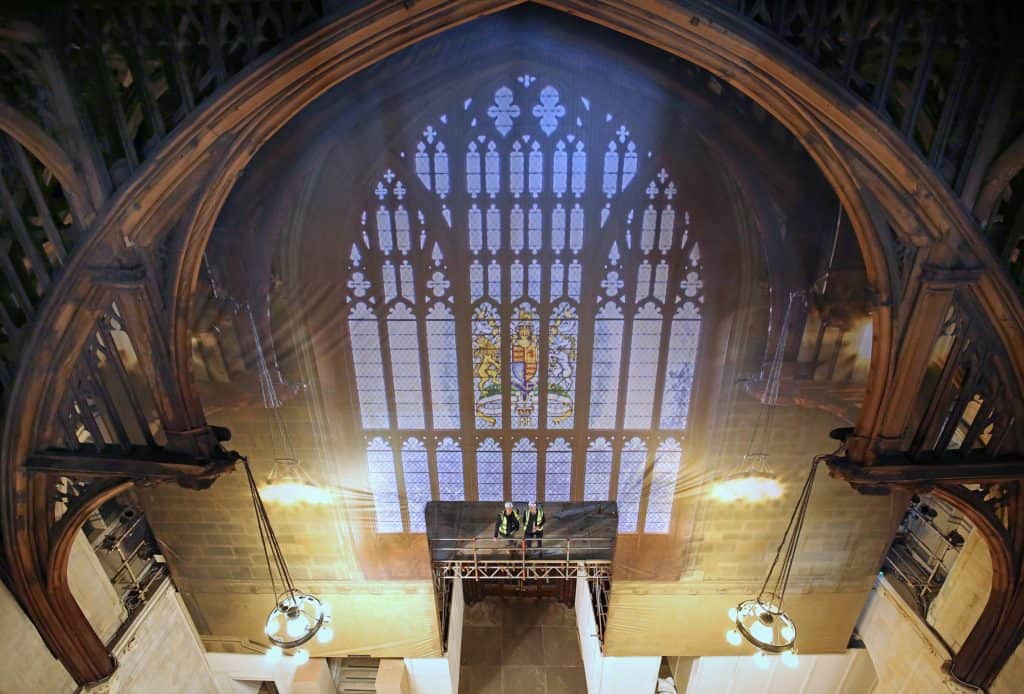 Alltask operatives involved in this major project were trained and competent in rigging, slinging, scaffolding, HAKI system trained & MEWP trained.


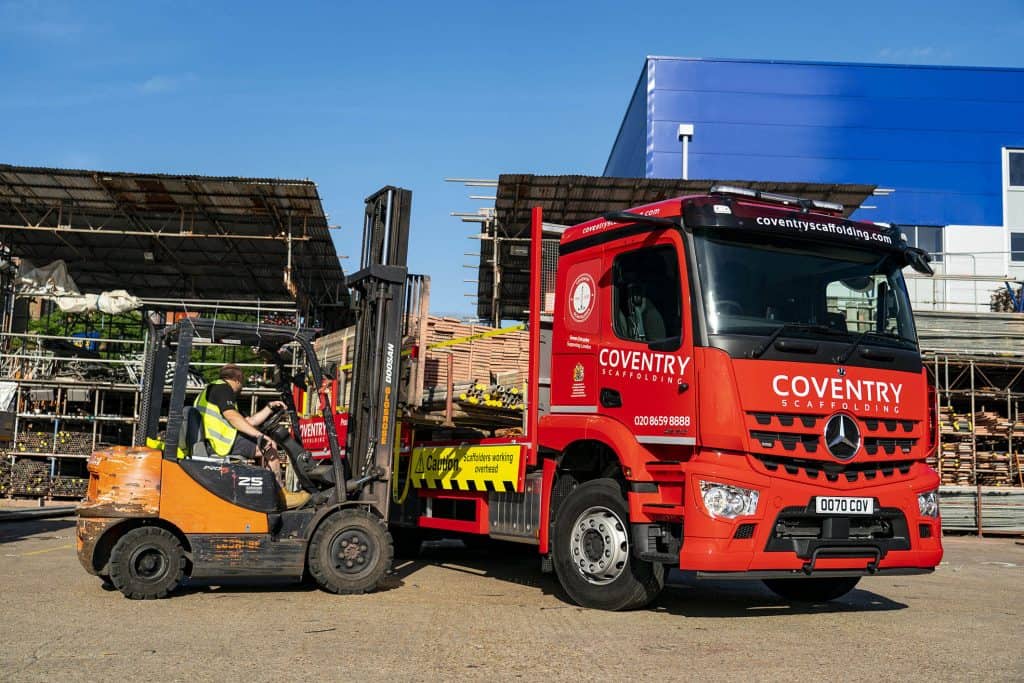 A 2530L model with 220 kW (300 hp) 7.7-litre in-line six-cylinder engine, the Arocs is the subject of a flexible and cost-effective Agility plan from Mercedes-Benz Finance. Agility offers all the benefits of conventional hire purchase with a balloon payment – including low monthly repayments – but provides customers with a variety of options at the end of the term.
Coventry Scaffolding was established in 1950 by Patrick Hanifan, who chose the name because of its association with the post-World War II rebuilding work being carried out at the time in the Midlands city – he later contemplated changing this to one that evoked a sense of London, but never did so as the business continued to go from strength-to-strength.
One of London’s largest independent scaffolding companies, Coventry Scaffolding has been managed since Patrick’s retirement in 1992 by his sons Perry and Paul. It runs a fleet of 13 trucks in which two other brands hold sway – in addition to its new Mercedes-Benz, the line-up comprises four tractor units, six 18-tonners and a pair of 7.5-tonners.
Coventry Scaffolding initially approached Sparshatt Truck & Van because it was interested in acquiring a new, DVS-compliant tractor unit. The 26-tonne Arocs had the right cab and had been pre-built with a scaffold body for sale from stock, so Sales Executive Shaun O’Hara drove this vehicle to the operator’s premises in Bell Green, for Perry and Paul Hanifan to see.
They liked the rigid so much that they bought it there and then, and have since ordered an Actros 1843 tractor unit. Due for delivery in September, it will have a 2.3 m-wide (the narrower of the two widths available) ClassicSpace L-cab with 320 mm engine tunnel – this specification, together with MirrorCam, means this vehicle will attract four Direct Vision stars.
Re-painted in Post Office red – complete with colour-coded bumper – at Sparshatt Truck & Van’s own bodyshop in Sittingbourne, the Arocs wears a specially designed livery that celebrates the seven decades over which Coventry Scaffolding has been trading.
Perry Hanifan recalled: “We wanted a stand-out vehicle on which to highlight our 70th anniversary milestone and Sparshatt’s truck fitted the bill perfectly. I’m a Mercedes-Benz car driver so Shaun didn’t have to sell the brand to me – it looks fantastic.”
He continued: “Image is all well and good, but we’re running a business, so the Arocs had to stack up from an operational point of view too. Not only are we looking forward to benefiting from the reliability and durability for which Mercedes-Benz products have long been renowned, but the truck also came with a full complement of safety technology and the three-star DVS rating that our established chassis supplier couldn’t offer.”
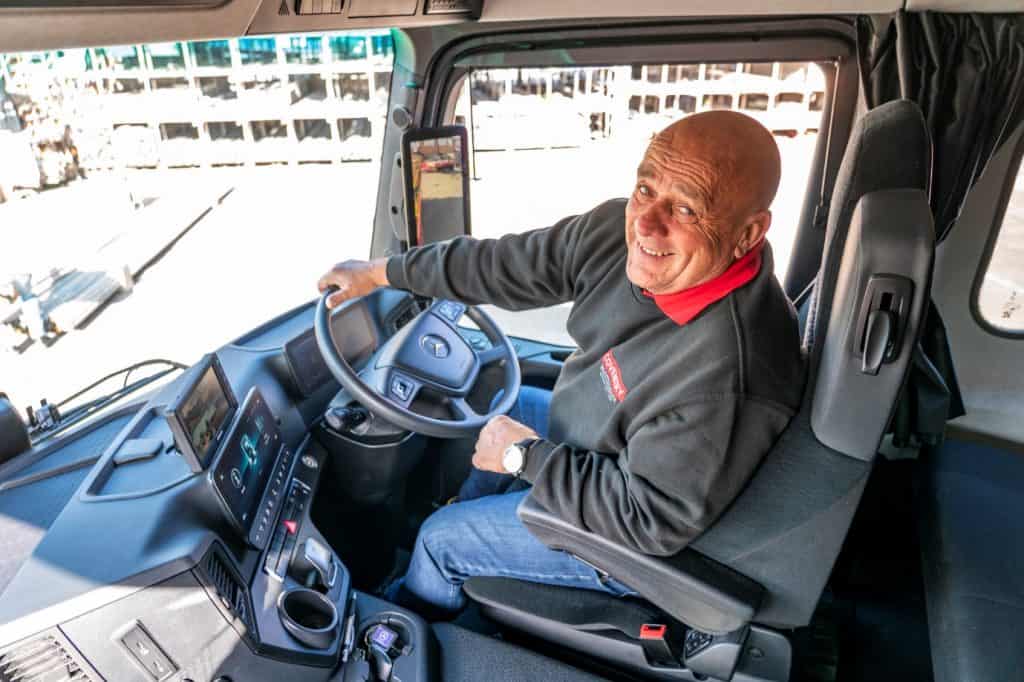
Driver Gary Hiley has certainly taken to MirorCam, and is equally enthusiastic about the radical Multimedia Cockpit, which has replaced traditional switchgear with stylish and intuitively operated twin screens.
A 2530L model with 220 kW (300 hp) 7.7-litre in-line six-cylinder engine, the Arocs is the subject of a flexible and cost-effective Agility plan from Mercedes-Benz Finance. Agility offers all the benefits of conventional hire purchase with a balloon payment – including low monthly repayments – but provides customers with a variety of options at the end of the term.
Coventry Scaffolding was established in 1950 by Patrick Hanifan, who chose the name because of its association with the post-World War II rebuilding work being carried out at the time in the Midlands city – he later contemplated changing this to one that evoked a sense of London, but never did so as the business continued to go from strength-to-strength.
One of London’s largest independent scaffolding companies, Coventry Scaffolding has been managed since Patrick’s retirement in 1992 by his sons Perry and Paul. It runs a fleet of 13 trucks in which two other brands hold sway – in addition to its new Mercedes-Benz, the line-up comprises four tractor units, six 18-tonners and a pair of 7.5-tonners.
Coventry Scaffolding initially approached Sparshatt Truck & Van because it was interested in acquiring a new, DVS-compliant tractor unit. The 26-tonne Arocs had the right cab and had been pre-built with a scaffold body for sale from stock, so Sales Executive Shaun O’Hara drove this vehicle to the operator’s premises in Bell Green, for Perry and Paul Hanifan to see.
They liked the rigid so much that they bought it there and then, and have since ordered an Actros 1843 tractor unit. Due for delivery in September, it will have a 2.3 m-wide (the narrower of the two widths available) ClassicSpace L-cab with 320 mm engine tunnel – this specification, together with MirrorCam, means this vehicle will attract four Direct Vision stars.
Re-painted in Post Office red – complete with colour-coded bumper – at Sparshatt Truck & Van’s own bodyshop in Sittingbourne, the Arocs wears a specially designed livery that celebrates the seven decades over which Coventry Scaffolding has been trading.
Perry Hanifan recalled: “We wanted a stand-out vehicle on which to highlight our 70th anniversary milestone and Sparshatt’s truck fitted the bill perfectly. I’m a Mercedes-Benz car driver so Shaun didn’t have to sell the brand to me – it looks fantastic.”
He continued: “Image is all well and good, but we’re running a business, so the Arocs had to stack up from an operational point of view too. Not only are we looking forward to benefiting from the reliability and durability for which Mercedes-Benz products have long been renowned, but the truck also came with a full complement of safety technology and the three-star DVS rating that our established chassis supplier couldn’t offer.”
Driver Gary Hiley has certainly taken to MirorCam, and is equally enthusiastic about the radical Multimedia Cockpit, which has replaced traditional switchgear with stylish and intuitively operated twin screens.


 CLC co-chair Andy Mitchell said: “We have reports from across the industry of plants, sites and offices having to wind down activities as staff have been asked to isolate. This is putting very significant pressure on the sector, risking project delivery and even the viability of some firms.
“Where staff are already fully vaccinated, and recognising that such people will be free to work from 16 August anyway, we are asking the Government to bring forward this date for essential industries like construction, ensuring that the industry doesn’t grind to a halt”
CLC co-chair Andy Mitchell said: “We have reports from across the industry of plants, sites and offices having to wind down activities as staff have been asked to isolate. This is putting very significant pressure on the sector, risking project delivery and even the viability of some firms.
“Where staff are already fully vaccinated, and recognising that such people will be free to work from 16 August anyway, we are asking the Government to bring forward this date for essential industries like construction, ensuring that the industry doesn’t grind to a halt”