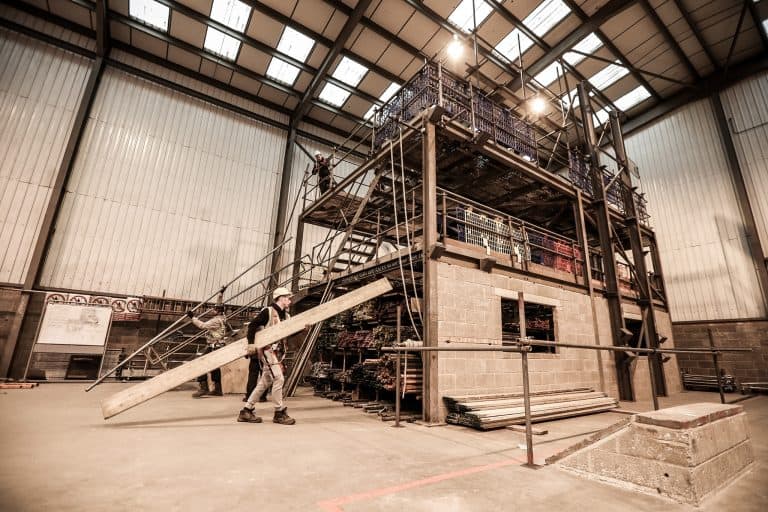
Burflex Scaffolding is poised to start work on a 17 storey £61m flats complex in Sheffield’s City Centre.
The East Yorkshire based company has been awarded the substantial contract and are set to provide a full scaffolding package starting in July.
Leading construction firm Watkin Jones awarded the scaffolders the contract. Watkin Jones has entrusted Burflex on a number of other projects in Sheffield and Leicester. The Welsh construction business is tasked with building the large redevelopment project located on Rockingham Street in Sheffield’s City Centre.
The development comprises of five blocks, up to 17 storeys with 794 beds for mainly student accommodation. Additionally, 106 beds will be for up-market flats aimed at young professionals.
The new blocks will be built on the old Grunwergs site, former home to houseware and catering products supplier Grunwerg.
ScaffMag understands that Burflex will be providing and erecting over 12,000m of scaffolding, 234 loading bay lifts and using 336m of beams. The project will also be wrapped and sheeted using 7,500m2 of monoflex.
Teams of Burflex scaffolders are set to start erecting from 1st July 2020 with the dismantling phase concluding by the end of May 2021.
Gareth Kay, Burflex Cost & Estimating Manager said: “We are delighted to have been awarded this prestigious contract in Sheffield City Centre, this is another significant win for the business to complement our other ongoing contracts within the Burflex Projects Division. This win and other recent wins further demonstrate our proven capability at delivering these large and complex major construction projects.
Our relationship with Watkin Jones has really flourished over the last 3 years due to our safe approach and can-do attitude. We have enjoyed repeat business following the completion of 3 other sites in Sheffield and we are also currently working on a site a similar size to Grunwergs in Leicester where the scaffold erection is currently nearing completion.”
“Since opening our Leeds office and Depot last year we have continued to grow and deliver within this sector and we are certainly looking forward to targeting and achieving further growth.
It is also worth noting that as part of the Grunwergs contract Burflex are tasked to employ local labour from Sheffield, as such we are actively recruiting in the area.”
CITB has today announced its plan to help employers recover from the impact of Coronavirus, including a substantial reduction in Levy bills.
The CITB has published its Skills Stability Plan 2020-21 which protects apprenticeships and provides direct funding to employers to adopt new ways of working needed in the wake of Covid-19.
The training board have announced that employers will continue to have a payment holiday on the Levy until September and then up to a full year to pay the 2020/21 levy.
They also say it will propose a 50% discount on the 2021/22 Levy rate. This means employers will pay 18 months’ Levy out of 24, making an overall saving of 25% across two years.
For example, An employer with an average annual levy bill of £1,200 would normally pay £2,400 over 2020-22. Instead, they will pay nothing from April to August this year and then take advantage of spreading the costs – £100 per month up to February 2022, paying £1,800 overall.
The changes will see CITB’s forecast Levy income drop by £166m across two financial years, it said.
However, despite this large drop in income, the CITB stressed that its Skills Stability Plan will protect apprenticeships, direct funding to employers and the Grants Scheme.
CITB has also confirmed it is also cutting costs and using its reserves to support employers’ skills needs.
CITB Chief Executive Sarah Beale said: “This represents a radical plan of action that balances the need for a reduction in the Levy at this time, alongside vital investment in the skills needed by employers now and in the future.“It is the result of hundreds of conversations with employers across the length and breadth of Britain and I’m confident it meets the sector’s immediate needs.We are committed to making the Levy work hard to protect apprenticeships and support hard-pressed employers as they equip themselves for the challenges and opportunities ahead.”CITB will now seek the views of industry employers and federations about the development of a new strategic plan, covering 2021-23, with the plan expected to be published in September. Sarah Beale added: “We have spoken to employers and federations and most have suggested that they want us to focus full-time on helping the industry meet the challenges posed by Covid. We have confirmed with the Department for Education that we will not run the usual Consensus process and instead we will speak to employers and industry groups to seek their views on our plans for next year.
“We will continue to be responsive and collaborative, working closely with the sector and Government to return the industry to growth. We will listen to industry and respond to its priorities and give every employer the confidence that we wish to understand and learn from their concerns and ambitions.”
Mark Reynolds, Mace Group Chief Executive and Skills Workstream Lead at the Construction Leadership Council (CLC), said: “Our industry has come together to develop an effective plan to come back from the effects of Covid-19, as detailed in the CLC’s Roadmap to Recovery document. CITB’s Skills Stability Plan builds on this work and clearly outlines how they will play their part in delivering the skills we need. We very much support efforts made by the CITB to substantially reduce the Levy. It is right that Consensus is delayed so we can work together to make sure that our recovery, still in its early stages, is as strong as possible.”
Read the full announcement here
Kee Safety a leading global supplier of fall protection and work at height solutions has acquired scaffolding and access training provider Safety and Access Ltd.
Kee Safety Ltd which specialises in the global supply of bespoke fall protection systems and equipment for working at height has signed a deal to take full ownership of the CISRS approved training provider.
The buyout, for an undisclosed sum, will see Kee Safety have overall control of Safety & Access’s operations here in the UK.
However, Rick Statham, Safety & Access Joint Managing Director stressed: “There will be no changes at all, It’s business as usual here in the UK and with our network of international partners”
“I am delighted with the acquisition as the deal will secure the future of the business and its staff. It will also place us in the perfect position for further expansion. We have been in discussion with Kee Safety Ltd since 2019, they are a great fit for the Safety & Access brand.”
Safety & Access have confirmed to ScaffMag that both existing Directors Rick Statham and Ray Johnson will remain in their positions and their staff structure will remain the same.
It’s is one of the UK’s leading scaffolding and access training and H&S consultancy providers offering a wide range of professional support services to a broad range of industry sectors for almost 30 years.
They have purpose-built training venues in Nottingham, Humberside and London. The business also provides training overseas in the Middle East, Far East and beyond.
A scaffolding company has been fined £5000 after one of its workers fell from an eight-meter-high scaffold.
JR Scaffolding Services has claimed responsibility in court after a cantilever scaffold collapsed leaving a scaffolder with serious injuries in September 2016.
The 47-year-old scaffolder sustained a collapsed lung, a ruptured spleen, and multiple rib and shoulder fractures. His spleen was also removed as a result of the incident.
The Paisley based company pleaded guilty on Tuesday at Glasgow Sheriff Court to failing to make suitable and sufficient risk assessments. The firm also admitted failing to provide a safe system of work to be followed by employees. And it failed to ensure the tower scaffold was attached to the building
The court heard there were not enough anchors to secure the scaffold to the building in Glasgow’s Alexandra Parade and instead used a friction tie.
It was also found the scaffolding structure was erected in the wrong place at the property.
According to reports, JR Scaffolding Services Managing Director instructed a cantilever to be built onto the existing scaffold rather than dismantling the entire structure.
Prosecutor Selina Brown told the court that the cantilever was attached to the existing scaffold with rope. The scaffolder pulled the cantilever up as parts were given to him by his workmates.
He was then asked to put boards on the structure while his colleague attached them to the rope.
Miss Brown said: “As he was carrying out this task, he felt the cantilever and tower begin to move.“The cantilever then collapsed along with the top of the tower scaffold and he fell eight meters to the ground, sustaining multiple injuries.”
The scaffolder was rushed to Glasgow Royal Infirmary for treatment and was discharged two weeks later. It’s understood he made a full recovery but requires to take antibiotics every day to fight off infection for the rest of his life.
Investigation
An investigation found that due to a lack of anchors and a ballast to support the scaffolding, it was unable to support the weight of the cantilever.
The court was told, “The incident could have been avoided if the task was properly planned, the existing scaffold was correctly positioned and securely attached to the tenement.”
Defence counsel, Susan Duff, said: “This offence occurred in a particular set of circumstances which didn’t reflect the company’s attitude to safety and employees.”
Sheriff Andrew Cubie reduced the fine from £10,000 to £5000 due to the current pandemic.
He said: “The direct consequences of these failures responded to the scaffolding collapsing and the scaffolder sustained serious injuries.“I accept from the material before me that the failures were not the company’s normal practices and standards. A number of factors appear to have transpired which caused the accident on that day.”
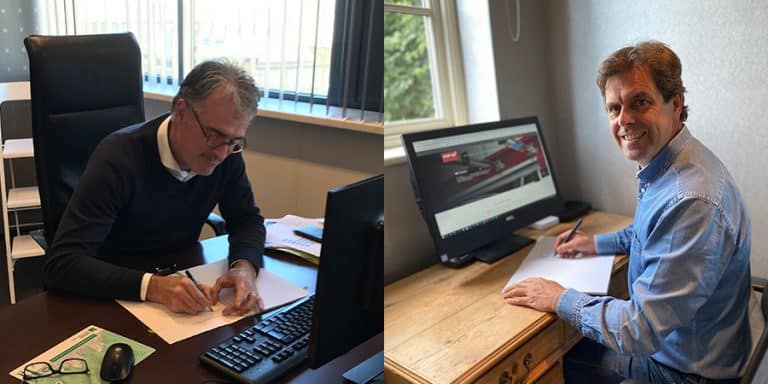
Pop Up Products and Altrex have confirmed the signing of a new 10-year deal in the UK.
Since the partnership came into existence in 2009, both companies have been able to celebrate many successes together, such as developing the world’s first one-person erect tower range and delivering more than 700,000 tower components in the UK market.In the new 10-year agreement, they have agreed the sales and distribution of mobile access towers, ladders, stepladders and associated access products in the UK and Ireland. The pair have also agreed a Worldwide Intellectual Property (IP) partnership. “We have worked with Altrex since 2009, to find a partner like Altrex and to work with such a dedicated and professional team is fantastic. Our goals and values are completely aligned, this is demonstrated through our success in developing products, developing new markets and above all serving our customers, we are as one!” Nigel Woodger (Pop Up Products Limited, CEO) said. “On behalf of Pop Up Products, I thank Altrex for the last 11 years and now look forward to the next 10 years of our special partnership”Eugène Derksen (Altrex BV, CEO) added: “The partnership with Pop Up Products Limited is unique, reliable and one of its kind due to the joint competencies and creativity where the beliefs of both organisations come together. The distinctive combination that is created enables the customers as well as the end-users to have access to “the best solutions” when it comes to sustainability, ergonomics, user-friendliness and last but not least, safety,” “I also trust that our companies continue to work together for the next 10 years, like in the past 11 years and that this remains to feel ‘natural’, because the relationship has arisen from mutual added value which results in strengthening each other. Fortunately I still recognize this every day!”
The Construction Industry Coronavirus Forum (CICV) has produced a short animation which aims to put workers in the picture about a safe return to work.
The 90-second film produced by Scotland’s CICV Forum outlines key health and safety steps that all staff should take during the return to work.
Entitled Working Together, the 90-second animation illustrates the positive day-to-day measures that workers in the construction industry can take to protect themselves, their colleagues and the wider community.
Its release follows the success of a previous Forum animation, In It Together, which outlined procedures for emergency domestic work and was adapted by a host of other UK and European organisations for their own use.
Its release follows the success of a previous Forum animation, In It Together, which outlined procedures for emergency domestic work and was adapted by a host of other UK and European organisations for their own use.
Rebecca Crosland, Health and Safety Advisor at Forum member the Building Engineering Services Association, said: “The restart has the potential to be an unsettling time for everybody concerned, with people unsure about exactly what they should do.“This latest animation lays down in simple terms, with bright and cheerful graphics, the common sense ways in which everyone can contribute to a safe working environment and help keep the virus at bay.”
In line with Scottish Government and Construction Scotland advice, which is underpinned in an earlier Forum guidance document, the animation advises that employees should:
Travel to work alone, if possible.
Observe physical distancing at all times.
Wear a proper face covering if required.
Wash their hands properly and often.
Regularly clean frequently touched tools, objects and surfaces.
The film also emphasises how everyone can play their part by:
Bringing their own prepared food and drink.
Staying on-site or using their vehicle during breaks.
Always coughing into their sleeve or elbow if they don’t have a tissue.
Staying at home and following Government guidance if they have Covid-19 symptoms.
Reading their company’s Covid-19 policy and risk assessment.
Iain Mason, Director of Membership and Communications at SELECT and Chair of the Communications Sub-Group on the CICV Forum,said: “The Forum has been at the forefront of information flow since the start of the crisis in March.“The number of trade associations, professional bodies, companies and individuals who have come together for mutual benefit and for the sake of the preservation of the sector underlines the core message of the film that, by working together, we can successfully navigate a safe return to work.”The animation was once again brought to life by creative agency Connect Communications whose Managing Director Alan Ramsay said: “For the second time during this pandemic we have successfully created a clear and straightforward message that can be quickly and easily understood and adopted by the construction sector’s diverse and varied workforce.”
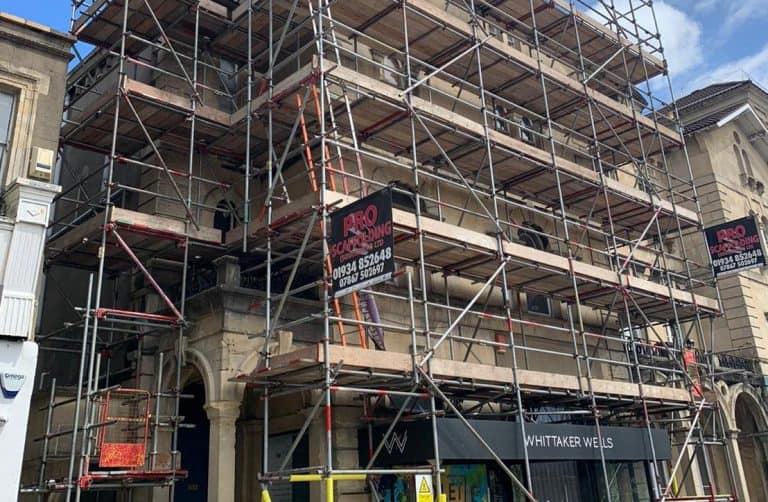
A leading south-west scaffolding company has relocated to a larger depot to enable more growth.
Pro Scaffolding (South West) Ltd has moved to Avon Riverside Industrial Estate in Avonmouth.
Established in 2010 Pro Scaffolding covers Bristol, the South West and Wales. According to reports the business has signed a ten-year lease on the 7,401 sq ft Unit 5 warehouse at Avon Riverside.
The firm is currently working towards it’s NASC accredition and was previously based at Aldwick Court Farm in Redhill, Bristol.
Property consultantancy company Knight Frank oversaw the property transaction who represented the owners of the unit London & Cambridge Properties.
Rhys Jones of Knight Frank’s Industrial & Logistics division in Bristol, said: “Avon Riverside is a highly-favoured Industrial Estate, close to the entrance to Bristol Port, and adjacent to the J18 motorway junction, with direct access to the M5/M49 and to The Portway arterial route into Bristol city centre.”
Dan Sullivan, chief executive of Pro-Scaffolding, added: “Trading from our new main depot in Avonmouth enables us to provide a very fast and efficient service to Bristol, Weston Super Mare and all surrounding areas.”
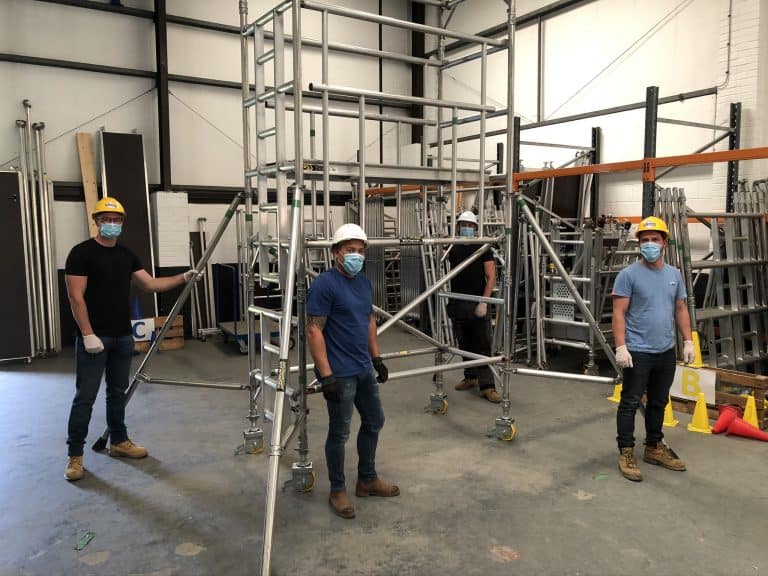
New guidance from PASMA is helping managers and health & safety professionals keep scaffold tower users safe during the coronavirus outbreak, whether they’re off on a training course or using towers in the workplace.
In the new document released free-of-charge to the industry, PASMA offers its advice on the challenges being faced by those responsible for the health and safety of tower users as they plan a return to work.
The guidance also covers issues such as how long the virus lasts on aluminium, how rescue plans will be affected, and how workers can avoid passing instruction manuals around.
“We recommend ways to assemble a tower while keeping your distance from everyone else, suggesting that the most reliable method could be buying or hiring one-person towers, which are specially designed to be built and dismantled by one individual working alone,” PASMA said.
As training starts to resume in some areas, PASMA has also addressed the need for people to be protected from coronavirus during their course.
“We’ve taken the opportunity to reassure managers of the protective measures they can expect to be in place during these vital courses, from e-learning to increased hygiene and cleaning. We also explain how PASMA cardholders can get an extension if their qualification is due to expire before it’s safe for them to visit a training centre.”
Roger Verallo, PASMA Chairman and Managing Director of Euro Towers, added: “Keeping tower users safe now means protecting them from coronavirus as well as falls and other injuries. Businesses are facing the unprecedented challenge of getting people safely back to work during a pandemic. Scaffold towers are only a small part of what they’ve got to consider, but scaffold towers are what PASMA knows best. We realised we could use our expertise to support all those whose workers will be heading back up towers and need to ensure every safety angle is covered.”
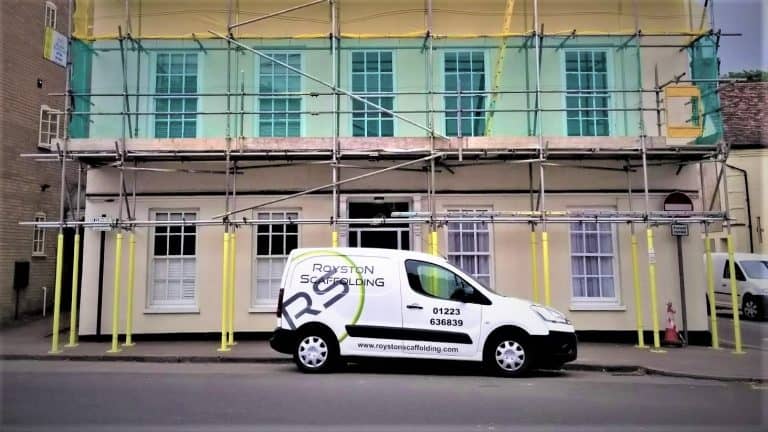
Royston Scaffolding has provided essential work for the NHS during the lockdown highlighting that work is still possible despite taking longer.
Cambridge and Hertfordshire based company Royston Scaffolding were recently on hand to help the NHS by providing essential work for St Michael’s hospital in Bristol during the Covid-19 lockdown.With social distancing restrictions and the understandably tight on-site measures put in place by the NHS, it meant that the scaffolding work took longer to construct than usual – But, it proved that even in these extreme conditions, it was still possible to continue.The project involved Royston Scaffolding erecting various structures to enable the pipework in the boiler room of Bristol’s St Michael’s hospital to be changed safely. St Michael’s is a maternity hospital and provides services to the south areas of Bristol. The team originally began work in Bristol just before the lockdown measures were introduced by the government on 23rd March 2020. As a result, the site was cleared temporarily until it was determined how work could continue safely. When work was allowed to continue, a team of three traveled to Bristol in separate vehicles with a letter from the hospital outlining the essential work they were doing. This came in handy when the lorry containing all the scaffold equipment was stopped by police to ask why they were traveling!To further add pressure to the situation, the power to the hospital would be turned off for 9 hours at a time to enable engineers to conduct their work safely. So, it was essential that the scaffolding crew worked quickly building the structures in time for this window. The largest scaffolding was a lifting frame structure, that allowed the engineers to lift the new pipework up and slide them through a hole in the wall on a Niko Track system.The team had to adhere to the 2m social distancing rule and follow a one-way system which made logistics very tough. And in addition to wearing their normal PPE, the team also wore face coverings which were reportedly difficult to wear initially, as they would steam up restricting visibility. But once the team got the hang of them this no longer became a problem and they were able to continue working at height safely. Although the work took longer than planned, the Royston Scaffolding team was able to complete the scaffolding structures in time for the engineers to conduct their work at the hospital.
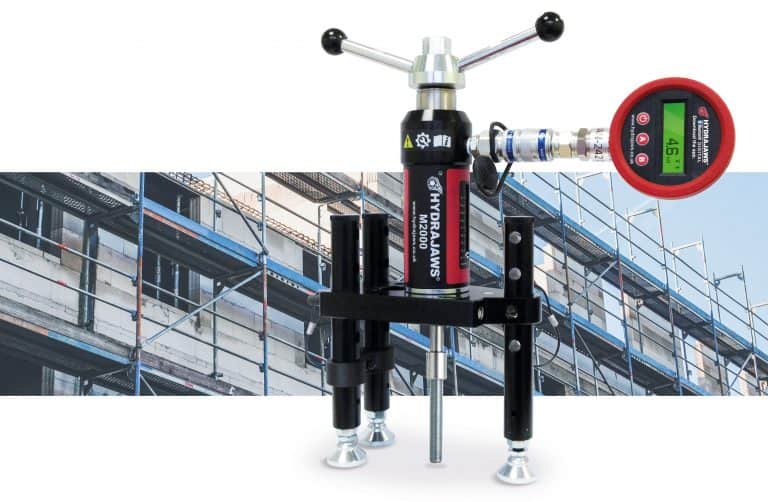
The recent high winds from storm Ciara and Dennis have highlighted the potential damage and destruction that can be caused by improper scaffold installation. Jonathan Craig from Hydrajaws guides us on the importance of installing and checking scaffold ties.
Scaffold Ties
A scaffold tie is an important connection that fastens the scaffolding to a solid building or body to prevent it from collapse. When installed properly in a system they enable a resistance to forces trying to pull the scaffold away from the structure, such as high winds. From the initial design of the scaffold structure, the predictable loads of the scaffold on the main structure will be identified.
Why Test Anchor Ties?
There are a variety of anchor ties that a scaffold designer can specify. Each have their strengths and weaknesses, either in terms of achievable loads or suitability in base materials. The designer of the scaffold may initially specify the required anchor ties to be used to ensure that the scaffolding does not collapse away from the main structure. However, if the anchor ties are installed incorrectly, or even installed correctly into a weak material they will be compromised and potentially fail. That is why testing on-site in the actual working conditions is so important.
BS 8539:2012, Code of Practice
In BS 8539:2012, Code of Practice for the selection and installation of post-installed anchors in concrete and masonry, there are two types of site testing to be considered with scaffolding, Preliminary Test and Proof Tests:
Preliminary Tests
As the names would suggest, preliminary tests are performed on anchors before the scaffold is erected at a site. This is normally required when tying into masonry or other base materials where the anchor manufacturer cannot provide characteristic load data. This generally involves installing anchors into the masonry and pull testing the anchors to a required load. A minimum of 5 tests per base material is required.
It is strongly suggested to avoid pull testing these anchors to failure, as this is likely to cause unwanted damage to the building. When preliminary tests are carried out at site, it is important that the results of these tests are communicated effectively to the scaffolding designer.
At this point, the scaffolding designer may wish to increase the number of anchor ties, or use a different anchor tie. It is important to note that should a different anchor tie be used, that preliminary testing of the new tie is performed.
Proof Tests
On all jobs, proof tests of scaffold ties are required. These proof tests are not designed to be a check on the manufacturer’s load test data, but a check that the anchors have been installed correctly (to the manufacturer’s recommendations) and that the substrate is capable of taking 1.25 times the working load of each anchor. Proof testing to 1.25 times the working load rather than just the working load gives a ‘safety factor’ to the installation of the anchor tie in the substrate.
A minimum of three anchors or 5% of the anchors installed (whichever is the greater number) are to be tested per scaffold. It is best practice to spread these tests around the scaffold, in particular if different anchors have been used in different sections or if these anchors have been installed by different teams. Should a scaffold tie fail a pull test, then the frequency of anchor testing doubles.
The frequency doubles again should a second anchor fails. Should more than two anchors fail, then 100% of the anchors require proof testing. It is advisable that the anchor used and the installation method are re-visited. Should this be required, then it is important to use a reputable anchor company with a strong technical department.
The Importance of Recording the Test Data
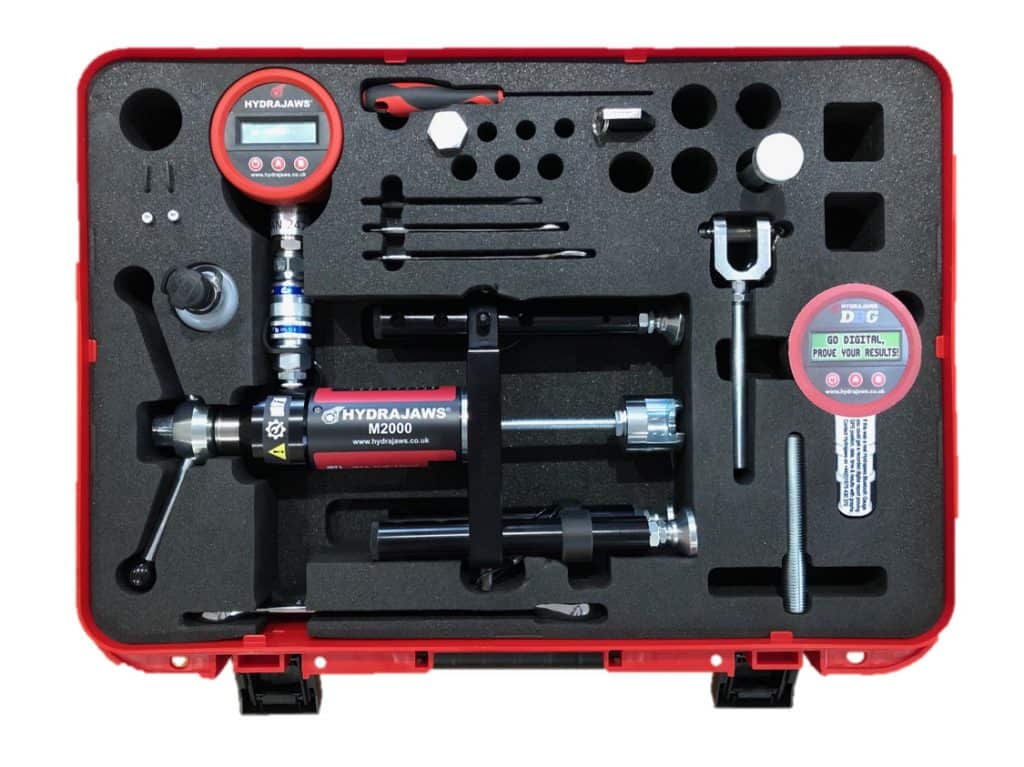
In line with BS 8539, the results of the pull tests need to be formally recorded and retained with the site documentation relating to the scaffold structure. Traditionally, these results were recorded manually, noting down the load achieved. As with many aspects of inspections and testing, a recent development is a digital way to record the results of these tests.
This digital method enables whoever performed the pull tests to show that they have complied with the testing element of BS 8539, not only in the load applied, but that the load was held for the specified length of time and collates the data into a site test report. These records are to be retained for the lifetime of the scaffold, not just the erection phase.
Keeping full records for on-site tie testing the lifetime of the scaffold as part of a Technical File on-site is not only good practice, but demonstrates that you as a scaffold company are professional, methodical and takes safety very seriously.
We use cookies on our website to give you the most relevant experience by remembering your preferences and repeat visits. By clicking “Accept”, you consent to the use of ALL the cookies.
This website uses cookies to improve your experience while you navigate through the website. Out of these, the cookies that are categorized as necessary are stored on your browser as they are essential for the working of basic functionalities of the website. We also use third-party cookies that help us analyze and understand how you use this website. These cookies will be stored in your browser only with your consent. You also have the option to opt-out of these cookies. But opting out of some of these cookies may affect your browsing experience.
Necessary cookies are absolutely essential for the website to function properly. These cookies ensure basic functionalities and security features of the website, anonymously.
Cookie
Duration
Description
cookielawinfo-checbox-analytics
11 months
This cookie is set by GDPR Cookie Consent plugin. The cookie is used to store the user consent for the cookies in the category "Analytics".
cookielawinfo-checbox-functional
11 months
The cookie is set by GDPR cookie consent to record the user consent for the cookies in the category "Functional".
cookielawinfo-checbox-others
11 months
This cookie is set by GDPR Cookie Consent plugin. The cookie is used to store the user consent for the cookies in the category "Other.
cookielawinfo-checkbox-necessary
11 months
This cookie is set by GDPR Cookie Consent plugin. The cookies is used to store the user consent for the cookies in the category "Necessary".
cookielawinfo-checkbox-performance
11 months
This cookie is set by GDPR Cookie Consent plugin. The cookie is used to store the user consent for the cookies in the category "Performance".
viewed_cookie_policy
11 months
The cookie is set by the GDPR Cookie Consent plugin and is used to store whether or not user has consented to the use of cookies. It does not store any personal data.
Functional cookies help to perform certain functionalities like sharing the content of the website on social media platforms, collect feedbacks, and other third-party features.
Performance cookies are used to understand and analyze the key performance indexes of the website which helps in delivering a better user experience for the visitors.
Analytical cookies are used to understand how visitors interact with the website. These cookies help provide information on metrics the number of visitors, bounce rate, traffic source, etc.
Advertisement cookies are used to provide visitors with relevant ads and marketing campaigns. These cookies track visitors across websites and collect information to provide customized ads.