Interlink Scaffolding Ltd wins the NASC Project of the Year 2017.
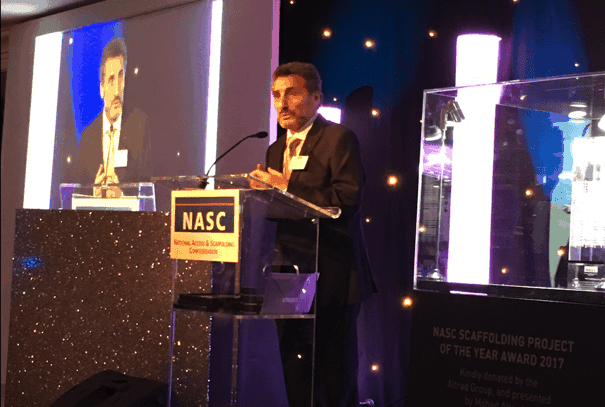
A set of intricately designed tube and fitting access scaffolds erected by Interlink Scaffolding Ltd (ISL) has won this years NASC Project of the Year 2017. The scaffolds played a vital role in the construction of the New Wear Crossing at Sunderland for Victor Buyck Steel Construction NV.ISL was awarded the highly desired accolade at the glitzy NASC ball and dinner held on Friday 24 November at the Intercontinental Hotel, Park Lane, London. Altrad Group founder and president Dr Mohed Altrad was in attendance and presented the award.
The Project
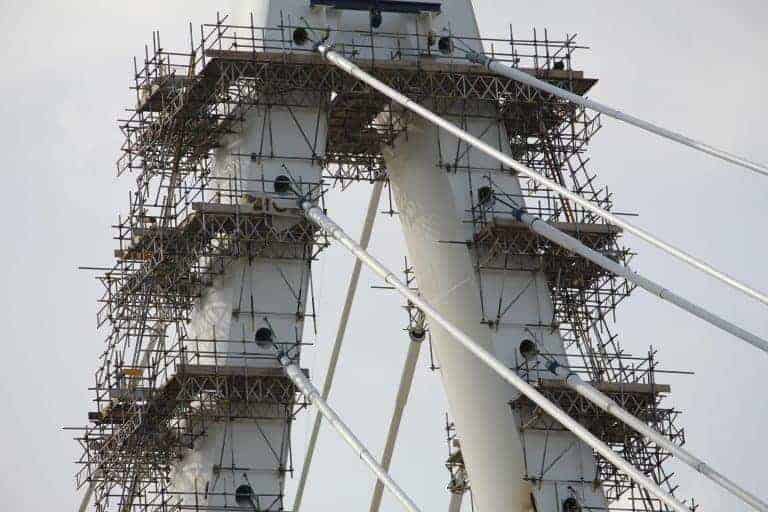
ISL told ScaffMag that they impressed the New Wear Crossing project team with the quality of tube and fitting scaffolds erected for welding of the bridge deck, ISL were invited to tender for the main scaffold package for installation of the A frame pylon and cables. Preliminary scaffold designs were submitted with the tender, giving the project team a visual representation of what would be erected to ensure that the scaffolds would meet their access requirements. Following a period of value engineering in relation to programming of scaffold quantities and hire periods, Victor Buyck awarded the contract to ISL in late 2016.ISL then commenced work to turn the preliminary designs into working drawings. Significant time had already been taken at tender stage to ensure the basic designs could withstand all required loadings, so this was completed quickly with connection points and dimensions detailed to avoid clashes with the permanent works. The primary scaffolds to be erected on the bridge pylon were formed of cantilevered beams attached to the pylon steelwork using custom manufactured shear tie fixings. Secondary hung access scaffolds counterbalanced by tube kentledge were required at bridge deck level.The pylon was manufactured by Victor Buyck at their factory in Belgium before being moved to Ghent ready for shipping across the North Sea on a barge. Following liaison with the project team an opportunity was identified to erect temporary supports for the pylon lifting equipment, which would avoid disruption at a later stage upon arrival in Sunderland. ISL duly reacted at short notice to send scaffolders and materials to Ghent in the week prior to the Christmas break.In the meantime, ISL trial erected a pylon scaffold in their yard. By erecting the scaffold at 90 degrees to its final orientation, with the pylon horizontal and only 2m above the barge deck, work could be carried out quicker and safer than working 90m up the pylon once raised into its final vertical position. This trial proved to be of great benefit when the barge arrived in Sunderland in early 2017, with the scaffolders already used to working sideways.Following removal of the lifting equipment used to raise the pylon to its vertical position, the final scaffolds including the top 90m level platform were erected in the Spring and Summer of 2017. Following successful installation of the cables, the scaffolds will be dismantled during the Autumn of 2017, using a range of methods including a crane basket and ultra-high reach MEWP for increased safety, with materials lowered using an electric winch.
NASC Director of Training announces winners of the NASC Apprentice of the Year 2017.
At a packed AGM held at the Intercontinental Hotel, London on Friday 24 November 2017. Dave Mosley NASC Director of Training and CISRS Manager announced the winners in the NASC Apprentice of the Year Awards 2017.
This years NASC Apprentice Awards which was co-sponsored by CISRS and the CITB was tough according to the trade body. The judge of the competition, Paul Gaze of the CITB, said after reducing the submissions to a shortlist of 8, he found it too difficult to recognise the achievements of only 2 apprentices and suggested an additional ‘highly commended’ category.
Three apprentices stood out when Paul reviewed the shortlisted submissions. All three had showed the desire to succeed and had overcome various challenges on their respective CISRS programmes.
Aidan Waldron receiving his award.
The overall winner of this year’s award was Aidan Waldron of Connect Scaffolding Ltd based in Bishops Stortford. He was presented with his Trophy, Certificate and cheque for £500 by Des Moore, the newly appointed NASC President, and Baroness Karren Brady CBE, business woman, football director and star of TV’s The Apprentice. His employer Connect Scaffolding also received a trophy, certificate and cheque for £500.
Paul Gaze said of Aidan “His Supervisors and Clients have provided a great deal of positive feedback on Aidan. He continually asked pertinent and sensible questions, demonstrating his awareness of carrying out the task in a safe and controlled manner with suitable regard for others that could be affected by his, or his team’s actions.”
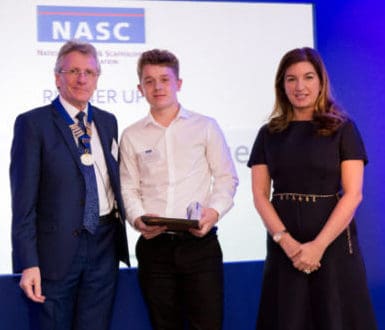
Tiger Fredrick awarded the runner up prize
Tiger Fredrick Hughes of Tamworth Scaffolding Ltd was awarded the 2017 Runner Up prize which saw him and his employer receive a trophy, certificate and a cheque for £250 each.
Tiger was previously working in another construction trade but felt that he was not developing his career. He since joined Tamworth Scaffolding and has excelled on his CISRS programme. His attendance and commitment are first rate, and his achievement at college is very good.
Gem Winstone, Tiger’s employer said “Tiger’s commitment to learning his trade is exemplified in that he needs to catch 2 trains and two buses to get to college and has never been late!”
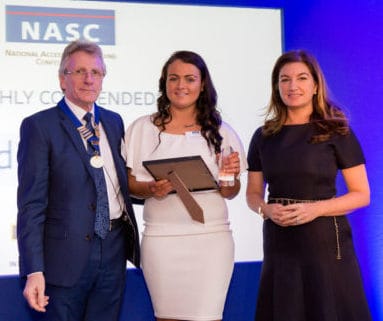
Claudia Ferguson awarded the Highly Commended prize.
The Highly Commended award went to Claudia Ferguson of Interlink Scaffold Limited (ISL) based in Birtley Tyne and Wear.
Paul Gaze felt she thoroughly deserved this recognition and stated: “Claudia is a credit to herself and her employer and has dedicated herself to learning the trade and is seen as a great addition to the team. She received a glowing report from her instructor, she has worked on a wide range of projects including the new Wear Crossing in Sunderland”
It was a highly successful day for Interlink and their workforce as the Wear Crossing job went on to win NASC 2017 Project of the Year Award which was presented by Dr Mohed Altrad founder and president of the Altrad Group who sponsored this special award.
Wood has secured a two-year industrial services framework agreement following on from its recent acquisition of Amec Foster Wheeler.
The contract has been awarded by Dounreay Site Restoration Ltd (DSRL), for work on its nuclear decommissioning site in Thurso, Scotland. The company will cover the delivery of electrical installation, control and instrumentation, testing, commissioning and maintenance support. It also carries two options for a one-year extension and builds on the existing presence of Wood at Dounreay, now into it’s third year. Wood say their expertise has been instrumental in the design and construction of a new effluent treatment plant and the design, safety case and environmental assessment of a new higher activity waste store. They will also continue to offer valuable support at what is the most complex nuclear site closure project in Europe. “We will leverage our strong industrial services capability to support DSRL at one of the most complex nuclear closure sites in Europe,” said Robin Watson, Wood’s chief executive. “Our knowledge of providing industrial services to the energy, pharmaceutical, and biotech industries combined with our experience in working with stringent safety systems will ensure we deliver assurance in the installation and validation of electrical and control equipment on-site.”The firm is a global leader in the delivery of project, engineering and technical services to energy and industrial markets. They operate in more than 60 countries, employing around 55,000 people, with revenues of more than $11 billion. At the company’s core is the delivery of comprehensive services to support its customers across the complete lifecycle of their assets, from concept to decommissioning, across a range of energy, process and utility markets.This recent move serves only to increase their outstanding reputation even further within the industry.DSRL is a wholly-owned subsidiary of the Cavendish Dounreay Partnership Ltd, a consortium of Cavendish Nuclear, CH2M and AECOM. It is funded by the Nuclear Decommissioning Authority (NDA) to deliver the site closure programme.
Trad Group CEO becomes the new president of the NASC.
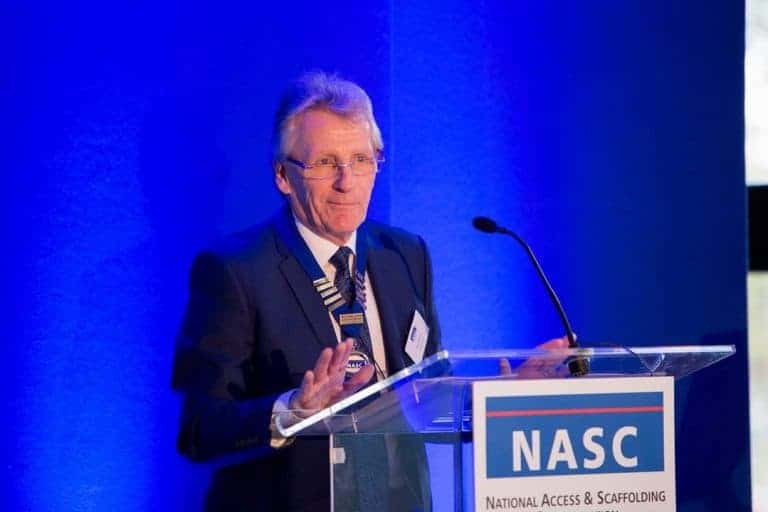
Over 160 NASC members, guests, confederation staff and members of the construction press that included ScaffMag, saw Des Moore become the new president of the NASC. The ceremony took place at a packed AGM held at the impressive Intercontinental London Park Lane Hotel on Friday 24 November 2017.
Des Moore takes the reins of the NASC presidency from the now ex-president Alan Lilley of the Hull based firm Commercial Scaffolding Ltd. In the new presidents welcoming speech Des thanked Alan for his two years of exceptional service, and also noted his contribution to growing the SME membership and mentoring smaller organisations to achieve compliance with the NASC criteria.
During his speech the new president set out his four key objectives he wishes to fulfil within his two year term.
Increase the pre-requisite for NASC membership by main contractors, developers, and national and local government agencies in tender documents.
Des discussed the importance of growing the NASC membership, as this would increase the positive influence which the confederation had over the industry, and assist with promoting and achieving core aims, the most important of which was a safer industry. Under this objective he also added that he intended to run a specific and targeted marketing campaign during his two year term as NASC president with a view to promoting the use of NASC members only for all projects, large and small.
Strike the right balance between the needs of both large and small companies.
Under this objective Des aims to meet the needs of both small and larger member companies, he noted that the voice of smaller companies should be heard and their contribution recognised, but also highlighted the importance of larger members to NASC membership should never be under-estimated.
Des stressed the importance of the NASC to the industry, he said the NASC was a true industry trade body with a rigorous audit process, and high standards for entry and retention of membership. He also aims to encourage and mentor more women into senior positions both in the NASC and across the industry in general.
Create mentoring and training schemes for all categories of staff, old and young. Academically gifted and those not so lucky.
The new president discussed this objective, outlining his own personal journey within the industry and noting that his lack of personal qualifications had not prevented him from progressing to the role of CEO of the TRAD Group of companies. He urged all at the AGM to encourage staff and operatives who had few or no academic qualifications to remain in the industry and pass on their knowledge and experience, and provide mentors to help them progress into support functions and management roles within their companies.
Des stressed the importance of encouraging more young people to enter the industry and represent their companies on NASC committees, noting that greater diversity brought with it new ideas, knowledge and fresh perspectives. This was vitally important given the current CITB re-structuring exercise and the recent decision to outsource all training courses by the latter part of next year.
Encourage and mentor more women into senior positions both in the NASC and across the industry in general.
In conclusion the new president commented on his objective to encourage more women to pursue careers in the scaffolding sector, and particularly to participate on the various NASC standing committees. He noted that at TRAD women had been encouraged and mentored and had gone on to excel in senior positions such as surveying and estimating, supervision and contracts management, and were now represented at board level.
Special Guest
Also speaking at the NASC AGM was special guest, Baroness Karren Brady CBE, the CEO of West Ham Football Club and star of the BBC hit show The Apprentice.
Karren outlined her own journey in the male-dominated world of football, stressing the importance of having a strong work ethic and determination. She discussed the challenges faced by organisations looking to attract skilled young people into their businesses and retain them.
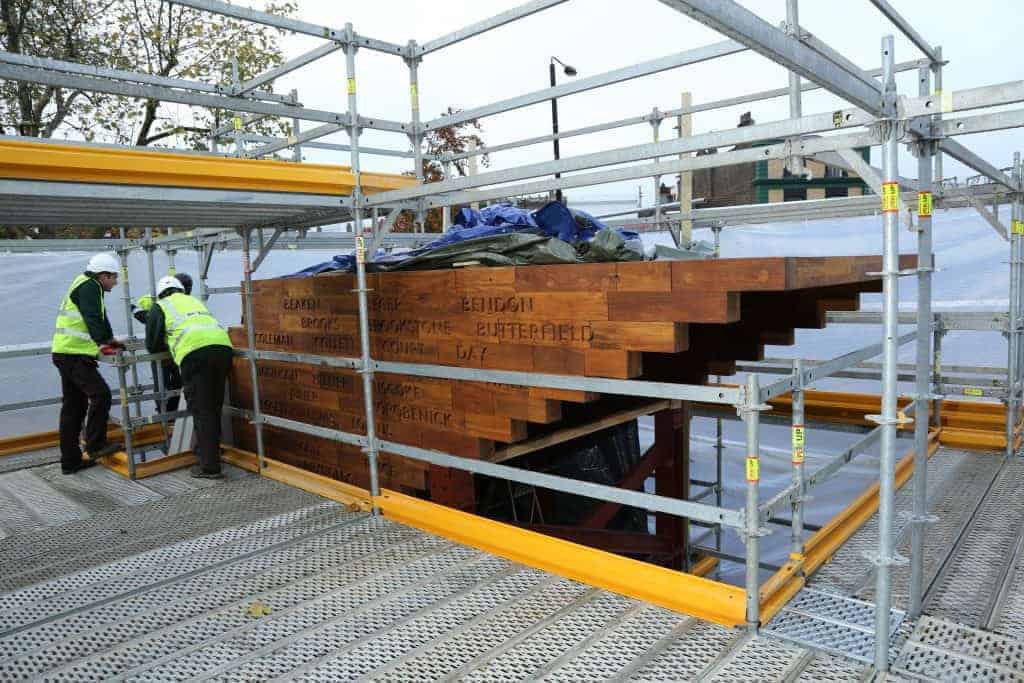
Disaster struck in 1943, during the Second World War, when a member of the public stumbled on the stairs in panic, causing those rushing behind to also stumble and fall. In total, 173 people were crushed to death as a result of many others forcing their way down the stairs to find shelter inside the station. The Stairway to Heaven Memorial is being built to remember the victims of the Bethnal Green tube disaster and is nearing completion.Plans for the inverted stairway have been approved for some time but due to unforeseen challenges, construction was unable to commence. The final phase is now taking place, 11 years after the project was first initiated by Harry Paticas, of Arboreal Architecture. PERI’s involvement is now visible on site as the installation of the stairway is underway. PERI UP shoring and access were loaned on free hire to facilitate the installation of the 5 tonne teak timber staircase, which will slide onto the concrete plinth already in place. The stairway will serve an important purpose as it features the surnames of all those who lost their lives in the disaster.The design of PERI’s scaffolding solution has been carefully considered to ensure it’s adaptable, freestanding and fully encapsulated to protect the public. Furthermore, it has been designed to provide access to all sides of the timber staircase, enabling additional work on the staircase to resume as planned. Scaffolding will remain on site for 5 weeks to further support the cladding process, marking the long-awaited end of the project.Sandra Scotting, the Secretary of the Trust said, “I know that all those involved in the disaster, the survivors, rescuers and victims’ relatives, will be delighted and will also have a much better experience at the official unveiling. With the money saved, thanks to PERI’s donation, we will be able to provide seating and hot drinks for these visitors near the Memorial, which will be a big help for elderly participants or those with mobility problems.”The charity anticipate that the project will be finished just in time for Christmas this year.
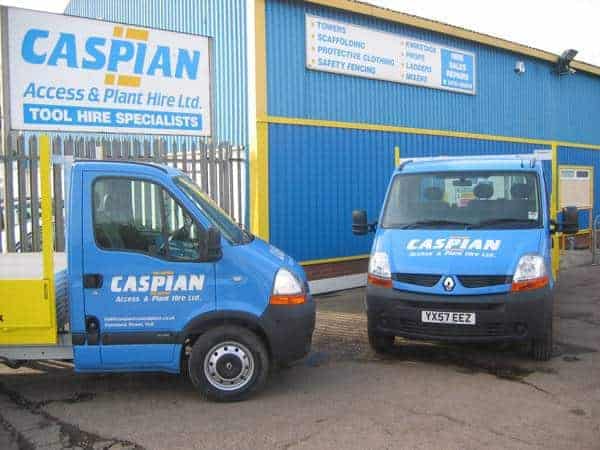
A leading scaffold boards provider has acquired the entire scaffold boards operation from Marley Eternit, formerly John Brash and Co Ltd.
The merger was recently completed to the delight of everyone associated with Caspian Access and Plant Hire Ltd. They currently have branches in Hull, Grimsby and Scunthorpe.Neil Garrison Managing Director, said: “This investment will reinforce and further develop our core value of supplying the very best quality timber scaffold boards, ensuring full complicity to BS2482:2009. We share the same values as Marley Eternit in customer service, innovation and integrity, and will continue to strive for nothing but excellence in all aspects of our operation. This acquisition will complement our ever-growing scaffolding equipment hire and sales business, providing comprehensive scaffolding packages throughout the UK and overseas. We would like to take this opportunity to thank Marley Eternit for their valued support and assistance during this transfer.”The move is set to strengthen the company’s position as the UK’s leading provider in the scaffold boards market. Their new state of the art manufacturing facility complete with new production line, will open in Scunthorpe early next year. Its design will enable both improved capacity and efficiency.Caspian has an outstanding reputation within the industry, and has been supplying scaffolding access equipment for than 20 years. Steady expansion here in Britain has helped the firm become one of the most competitive equipment providers, not only of scaffolding but also of a wide range of tools and accessories for the building industry as a whole. Mr Garrison added: “We already supply scaffolding and access equipment to companies in the Far East, the Middle East and Europe. Now we’re looking to expand that. We’ve built our international reputation on good, fast service and we’re proud of that fact. And with emerging nations seeking to develop their industrial base we are also involved with major projects across Eastern Europe.“We are dedicated to working closely with Marley Eternit to ensure continuity of supply to all their customers and to ensure the process runs as smoothly as possible for all involved. For our existing customers it is very much business as usual.”
SGB Scaffolding is back on the scene after the announcement of a huge £13 million four-year deal with Countryside.
The once legendary industry giant SGB has today revealed details to ScaffMag on this significant new deal. The scaffold contract sees SGB appointed as the sole scaffolding provider to Countryside’s North West division. SGB which is part of the Brand Energy & Infrastructure Services group will now provide scaffolding services to Countryside.
SGB say the negotiations were led by SGB’s Business Development Manager, Jason Milner. “We are extremely proud and excited to be partnering Countryside on these schemes,” he said. “We currently have 23 live sites in progress with more set to follow, and this will make a great contribution to our planned growth strategy over the next 4 years.”
The Countryside work will be focussed on SGB’s Manchester depot, where General Manager Alan Arthur added: “We have proved to Countryside the we have the size, strength and capabilities that few other scaffolding providers, if any, can match, but which are essential to fulfil a major contract such as this.”
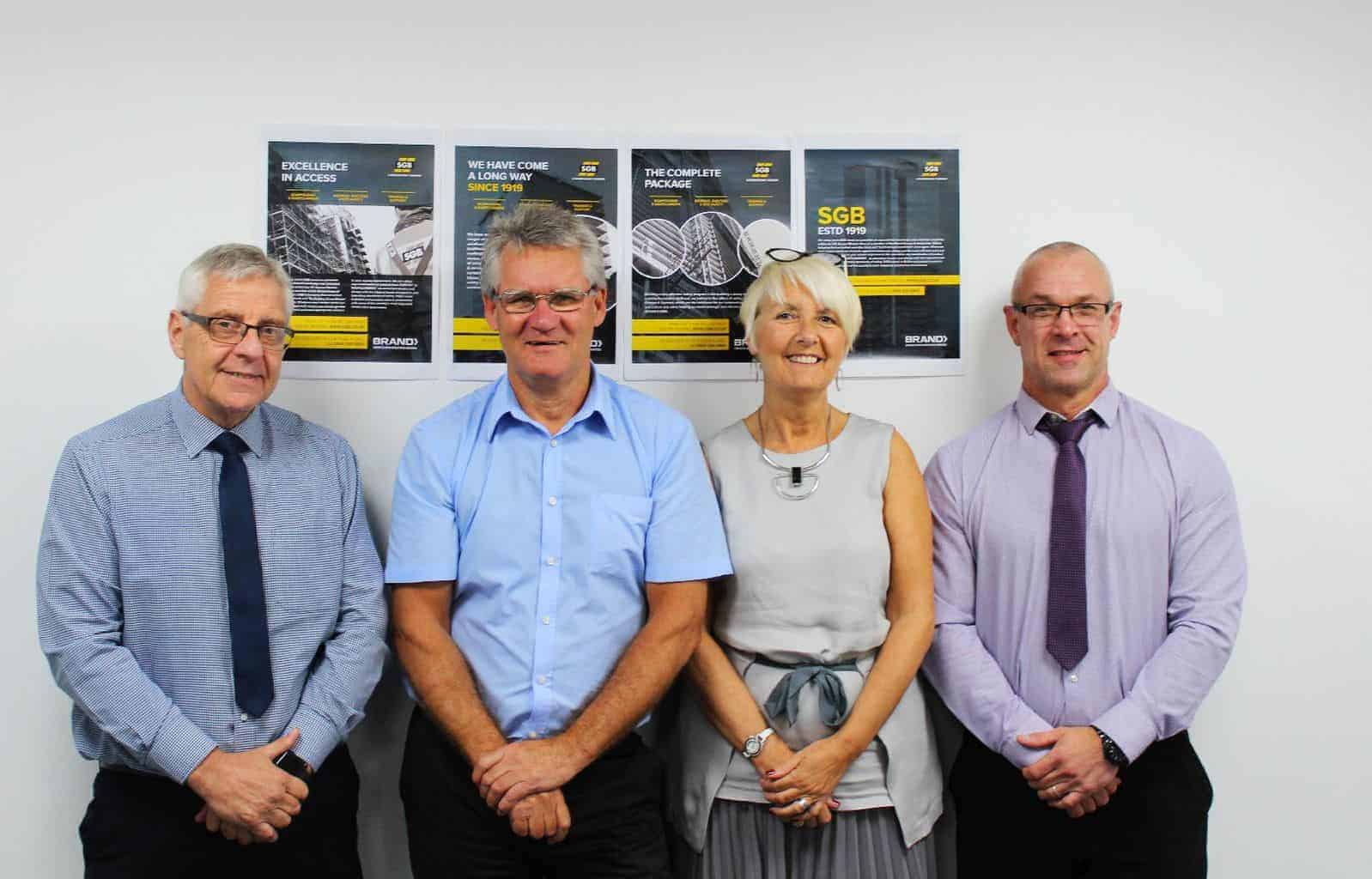
Pictured are members of the SGB team who helped secure the new £13 million contract. From left, they are General Manager Alan Arthur, Operations Manager John Woodcock, Senior Quantity Surveyor Elaine Morgan, and Business Development Manager Jason Milner.
SGB has told us they already have a well-established relationship with Countryside. In 2014 the company was chosen from a list of five scaffolding suppliers to be Countryside’s sole provider, under a two-year deal, which saw the volume of business grow to an annual order value of £3.5m
“This new deal is a result of all the hard work and commitment from the team in Manchester, with particular praise going to our site teams led by Operations Manager John Woodcock,” adds Jason Milner. “John and his teams have delivered some 3,400 units of scaffolding over the last five years, successfully meeting challenging build programs in a very fast-paced environment.”
SGB is now working with Countryside to extend the contract model to other areas of the UK. It has already secured contracts covering two new sites developed by Countryside’s Midlands office, with more set to follow.
Certified by Lloyds British and trending in the industry
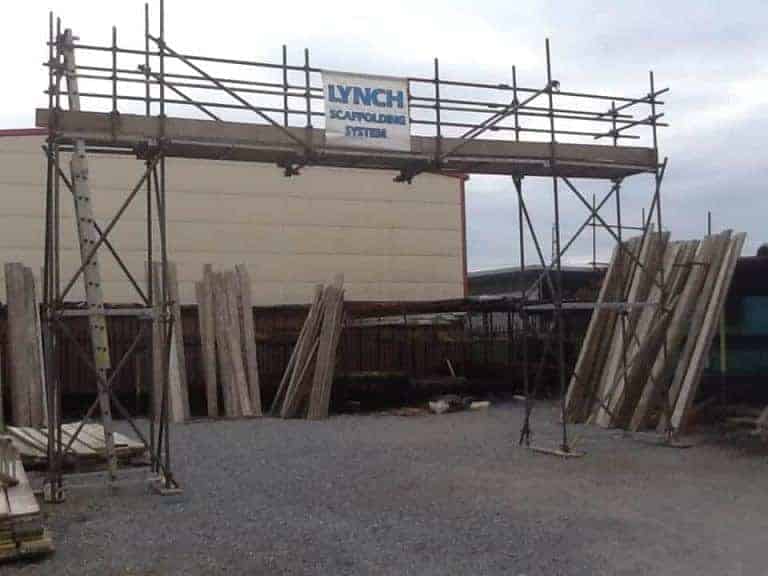
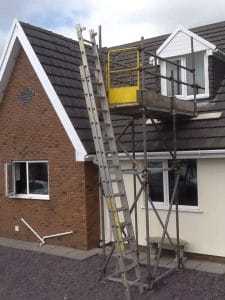
An innovative approach to construction has resulted in a new and unique revolutionary Lynch scaffolding system. Working in combination with tube and fitting scaffolds, it’s been designed to meet all access requirements, saving valuable time on the whole process.
Streamlined For Better Productivity
This streamlined system can speed up and ease erection on base settings and revert back whenever required. The designers claim productivity can be improved by a full 100 per cent, saving massively on labour costs.
Innovation In Action
As a tool package it’s completely unique because according to the designers, it’s the only type of scaffolding to facilitate the attachment of transoms to ledgers before the attachment to the upright standards. This enables bay sections of transoms and ledgers to be stored or transported while remaining attached. It all makes for much greater stability in creating safer working platforms. Tests have already proven this is incredibly quick scaffolding to either erect or dismantle, reducing work time by 30 per cent over traditional scaffolding systems Lynch say.
Smarter Safer Working For The Industry
In terms of advantages, bay sections can be attached complete or as individual components, and there are no height restrictions offering much greater stability overall to working platforms. Uneven ground isn’t a problem, and much smaller scaffolds can actually be both lifted and moved comfortably and easily. What’s more, connections of ledgers are more securely attached by couplers, not internal or external joints.
Stocking For Success
The new Lynch system doesn’t require adjustable jack plates on ground surfaces. Also, the designers maintain there’s no need for re-stocking of materials and no need to buy costly uprights – tube and fitting scaffolding users can purchase a few bay sections to improve towers, mobiles and base settings.
In fact, it would seem the makers have thought of everything. This thoughtful Lynch System is yet another example of the scaffolding of the future it would seem. The system is certified by Lloyds British BS EN 12811 BS EN 74
For more information vist www.lynchscaffoldingsystem.co.uk
‘An end of an era’, Bircham Newton Construction College is set to close by 2019.
The 50-year-old Bircham Newton base in Norfolk has been the must go-to training college for thousands of scaffolders over the years.
Sources say the CITB management called a meeting and broke the news to staff yesterday.
The news comes after the CITB training body laid out plans to streamline its business operations as part of a major shake-up was revealed. The CITB, which is funded by a levy on construction firms, will no longer carry out direct training.
In future, the body will oversee training by external private sector training providers.
A recent government review of the CITB found that although construction employers and trade associations voted for the industry levy to continue, there was heavy criticism of how it currently operates.
Sarah Beale, Chief Executive of CITB, said: “Construction needs to modernise and CITB is no exception. We accept the challenges laid down by industry and Government and we will deliver a future-fit training body by adapting and updating our business model.“Some really tough decisions could be made under these proposals but I’m confident in our commitment to becoming a more representative, accountable and reliable ‘levy in, skills out’ organisation. We now have a clearly defined path, and we see a bright future for a modern, engaged CITB. We look forward to working with our industry and Government to build a better Britain.”
Job losses are rumored to be on the cards among the CITB’s 1,300 staff, but no official comment has been made available.
CISRS Scheme Manager Dave Mosley said “It’s the end of an era and a great shame. CITB has played a huge role in establishing the CISRS scheme and Scaffolder training over the years. It’s a real blow to the scaffolding industry, although we are being assured by CITB/NCC that they will not pull out of training until there is alternative provision, I can only see this having a negative effect whilst the requirement for a skilled labour force continues to increase”.
Lincolnshire based Rilmac Scaffolding have been Highly Commended in the Fastest Growing Business category at the annual Midlands Family Business Awards.
The announcement was made during the gala awards ceremony at the Derby Velodrome on Thursday 9th November. The Rilmac Group (comprising of Insulation, Asbestos Services, Fabrication and Scaffolding divisions) were also shortlisted to be a finalist in the prestigious Family Business of the Year Award.
Paul Walker, Group Chairman and, second generation family member said, “there is a lot of hard work in putting together applications, creating suitable presentations, and preparing for the challenging interviews. Whilst only a smaller team was responsible for the award entry, it is the effort and dedication of everyone at Rilmac Scaffolding that has been rewarded with the Highly Commended recognition.”
Steve Baxter, Group MD, added. “This is a team endeavor and every employee at Rilmac Scaffolding has played a part in achieving this success. Thank you to everyone for their positive involvement. It is wonderful to see everyone’s hard work recognised in this way.”“As a Lincolnshire based business it was great to see how many fellow companies from the county had also been shortlisted this year. The event further outlined how successful and buoyant the Family Business community is across the Midlands. Every entry was of a very high standard and there were some fantastic business success stories told.”
The Awards were expertly managed by The Wilson Group and included shortlisted finalists from as far afield as Worcester and Skegness.
We use cookies on our website to give you the most relevant experience by remembering your preferences and repeat visits. By clicking “Accept”, you consent to the use of ALL the cookies.
This website uses cookies to improve your experience while you navigate through the website. Out of these, the cookies that are categorized as necessary are stored on your browser as they are essential for the working of basic functionalities of the website. We also use third-party cookies that help us analyze and understand how you use this website. These cookies will be stored in your browser only with your consent. You also have the option to opt-out of these cookies. But opting out of some of these cookies may affect your browsing experience.
Necessary cookies are absolutely essential for the website to function properly. These cookies ensure basic functionalities and security features of the website, anonymously.
Cookie
Duration
Description
cookielawinfo-checbox-analytics
11 months
This cookie is set by GDPR Cookie Consent plugin. The cookie is used to store the user consent for the cookies in the category "Analytics".
cookielawinfo-checbox-functional
11 months
The cookie is set by GDPR cookie consent to record the user consent for the cookies in the category "Functional".
cookielawinfo-checbox-others
11 months
This cookie is set by GDPR Cookie Consent plugin. The cookie is used to store the user consent for the cookies in the category "Other.
cookielawinfo-checkbox-necessary
11 months
This cookie is set by GDPR Cookie Consent plugin. The cookies is used to store the user consent for the cookies in the category "Necessary".
cookielawinfo-checkbox-performance
11 months
This cookie is set by GDPR Cookie Consent plugin. The cookie is used to store the user consent for the cookies in the category "Performance".
viewed_cookie_policy
11 months
The cookie is set by the GDPR Cookie Consent plugin and is used to store whether or not user has consented to the use of cookies. It does not store any personal data.
Functional cookies help to perform certain functionalities like sharing the content of the website on social media platforms, collect feedbacks, and other third-party features.
Performance cookies are used to understand and analyze the key performance indexes of the website which helps in delivering a better user experience for the visitors.
Analytical cookies are used to understand how visitors interact with the website. These cookies help provide information on metrics the number of visitors, bounce rate, traffic source, etc.
Advertisement cookies are used to provide visitors with relevant ads and marketing campaigns. These cookies track visitors across websites and collect information to provide customized ads.
 ISL then commenced work to turn the preliminary designs into working drawings. Significant time had already been taken at tender stage to ensure the basic designs could withstand all required loadings, so this was completed quickly with connection points and dimensions detailed to avoid clashes with the permanent works.
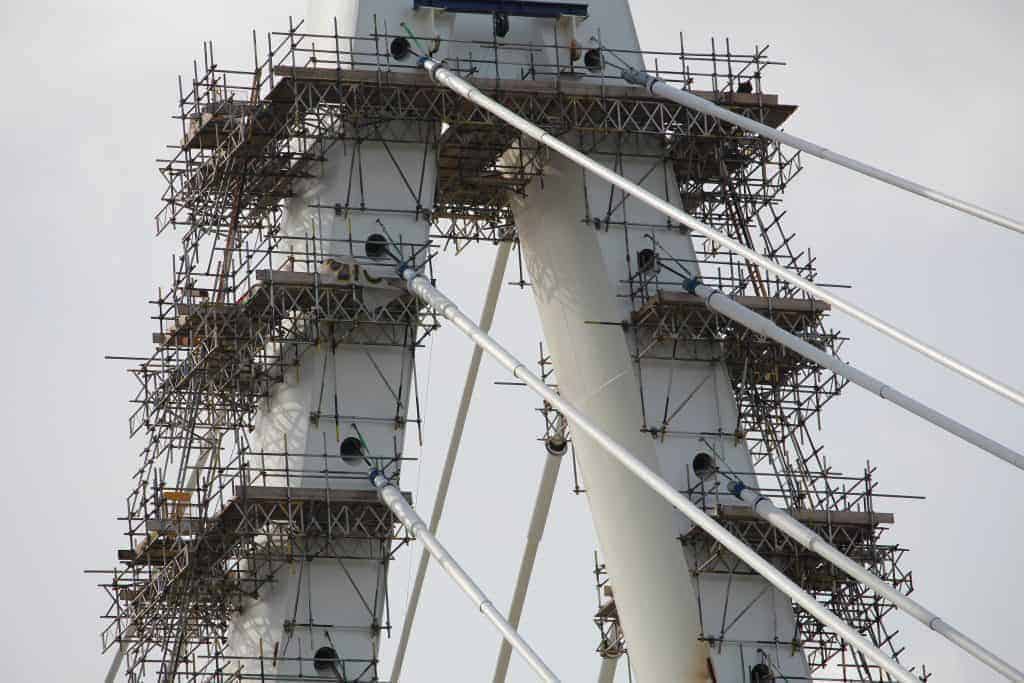
The primary scaffolds to be erected on the bridge pylon were formed of cantilevered beams attached to the pylon steelwork using custom manufactured shear tie fixings. Secondary hung access scaffolds counterbalanced by tube kentledge were required at bridge deck level.
ISL then commenced work to turn the preliminary designs into working drawings. Significant time had already been taken at tender stage to ensure the basic designs could withstand all required loadings, so this was completed quickly with connection points and dimensions detailed to avoid clashes with the permanent works.
The primary scaffolds to be erected on the bridge pylon were formed of cantilevered beams attached to the pylon steelwork using custom manufactured shear tie fixings. Secondary hung access scaffolds counterbalanced by tube kentledge were required at bridge deck level.
 The pylon was manufactured by Victor Buyck at their factory in Belgium before being moved to Ghent ready for shipping across the North Sea on a barge. Following liaison with the project team an opportunity was identified to erect temporary supports for the pylon lifting equipment, which would avoid disruption at a later stage upon arrival in Sunderland. ISL duly reacted at short notice to send scaffolders and materials to Ghent in the week prior to the Christmas break.
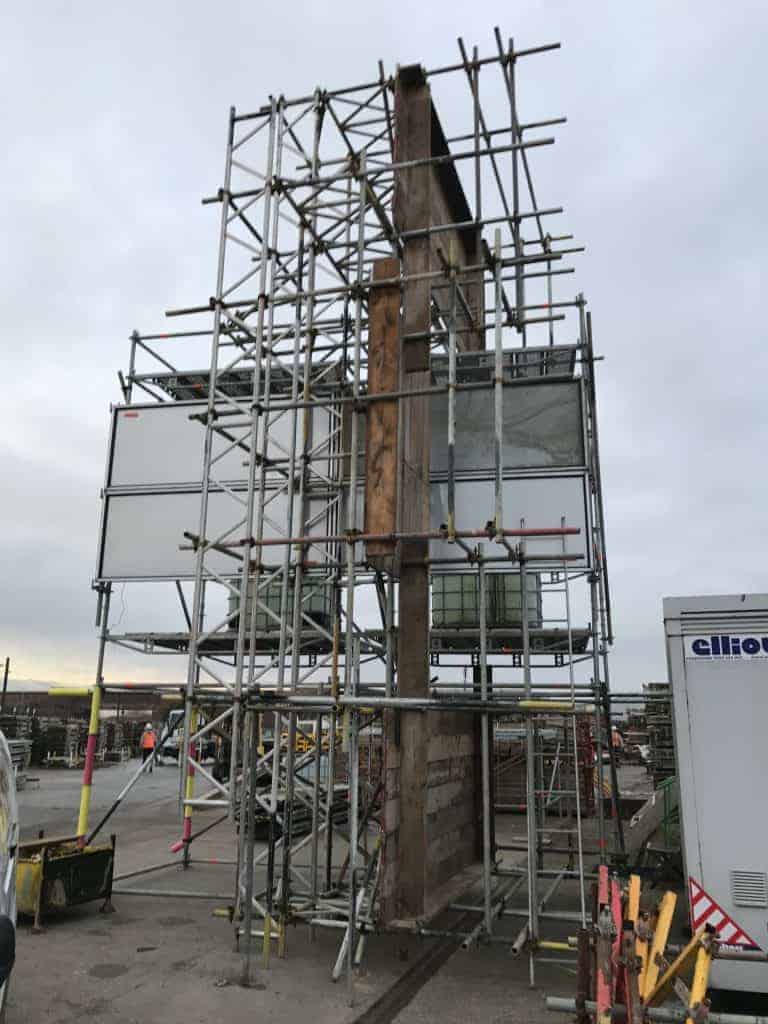
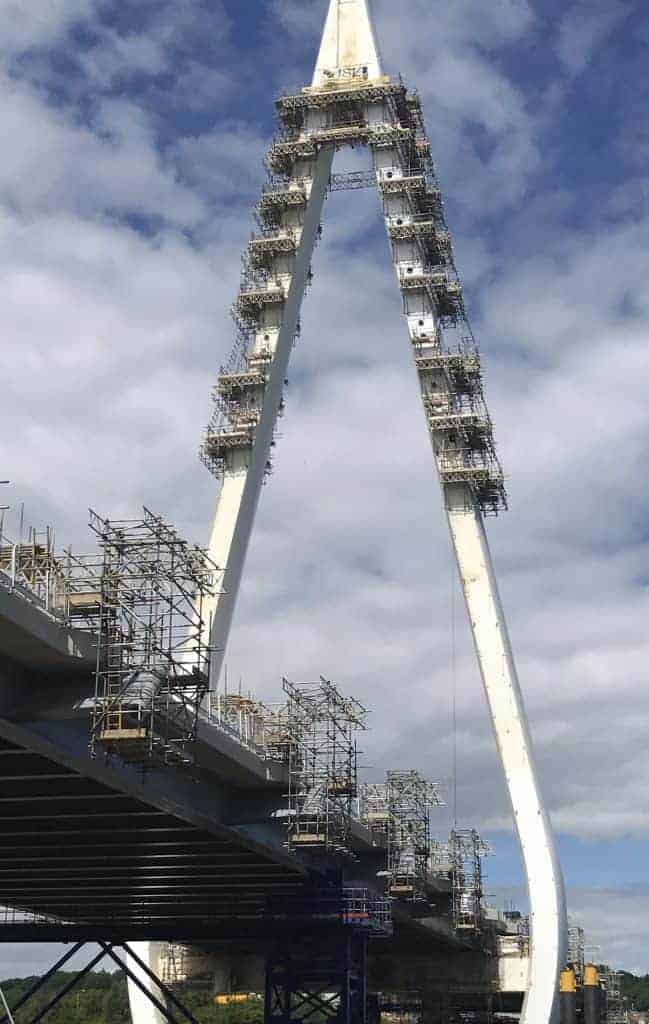 In the meantime, ISL trial erected a pylon scaffold in their yard. By erecting the scaffold at 90 degrees to its final orientation, with the pylon horizontal and only 2m above the barge deck, work could be carried out quicker and safer than working 90m up the pylon once raised into its final vertical position. This trial proved to be of great benefit when the barge arrived in Sunderland in early 2017, with the scaffolders already used to working sideways.
 Following removal of the lifting equipment used to raise the pylon to its vertical position, the final scaffolds including the top 90m level platform were erected in the Spring and Summer of 2017.
Following successful installation of the cables, the scaffolds will be dismantled during the Autumn of 2017, using a range of methods including a crane basket and ultra-high reach MEWP for increased safety, with materials lowered using an electric winch.
Following removal of the lifting equipment used to raise the pylon to its vertical position, the final scaffolds including the top 90m level platform were erected in the Spring and Summer of 2017.
Following successful installation of the cables, the scaffolds will be dismantled during the Autumn of 2017, using a range of methods including a crane basket and ultra-high reach MEWP for increased safety, with materials lowered using an electric winch. 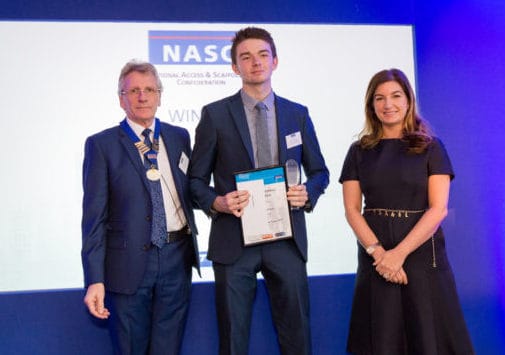



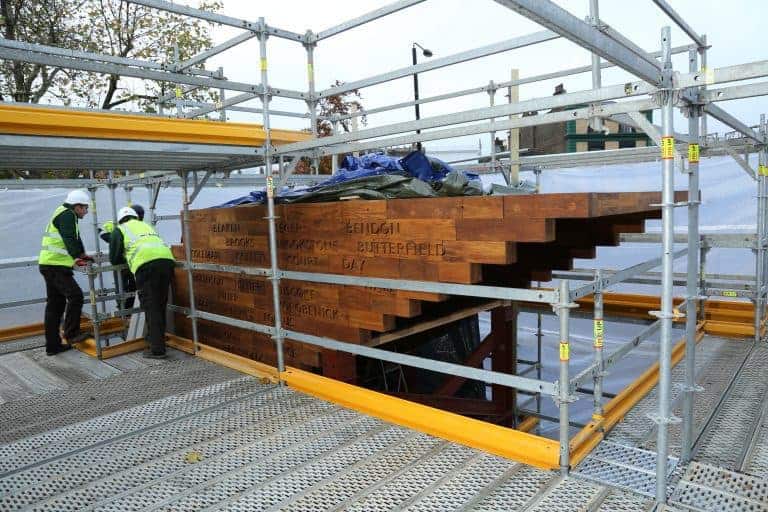
 Disaster struck in 1943, during the Second World War, when a member of the public stumbled on the stairs in panic, causing those rushing behind to also stumble and fall. In total, 173 people were crushed to death as a result of many others forcing their way down the stairs to find shelter inside the station. The Stairway to Heaven Memorial is being built to remember the victims of the Bethnal Green tube disaster and is nearing completion.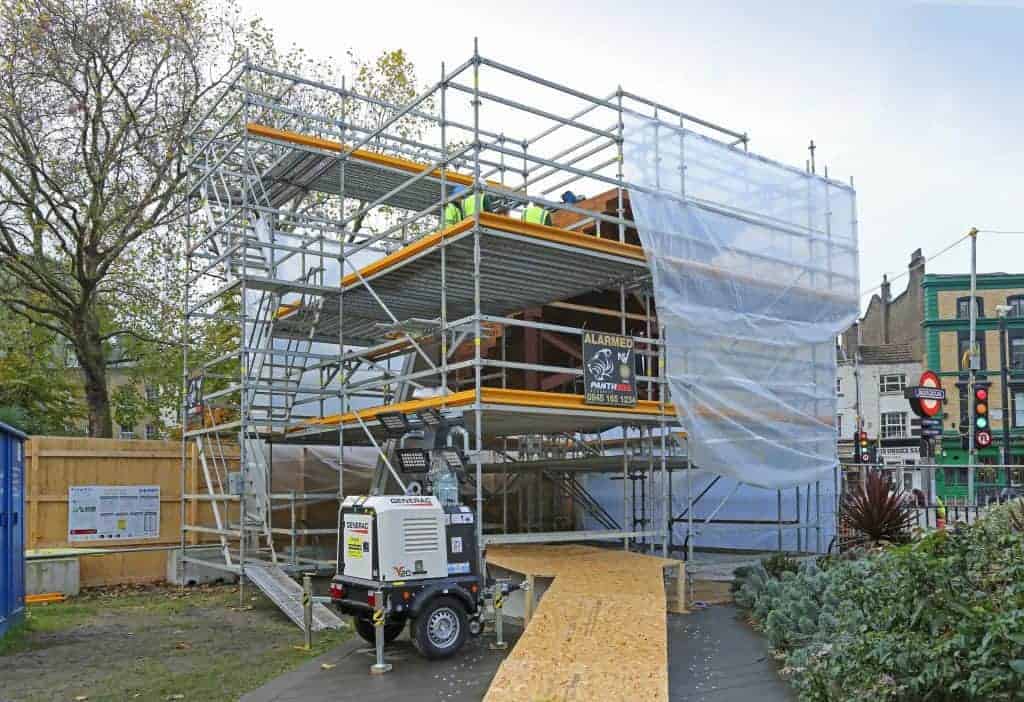

 An innovative approach to construction has resulted in a new and unique revolutionary Lynch scaffolding system. Working in combination with tube and fitting scaffolds, it’s been designed to meet all access requirements, saving valuable time on the whole process.

 The announcement was made during the gala awards ceremony at the Derby Velodrome on Thursday 9th November. The Rilmac Group (comprising of Insulation, Asbestos Services, Fabrication and Scaffolding divisions) were also shortlisted to be a finalist in the prestigious Family Business of the Year Award.
Paul Walker, Group Chairman and, second generation family member said, “there is a lot of hard work in putting together applications, creating suitable presentations, and preparing for the challenging interviews. Whilst only a smaller team was responsible for the award entry, it is the effort and dedication of everyone at Rilmac Scaffolding that has been rewarded with the Highly Commended recognition.”
Steve Baxter, Group MD, added. “This is a team endeavor and every employee at Rilmac Scaffolding has played a part in achieving this success. Thank you to everyone for their positive involvement. It is wonderful to see everyone’s hard work recognised in this way.”
“As a Lincolnshire based business it was great to see how many fellow companies from the county had also been shortlisted this year. The event further outlined how successful and buoyant the Family Business community is across the Midlands. Every entry was of a very high standard and there were some fantastic business success stories told.”
The Awards were expertly managed by The Wilson Group and included shortlisted finalists from as far afield as Worcester and Skegness.
The announcement was made during the gala awards ceremony at the Derby Velodrome on Thursday 9th November. The Rilmac Group (comprising of Insulation, Asbestos Services, Fabrication and Scaffolding divisions) were also shortlisted to be a finalist in the prestigious Family Business of the Year Award.
Paul Walker, Group Chairman and, second generation family member said, “there is a lot of hard work in putting together applications, creating suitable presentations, and preparing for the challenging interviews. Whilst only a smaller team was responsible for the award entry, it is the effort and dedication of everyone at Rilmac Scaffolding that has been rewarded with the Highly Commended recognition.”
Steve Baxter, Group MD, added. “This is a team endeavor and every employee at Rilmac Scaffolding has played a part in achieving this success. Thank you to everyone for their positive involvement. It is wonderful to see everyone’s hard work recognised in this way.”
“As a Lincolnshire based business it was great to see how many fellow companies from the county had also been shortlisted this year. The event further outlined how successful and buoyant the Family Business community is across the Midlands. Every entry was of a very high standard and there were some fantastic business success stories told.”
The Awards were expertly managed by The Wilson Group and included shortlisted finalists from as far afield as Worcester and Skegness.