Build UK's Common Assessment Standard changes on 1 November will let eligible scaffolding contractors opt out of Building Safety questions, while retaining competence checks and adding new policy requirements.
Build UK's Common Assessment Standard changes on 1 November will let eligible scaffolding contractors opt out of Building Safety questions, while retaining competence checks and adding new policy requirements.
Build UK's Common Assessment Standard changes on 1 November will let eligible scaffolding contractors opt out of Building Safety questions, while retaining competence checks and adding new policy requirements.
Build UK's Common Assessment Standard changes on 1 November will let eligible scaffolding contractors opt out of Building Safety questions, while retaining competence checks and adding new policy requirements.
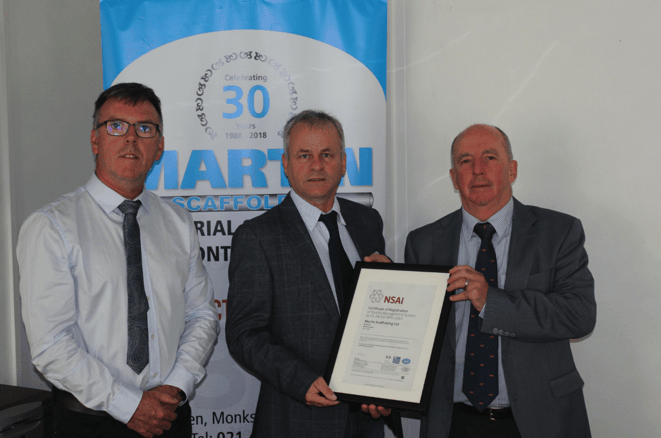
Martin Scaffolding based in Raffeen, Co. Cork have been awarded the prestigious ISO 9001 2015 Quality Management System Award which is presented to organisations that demonstrate the ability to consistently provide products and services that meet customer and regulatory requirements. Martin Scaffolding are celebrating 30 years in business this year and employ 80 full time workers with a fleet of 20 trucks. Martin Scaffolding are currently the only Irish Scaffolding company to be awarded the accolade and are delighted with such an achievement. Brian Martin, Managing Director of Martin Scaffolding says “We are proud to be an early adopter of the updated standard as it provides further proof that we are very serious about the service we supply and will always strive to deliver top quality for our customers.” The road to certification requires time and commitment but this is something that Martin Scaffolding have embraced and considered it a valuable investment in their service, staff and clients. “It is great to be recognised for our hard work and dedication to quality. We want our clients to feel secure in knowing that by choosing Martin Scaffolding they are working with an internationally recognised company whose commitment to safety, quality and customer service is at the core of the business. This award coupled with our continued Grade A Safe T-Cert is a credit to everyone who worked hard to achieve it.” International Organization for Standardization (ISO) 9001:2015 is the most updated standard of its kind and focuses on quality management systems and performance. There is a huge advantage of using suppliers accredited with this certification as it ensures consistent and good quality products and services, which in turn brings many business benefits. Dermot Murray, Head of Health and Safety in Martin Scaffolding is proud of the company’s achievement, “We are excited to earn this certification and feel it provides additional assurance to our customers that we are focused on continuous improvement and customer satisfaction. Ultimately it demonstrates our desire to perform at the highest levels of quality and efficiency. It’s essential to delivering high quality to our customers.”
A British poker champion is now estimated to have won £30 million during his professional career.
Nottingham ex-scaffolder Sam Trickett, 32 gave up his scaffolding job in 2006 to pursue his dreams of becoming a professional poker player. Fast forward twelve years and according to Poker Followers, he has now won £30million in tournaments and cash games.
On some occasions during his career, he would lose as much as a million in one go. However, there were other times when he could win up to £7.6 million in a single day reports the Daily Star.
Sam who is the UK’s all-time leading poker money player started gambling when he was 14, playing pool in pubs and clubs in Nottingham. But by 18 he had started playing poker for £5 wins. Two years later he turned professional.
“I was working as a scaffolder at the time and it was difficult to fit in poker. Eventually, I quit work and started playing poker as my job,” he told the newspaper.
“The most I’ve won in a day is about £7.6 million. I’ve lost £1 million in a day a few times. If I thought I was going to lose more than that I’d feel uneasy. So, when that happens I tend to quit so I don’t lose more.”
The Partypoker ambassador has taken part in competitions all over the world.
Sam Trickett’s pad in Ibiza, Image: Twitter
With having the rock and roll lifestyle Trickett likes the finer things in life, he’s the owner of four properties including a plush villa on the island of Ibiza. Sam also likes his cars, he says he has a custom-made Ferrari which cost him £275,000. His Range Rover cost £90,000, while another car amounted to £120,000.
Shocking video filmed in Hong Kong during typhoon Mangkhut shows the moment scaffolding collapsed on a highrise housing development project.
The deadly typhoon Mangkhut hit Hong Kong over the weekend it is said to be one of the most powerful storms to hit the region in decades. The storm has wrecked buildings and shut down the city.
Palmers Scaffolding UK are providing modern scaffolding solutions on an historic old mint in Edinburgh, for top main contractors, ISG Construction Limited.ISG’s premium central Edinburgh re-development project – to be known as ‘The Registers’ – comprises the mint building (previously used for the manufacture of currency) at 28-52 West Register Street, which incorporates a listed warehouse constructed in the Venetian Gothic architectural style of the 1860s, just adjacent to the well-known St Andrew Square in the city centre. It is a mixed-use re-development of the mint building, where the team at ISG are creating create 5,700 m2 of Grade A office space and 1,000 m2 of leisure space across ground and basement levels.Nine Palmers Scaffolding UK Ltd operatives are providing 11 lifts of scaffolding access from April to December on the 21.5m high historic mint building, enabling ISG’s construction workers to retain and repair the building’s façade, whilst reconfiguring and extending the capacity of the building, with a new steel frame structure.The £200,000+ scaffold is a physically-tied Layher Allround modular access system, designed by Palmers’ in-house engineers to provide access for the construction workers to the external façade and roofs of the new mint building and the existing Venetian building. In addition, Palmers scaffolders are installing 1,330LM of edge protection handrails erected from MEWP’s (eliminating the need for additional working at height) directly to floor steels, for compliant work at height safety during the formation of each of the eight-floor levels. Palmers Scaffolding UK Limited Managing Director, Lindsay Harle said: “It’s fantastic to be working with ISG on this interesting, challenging project on such an historic building in central Edinburgh – working closely with them to overcome access hurdles in the process. The very tight nature of the city centre site has made the temporary scaffolding works particularly challenging. And the client has also made the unusual request of installing the scaffold ties to the steelwork prior to the scaffold being erected. But these are challenges we relish for our clients.”Ian McFarlane, Palmers Director of Business and Project Development added: “Palmers Scotland branch has won a number of significant contracts in Edinburgh and Glasgow recently, close to our headquarters. We are pleased to be working in conjunction with ISG Construction Limited to provide their scaffold support on this significant development in central Edinburgh and look forward to bringing the access provision in on time, and on budget.”
One of the UK’s leading manufacturers and suppliers of height safety equipment has partnered up with Simian Risk to showcase working at height safety solutions.
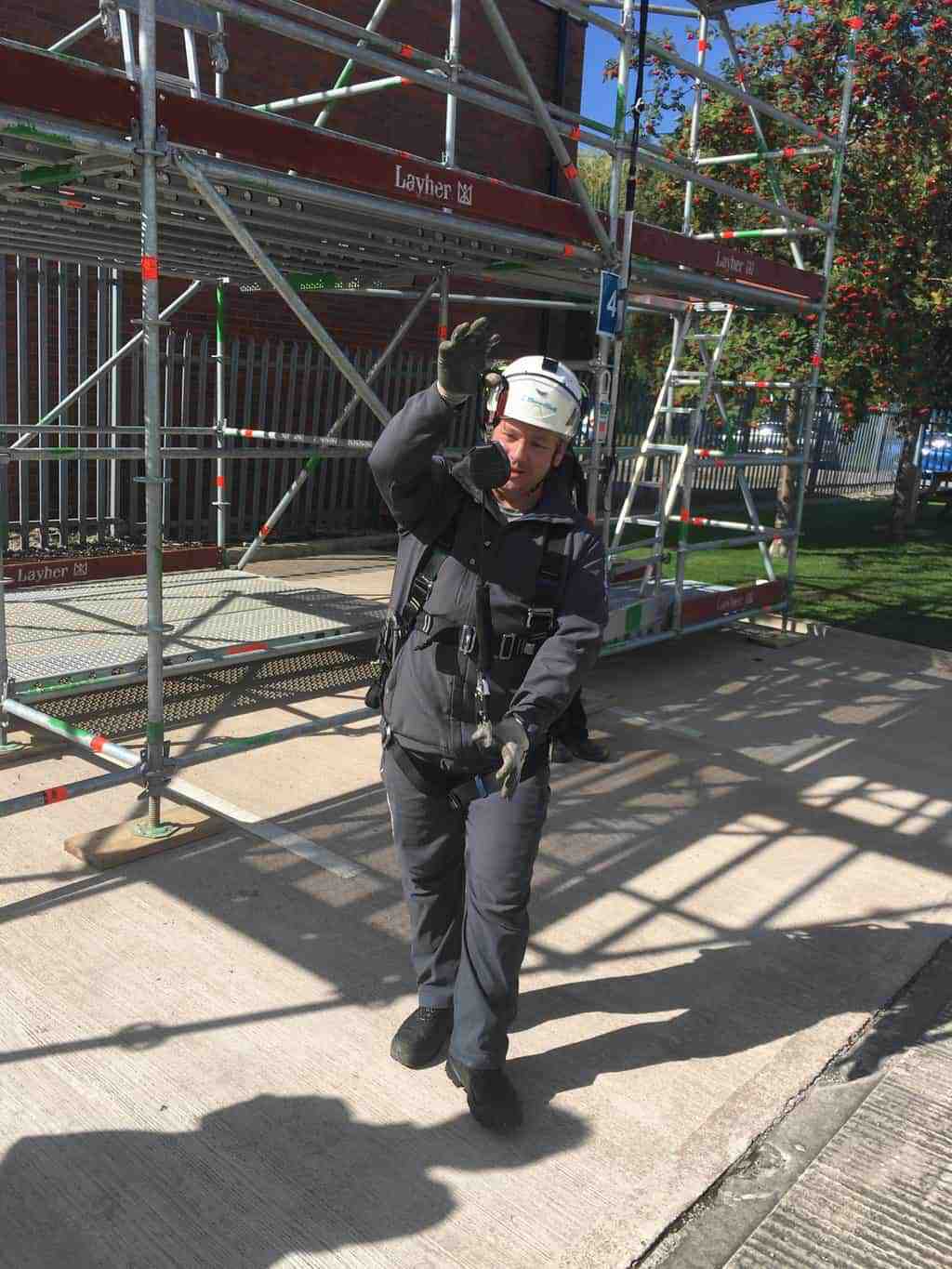
At SpanSet’s impressive custom-built training facility in Cheshire, the duo on Wednesday expertly delivered a technical open day focusing on the scaffolding and access industry. Simian and SpanSet highlighted a number of areas where SpanSet’s products could help reduce or manage risks associated with building, maintaining and working from scaffold and access platforms.
Pete Ward Managing Director of SpanSet got the technical open day underway with an introduction to the company while Simon Hughes Managing Director at Simian Risk and Technical Author of SG4 delivered a short presentation to the attendees on the latest scaffolding guidance and hot topics.
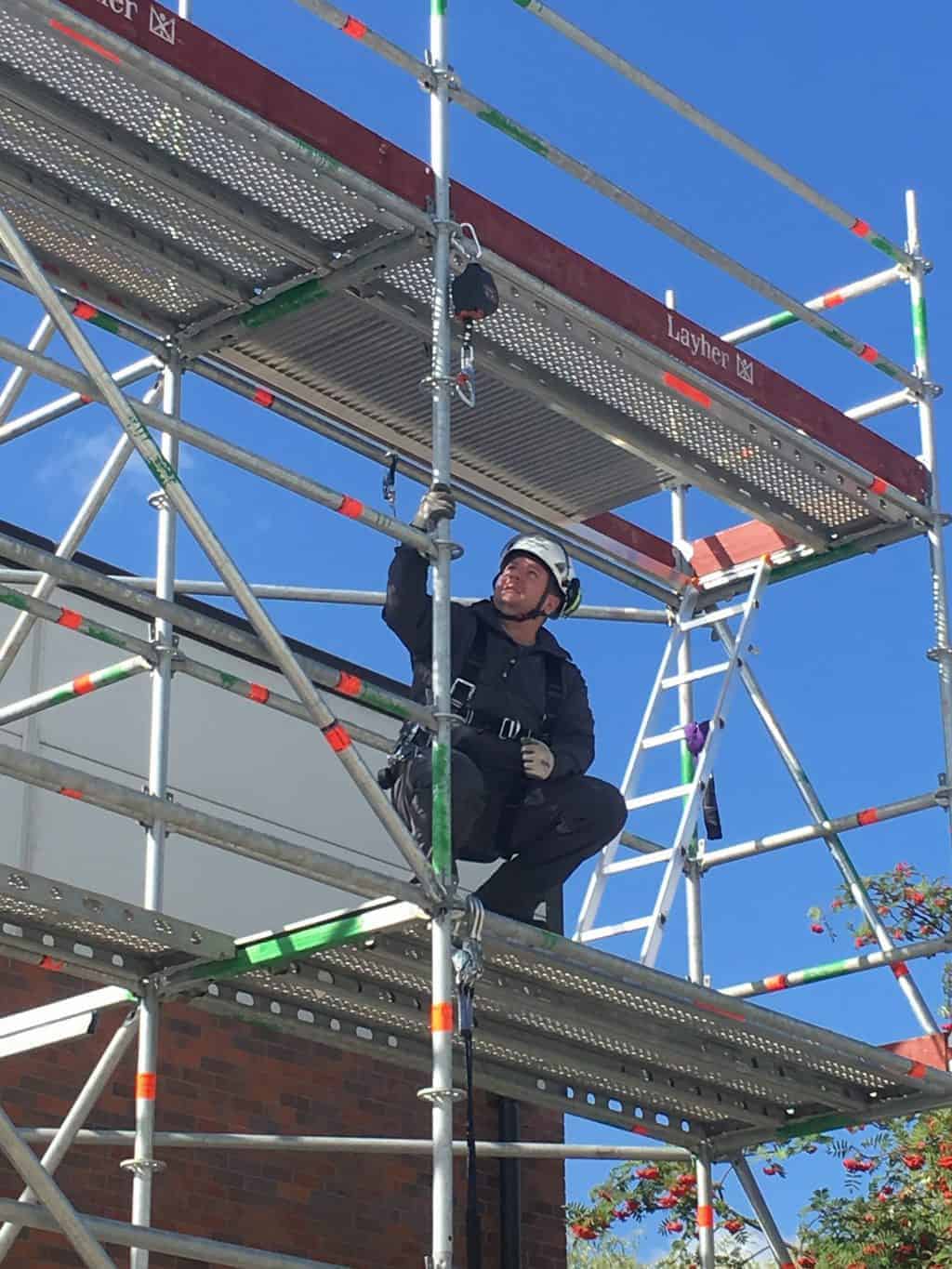
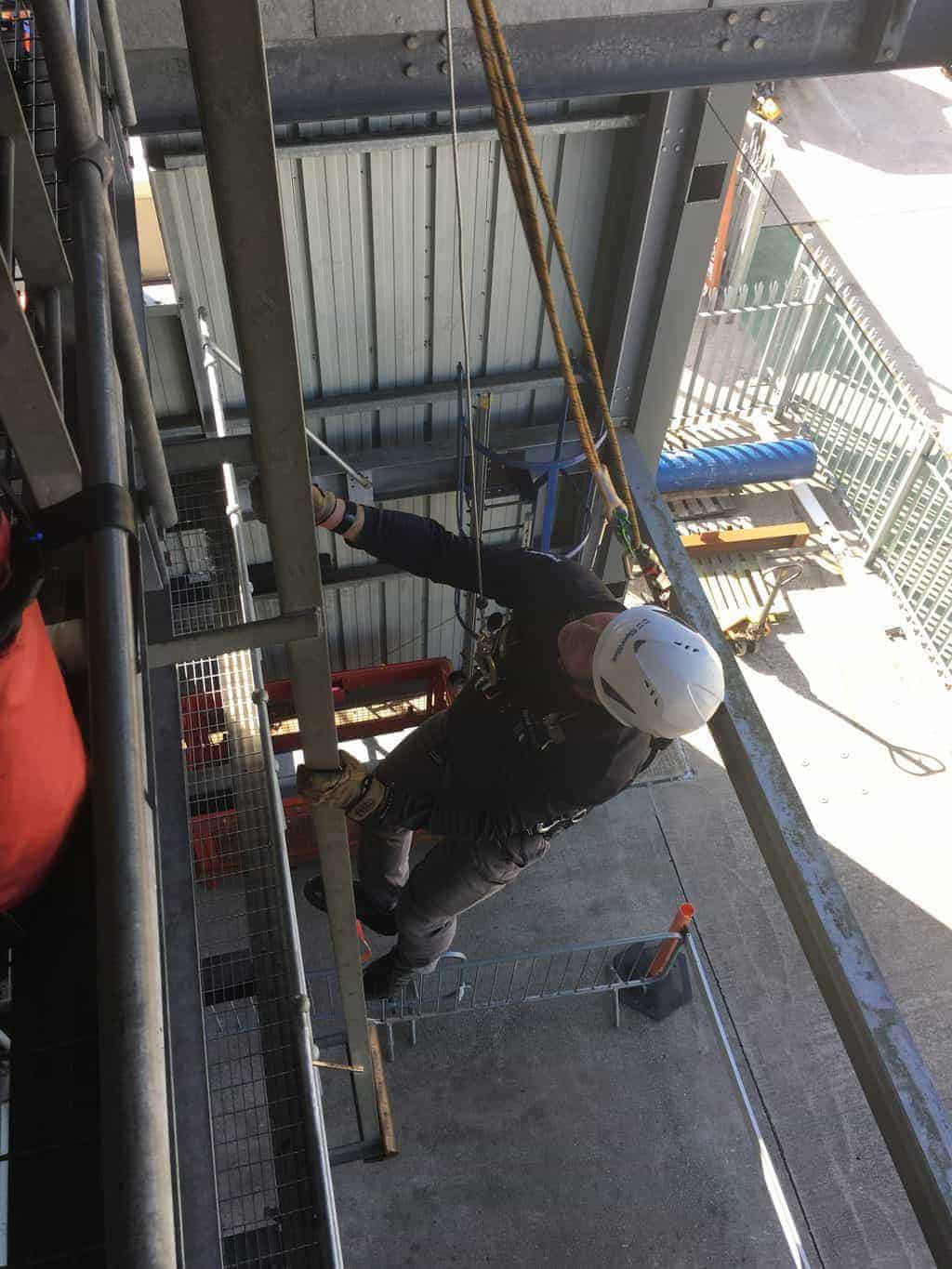
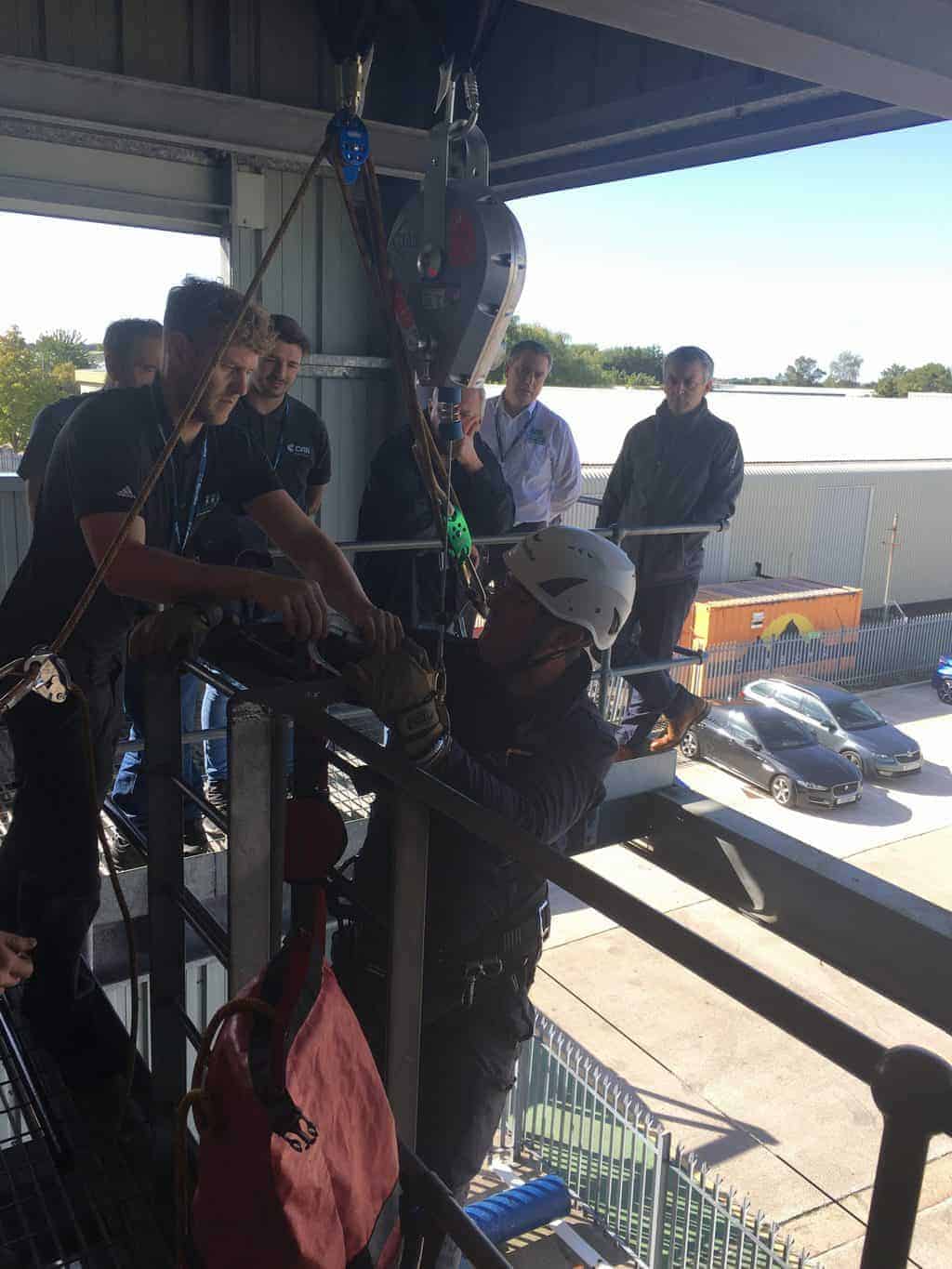
Attendees to the open day were also enthralled with several expertly delivered live demonstrations of Personal Fall Protection Equipment (PFPE). These real-world demonstrations were made even more life-like due to SpanSet’s recently refurbished training facility. The facility contains the resources to recreate a broad range of operational environments.
1 of 5
Practical demonstrations and advice from both SpanSet and Simian included Traditional Landyards vs Hybrid Lanyards and how they have revolutionised scaffolders safe clearance height, Products for low clearance applications, Safe rigging and lifting of light materials to prevent dropped objects. The duo also demonstrated first response rescue for scaffold structures using the GOTCHA kit.
Simian Risk’s Business Development Manager, Simon O’Donnell said: “As we have recently entered a partnership with Spanset Ltd for the supply of PFPE in our training centres, the open day was a great opportunity to showcase the fantastic training facilities and products they have at Spanset to our Clients, as well as providing an informative and educational content.
“The day was a joint technical day in conjunction with Spanset Limited, focussing on height safety solutions for the scaffolding industry. The day was well attended and a great success for both companies with a lot of positive feedback from attendees. Simian are delighted to be working with Spanset on this collaboration and hope that there will be many more joint initiatives in the future”.
The recent refurbishment of one of the Army’s most significant training assets was made possible thanks to a team of fast-working scaffolders.
The Combined Arms Tactical Trainer (CATT), which is based at Warminster and uses networked simulators to enable soldiers to train in a virtual environment, underwent a major £1.9m upgrade over August and September.
The project was funded by Aspire Defence Limited (ADL), with on-site works managed by KBR-owned Aspire Defence Services Limited (ADSL), on behalf of the Defence Infrastructure Organisation (DIO). Aspire Defence is contracted by the MOD under Project Allenby/Connaught to build and maintain soldiers’ living and working accommodation at military garrisons across Salisbury Plain and at Aldershot.
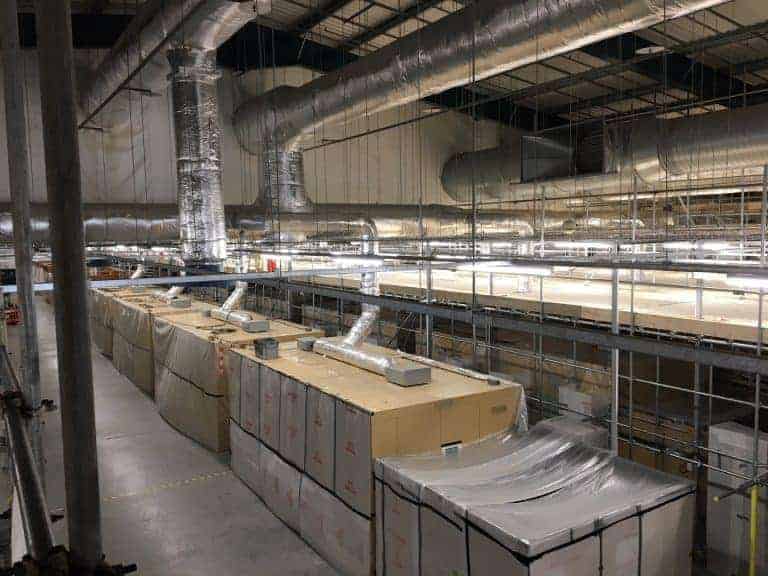
The CATT refurb required the installation of the largest volume of scaffolding in the shortest possible timeframe for any Aspire life cycle project.
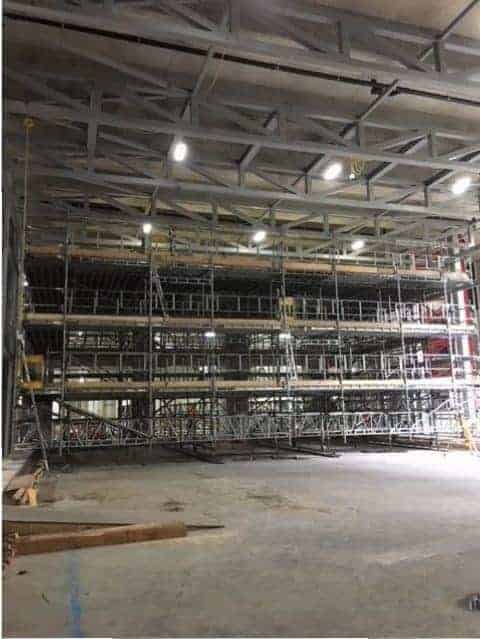
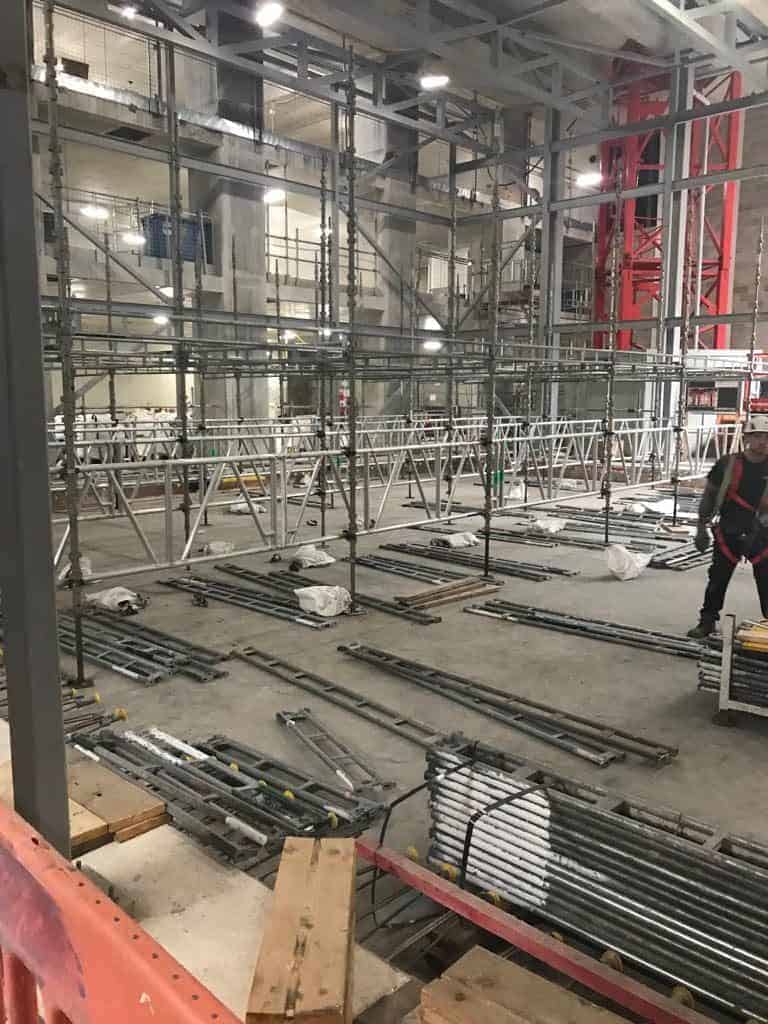
To enable access to the high ceiling within the CATT, around 324 tonnes of scaffolding were erected by contractors Ideal Scaffolding (Southern) Ltd and S&K Scaffolding Ltd – that’s over 14 miles of scaffold boards and more than 20,000 metres of tubing. In addition, four lorry loads of plywood timber were delivered to the site, so that each state-of-the-art simulator could be boarded up and protected during works. The wood has since been donated to the Ghurkhas for reuse.
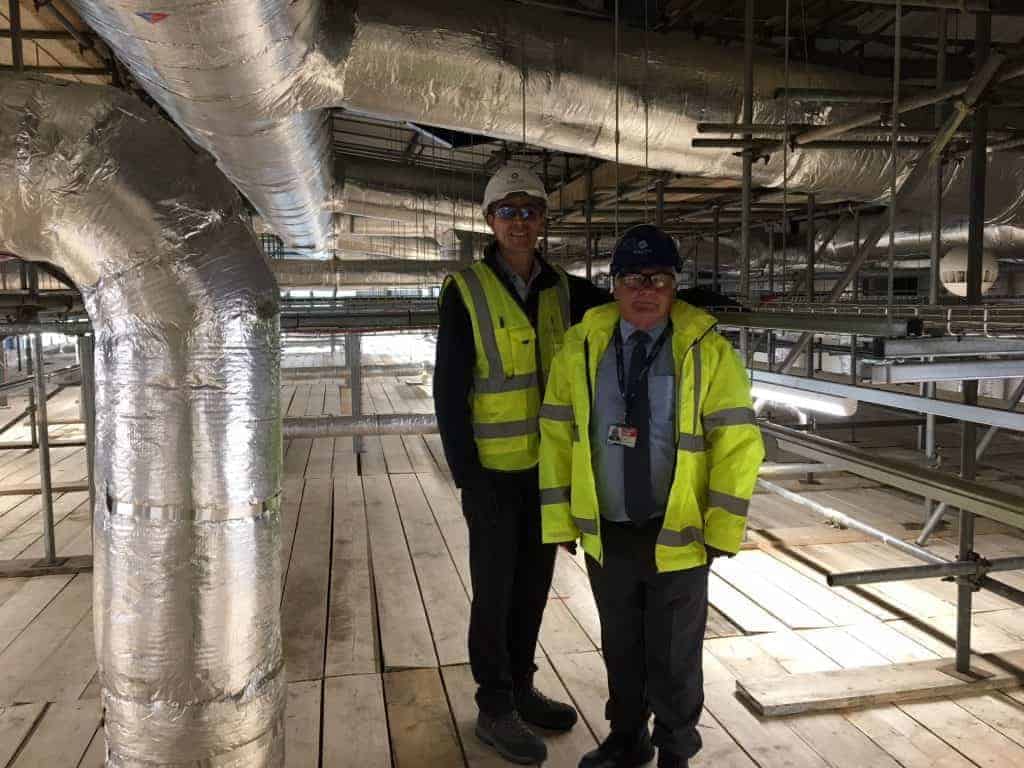
Richard Pearce, Strategic Asset Manager (Aspire Defence Limited) and Brian Martin, Programme Manager (Aspire Defence Services Limited) on the scaffolding platform inside the CATT
Brian Martin, Programme Manager for ADSL Warminster & Larkhill Garrison, explained: “The scaffolders were exemplary. This was the largest internal job they had ever taken on and, in just one week, they completed an installation that would normally take a month. We had around forty contractors on site in a highly-controlled working environment, with excellent collaboration and productivity.”
Every simulator now has an individual fire alarm and air-conditioning controls, enhancing the safety and comfort of soldiers during training. The installation of over 600 energy-efficient LEDs (totalling 21 miles of cable) will also create substantial savings, dramatically reducing the power bill for the building.
Richard Pearce, Strategic Asset Manager for ADL, said: “Our customer will notice a huge difference, thanks to improved lighting levels and ventilation throughout the facility. This significant investment will ensure that the CATT remains a safe, compliant and economical asset for the Army, where soldiers can continue to gain vital operational skills.”
US oil giant ExxonMobil is preparing to spend more than £500m on a major overhaul of the Fawley refinery.
If approved by local authorities, the half a billion pound upgrade would enable the refinery to produce more high-quality diesel from new oil processing units, and extend the life of the facility.
Located on the south coast of England Fawley processes around 270,000 barrels of crude oil a day, fueling around one in six British vehicles.
Work has already begun on clearing the site for the planned units which will sit within the 3,000 acre Fawley refinery.
Speaking to the Financial Times refinery manager Simon Downing said: “We see a long-term future for Fawley and we’re looking to make a significant investment in the site,”
“This is not a paper exercise, we already have a big team working on this.
Altrad has combined Cape PLC, NSG and Hertel to create UK’s largest industrial services provider to the petrochemical, energy and infrastructure industries.
The consolidation of the three Altrad-owned business creates a single business named Altrad Services that has been designed to provide an efficient, streamlined offering to customers.
Altrad Services has developed three distinct business lines, with each having its own separate strategy, aligned to its customers and markets. These include Maintenance, Modifications and Overhauls (MMOs), Projects and Nuclear.
Simon Hicks, managing director for Cape UK said: “The newly launched Altrad Services enables us to offer something truly unique to our customers – with our dedication to customer service and operational excellence continuing to drive our approach.
“MMO is the traditional part of the business and will continue delivering industry-leading excellence developing deeper relationships with our customers. Projects will be made up of Altrad’s specialist services and offshore businesses – targeting growth through major projects. The Nuclear Stream brings together the excellence of Hertel and Cape, continuing their work with current customers in this area, while developing greater capabilities around nuclear decommissioning.”
“Our vision is clear and ambitious. By bringing together these three leading brands, we’re future-proofing our business and aligning our operations to the current market trends. Altrad’s new expanded offer delivers an enhanced, innovative service – catering for every business in the oil, gas and chemicals industries, no matter what the size or requirement.”
Future developments will see the new integration build on its years of experience in the oil and gas, energy and infrastructure industries, with a vision to become a sustainable business for the future.
Lyndon Scaffolding has been supporting their client Lendlease with innovative access solutions on a prestigious project in London at 150 Bishopsgate.They erected a mobile birdcage scaffold that is 16m wide, 10m long, 7m high and weighs 18.5 tonnes, for the creation of one of the first ballrooms to be built in the city for decades, in an area that is 4,800m3.Lendlease needed access 9m up to install the services inside and over the top of the acoustic ceiling for the ballroom. Jon Smith, Project Manager said: “They couldn’t install a full birdcage to the area, so we needed a solution, I had an idea to erect a birdcage and put it on tracks. Thankfully, this idea was very well received by Lendlease, as it solved their problems immediately and safely: They loved the innovation. After all, it’s not everyday you see a 18.5-tonne mobile tower.”As the scaffold structure – all designed in-house by Lyndon engineers – is 10m long, it will need to be moved twice to cover the vast 30m long ballroom. The top lift is 7m high to allow operatives to work from podiums to access in between the concrete and steel beams which have a 1.5m recess. And the scaffold also has boarded lifts around the perimeter to access the columns to do the cladding at the same time.Jon Smith said: “This solution has potentially taken months off the fit out programme, as the other solution was to do it all from MEWP’s. And as the birdcage will move both ways at various times to allow the install of services, it may be moved a dozen times depending on the clients’ needs.” CEO Rob Lynch added: “We are delighted with the solution, it’s a classic case of Lyndon finding the right, innovative, safe, cost-saving solution for clients with our temporary works and scaffolding.”
Global system scaffolding manufacturers Layher have released ‘The Layher App’ with the added benefit of Mixed Reality.
Mixed Reality combines real camera shots with digitally generated scaffolding models. In this process, reality – that means all things that you just see – are supplemented with additional information in the form of 3D scaffolding objects.
Available free to download on iOS and Android the app essentially works in conjunction with the Layher Allround Catalogue. The app user has the ability to scan over specific images within the catalogue with their smartphone camera thus bringing that element to life in the form of an impressive 3D scaffolding object. Like magic, Layher products and structures can now be seen in the users actual surroundings.
The structures or products can be manipulated, enlarged and rotated giving the user a more detailed view of the structures.
The news of the app seems to of been well received after Sean Pike, Managing Director at Layher UK announced the launch on Linkedin last week. Commenting on his post, Helen Gawor, Business Director at GKR Scaffolding Ltd said: “I’d like to see this Sean. AR, MR and VR will play a huge part in our industry over the next 5 years in various applications. Congratulations on this development”.
More information can be found on the Layher website.








 They erected a mobile birdcage scaffold that is 16m wide, 10m long, 7m high and weighs 18.5 tonnes, for the creation of one of the first ballrooms to be built in the city for decades, in an area that is 4,800m3.
Lendlease needed access 9m up to install the services inside and over the top of the acoustic ceiling for the ballroom.
Jon Smith, Project Manager said: “They couldn’t install a full birdcage to the area, so we needed a solution, I had an idea to erect a birdcage and put it on tracks. Thankfully, this idea was very well received by Lendlease, as it solved their problems immediately and safely: They loved the innovation. After all, it’s not everyday you see a 18.5-tonne mobile tower.”
As the scaffold structure – all designed in-house by Lyndon engineers – is 10m long, it will need to be moved twice to cover the vast 30m long ballroom. The top lift is 7m high to allow operatives to work from podiums to access in between the concrete and steel beams which have a 1.5m recess. And the scaffold also has boarded lifts around the perimeter to access the columns to do the cladding at the same time.
They erected a mobile birdcage scaffold that is 16m wide, 10m long, 7m high and weighs 18.5 tonnes, for the creation of one of the first ballrooms to be built in the city for decades, in an area that is 4,800m3.
Lendlease needed access 9m up to install the services inside and over the top of the acoustic ceiling for the ballroom.
Jon Smith, Project Manager said: “They couldn’t install a full birdcage to the area, so we needed a solution, I had an idea to erect a birdcage and put it on tracks. Thankfully, this idea was very well received by Lendlease, as it solved their problems immediately and safely: They loved the innovation. After all, it’s not everyday you see a 18.5-tonne mobile tower.”
As the scaffold structure – all designed in-house by Lyndon engineers – is 10m long, it will need to be moved twice to cover the vast 30m long ballroom. The top lift is 7m high to allow operatives to work from podiums to access in between the concrete and steel beams which have a 1.5m recess. And the scaffold also has boarded lifts around the perimeter to access the columns to do the cladding at the same time.
 Jon Smith said: “This solution has potentially taken months off the fit out programme, as the other solution was to do it all from MEWP’s. And as the birdcage will move both ways at various times to allow the install of services, it may be moved a dozen times depending on the clients’ needs.”
CEO Rob Lynch added: “We are delighted with the solution, it’s a classic case of Lyndon finding the right, innovative, safe, cost-saving solution for clients with our temporary works and scaffolding.”
Jon Smith said: “This solution has potentially taken months off the fit out programme, as the other solution was to do it all from MEWP’s. And as the birdcage will move both ways at various times to allow the install of services, it may be moved a dozen times depending on the clients’ needs.”
CEO Rob Lynch added: “We are delighted with the solution, it’s a classic case of Lyndon finding the right, innovative, safe, cost-saving solution for clients with our temporary works and scaffolding.”  They erected a mobile birdcage scaffold that is 16m wide, 10m long, 7m high and weighs 18.5 tonnes, for the creation of one of the first ballrooms to be built in the city for decades, in an area that is 4,800m3.
Lendlease needed access 9m up to install the services inside and over the top of the acoustic ceiling for the ballroom.
Jon Smith, Project Manager said: “They couldn’t install a full birdcage to the area, so we needed a solution, I had an idea to erect a birdcage and put it on tracks. Thankfully, this idea was very well received by Lendlease, as it solved their problems immediately and safely: They loved the innovation. After all, it’s not everyday you see a 18.5-tonne mobile tower.”
As the scaffold structure – all designed in-house by Lyndon engineers – is 10m long, it will need to be moved twice to cover the vast 30m long ballroom. The top lift is 7m high to allow operatives to work from podiums to access in between the concrete and steel beams which have a 1.5m recess. And the scaffold also has boarded lifts around the perimeter to access the columns to do the cladding at the same time.
They erected a mobile birdcage scaffold that is 16m wide, 10m long, 7m high and weighs 18.5 tonnes, for the creation of one of the first ballrooms to be built in the city for decades, in an area that is 4,800m3.
Lendlease needed access 9m up to install the services inside and over the top of the acoustic ceiling for the ballroom.
Jon Smith, Project Manager said: “They couldn’t install a full birdcage to the area, so we needed a solution, I had an idea to erect a birdcage and put it on tracks. Thankfully, this idea was very well received by Lendlease, as it solved their problems immediately and safely: They loved the innovation. After all, it’s not everyday you see a 18.5-tonne mobile tower.”
As the scaffold structure – all designed in-house by Lyndon engineers – is 10m long, it will need to be moved twice to cover the vast 30m long ballroom. The top lift is 7m high to allow operatives to work from podiums to access in between the concrete and steel beams which have a 1.5m recess. And the scaffold also has boarded lifts around the perimeter to access the columns to do the cladding at the same time.
 Jon Smith said: “This solution has potentially taken months off the fit out programme, as the other solution was to do it all from MEWP’s. And as the birdcage will move both ways at various times to allow the install of services, it may be moved a dozen times depending on the clients’ needs.”
CEO Rob Lynch added: “We are delighted with the solution, it’s a classic case of Lyndon finding the right, innovative, safe, cost-saving solution for clients with our temporary works and scaffolding.”
Jon Smith said: “This solution has potentially taken months off the fit out programme, as the other solution was to do it all from MEWP’s. And as the birdcage will move both ways at various times to allow the install of services, it may be moved a dozen times depending on the clients’ needs.”
CEO Rob Lynch added: “We are delighted with the solution, it’s a classic case of Lyndon finding the right, innovative, safe, cost-saving solution for clients with our temporary works and scaffolding.” 
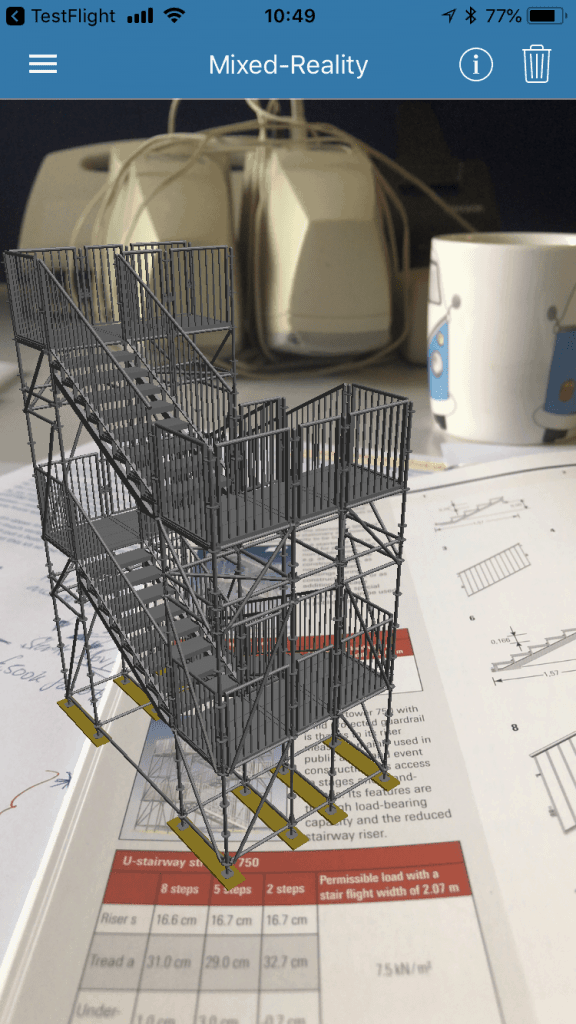 The structures or products can be manipulated, enlarged and rotated giving the user a more detailed view of the structures.
The news of the app seems to of been well received after Sean Pike, Managing Director at Layher UK announced the launch on Linkedin last week. Commenting on his post, Helen Gawor, Business Director at GKR Scaffolding Ltd said: “I’d like to see this Sean. AR, MR and VR will play a huge part in our industry over the next 5 years in various applications. Congratulations on this development”.
More information can be found on the Layher website.
The structures or products can be manipulated, enlarged and rotated giving the user a more detailed view of the structures.
The news of the app seems to of been well received after Sean Pike, Managing Director at Layher UK announced the launch on Linkedin last week. Commenting on his post, Helen Gawor, Business Director at GKR Scaffolding Ltd said: “I’d like to see this Sean. AR, MR and VR will play a huge part in our industry over the next 5 years in various applications. Congratulations on this development”.
More information can be found on the Layher website.