Thinking of a career in Scaffold Design?
I am writing this article as a response to the many enquiries received by 48.3 from people asking “how do I become a scaffold designer?”. Over the course of the past 12 months alone, 48.3 have received well over 100 enquires of this nature, from many different people in many different positions, generally all wanting the same thing; a career in scaffold design.
I will cover all the main aspects to consider when weighing up whether this profession is for you. There are many misconceptions, but I believe, as I said to one gentleman recently “I would prefer that you go onto this knowing all the facts at the start, than starting, only to find out the hard truths later on!”
The only caveat I will place on this at the start is that these are only my views on the subject; there are people out there that will disagree or have done something different. In the 14 years I have been designing scaffolding, I have personally trained 21 people and provide mentoring to around a dozen more. That’s not hundreds, but it’s a few, and more than most. They range from graduate engineers to ex-scaffolders. I have also written a complete training programme for Draughtsman and Engineers that 48.3 deliver to our own staff and external training clients. It is the results of this programme that gives me the confidence to speak with authority on this subject, as the results have been spectacular.
The aim of the article would be to encourage new people into the profession and raise awareness of what great scaffold design involves. (Like all industries) Scaffold Design has its share of ‘chancers’ and incompetent people, if this article exposes those people then great, if it encourages them to improve, even better. If anyone reading this would like my help then please ask – that is my duty to this industry and how I am committed to making a difference.
So what is Scaffold Design?
The first thing to get straight is that scaffold design engineers are (or should be) professional engineers. They are civil or structural engineers that specialise in the design of temporary works, and within the field of temporary works, they specialise in the design of scaffolding – a niche within a niche! This is important as it governs your mindset and your actions when carrying out your role and the importance of completing CPD (Continued Professional Development). The design of scaffolding is similar to most other engineering professions – we solve problems. In this case, the problems involve providing access, support, propping, encapsulation and a whole host of other things, in a safe and cost effective way. In creating those ‘solutions’ an engineer could visit site, survey, create design briefs, risk assess, plan methods, draw, calculate, assess, check and plan. They have to communicate excellently, liaise with many other people and trades, all with their own priorities, be diligent and professional, and most importantly, create a solution that is fit for purpose, build-able and commercially viable. These last three are critical.Do you need to be an ex-scaffolder to design scaffolding?
No. However understanding the practicalities of scaffolding is key skill for any scaffold designer… in fact, its more important than that, it’s critical. If you don’t understand how the scaffold will be built, and be able to built it in your own mind as you design it, you will invariably create a design that cannot be built, or be unnecessarily difficult, complex or time consuming, usually making the scaffold commercially challenging. One of the most valuable experiences of my career to date came when working as the design manager at Tone Scaffolding. Up to that point, I had never worked for a scaffolding contractor. One of my designs was being critiqued by the owner, Andy Needham (link), he asked me if, during the production of the design, I had considered every possible option for a particular beam fixing, and in doing so, was I absolutely sure that it could not be done with less fittings? I thought I had (or at least, done my best in the time I had available), but the truth is, I hadn’t considered everything. After a 30 minute discussion, it transpired that, for a large section of the scaffold the beam anchorage could be done with one less fitting, and on a smaller part within that, two less! “Whoooa!” I hear you say. Well, the truth is, it mattered. Adding up all the fittings over the whole job meant a big saving on labour time and cost. At that point, the ‘commercial’ penny dropped. The reason I shared that story is because it’s obvious for scaffolders – that’s the basics. But I can assure you it’s not obvious to a design engineer that does not understand the practicalities of scaffolding. The following day I went into the yard and built that beam fixing. I checked it, I saw the tight space to turn the spanner against the wall, I saw what a saving going from six to five fittings was. I learnt a valuable lesson that day; my designs, and my team’s designs, have not been the same since. Lets consider this in a different way. To design structural steelwork do you need to have spent time fixing it and bolting it together? To design concrete do you need to have spent time mixing it or fixing rebar? To design timber do you need to spent time as a lumberjack or in a mill? No, No, No. So why is there this misconception that you must have to have ‘done your time on the tools’ to design scaffolding (or any job in scaffolding for that matter)? I’m not underestimating the importance of practical scaffolding knowledge, every scaffolder has a story of getting a design that couldn’t be built, and that, I find very embarrassing for the scaffold design profession – that fact that this mistake is so common. You must understand it, you must appreciate it, but you don’t have to spend years doing it. It comes back to the definition of what scaffold design engineers are – professional engineers, not scaffolders who can draw. Therefore, anyone who wants to make a move from practical scaffolding to scaffolding design must get this mindset right at the start. “So what did you do at the start to get the practical experience?” I hear you ask. Well, when I started as a graduate engineer with Alwyn Richards in 2004 the first thing I did was read BS 5973 cover to cover – twice. Then again after I had asked a huge number of questions to Alwyn (he was very patient!). Next I went and carried gear around in a local clients yard for a week or so to learn what the materials and components were and also go for a ‘long stand’, a ‘glass hammer’ and alike. Then I went and did my Part 1. That’s when I realised how hard it is to top out a 21’ at chest height (very valuable lesson for staggering joints and specifying tube lengths!). That’s when I developed a healthy respect for the challenges of erecting scaffolding competently, compliantly and quickly. Alwyn has many years of scaffolding experience, and I was very fortunate to learn from him, he was a great teacher and I was very lucky (Thank you Alwyn). In conclusion, no you don’t have to be an ex-scaffolder to design scaffolding, but you must be able to build the scaffold you design in your mind. You must understand the challenges scaffolders face erecting scaffolding generally, and in compliance with SG4, and then at a sufficient speed that makes it commercially viable. Apply that understanding to your design solutions and you’ll be better than most – that’s what I think.I am a scaffolder and want to get into design
STEP 1: Start with the end in mind. Know what you want to do: have a goal to work towards, do you want to be a Technical Design Draughtsman (TTD), Design Engineer (DE) or a Senior Design Engineer or Principal Engineer? To provide an understanding of what is involved with each role, here are some common tasks associated within each one in a scaffolding design office: Technical Design Draughtsman (TDD): site survey, hazard identification and risk assessment, brief creation, solution creation, development and appraisal, production of design drawings and modeling, checking of all previous. Design Engineers (DE): site survey, hazard identification and risk assessment, brief creation, solution creation, development and appraisal, production of design calculations including 2D and 3D frame analysis, foundation design, design checking. Principal Engineers (PE): site survey, hazard identification and risk assessment, brief creation, solution creation, development and appraisal, production of design calculations including 2D and 3D frame analysis, design checking, overall design responsibility. All these roles have commonalities, a great mindset, positive attitude, motivation, patience and the right academic qualification are must have’s. You are likely to find that a draughtman will spend the majority of their time drawing, similarly a senior engineer may spend a lot of time doing calculations, checking designs and mentoring. Once you have established what you want long-term then there is nothing better than to talk to people, read codes of practice and industry guidance, find out exactly what is involved with each role, and then decide which one you want to go for. There is nothing to stop you becoming and TDD and then progressing into a role of a DE during your career. If you don’t have any academic qualifications then you will need to look at local colleges and universities and see what courses they offer, in what format (part time, full time, day or evening etc.) and how much they cost. The first step is likely to be an HNC or HND. I would recommend studying Civil Engineering or Structural Engineering. Avoid other watered down subjects. Check that the course you are looking at is accredited by the JBM (Joint Board of Moderators) to meet the academic requirements for membership of the ICE (Institution of Civil Engineers) or IStructE (Institution of Structural Engineers) through the Engineering Council. Its is my recommendation that Technical Draughtsmen target Engineering Technician (EngTech) membership of the ICE or IStructE, and Design Engineers target Incorporated (IEng) membership. There is also nothing to stop you working towards Chartership in the future if that is where you want to go. The minimum academic qualification for EngTech membership is an HND. The minimum academic qualification for IEng is a Bachelors Degree (BEng). If you want to pursue Chartership then you will have to complete a masters degree (MEng). There are other routes to membership that you can pursue if you have significant industry experience, and if this is of interest, I would suggest contacting the ICE or IStructE and discussing it with your local membership officer. STEP 2: “Walk a mile in another man’s shoes” (or women’s shoes!) Ideally before you enroll at college or quit your job or do anything drastic, try and find somewhere to get some work experience or do some shadowing. If you can arrange a work trial, placement, internship or secondment and you can fit it in with existing commitments, then this would be ideal. The reason I think this is important is so that you see what it’s actually like working day-in, day-out in this role. There are plenty of misconceptions out there about scaffold design and many people will be in for a reality check. Here are some of the considerations to make:- You are moving from a professional scaffolder to a professional engineer – they are entirely different.
- You will be going from a manual, outdoors job to an office based, indoor job. If you like doing things with your hands, or being active all day, the change could be difficult.
- Your mindset and motivation will have to change – not necessarily increase, just change. You will have new motivating factors that drive your work ethic and new challenges that will test your mindset and attitude.
- You will probably have to take a pay-cut initially if you were a Part 2 or Advanced Scaffolder, charge-hand or foreman. You will be competing for jobs with graduate engineers in a different job market and the pay is different.
- Your working hours may change and that could affect your routines at home or with family.
How 48.3’s team operates
48.3 operates a distinct design process from an initial enquiry through to delivering a fantastic solution. Our technical staff are in three main groups: technical draughtsperson, design engineers and principal engineers. Resources and delivery is managed by a design manager or team leader. Our project teams are made up of combinations of people from these three groups, and they depend on the size, complexity, and deadline of a project. Resources are combined across the business and people are working daily with other team members in other locations by leveraging modern technology for communication, file sharing and project management. All roles have responsibility for design compliance and improvement in terms of quality and process. Quality of the end product takes preference over everything else – that is one of the cornerstones of our operating principles. At 48.3 there is no difference in importance between roles. Every role has different key result areas and areas of responsibility, and if one is not completed perfectly, the project isn’t delivered perfectly. This means the work done by a draughtsperson is no less important than the work done by a principal engineer and vice versa – we are a team, and every player is critical. Some companies believe that all staff should be design engineers (or fulfil this role) and then do everything in the delivery of a project. 48.3 very occasionally work like this, but not often. We focus on strengths and deliver projects based on the strengths of people within roles. If you are a sole trader or working alone, then you have no choice – do everything and anything that needs doing.Final thought
I hope this article has given you an insight into what a career in scaffold design would be like and what the journey would be like to get there. If you want something enough, you can achieve it. As Mark Twain said “Twenty years from now you will be more disappointed by the things you didn’t do, than the ones you did.” Good luck! Ben Beaumont Founder & Managing Director of 48.3 Director of the Temporary Works Forum This article was first published in the Winter 2017 issue of the ScaffMag magazine. View IssueWhat made you want to be a scaffolder then?
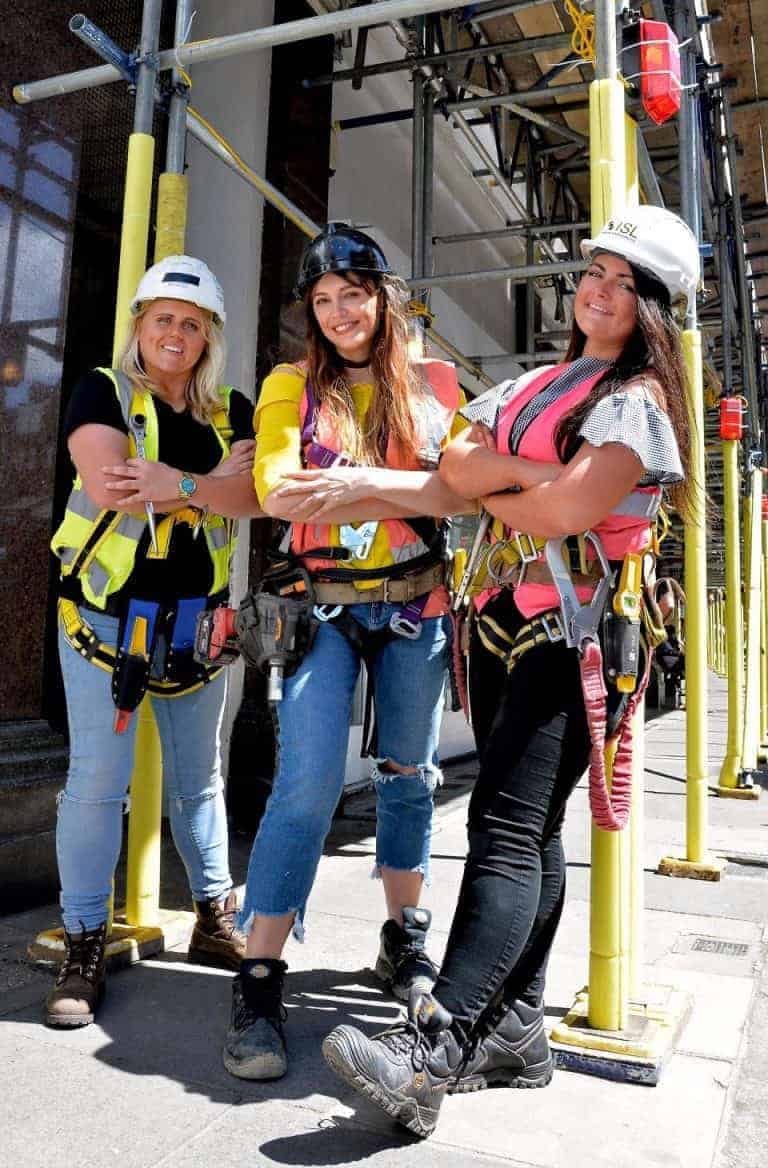
I must have been asked this about 1000 times over the 8 years I’ve been in the industry, and over 1000 times I’ve roiled my eyes and sighed. It’s one of the most complicated questions to answer without either going into a long-winded story or sounding like a total bitch with a serious attitude problem. The question can come from Site managers, the man sitting next to you in the pub, other people on the SSTS course, college tutors, ground workers in the bait cabin, any new scaffs and even labourers you work with. It could also be a friend of a friend you’re introduced to or most people you meet really.
I get the impression everyone thinks you’re out there chasing your dreams because your dad, granddad or favorite uncle are scaffolders and you’ve been brought up as a tomboy really. Why else would you do this to yourself right? There’s bound to be a really inspiring story behind it. Well, it might be the case for others but not for me. The story goes, I was totally off the rails as a teenager, struggling with a council flat full of aging hand me downs including a 50-year-old sofa, ugly burgundy floorboards and un-decorated walls. I could go on forever describing the downbeat place I was in, but the top and bottom of it was I was on my own without the money to get someone to come and sort it out.
I was on the ‘rock and roll’, and one day I went to meet a friend and she asked me to come to an ‘open interview’ for an office job at a scaffolding company. As I had nothing better to do I made the effort. The director was there describing the job, he gave a speech about scaffolding being good money, the healthy outdoors, and the possibility of sending scaffolders to work abroad. “Can lasses do it”, I said. I had to ask as it sounded more adventurous to me. I’d tried seven other jobs from McDonald’s, call centres, door to door sales etc, and nothing interested me to keep me there longer than three months. He waffled on a bit and somewhere amidst the waffling I heard the words ‘equality and diversity’ is good for the company. Later that day they rang my friend, offering me a trial at the stadium of light as they were doing the stage for an Oasis Concert. This was 2009, the same year I started an apprenticeship with Citb, going on to gain my blue scaffold two years later.
Explaining all of that to people takes some time so I’d normally just reply “I didn’t want to be a scaffolder, I just fell into it”. To be honest, it’s the best decision I ever made, I can’t begin to explain how rewarding the hard work feels.
My life didn’t change dramatically in those two years. In fact it took a long time and a lot of hard work to sort myself out. It was when I nearly lost my job because of blowing a Monday shift I realised how much I cared, and how much I wanted to succeed. To finish what I’d started.
I now have a beautiful home my partner and I have bought, and we’re also getting married next year. I’ve not had to face anything on my own now for six years. I was also short-listed for Tradeswoman of the Year making the final three at this years’ Woman in construction awards. I was so proud to be part of it. I went on to work in Admin, Operations, Finance and now Contract management for North East company James Inglefords Scaffolding. I didn’t just take a job back in 2009, I took on a career.
Raising Awareness
Is it just me? Do others feel how I feel? Is it really that rare? I’ve always wondered this, but it wasn’t until I was approached last year and asked to help raise awareness of the lack of woman in the industry. The aim was to promote getting more woman involved. that I took action and came up with the facebook page ‘Females in Scaffolding’. Within those couple of months, I discovered Claudia Ferguson, from Sunderland, was an apprentice at Newcastle College, She’d transferred the second year of her specialist course over to AIS training centre, which just so happens to be on my doorstep, so I made contact. I found Carlene Brookes, a part one scaffolder from London, then eventually Farren Williams. Eventually, I was getting answers, and yes there are other woman in the trade. But how many? It was then I turned to CISRS who provide some fascinating information. There are only six-part two’s, eight Trainee’s, and 17 labourer registered. They couldn’t really tell me any more information about who they are or who was first, though I was secretly hoping it was me. They did confirm I was third to qualify. Top three, I’ll take that! All of this research has really awakened a fire in me and although I downed tools almost three years ago to train as a QS, I’m ready to challenge myself again. I’m ready to get practicing and go for my level three Advanced course. It’s going to be so hard as I’m out of practice. I don’t scaffold every day now and haven’t for a couple of years, but I’m using the others as role models. It’s like riding a bike, you’ll never forget how to turn a spanner. I can’t wait to learn more and expand my skills. The secret about scaffolders is we’re all insane but in the best way possible. We are lifesavers, the purpose of scaffold is so people can work at height, safely. I really don’t think the scaffold industry gets enough credit, what would construction do without it? This article was first published in the Winter 2017 issue of the ScaffMag magazine. View IssueScaffs Sit Com Set To Take Centre Stage
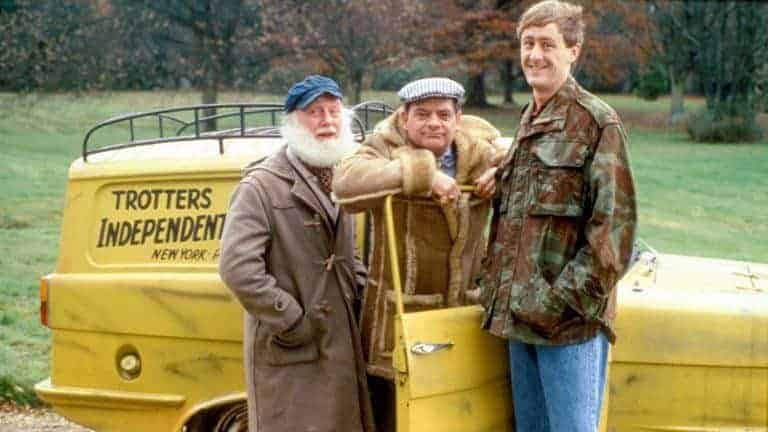
The BBC are working on a situation comedy aimed at the scaffolding industry in the hope of taking over from where Only Fools and Horses left off. John Sullivan’s much-loved sitcom about Del Boy, Rodders and co is now firmly ensconced in British Television history.
The basis and message of the show is often discussed in universities these days, and it’s felt the world of the working class scaff would make for perfect new material in the hope of constructing another comedy classic. We can reveal it’ll be set in Frinton-on-Sea on the Essex coast, and written by Rhys Thomas, the voice of Brian Bellamy in Radio 4’s Down the Line and creator of comedy rock legend Brian Pern. Rhy’s told the media:
“The plan is a little bit Only Fools and Horses but set now. There aren’t many things that really represent working class life on telly. That’s why I want to do it. It would be quite nice to make something that the whole family could watch that doesn’t have any swearing but isn’t naff.”
Though still in the early stages it’s foundations have already been laid with the help of what Rhys describes as a ‘healthy development budget’ from the corporation. Readers of a certain age of course will remember how well auf wiedersehen pet, following the adventures of a gang of British workmen abroad, was received in the early 1980’s.
The Channel 4 station is currently working on a sit com about a pair of dodgy cockney builders, Lee and Dean, for its on-demand service All 4. It’s being written by Mark O’Sullivan and Miles Chapman. The BBC, of course, are renown for creating classic comedies, and it’s a tough job to fill the boots of John Sullivan. But Rhys Thomas actually welcomes the comparison with all things Peckham, and has a good idea of who he’d like to play some of the leading roles:
“I would love to pair Christopher Eccleston and Michael Kitchen up in it because they are my favourite actors. In Brian Pern, Kitchen played the rocker’s unscrupulous agent John Farrow while Eccleston was taciturn ‘Madchester’ rock producer Luke Dunmore who produced Pern’s awful LP Shelf Life.”
Given Kitchen’s brilliant performance as the constantly swearing agent, he’d be favourite to revel in such a role. The versatile and down to earth Christoper Eccleston certainly wouldn’t be out of place. The scaffolding industry of course represents real every day life in more ways than one. It seems a fitting choice therefore for a sit com packed with great one liners and lots of funny situations.
It’s not the only new show that Thomas is currently developing with the BBC. He’s also working on a comedy drama set in a caravan park full of divorced men. It’s modelled on the experience of Thomas’s own father, who moved into a caravan site on a temporary basis and remittance 18 years. Thomas is developing the idea with Fifth Fathoms, the production company behind recent hits Fortitude, Marvellous and The A Word. In terms of Only Fools and Horses, Seven series were originally broadcast on BBC One in the United Kingdom from 1981 to 1991, with sixteen sporadic Christmas specials until its end in 2003. Watch this space for more news on the scaffs sit com.
This article was first published in the Winter 2017 issue of the ScaffMag magazine. View Issue
SafeTime launches new scaffolding inspection portal Inspect7
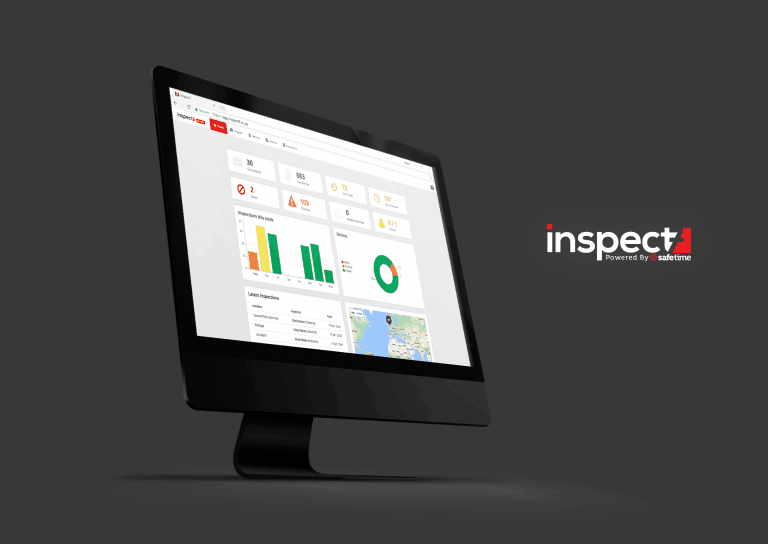
The award-winning London based digital scaffolding inspections company SafeTime® has been hard at work redesigning their scaffolding inspection portal.
The new portal which is now called Inspect7 aims to vastly improve usability, add beneficial features and demonstrate a fresh new look, says SafeTime®. The revamp comes shortly after their website redesign and product rebrand. With the company branching out into new sectors, SafeTime® has now become the overall brand name, with Inspect7 (digital scaffolding inspections) now becoming one of the multiple products the company aims to provide. SafeTime® have put in a lot of effort into making the new portal easy to move over to. Despite the revamp, everything will still appear and work in the same way as before. The portal has been carefully designed so that it matches the new look, without making any fundamental changes that affect usability.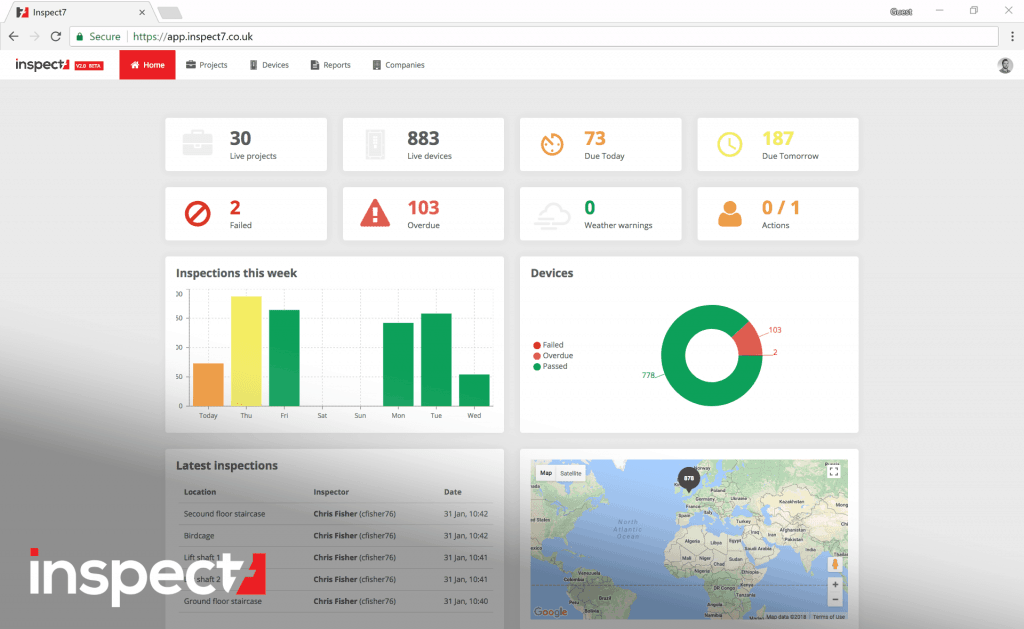 A full list of changes is available on the companies website blog here
Commenting on the update Carl Sharley, Co-Founder at SafeTime® said: “We are always looking to innovate and very proud of our latest release. We are very excited for the year to come and looking forward to releasing the next stages of our planned roadmap.”
SafeTime® also say they have been working on various new projects for 2018, that they plan to announce in the coming months.
A full list of changes is available on the companies website blog here
Commenting on the update Carl Sharley, Co-Founder at SafeTime® said: “We are always looking to innovate and very proud of our latest release. We are very excited for the year to come and looking forward to releasing the next stages of our planned roadmap.”
SafeTime® also say they have been working on various new projects for 2018, that they plan to announce in the coming months. CPD scaffolder training to be funded by employer
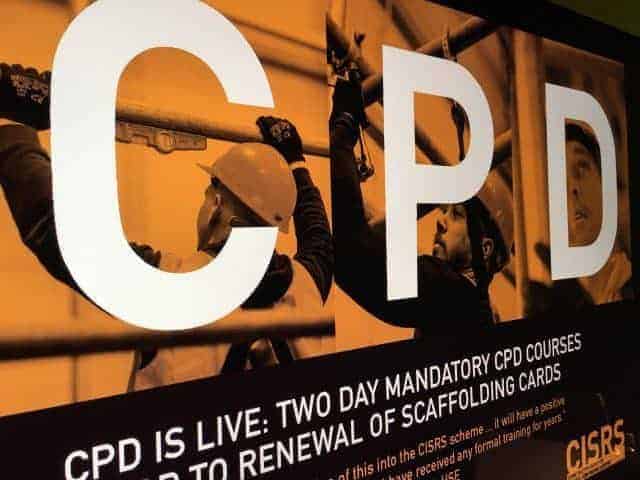
All NASC members are set to pay for the scaffolder CPD course according to a new statement of clarification within the Working Rule Agreement (WRA).
The requirement for Scaffolders and Advanced Scaffolders to complete the mandatory CISRS 2-day CPD course has been in place since 1st July 2017. The hotly debated issue of who pays for the CPD training has been on everybody’s lips across the industry since the mandatory course went live. According to NASC, The issue was raised with the confederation via the Construction Industry Joint Council who wish to include a statement within the WRA giving clarification. Additionally, a statement of clarification as appropriate to the National Agreement for the Engineering Construction Industry (NAECI) has recently been added to that Agreement. Towards the end of 2017, further to consideration by NASC Council, the basic premise that employers should pay for CPD training courses was agreed by consensus, says NASC. A proposed form of words was circulated to Council members in respect to the issue and the following statement has since been agreed:‘The NASC Council has confirmed that Members will fund the CPD course fee and reasonable associated costs of attendance for scaffolders in their direct employment as at the date of CISRS Scaffolder and CISRS Advanced Scaffolder card renewal. As with other employer-funded training, such funding may be linked to Training Agreements.’The NASC added, A very similar statement has been offered by the CIJC Employers to the CIJC Trade Unions for inclusion within the Working Rule Agreement and if adopted will then apply to all scaffolding companies who operate under that WRA agreement. CISRS Manager and NASC Director of Training, Dave Mosley said: ”I see this as a very welcome and positive move. One of the most frequently asked questions following the introduction of CPD was the issue of who will pay for the course. It is clear with this statement that NASC members are looking to do the right thing by their directly employed labour force.”
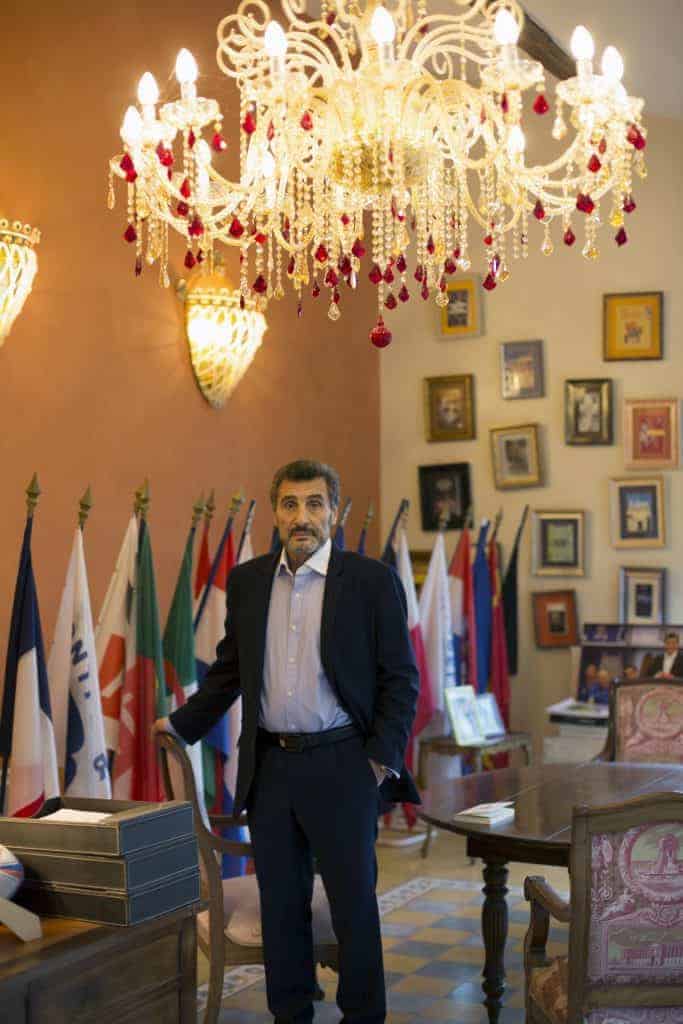
Mohed Altrad: The Interview

ScaffMag was given an interview with one of the world’s biggest movers and shakers, In order to find out more about this most enigmatic of business leaders. Grahame Anderson takes up the story.
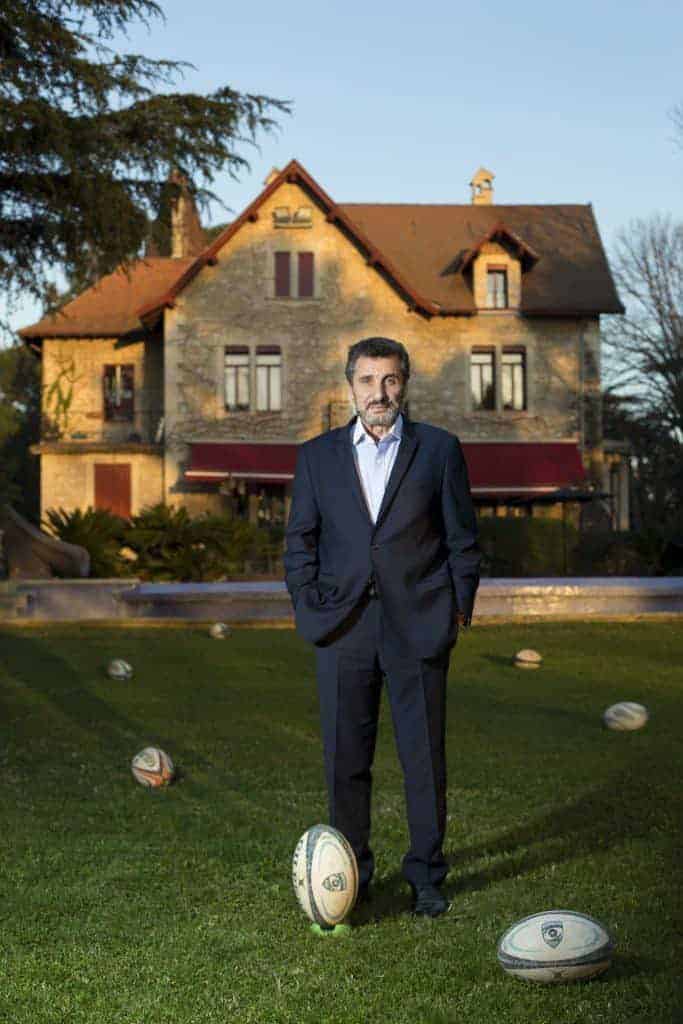
If ever there was proof people can succeed whatever their background in life, Mohed Altrad is the perfect example. Born into a Syrian tribe he moved to France as a 17-year-old with little money and studied hard to secure a phD in Computer Sciences. He took the plunge with a partner in 1985 to buy a scaffolding maker close to bankruptcy.
The rest, as they say, is now history with the Altrad Group now a global leader in the industry with more than 39,000 employees in 130 worldwide subsidiaries. Given their recent acquisition of Cape, I wondered how big a step forward this was in real terms.
He told me: “The acquisition of Cape is another very important milestone for the Altrad Group. We truly respect and admire their achievements. Our ambition for our Industrial Services division is to become a global industrial solutions provider, offering a range of complimentary services to our customers. Cape complements our existing geographies, customers, and services, also including our respect for Safety. Our shareholders are long-term investors. The Altrad Group is just over 30 years old but is made up of businesses with histories exceeding 100 years. So, just as the businesses existed before I came along, they will survive long after I leave.”
“My longer term view is to provide a stable and sustainable business, for the benefit of our employees, customers, shareholders and all other stakeholders.”
Moving forward
It’s clear looking at the achievements of both Mohed and the group, meticulous planning is part of everyday working life. So what’s the strategic rationale for the company going forward? He added: “Altrad will continue to grow, both organically and through acquisitions. We see this growth as essential to our survival. It will enable us to penetrate new markets, attract a diverse and talented workforce, expand our service offering and, better meet our customers’ needs and expectations.”
Monopolizing the market
So what would be the answer to those who’d say your business is beginning to monopolize the market?
“Our ambition is to become best in class and we think this can be achieved through growth, consolidation, and sharing of resources, people, and knowledge. However, we do not believe we are monopolizing any market. There are a number of markets in which we have a stronger presence, but this has no adverse impact on competition. These markets have healthy competition with large and smaller operators able to compete, and sophisticated customers who select their suppliers based on many factors including safety, performance, productivity, quality and, of course, price. We have been through competition authority reviews in a number of jurisdictions and never been subject to any conditionality, which reinforces our view of the strong competition in the market.”
Brexit
This is, of course, a growing period of uncertainty given the ongoing Brexit negotiations. As a large company, I wondered what effect this might be having on the business, and what its legacy could be. Mohed told me:
“The impact of Brexit is still very difficult to judge. Unfortunately, the European and British politicians seem to be playing a very fragile game of cat and mouse. I sincerely hope common sense will prevail. Whilst our UK operations are relatively contained, the supply chain is international, and Brexit may impact this.”
“Likewise, the impact on exchange rates is impossible to predict. Given our very significant activity in the UK, with a turnover of approximately €950m and EBITDA of €115m, exchange rate fluctuations could have a material impact.”
The United States President
Looking at his Syrian background, I was particularly interested on his thoughts toward the United States President.
“His protectionist agenda in today’s modern world is not constructive. So far, I am not convinced that many of his ideologies will be implemented, as there seem to be divisions within his own ranks about their economic roadmap. Only time will tell. In terms of foreign policy, I think there is potential for these to create very significant repercussions to business worldwide. Having said this, I do agree in principle action is required – the global community has for too long been reluctant to move beyond diplomacy to resolve conflicts. Take Syria or Yemen, for example, where we see humanitarian disasters with little prospect for resolution. The consequences of a new nuclear arms race also concern me, and it will be terrible for business if we were to go beyond the tipping point.”
Oversupply of oil
Several commentators have made the claim, but is there really an oversupply of oil, and how would this affect the markets? He added: “It is not for me to say whether there is an oversupply of oil in the market. There is a complex relationship between oil supply, alternative energy sources, markets, growth, inflation, sovereign debt, etc all of which impact business and our economy. The Altrad Group has survived various economic peaks and troughs and retains a structure, with built-in agility.”
The Drive
This is clearly a highly driven man, so what spurs him on having already recorded significant achievements in his career?
“I am very optimistic for what more we can still achieve and am driven by a desire to create, to innovate and to challenge both myself and my colleagues to dig deeper. We all have the capacity to learn and develop. It gives me great pleasure to see people exceed their own expectations. I also feel a deep sense of responsibility towards stakeholders, who rely on our success and sustainability for their own security.”
“The Altrad Group now turns over in excess of €3bn. Some €2.7bn of this is paid to our employees and suppliers. It is hard to put a number on it, but I imagine our Group contributes to the livelihood of 500,000 people or more, once families are factored in. I have seen the Group grow over 32 years to what it is today – this is an exciting human adventure, in which we are creating a business built by its people, for its people. We each have our unique strengths and weaknesses. If sharing my past and providing insights into my work and life philosophy inspires other people to achieve their full potential, then I am delighted and truly humbled. My ambition was never to succeed in business. It has been to succeed in whatever I do, to the best of my abilities – whether in business, with Montpellier Hérault Rugby club, my literary projects… There is always more to achieve.”
Helping humanity
Mohed had previously said the object of life is to help humanity – what role can entrepreneurs play in this sense? “Helping humanity comes in so many different shapes and sizes,” he explained;
“From the dedicated and selfless work of charitable organizations to the impact of sport and the influence of community, political and business leaders. Somewhere within this spectrum is the entrepreneur. As I have mentioned above, building successful organizations provides financial security to countless families and communities. I hope my legacy will be to inspire humanity – to demonstrate anyone can achieve their ambition by pursuing their goals, facing and overcoming difficulties and challenging themselves. The biggest thing is to remain true to yourself, your beliefs and your values – and take pleasure in what you do, or aspire to do.”
This article was first published in the Winter 2017 issue of the ScaffMag magazine. View Issue40K Fine for spilling scaffolding tubes and injuring scaffolder
BAM Construction has been fined £40,000 after spilling scaffolding tubes and injuring a scaffolder.
The large well-known construction company was fined after Westminster Magistrates’ Court heard about the incident. On 9th December 2015 a pack of scaffolding tubes was being lifted by a crane onto a platform that was two stories above the gantry below. The crane driver could not see the load, and was being assisted by a slinger-signaller working from the platform. The load clipped the edge of the platform and tipped, spilling scaffolding tubes onto the gantry and injuring a scaffolder who was working there. Existing measures to control access to nearby areas during lifting operations were enhanced following the incident BAM Construction Ltd pleaded guilty to breaching Section 8(1) of the Lifting Operations and Lifting Equipment Regulations 1998. It was fined £40,000 and ordered to pay costs of £8,700. HSE inspector Stephron Baker Holmes said after the hearing: “Construction companies should think carefully about how best to prevent loads being lifted over people who may be working in areas nearby. In some cases it may be possible to restrict access to a particular area while lifting operations are being carried out above.”Brogan Group awarded Royal Winchester House scaffolding contract

Brogan Group are to be involved in a major new project involving the construction of a landmark building named Royal Winchester House, in Bracknell, Berkshire.
The internationally based scaffolding and access contractors will be installing a 70-meter-high twin hoist and safe access to 20 landings.
The location of the build had been vacant since 2015, when the controversial Winchester House, owned by a science-based technology company called 3M, was demolished.
The Royal Winchester House project was delayed last year after the devastating Grenfell Tower fire. This was to ensure the buildings cladding met the latest requirements.
The development will form a central part of Bracknell’s wider regeneration by adding 311 flats, a gym and space for restaurant or retail use to the area.
The profile of the 19 storey building incorporates multi-levelled roof terraces for residents above the 10th floor.
The project’s completion is estimated for the end of 2018.
Scaffolder faces jail for not being clipped on

A scaffolder faces jail after being caught erecting scaffolding 60ft in the air without clipping on.
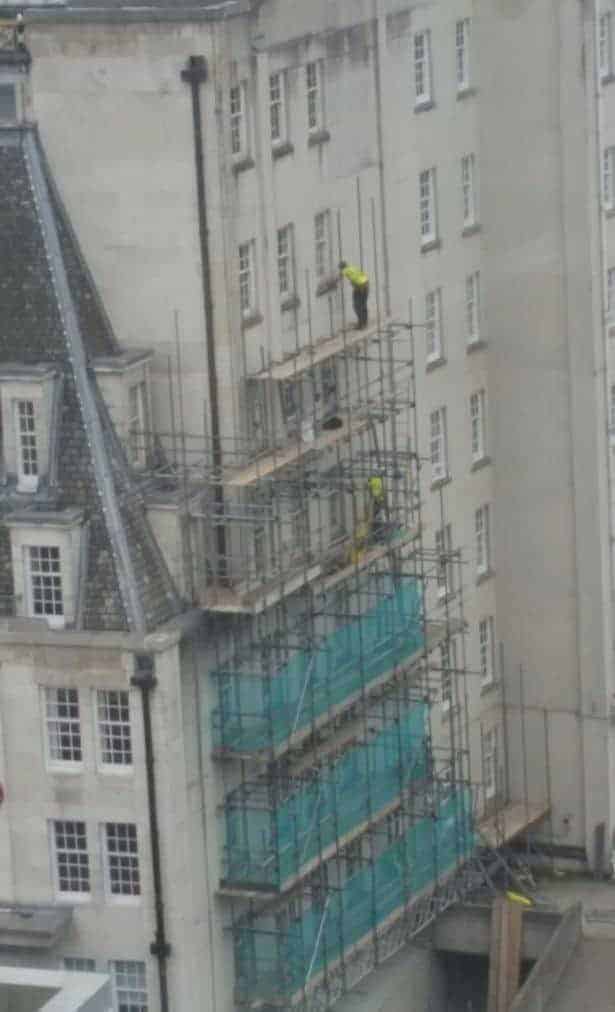
Manchester and Salford Magistrates’ Court yesterday heard how on the 30 June 2017 Terrance Murray was erecting scaffolding at the rear of a Grade II-listed building on Quay Street in Manchester as part of works to renovate the windows. The court was told Terrance was spotted and photographed by a retired Health & Safety inspector wearing a harness but wasn’t clipped on, he was at least 60ft up on the top lift of the scaffolding. In the image below, the experienced scaffolder can be seen standing on the top lift without first erecting a SG4 guardrail.