
Complete Access installs major power line protection over M25
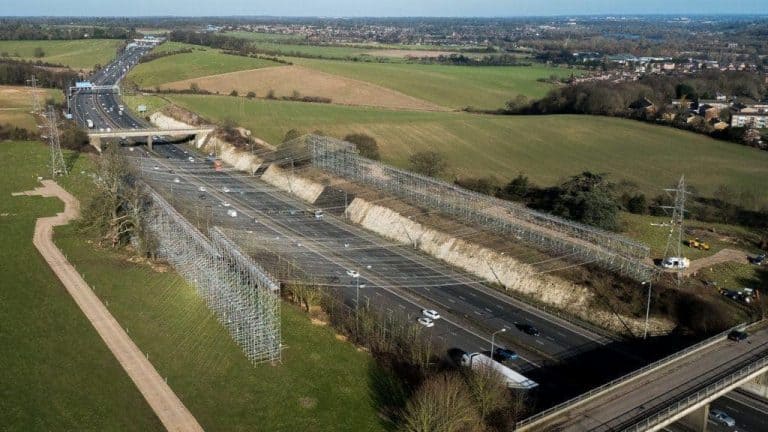
Scaffolding contractors, Complete, have installed over 200 tons of scaffolding to successfully complete a huge challenging power line protection scaffold over the M25 motorway.
The Barnsley based firm, Complete Access Specialist Contracts Ltd have finished a substantial large-scale system scaffold with a protective netting spanning the busy M25 motorway below. Working for Interserve Industrial on behalf of SSE, Complete erected the scaffold to provide protection to the M25 motorway between junctions 16 (M40) and 17 (Rickmansworth) while refurbishment of the power line are carried out overhead. The scaffolds are 154m long, due to the angle at which the power line crossed the motorway, stand 9m-13.5m tall with protective netting spanning 82.0m over the carriageway. The scaffold design, approved by M25 agents Connect Plus M25 and Highways Agency, was produced to cope with winter loads; considering the potential for ice on components and snow on platforms and net producing massive tensile loads in the catenary support wires. As a result, bay sizes were reduced, more than doubling the number of frames throughout. Specially made heavy duty 12mm diameter wire rope catenaries were required, a total of 550 stay wires and ground anchors were installed for stability and a total of 880 half-railway sleepers (60 tonne) were used for foundations in order to distribute the scaffold leg loads . The scaffold was formed from approximately 200 tons of Layher all round system scaffold and took 12 men 4 weeks to erect from start to finish. A complex traffic management scheme involving the simultaneous total closure of both M25 carriageways, junction 17 on-slip road and both Eastbound and Westbound M40 link-roads was necessary to install the netting, which was coordinated between three separate TM contractors, Connect Plus M25 and Buckinghamshire County Council, and took place over 3 consecutive evenings.
A spokesperson for Complete Access Specialist Contracts Ltd said:
“This item in particular presented great challenges, not only in design but also in coordination and interface with highways’ and other third parties. The sheer scale and amount of material in the job is testament to the resolve of the operatives involved in the erection and netting. We believe that it’s the first time M25 has had this kind of protection scaffold installed. Complete have worked on some major crossings in the uk which include the A1, M1, A9 in Scotland & M40 to name a few. The M25 has been the most difficult to date for installing netting taking 15 men 3 consecutive night shifts to install.”
The scaffold was formed from approximately 200 tons of Layher all round system scaffold and took 12 men 4 weeks to erect from start to finish. A complex traffic management scheme involving the simultaneous total closure of both M25 carriageways, junction 17 on-slip road and both Eastbound and Westbound M40 link-roads was necessary to install the netting, which was coordinated between three separate TM contractors, Connect Plus M25 and Buckinghamshire County Council, and took place over 3 consecutive evenings.
A spokesperson for Complete Access Specialist Contracts Ltd said:
“This item in particular presented great challenges, not only in design but also in coordination and interface with highways’ and other third parties. The sheer scale and amount of material in the job is testament to the resolve of the operatives involved in the erection and netting. We believe that it’s the first time M25 has had this kind of protection scaffold installed. Complete have worked on some major crossings in the uk which include the A1, M1, A9 in Scotland & M40 to name a few. The M25 has been the most difficult to date for installing netting taking 15 men 3 consecutive night shifts to install.” Terry’s Legacy – Safeguarding Lives Through Industry Education

UAE event takes place paying tribute to Terry Sennett and shared a vision of Terry’s legacy – “Saving Lives Through Industry Education”
The late Terry Sennett‘s tireless dedication and determination in making a fundamental change within the GCC region was once again credited at a packed out event in Dubai, UAE. The event initially paid tribute to Terry’s life with a very moving eulogy by his wife Fiona Sennett. Fiona highlighted Terry’s humble beginnings, his unflagging passion and dedication to the scaffolding industry and how he influenced and inspired so many people throughout his life. Ben Beaumont, Managing Director of 48.3 International Design and Technical Services who was Terry’s business partner and close friend, also spoke at the gathering. Ben shared a in-depth presentation on Terry’s Legacy and how he defined the word ‘legacy’. Ben also shared the companies vision and beliefs of moving forward after Terry’s untimely death, with the commitment to ‘Safeguarding Lives Through Industry Education’. 48.3 International will strive to deliver Terry’s vision for training across the GCC region, in his honour and in tribute to his legacy. After his presentation Ben Beaumont said: “Terry was one of my closest friends, a mentor, a sounding board, my biggest critic and my biggest fan, but most of all, he was an inspiration. I feel privileged to have known him and I only wish I’d have met him sooner. It was a bittersweet moment talking about Terry’s legacy and what that means to us, a moment that I will never forget. We hope that through our work, drive, passion and commitment to Terry’s legacy, we will be able to positively influence many people in the same way that Terry influenced us. He will never be forgotten, and we will ensure that his values and beliefs live for many years to come, helping to shape a better, safer future, for all those people who are working at height throughout the GCC and across the world.” Terry’s life was tragically cut short by Sepsis in December 2014, the event also raised awareness on this relatively unknown killer. Colin Fincham, Chief Medical Officer for the Middle East, Africa, Asia-PAC, spoke about the dangers of Sepsis, the aggressive and fast acting condition that took Terry’s life. Sepsis (previously known as Septicaemia or Blood Poisoning) kills 37,000 people in the UK each year alone, that’s more than breast cancer, bowl cancer and prostate cancer combined! Sepsis is the acute bodily reaction to infection. Symptoms initially present as flu like but can rapidly deteriorate into a life threatening condition. the attendees at the event managed to raise over AED 4000 for The Sepsis Trust in the UK.MAR Scaffolding (Scotland) Ltd achieves Investors in Young People & Investors in People Accreditation

Fife based Mar Scaffolding Ltd have achieved the double success of Investors in Young People and Investors in People accreditation.
Mar Scaffolding is the first scaffold company in Scotland to achieve the Investors in Young People award. Investors in Young People is the only people management standard that focuses on an employer’s recruitment and retention of young people. This represents a true commitment to the training and development of young people and demonstrates Mar Scaffolding as an employer of choice for young people. Launched in July 2014, Investors in Young People originated through a key recommendation from the Commission for Developing Scotland’s Young Workforce, led by Sir Ian Wood. The accreditation is offered to all businesses across Scotland and exists to recognise and support organisations across Scotland in the employment of young people. Achieving Investors in People accreditation meanwhile, illustrates Mar Scaffolding’s dedication to their employees and demonstrates a solid foundation of good practice which remains challenging and aspirational for many organisations. Having now achieved the accreditations, Mar Scaffolding is now eligible to use and display the Investors in Young People and Investors in People logo and plaque, and enjoy their benefits. 80 organisations have now been accredited by Investors in Young People, with interest being shown by a further 200. Commenting on the award, Nat Wilson Managing Director said, “Training and investment in young people has long been an integral part of our business aims: many of our core staff came to us as school leavers and our high level of staff retention is testimony to the stability and opportunities within the company. We are proud to have received the IIYP award in recognition of our commitment to supporting young people, especially at a time when Fife as a region is experiencing very high levels of youth unemployment.” Peter Russian, Chief Executive of Investors in People Scotland, said “I’m delighted that Mar Scaffolding have achieved IIYP and IIP accreditation. To see over 1,000 young people working in IIYP accredited organisations in such a short space since the launch date is testimony of the appeal, rigour and value that organisations across Scotland are putting on the award. We now have organisations accredited in nearly every geographical part of Scotland covering the private, public and third sector” NASC members Mar Scaffolding was established in 1991 and is one of the largest independent scaffolding companies in the East of Scotland. Based in Cowdenbeath, Mar Scaffolding employ over 40 staff from the Fife area, from apprentices to fully qualified advanced scaffolders and supervisory staff.Milestone reached for CISRS Overseas Scaffolder Training Scheme
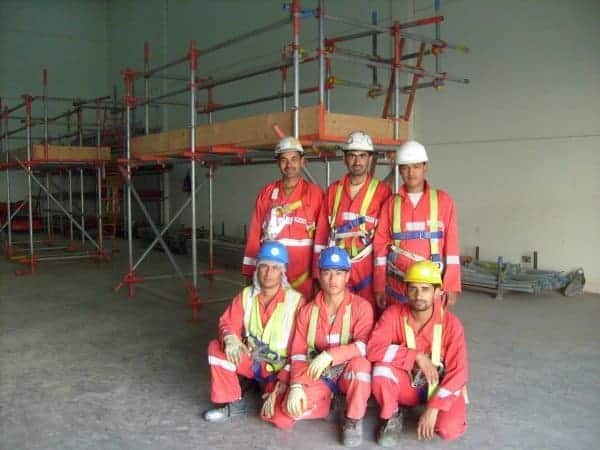
2,500 operatives complete CISRS Overseas Scaffolder Training Scheme (OSTS)
Following the recent CISRS news, that there are now more than 50,000 CISRS card holders in the UK, the CISRS Overseas Scaffolder Training Scheme (OSTS) has reached another milestone for the organisation – with 2,500 operatives having completed training and holding CISRS OSTS cards. CISRS Scheme Manager & NASC Director of Training, Dave Mosley, said: “The news that we have trained 2,500 overseas card holders via the CISRS Overseas Scaffolder Training Scheme in such a short period of time is very positive indeed. We are really getting the message out across the globe that CISRS is the right training programme for scaffolders.” The Overseas Scaffolder Training Scheme (OSTS) was originally developed around 3 years ago by CISRS with support from 2 of its UK approved training providers, Safety and Access Ltd and Simian Skill Ltd. It is based upon the same sound principles as the UK training scheme, including on site experience and assessment. The practical course elements are almost identical to the UK programme, although Level 1 – Level 3 Scaffolder course delivery takes place in 5 day blocks as opposed to 10. Health & Safety and UK industry guidance remain an integral element of CISRS overseas training, and it is felt that this could provide a major boost to working practices in some countries where operatives may not always be required to adhere to the safest working methods for the erection and dismantling of Scaffolding. After a relatively steady start OSTS is beginning to make a real impact within the regions in which it operates. These include UAE, Qatar, South Korea, India and the Philippines. CISRS has been the established qualification for the scaffolding industry within the UK for over 40 years. Occasionally there is a misconception internationally that CITB is the relevant industry qualification for scaffolding in the UK, when in fact CITB’s main role in relation to scaffolding training is to issue cards on behalf of CISRS and provide grant funding. The CITB logo did historically appear on CISRS cards however this was removed around 15 years ago. The National Construction Colleges, including NCC East (Bircham Newton) are accredited by and deliver CISRS scaffolder training. Through further promotion of the OSTS course, CISRS are seeking to establish themselves as the brand of choice for scaffolder training worldwide. CISRS OSTS centres are operated either solely by or in partnership with accredited UK providers, which allows their experience, knowledge, and good practice established over the years to be directly transferred to the overseas centres. UK approved instructors carry out the training and local instructors are required to qualify via OSTS and shadow UK instructors prior to gaining accreditation to deliver training in their own right. Cape’s centre in the Philippines was the first ever CISRS training centre to operate outside the UK (2006). Although initially operated to CISRS UK criteria it has since moved on to deliver CISRS OSTS. Mike Harding, Director (Philippines, Thailand, Myanmar, Vietnam, and PNG), stated: “We have always been big supporters of the CISRS scheme, and we feel that training our operatives to these standards has given us the edge over our competitors within the region. Moving over to the OSTS scheme will allow us to retain the quality and rigour of the UK scheme whilst the shorter duration training modules will help us operationally and logistically when programming courses for scaffolders who are working all over the world and are often away for considerable periods of time.” To have the support of major players within the sector is essential to the success of CISRS OSTS. This has become apparent in South Korea, where a partnership between Safety & Access and Samsung Heavy Industries has seen OSTS courses run continuously since the centre initially gained accreditation in July 2013. Several hundred scaffolders have now completed both Level 1 and Level 2 OSTS training with regular Scaffold Inspection and Scaffolding Supervisor courses being completed within the same period. The aim ultimately is to put all scaffolders and supervisors on site through the CISRS OSTS programme. The most recent addition to OSTS has seen a brand new purpose built scaffolding training centre opened in Chennai (Southern India) by UG/Safety & Access UK (PVT) Ltd. There are currently thousands of Indian scaffolders working all over the world, with very few of them having undertaken any formal or industry recognised training. More often than not they have been trained ‘in-house’ or on the job once arriving in the country where they are working. To provide a CISRS facility at source in India will allow high quality training to be completed prior to operatives arriving on site. Rick Statham, Joint Managing Director for Safety & Access Ltd, said: “It’s been a real pleasure helping to get OSTS off the ground and assist in cementing CISRS’s reputation across the globe. We are confident that the scheme’s solid start will continue to snowball and we hope to be celebrating further milestones in training completed and CISRS cards issued as the scheme develops.” In April CISRS will be returning to Dubai, Ajman and Qatar to carry out an annual audits on both Simian Skill and Safety & Access approved training centres in the region. Whilst there they will be meeting with clients within the oil and gas sector in order to further promote CISRS OSTS. “There is so much work going on across this region with many very large and important companies operating in the sector. A lot of these multinational companies do promote safe working conditions and look to train their workforce to a high standard. In the UK they would insist on CISRS qualified scaffolders working on their projects. It’s now the job of CISRS and its accredited providers to make them aware that their training programmes are available locally and as such they can then impose the same requirements across the UAE and surrounding areas,” said Ian Fyall, Operations Director at Simian Skill. CISRS OSTS has made a very positive start in a relatively short period of time and is hoping that it can continue to grow as news of its arrival on the world stage reaches more of those within the sector.Construction giant rewards XERVON Palmers performance at Heathrow

XERVON Palmers have been praised once again for their scaffolding and access solutions at Heathrow Airport.
The firm picked up “Suppliers” award and an “Individual Achievement” award for their contracted work for construction giant Morgan Sindall. XERVON Palmers’ team of a dozen operatives have been working night shifts providing a 70m long and 35m wide tube and fitting scaffolding with a system and Kedar clad temporary roof on this highly technical job renovating the airport’s CIP Lounge over a 10 month period. The scaffold and access works were carried out in a highly sensitive airside environment – right next to the large aircraft stands and aircraft taxi ways in a windy environment –and the CIP Lounge building was fully utilised by the public during the whole operation. Heathrow Airport deals with over 67 million passengers a year from its five terminals and more than 90 airlines use the airport. Working on such a busy, sensitive site has thrown up unique scaffolding and access challenges for XERVON Palmers operatives – including not interrupting sight lines for the Air Traffic Control (ATC) tower or disturbing RADAR signals while working at height and also gaining clearance of advanced security systems and organising BAA passes for all of the operatives (a six month process). In addition, all site deliveries have been made, using specific pre-set access and egress routes at set times, gaining permit approvals for certain access equipment and clearance of night / weekend / overtime working hours. Furthermore, XERVON Palmers had to adhere to strict risk assessments for working at height, working adjacent to live aircraft, airport roads and pedestrian routes, working adjacent to live occupied buildings, materials handling, working with access equipment and plant, working in a multiple contractor environment and extraordinary working hours. And all XERVON Palmers operatives needed to be briefed on the airport’s extensive emergency arrangements, traffic management systems on site and be up to date with COSHH and manual handling assessments. Ian McFarlane, Director for Business & Project Development at XERVON Palmers said: “We are delighted to have been awarded more accolades for our highly skilled scaffolding works at Heathrow, from a client of the ilk of Morgan Sindall. Airport works of this nature always require expertise and knowledge when it comes to providing access solutions and our XERVON Palmers team – from management to operatives – have the know-how to make it happen, safely and efficiently. We’re very proud of them all for the work they do and how they represent the brand.” Donald Morrison, CEO of XERVON Palmers added: “Having previously worked on Terminal 5 and Terminal T2B at Heathrow, this contract was smaller scale, but none the less required the same levels of skill, training and expertise to complete and we’re thrilled our client, Morgan Sindall recognised our performance and as such presented us with awards.” The XERVON Palmers Divisional Manager for Airports said: “Working on such a sensitive, busy site provides myself and our team with plenty of challenges, but XERVON Palmers have considerable expertise in aviation scaffolding and access. Core to our success is ensuring the security, health, safety and logistic issues of working on large airports are addressed properly, our experienced team are well used to implementing this – particularly at Heathrow, where we’ve previously worked on all five Terminals and other surrounding buildings providing quality scaffolding and access, the CIP Lounge job was another welcome extension of those works for us. We have risen to the challenges, met all site criteria and have completed the works collaboratively and efficiently working together with the principal contractor. “The work itself providing scaffolding and access to support Morgan Sindall’s building work has been exciting and challenging and we have enjoyed being part of such a large scale, modern construction project. It’s just the sort of aviation contract XERVON Palmers thrive on.” The XERVON Palmers Heathrow CIP Lounge scaffolding and access contract is now finished – on time, on program and on budget.SGB Provides bespoke scaffolding for complex bridge refurbishment project
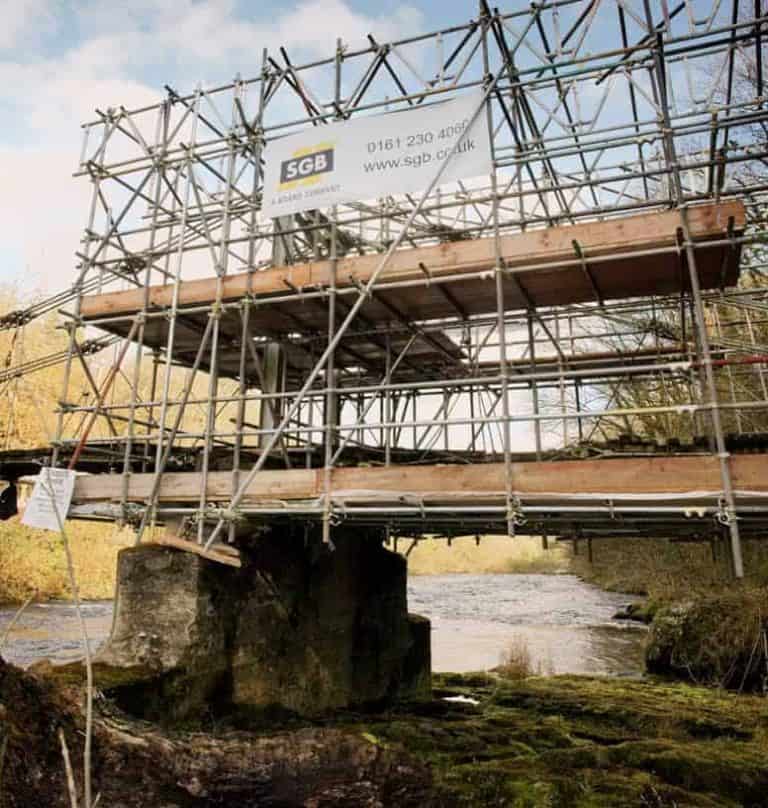
SGB has successfully completed a complex scaffold on the historic Welsh ‘Chain Bridge’
The major Welsh landmark has benefitted from a bespoke scaffolding and access solution provided by the BRAND owned SGB. The historic ‘Chain Bridge’ in Llangollen, Denbighshire is undergoing a £465,000 restoration, and the scaffolding and access work carried out by SGB is central to the project. The 1929 bridge which crosses the River Dee had previously fallen into disrepair, and a campaign began to refurbish the structure and restore the link between the Llangollen Canal and the railway line which lie on opposite banks. “We were initially contacted by the locally-based principal contractor, Shemec Ltd, to propose a scaffolding design that would allow the work to take place,” comments SGB Estimator, Tony Lunt. “All the chain work that holds the bridge deck needed to be removed, refurbished and replaced, which is a very challenging and intricate task. Other scaffolding designs had already been put forward, but when it became clear that this was a more complex job than originally anticipated, an alternative was sought.” The original proposal had been to use scaffolding to provide access to the central span of the bridge. “However the problem was that this might impinge on the amount of headroom that had to be maintained above the water to allow for river traffic and high water levels,” adds Tony. “Fortunately our team, led by project manager Alan Arthur, was able to devise some innovative solutions which enabled the structure to be built without the use of a single mechanical anchor – something which also created many benefits, such as eliminating the danger of debris falling into the river below”. Despite the high degree of complexity, SGB was able to demonstrate a very detailed understanding of the technical issues involved. The company also worked very closely with the main contractor to ensure that the final solution met all Shemec’s requirements, not only for the construction of the scaffolding but also for other considerations such as logistics and site access. “While access and flexibility were obviously vital, we were also able to demonstrate that our solution provided a high degree of safety – something which is always a prime aim for us,” adds Tony.BILFINGER Salamis wins £100m North Sea work

BILFINGER Salamis has won North Sea work contracts worth more than £100m in total in a sign that there is still business being done in the area in spite of the oil price slump.
The oil services business said it has own a series of deals in the last three months from clients including Taqa Bratani and Apache, both of which have big North Sea portfolios. German-owned Bilfinger Salamis has own a five year contract from Taqa Bratani to work on all of the company’s UK assets, including the Harding platform 200 miles off Aberdeen. The company has won a three year extension of a contract with Apache covering the Beryl A and B platforms 200 miles off Aberdeen. The services it will provide include offshore inspection and specialist cleaning work and fire protection. The Aberdeen-based company appeared to hold out the prospect that the contract wins could result in it creating additional jobs. Managing director, Graham Hayward said: [quote_center]”Looking forward, we will be continuing to reinforce our personnel resources in order to make full use of the potential offered by these contracts to our customers’ satisfaction.”[/quote_center] Bilfinger Salamis, which has more than 350 staff in Aberdeen and Lowestoft and 2,000 offshore, said it will recruit in line with clients’ requirements. The contracts provide evidence that significant oil and gas companies are continuing to commit to long term maintenance contracts in the North Sea in spite of the challenges facing the industry. Giants such as BP have announced plans to shed hundreds of jobs following a near 60 per cent fall in the oil price since June. Brent crude traded at $49.18 per barrel yesterday compared with $115/bbl in June. While firms are expected to cut investment in new fields they will need to maintain spending on ensuring that existing assets are kept in good shape. Oil services firms that can help operators make savings may be able to win business from rivals.Mass Walk Out At Sellafield Is Over Scaffolding

Around 1,300 contractors based at Sellafield have walked out over a dispute between two companies about who owns a piece of scaffolding.
A mass walk-out at the nuclear reprocessing site, Sellafield, has reportedly been caused by a dispute between two companies over who owns a piece of scaffolding at the site reports ITV. The union UNITE is claiming its members may not be insured to touch the equipment. The main contractor Doosan Babcock has said it’s in talks with unions to try and resolve the matter. A spokesperson for DOOSAN BABCOCK said: [quote_center] “Doosan Babcock can confirm that it is in consultation with its employee union representatives to fully understand and resolve the unofficial industrial strike action undertaken at Sellafield. “While those talks are underway, we are unable to comment further”. [/quote_center]Scaffolding Software Giant Avontus Expands Into The UK

Software corporation expands its global reach into the UK to meet the increasing demand for high quality scaffolding software.
Avontus is proud to announce that they are expanding their global reach and have opened a new office in Ely, UK. The new office is located near the tech hub of Cambridge and will employ sales, support, training, and implementation staff. The office has been started to meet the increasing demand for high quality scaffolding software tailored to the industrial and systems scaffolding markets. “The UK is a natural extension to our presence in Australia and we are excited to be opening this office. Our support and development systems allow us to easily expand while still maintaining the high level of service that our customers enjoy,” says Brian Webb CEO and founder of Avontus Software. Leading the team in this new location is Andrew Smith, recently relocated back to the UK from Canada where his extensive scaffolding career and love of technology are perfectly suited to the UK industrial scaffolding market. “Software to manage industrial scaffolding has always been the strength of Avontus. Having used the full suite of software in a scaffolding setting myself, I’m very excited to be in a unique position to bring our design and management software back home,” says Andrew Smith. Avontus has an existing base of customers in the UK and Europe, including some of the world’s largest equipment supply and manufacturing companies. Avontus has been developing software specialized for scaffolding, formwork, and small tool management for over a decade. Avontus customers include owner-operated single-branch companies as well as major multinational firms, all of whom receive full support and ongoing software updates. For more information and a free trial of their scaffolding software please contact Andrew Smith at Avontus on:- Tel: +44 0122 392 6298
- Email: [email protected]
- Web: http://www.avontus.co.uk