A Cornish scaffolding company has been fined £24,000 after a worker was injured when he fell through a fibreglass skylight.
The 37-year-old scaffolder was working for Worden Scaffolding, part of GK Worden & Son Limited, on a commercial project at an industrial unit in Liskeard on 22 July 2019.
The company had been tasked with installing edge protection on the unit’s asbestos cement pitched roof, which had fibreglass rooflights running along it.
The scaffolder was walking up the apex of the gable end of the roof when he stepped on and fell through a rooflight, landing on a concrete mezzanine floor about 3m below.
He suffered a complex fracture to the wrist and hand, a broken rib and a bruised kidney.
An investigation by the Health and Safety Executive (HSE) found that another scaffolder from Worden Scaffolding had also been exposed to similar risks of working near fragile rooflights at the same site in the months before.
In both instances, HSE found the work was not properly planned, appropriately supervised or carried out in a safe manner when the incident occurred. The workers were on the roof without edge protection, crawling boards, harnesses, lanyards or nets. The company had a duty to control how the work was carried out, including staff instruction.
GK Worden & Son Ltd of St Ann’s Chapel, Gunnislake, Cornwall, pleaded guilty to breaching the Work at Height Regs 2005, and was fined £24,000 and ordered to pay costs of £14,000 at Plymouth Magistrates’ Court on 1 November 2022.
Speaking after the hearing, HSE inspector Peter Buscombe said: “This worker’s injuries were serious. This incident could have been avoided if basic safeguards had been put in place.“Falls from height remain one of the most common causes of work-related fatalities and injuries in this country and the risks associated with working on or near fragile surfaces are well-known.”
Specialist scaffolding contractor, Millcroft, has successfully won the second phase of a £multi-million contract at HS2 Euston Station.
The scaffolding contractor will be providing temporary works infrastructure, acoustic and public protection screens, and all the required access and containment solutions to support Skanska in delivering the enabling works at London Euston.
Millcroft was chosen by main contractor, Skanska, after the success of their work on phase one, which will be completed over the next few months.
Following a complex and competitive tender process, based on technical and qualitative questions and commercial scoring, Millcroft succeed against strong competition from multi-regional and nationwide competitors.
Millcroft’s team will be involved in the enabling works to facilitate the construction of the new HS2 Euston Station.
The works include platform containment screens on three platforms. Scaffolders will also erect large birdcage structures over the live site offices, and protection decks over the back-room areas to ensure day-to-day ‘business as usual’ running of the station can take place during the removal of the roof structure.
Billy Jones, Managing Director at Millcroft said: “We are delighted to have won the second phase in what is such a prestigious project. The rail industry is one of the specialist sectors where we can build on our core discipline of expertise in infrastructure-based works. Our experience in rail means we are equipped to answer the specific requirements as we work collaboratively with the client to offer a robust and specialist installation.“This project strengthens our HS2 division, with the works being designed by our in-house technical team. This two-year programme will deliver core elements of one of the highest profile rail projects the UK has ever embarked upon.”
TRAD UK’s Plettac Metrix system has been widely used by scaffolding contractors on significant projects since its introduction in 2014.
PLETTAC METRIX is TRAD UK’s proprietary modular scaffolding system. It’s been used by scaffolding contractors across the UK for a wide range of project types – including Grade I listed buildings like Lincoln Cathedral, iconic infrastructure like the Forth Rail Bridge, Royal Navy Trident submarines, Petro-chemical installations, and the latest mixed-purpose development builds.
Designed to make scaffolding erection easier, safer and smarter, PLETTAC METRIX is a proprietary rosette scaffolding system that has, over the past eight years, been used on a wide range of major residential and commercial construction projects in the UK and beyond. Being a true metric modular system, it’s particularly useful for the housebuilding and developer market, as well as heavy-duty industrial and civil projects.
And that’s important for any contractor considering system scaffolding. Many developers are now specifying system scaffolds in their tenders, because it is neater and tidier on-site and therefore helps them to promote a better approach to development. But it also has a number of other benefits – for both contractors and customers:
Undeniably faster to erect than traditional forms of scaffolding.
Can be used on almost any structure.
Colour-coded components for easy identification of size.
Minimal number of components required for high-load capacity scaffolds in comparison to traditional scaffolding.
Integral handles, wind-locking components and anti-tilting devices on decking.
Optional integral Permanent Advanced Guardrail system.
PLETTAC METRIX has added value to the products available on the market, as it is designed and produced with engineering using the latest technologies. These include 3D modelling, stress analysis software and state-of-the-art manufacturing.
Being a fully NASC Code of Practice compliant and CISRS-approved system, it exceeds all relevant British and European standards.
The unique PLETTAC rosette allows up to eight components to be inserted into the joint at any one time and, being truly metric, the horizontal components are divisibly interchangeable, meaning the system is highly adaptable and can be easily changed to suit site requirements. In addition, the junction, or node point, that is formed from the distinctive rosette which is welded to the vertical components, and the wedge-head that is attached to the horizontal or diagonal components, offers superior strength and load capacity, especially when compared to traditional tube and fitting structures.
In addition to the divisibility, there is an exclusive optional Permanent Advanced Guardrail system which allows scaffolders to work in complete safety from the level below, whilst complying fully with the NASC’s guidance note SG4.
Both of these unique features lead to significant benefits, including reduced equipment levels, labour savings, decreased assembly times and improved safety.
Significantly quicker to erect and highly adaptable, with tubular elements being made from standard scaffolding tube dimensions, the system is also compatible with traditional components, allowing even more flexibility in use. PLETTAC METRIX offers both cost and time savings in terms of labour and is itself a long-term cost-effective system to hire or buy.
“PLETTAC METRIX has revolutionised the scaffolding market and increased the use of system since its introduction in 2014,” says Colin Dobson, Managing Director at TRAD UK.
“We have already added new components to the system and we are researching and developing more, to make sure that this system continues to be market-leading in terms of ease of erection and flexibility. Our aim is to produce inherently safe systems that keep costs down and make life on site easier, and we will continue to develop this product alongside the industry to make sure we are always supplying the best.”
Open Days
TRAD UK is planning a series of open days over the next year to showcase PLETTAC METRIX, along with their other product ranges, giving clients and contractors a hands-on look at the system, and the opportunity to discover how it can support their business growth.
Look out for dates so you can register your interest, or contact Kevin McGill at [email protected].
AT-PAC & Doka have solidified their commitment of bringing high quality Ringlock scaffolding to the global construction industry.
Following the majority acquisition of AT-PAC by Doka, a world-leading formwork, solutions and services provider for the construction sector, AT-PAC’s Ringlock system scaffold was provided a high-profile exhibit at this year’s bauma, held in Munich, Germany.
Bauma is the world’s largest trade fair seeing up to 500,000 visitors & 3,200 exhibitors.
Ringlock was shining bright across the fairgrounds with a Landmark Scaffold Tower wrapped in 360-degree LED screen.
Julio Black, VP Technical Services & Marketing for AT-PAC on the Landmark Scaffold Tower said: “We wanted to do something truly remarkable for our visitors and shine a bright light on our DIBt approved Ringlock System Scaffold. We did this by designing and engineering a 30m freestanding tower, with integrated access and egress for visitors to enjoy the view across the fairground from our 20m high viewing deck. Furthermore, we designed the scaffold to support a full 360-degree LED screen that could be seen from miles away and brought in visitors from all over the world. We erected 52 tonnes of Ringlock and 250 tonnes of reinforced concrete at the foundation. We had over 7,000 visitors enjoy the view throughout the week.”
Ringlock was installed all over the 5,600m2 Doka booth highlighting its commercial & industrial construction scaffold applications along with 3 live install demonstration on the main stage each day.
AT-PAC’s Ringlock system scaffold is the first non-European produced modular scaffold system to attain DIBt approval, which is a true testament to the quality, design and engineering provided by AT-PAC and enjoyed by thousands of customers.
AT-PAC’s proprietary scaffold management software – Hi-Vis® was heavily on display throughout the week.
Hi-Vis® provides scaffold contractors, EPC’s & EPCM’s the tools to better plan, manage and execute the entire scaffold lifecycle on any project. Tools such as easy to read dashboard reports, NFC Smart Tags for quick and easy scaffold inspections, request management & estimating, detailed labor tracking and inventory management.
Southampton-based Skill Scaffolding Ltd is reaping the rewards after investing in LIFTBOT – the first robotic material hoist for scaffolding from KEWAZO.
In the current post-Brexit, post-Covid, inflation-ridden landscape, 2022 has proven as difficult to navigate as any of the tough years of the past. Such times serve as a brutal reminder to all businesses on why it is so important to remain focused, flexible, and ahead-of-the-game.
When looking for ways to do just that, Skill Scaffolding engaged with KEWAZO out of Germany and their LIFTBOT – the first robotic material hoist for scaffolding.
During introductory meetings, Skill Scaffolding learned that up to 80% of projects in industry are still executed completely manually, relying on an especially tedious and physically degrading process of manual vertical material transport.
To mitigate this, Skill’s management team and KEWAZO looked at opportunities of automating vertical material transport within upcoming projects of Skill Scaffolding. As result, companies identified a flagship project in Poole Quay for a trial with LIFTBOT. The project setup was ideal for the robotic system: erection job, system scaffold, and higher than 6m.
After only a few days of operations, Skill Scaffolding could learn about the main advantages of LIFTBOT:
Solution against labour shortage:The number of operatives on-site required to complete the project is significantly reduced – up to 70% – allowing disengaged scaffolders focus on further projects.
Safety focused:As the material transport is automated, the chances of falling objects as well as operative injuries decrease significantly. Additionally, the task of lifting equipment outside of a scaffold is removed entirely from human hands, resulting in a considerable reduction of accidental free-falling objects.
Time savings:LIFTBOT accelerates erection time, enabling hand-over of scaffolds to client sooner, which leads to overall construction programme advancements.
Data analytics: The data analytics platform behind LIFTBOT, called KEWAZO ONSITE, enables in-depth analysis of work progression and performance. This guarantees enhanced forecasting & scheduling of work-sequences as well as early identification of labour requirements and transportation.
The project was a unanimous success. Accordingly, Skill Scaffolding — as industry leader and pioneer — became one of the first scaffolding companies in the UK to acquire their own LIFTBOT (now aptly named the “SKILLBOT”). It was clear for Skill that LIFTBOT would be a key asset on high-rise building projects across the South-Coast and beyond.
LIFTBOT has since continuously proven to be success on a number of projects across the South of England, including a project at London Heathrow. Recently, the system has returned to its flagship project at Poole Quay to support the 2nd and 3rd phases of subsequent site work.
KEWAZO has been supporting Skill Scaffolding in all aspects related to LIFTBOT – with training right after the delivery, and with annual and emergency maintenance support today.
KEWAZO added from their side: “We are extremely glad to be able to count on such motivated innovators as Skill Scaffolding. We are already looking forward to seeing LIFTBOT deployed on further trial and pilot projects across the UK.”This article was first published in the ScaffMag Magazine Issue 17
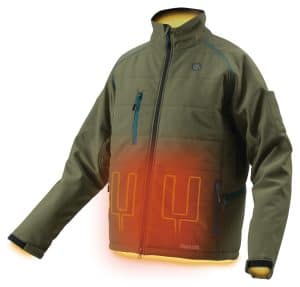
Makita has released its latest heated jacket, helping to protect wearers against the elements.
Powered by the reliable 18V LXT battery, this new warm and stylish jacket is a must-have for cold, harsh job site environments, or for outdoor leisure in the cold winter months.
The latest DCJ205 heated jacket is here to offer maximum comfort and durability. Thanks to the five heating zones, users benefit from continuous warmth in the chest and back areas whilst also having control over the three heat level settings.
The powerful 18V LXT battery offers even longer continuous runtimes, with a fully charged battery lasting seven hours on the highest setting, 11 hours on medium, and 29 hours on low (when powered by the BL1850B 5.0Ah battery). Customers can use existing batteries or purchase one with the DCJ205 as a kit.
The jacket’s olive-coloured, polyester outer lining makes it waterproof and windproof, whilst the inner fleece lining helps keep the user warm and comfortable even with the power off. Additionally, it is fully washable and dryable, so cleaning is easy and hassle-free without damaging its heating capabilities.
It is also equipped with a two-way zip, offering more flexibility when wearing a tool belt, as well as six pockets. And last but not least, this lightweight product is available in a range of sizes, catering to sizes M to 2XL.
Kevin Brannigan, Marketing Manager at Makita, said: ‘We are very excited to be releasing our new LXT heated jacket. We understand the harsh conditions that our customers are faced with during the colder months, and have designed this product with comfort, durability and style in mind. Even without the aid of our LXT battery, this jacket is an excellent product that will prove invaluable both on-site but also in other outdoors environments.”
With the World Cup fast approaching, Leach’s have announced their own online football tournament from the 2nd-11th November.
The tournament will give you a chance to #ChooseYourSide and be entered into a draw to win discount codes, merchandise and a copy of FIFA 23.
It’s been launched alongside the introduction of some new coloured BIGBEN Scaffolder’s Kits. The kits are available in Red or Blue, each coloured belt comes with a matching frog, level holder and tape holder; with the option to include matching tools.
How to win a copy of FIFA 23 and Leach’s discount codes?
From the 2nd-6th November, you will be able to visit https://leachs.com/pages/leachs-league and submit a short, simple form declaring which team you think will win the tournament. Every entry that picks the winning team will be entered into the draw to win a copy of FIFA 23 and exclusive Leach’s discount codes.
As an extra bonus, if your team wins in Round 1, Leach’s will give you 10% off their entire store!
How will the tournament work?
On the 2nd November, the fixtures for the first round will be released on Leach’s social media, revealing the 8 Premier League teams competing. The online matches will be simulated using the match engine in FIFA 23 and highlights will be posted on social media for you to watch.
This classic knockout-style tournament will see 8 teams compete in Round 1, with the winning teams moving into the semi-finals.
On Friday 11th November at 12:00pm, the final will be streamed LIVE across Leach’s social media profiles. This will give you a chance to cheer on your team while receiving extra discount codes just by watching!
#ChooseYourSide
There is only one thing left for you to do, head over to Leach’s and #ChooseYourSide! You can follow Leach’s on social media using the links below:
FacebookInstagramTwitterLinkedInTikTok
Layher UK has launched its ground-breaking new beam after unveiling the cutting-edge product at its jam-packed solutions open day.Layher the world’s largest system scaffolding manufacturer launched its latest beam innovation to the UK market on Wednesday (2 November).
The new TwixBeam launch that headlined the event came as Layher showcased its latest developments at its biannual Solutions Open Day held at Layher UK’s Headquarters in Letchworth, Hertfordshire.
More than 200 invited guests consisting of industry leaders, customers, clients and Layher Germany shareholders including joint Directors, Georg Layher & Carolin Langer attended the launch event.
Those attending were wooed and impressed by the dramatic entrance of the new beam as it was slowly lowered from the roof wrapped in a bespoke chocolate bar wrapper ready for unveiling.
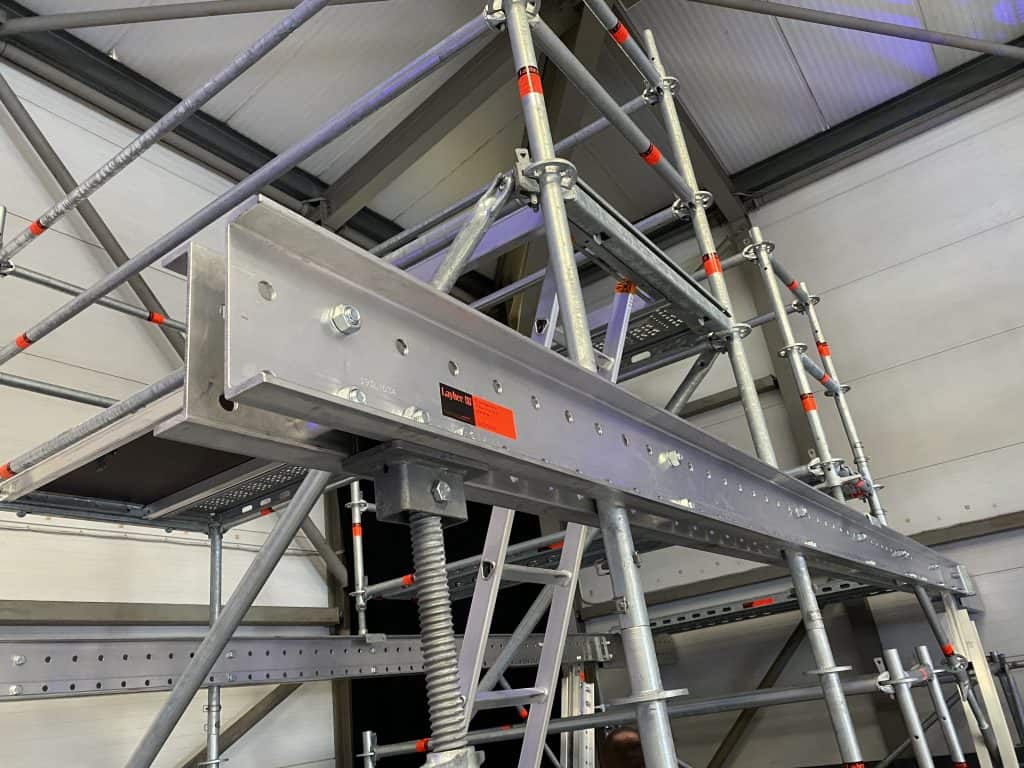
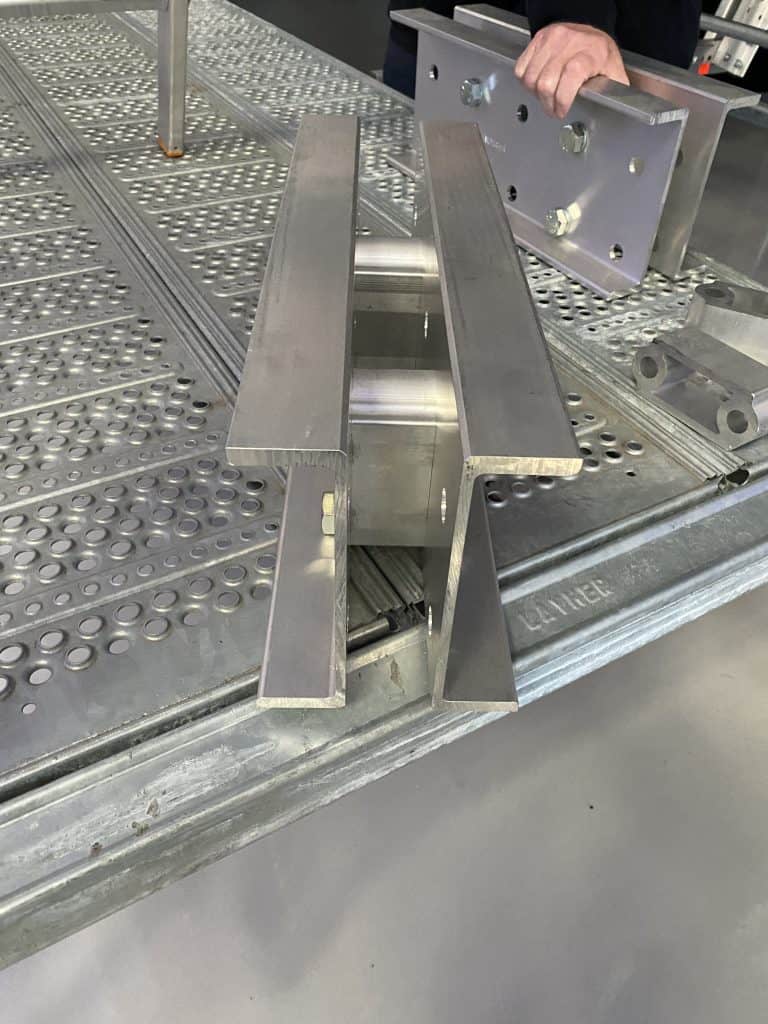
The new two-piece multifunctional beam which has been aptly named after the well-known chocolate bar is made entirely from high-grade aluminium and produced at the world-famous Layher Eibensbach factory near Stuttgart in Germany.
TwixBeam is a low weight easy to dismantle and incredibly strong beam that effortlessly integrates into the Layher Allround System.
Users of the scaffolding system will also benefit from its versatility as it works perfectly in tandem with the highly successful Flexbeam that launched in 2018.
Weighing just 12kg/m the new smart multifunctional beam will be available in an array of lengths from 0.8m to an impressive 6.6m.
The TwixBeam will have many uses for specialist scaffolding contractors including conventional scaffolding, industrial scaffolding/boiler scaffolds and shoring in combination with TG60.
Speaking about the event and the new TwixBeam, Sean Pike Layher UK’s Managing Director said: “We were, as always humbled by the huge attendance and most grateful to all who came for giving up their time to spend with us. This year, the attendance has grown significantly, and we were delighted to welcome many new faces and celebrate with them many examples of their work with our products, as well as taking the opportunity to highlight our hints, tips and solutions as well as launch our new Twixbeam. The interest on the day in the Twixbeam was one of the biggest responses we have ever had to a new product launch, topped only by receiving our first order for it on the day, with several other enquiries quickly following”.
Des Moore, CEO at TRAD Group, takes a look at system scaffolding and whether it can add value to your business.Des Moore, CEO of the TRAD Group
In September, I took part in a panel discussion as part of the Scaffolding Conference 2022. The subject of the panel was ‘System Scaffolding – Is this the future?’ and it was great to hear a range of viewpoints and take questions from the audience about the pros and cons of system scaffolding.
I’d have liked to discuss this further, but of course these events have a strict time limit. So I thought it would help to set out my thoughts in this article.
I first got involved with system scaffolding in 1991, when I joined TRAD. We were in the middle of a bad recession, and we needed to look for ways to save money across the business. We tried out system scaffolding to see if it would result in savings – it did. We significantly reduced labour costs, were able to offer a competitive advantage and found work with new customers and in new industries – such as the industrial sector and aircraft maintenance sector.
So, in general, I am very pro system scaffolding – in particular because it has excellent characteristics that encourage us to look at a wider pool of talent in the industry, including increasing the number of women in the sector. But I know that it might not be for everyone. When I started writing this article, I put a poll out on my LinkedIn page:
Q: What do you think about system scaffolding?
64% said it saves them time and money. 19% said they thought it was too expensive and 16% said they either wouldn’t use system scaffolding or didn’t know enough about it.
These are interesting statistics, and I’m always happy to have a chat with anyone who has questions about the cost, or use-case for system scaffolding. First, let’s address the cost question.
Is system scaffolding expensive?
Like all capital expenditure, system scaffolding can seem expensive in terms of initial outlay. But, like all capital expenditure, you need to also consider any potential long-term savings. Over a 10-year period, for example, system scaffolding will undoubtedly give you better value for money than tube, fittings and boards.
That’s because tubes will invariably be cut on each project – eventually making them far less usable. For example, how many boxes of butts do you currently have? Fittings get lost or stolen, and timber boards can rot or be easily damaged. In comparison to system scaffolding, the elements of a traditional scaffolding system will generally need to be repaired or replaced periodically – and those costs add up. System scaffolding is extremely robust and usually fully galvanised, so suffers far less loss and damage and your investment is still delivering value over a long period.
What do you know about system scaffolding?
Of course, most people start their training on tube and fitting and, in England and Wales at least, it’s the most common form of scaffolding used. In Scotland and Northern Ireland, firms have been using system scaffolding successfully for a long time and there are some great case studies showing how it can be adapted across a wide range of projects.
At TRAD, we use, hire and sell both traditional and system scaffolding. That’s because sometimes traditional scaffolding is the best choice for a particular specialised project that may also require a significant investment in special components, and sometimes system is the right choice. Using both broadens our market reach and allows us to use the skills of our teams in the best way.
So here are my thoughts about why it’s worth considering system scaffolding:
It’s a good investment – we’ve covered this above, and I believe that if you can manage the capital cost, you will get measurable value from investing in system scaffolding and have a valuable asset that will provide you with many years of service.
Labour savings – system scaffolding is generally faster to erect and dismantle, and in the majority of instances, much easier and quicker to adapt – particularly on scaffolding that is designed for multi-trade use. In fact, some time and motion studies have shown this to be up to 70-80% quicker! Although, it has to be said, I don’t believe you will gain this level of saving in the real world, as there are a lot of other factors which come into play. However, from my experience the reduction in labour costs on projects can be quite significant, especially when examined in comparison to similar projects completed in traditional forms of scaffold.
Skills shortage – we have seen over the last decade or so a real shortage of available labour. One advantage of system is that it is possible to reduce the reliance on the quantity of highly-skilled labour required. Typically, and depending on the site, the mix of labour for tube, fittings and boards is usually based upon the traditional scaffold gang, which customarily consisted of two qualified scaffolders (one commonly being the chargehand) and a labourer (or trainee). With system scaffold this can be changed. The speed of erection means that fixers require equipment to be available at a much faster rate, so the ratio of skills within the gang can be changed to suit, freeing up the more skilled scaffolders to be utilised more effectively.
Skills and training – system scaffolding is a great way to start people on their scaffolding training. You can cover all the essential principles of scaffolding faster and more safely, helping you to give new people a good grounding in scaffolding before moving them on to tube and fitting.
Opens up opportunities – system scaffolding is easier to handle, lift and manage than traditional scaffolding. This opens up opportunities to recruit from a wider pool of people, including encouraging more women into the industry. This is something I have promoted during my time as CEO at TRAD Group, and when I was President of the NASC – and it’s something I’ll be writing about in more detail in my next article.
Health & Safety – the design and assembly of system scaffolding makes it a safer option on-site. It’s easier to risk assess and to manage, and also makes it safer for regular on-site inspection.
Load capacity – the very nature of system scaffolding means that it has a greater capacity to carry higher loads than traditional scaffolding and, with a minimal amount of equipment, you can, in some instances, quite easily construct Load Class 6 structures straight from the user guide, whereas an extensive design would be required for traditional forms. Be aware though, as there is generally no requirement for intermediate support, that if using metal system decks, and they get beyond, say, 2.5 metres, they may flex, although they are still completely safe.
New market opportunities – there are projects where clients prefer system scaffolding, and if you can’t meet those requirements, you can’t bid for the contract. Being able to offer a wider range of services can help you to access new markets and grow your business. This includes major residential developers, who often prefer the aesthetics of system scaffolding – it becomes a great advert for the project. In fact, a number of developers and house builders now insist on system scaffolding in their tenders.
However, don’t forget to really do your research before you try to break into a new market. A quick story about how I didn’t get that quite right when I started out in system scaffolding:
When TRAD started looking at using system scaffolding, we trialled a number of systems and eventually invested in one. I thought I could take it into any new market and be successful. So I looked at the events sector – which is actually a very niche market that requires a lot of specialist knowledge. I hadn’t done any research, but won a contract to provide a covered stage for a Hell’s Angels annual Chapter concert in Dymchurch.
But my inexperience and lack of research meant that I didn’t use the right roofing materials, and the roof started leaking when the band was on. We were up on the roof for the duration of the concert, trying to patch it so that the equipment didn’t get damaged and the band didn’t get wet.
When the time came to go back over to the site the following week and collect payment, I was very worried. I was met by two Hell’s Angels – each well over six feet and looking pretty mean. They took me into a caravan, and I wasn’t sure I was going to get out again! But they paid me – in cash, in a Tesco bag – and were very understanding. They were total gents, which just goes to show that looks can be deceiving.
All turned out well in the end, but a great lesson in doing your research and not taking on more than you can realistically handle without the right experience, training and sector knowledge.
Where to start?
If you’re interested in investigating system scaffolding, I’ve got a few pieces of advice:
Hire first – it’s a good idea to hire system scaffolding so you can try before you buy. And if you’re a manager who’s come from the tools, make sure you get back on site during the hire period so that you can see how it works for yourself. When we first starting using system at TRAD, Hayden Smith and I spent two months of weekends on-site, using the system with our scaffolders, understanding how it worked and whether it was the right choice for us.
Research – look at all the products available on the market to see what’s best for you. Look at price, availability, hire or buy and the support and advice that’s available. It’s a significant investment, so learn as much as you can before you commit.
Always buy from a reputable manufacturer or supplier – this will ensure that you get the best support. Look for companies that have staff who have direct scaffolding experience and back-up – they will understand what you need and give you the right advice, and not just for the first purchase.
Different management approach – with system scaffolding, you need to properly assess the components required before you leave the yard. Because of its nature, you can’t ‘make do’ on site in a similar way that you would with tube and fitting. For system scaffolding, 75% of your assessment of materials and work to be done needs to be done before any material leaves your premises. I can’t emphasise enough how important this is – you need to get it right in order to maximise the value of your investment. If the approach is wrong, the whole experience will be poor.
Ensure your scaffolding designers design around the stock you hold – then you will be able to limit the amount of specialist stock that you have to hire or buy. You’ll also get the best utilisation out of your investment. If you do need to hire, it’s most effective to hire and return on a project basis. And plan ahead as far as you can – as you’d expect, specialist items can have long lead-in times.
Storage and transport – you need to make sure you store it properly. System scaffolding often needs more space than tube and fitting, and you will also need a suitable trailer bed to transport it. However, if stacked correctly, TRAD UK can still transport the weight limit of 12 tonnes on our fleet of trucks, whether it be system or tube, fittings and boards. And, if you consider that you generally require a lesser total amount of componentry with system, it is perfectly feasible to reduce the number of journeys required to site, helping with your carbon footprint!
If you’re looking for a way to expand your business, get into new markets, open up your labour opportunities and give yourself some flexibility, you should investigate how system scaffolding could work for you. I believe that it’s a good string to add to your bow – there’s always going to be a place for tube and fitting, and for highly skilled and qualified scaffolders, but adding system to your portfolio will increase your business opportunities.
There’s lots of information out there, lots of options on the market, and some good quality systems for hire or sale. At TRAD, we’re always happy to chat about how system can support your business – feel free to give us a call.
The courts have disqualified a Scaffolder from Berkshire for 6 years after failing to pay close to £210,000 of tax.
Scaffolder, Vincent Larkin (51), from Bracknell, Berkshire, has received a 6-year disqualification order in the High Court of Justice before Insolvency & Companies Court Judge Jones.
During proceedings, the court heard that Vincent Larkin was the director of a scaffolding company called V Larkin Limited. Trading as Olympic Scaffolding, the firm was incorporated in February 2006.
The scaffolding firm, however, went into liquidation in May 2019 and V Larkin Limited’s insolvency triggered an investigation by the Insolvency Service.
Investigators uncovered that Vincent Larkin caused the business to trade to the detriment of the tax authorities when V Larkin Limited failed to pay £209,000 worth of business and employee-related tax from the tax year ending 2016/2017.
Further enquiries revealed that between April 2017 and right up to the point the company was heading into liquidation in May 2019, Vincent Larkin caused the business to make payments totalling close to £489,000 but no payments were identified as having been made to the tax authorities.
Vincent Larkin was disqualified and ordered to pay costs of £7,355.80.
Lawrence Zussman, Deputy Head of Company Investigations at the Insolvency Service, said: “As a company director, Vincent Larkin had a duty to ensure the scaffolding firm declared and paid the correct amount of taxes due. Our enquiries, however, clearly showed that Vincent Larkin systematically abused the tax authorities when the scaffolders failed to pay more than £200,000 of tax.
This type of behaviour from a company director is deplorable and we will not hesitate in taking action against tax abuse.”
We use cookies on our website to give you the most relevant experience by remembering your preferences and repeat visits. By clicking “Accept”, you consent to the use of ALL the cookies.
This website uses cookies to improve your experience while you navigate through the website. Out of these, the cookies that are categorized as necessary are stored on your browser as they are essential for the working of basic functionalities of the website. We also use third-party cookies that help us analyze and understand how you use this website. These cookies will be stored in your browser only with your consent. You also have the option to opt-out of these cookies. But opting out of some of these cookies may affect your browsing experience.
Necessary cookies are absolutely essential for the website to function properly. These cookies ensure basic functionalities and security features of the website, anonymously.
Cookie
Duration
Description
cookielawinfo-checbox-analytics
11 months
This cookie is set by GDPR Cookie Consent plugin. The cookie is used to store the user consent for the cookies in the category "Analytics".
cookielawinfo-checbox-functional
11 months
The cookie is set by GDPR cookie consent to record the user consent for the cookies in the category "Functional".
cookielawinfo-checbox-others
11 months
This cookie is set by GDPR Cookie Consent plugin. The cookie is used to store the user consent for the cookies in the category "Other.
cookielawinfo-checkbox-necessary
11 months
This cookie is set by GDPR Cookie Consent plugin. The cookies is used to store the user consent for the cookies in the category "Necessary".
cookielawinfo-checkbox-performance
11 months
This cookie is set by GDPR Cookie Consent plugin. The cookie is used to store the user consent for the cookies in the category "Performance".
viewed_cookie_policy
11 months
The cookie is set by the GDPR Cookie Consent plugin and is used to store whether or not user has consented to the use of cookies. It does not store any personal data.
Functional cookies help to perform certain functionalities like sharing the content of the website on social media platforms, collect feedbacks, and other third-party features.
Performance cookies are used to understand and analyze the key performance indexes of the website which helps in delivering a better user experience for the visitors.
Analytical cookies are used to understand how visitors interact with the website. These cookies help provide information on metrics the number of visitors, bounce rate, traffic source, etc.
Advertisement cookies are used to provide visitors with relevant ads and marketing campaigns. These cookies track visitors across websites and collect information to provide customized ads.


 The unique PLETTAC rosette allows up to eight components to be inserted into the joint at any one time and, being truly metric, the horizontal components are divisibly interchangeable, meaning the system is highly adaptable and can be easily changed to suit site requirements. In addition, the junction, or node point, that is formed from the distinctive rosette which is welded to the vertical components, and the wedge-head that is attached to the horizontal or diagonal components, offers superior strength and load capacity, especially when compared to traditional tube and fitting structures.
In addition to the divisibility, there is an exclusive optional Permanent Advanced Guardrail system which allows scaffolders to work in complete safety from the level below, whilst complying fully with the NASC’s guidance note SG4.
Both of these unique features lead to significant benefits, including reduced equipment levels, labour savings, decreased assembly times and improved safety.
Significantly quicker to erect and highly adaptable, with tubular elements being made from standard scaffolding tube dimensions, the system is also compatible with traditional components, allowing even more flexibility in use. PLETTAC METRIX offers both cost and time savings in terms of labour and is itself a long-term cost-effective system to hire or buy.
“PLETTAC METRIX has revolutionised the scaffolding market and increased the use of system since its introduction in 2014,” says Colin Dobson, Managing Director at TRAD UK.
“We have already added new components to the system and we are researching and developing more, to make sure that this system continues to be market-leading in terms of ease of erection and flexibility. Our aim is to produce inherently safe systems that keep costs down and make life on site easier, and we will continue to develop this product alongside the industry to make sure we are always supplying the best.”
The unique PLETTAC rosette allows up to eight components to be inserted into the joint at any one time and, being truly metric, the horizontal components are divisibly interchangeable, meaning the system is highly adaptable and can be easily changed to suit site requirements. In addition, the junction, or node point, that is formed from the distinctive rosette which is welded to the vertical components, and the wedge-head that is attached to the horizontal or diagonal components, offers superior strength and load capacity, especially when compared to traditional tube and fitting structures.
In addition to the divisibility, there is an exclusive optional Permanent Advanced Guardrail system which allows scaffolders to work in complete safety from the level below, whilst complying fully with the NASC’s guidance note SG4.
Both of these unique features lead to significant benefits, including reduced equipment levels, labour savings, decreased assembly times and improved safety.
Significantly quicker to erect and highly adaptable, with tubular elements being made from standard scaffolding tube dimensions, the system is also compatible with traditional components, allowing even more flexibility in use. PLETTAC METRIX offers both cost and time savings in terms of labour and is itself a long-term cost-effective system to hire or buy.
“PLETTAC METRIX has revolutionised the scaffolding market and increased the use of system since its introduction in 2014,” says Colin Dobson, Managing Director at TRAD UK.
“We have already added new components to the system and we are researching and developing more, to make sure that this system continues to be market-leading in terms of ease of erection and flexibility. Our aim is to produce inherently safe systems that keep costs down and make life on site easier, and we will continue to develop this product alongside the industry to make sure we are always supplying the best.”

 Julio Black, VP Technical Services & Marketing for AT-PAC on the Landmark Scaffold Tower said: “We wanted to do something truly remarkable for our visitors and shine a bright light on our DIBt approved Ringlock System Scaffold. We did this by designing and engineering a 30m freestanding tower, with integrated access and egress for visitors to enjoy the view across the fairground from our 20m high viewing deck.
Furthermore, we designed the scaffold to support a full 360-degree LED screen that could be seen from miles away and brought in visitors from all over the world. We erected 52 tonnes of Ringlock and 250 tonnes of reinforced concrete at the foundation. We had over 7,000 visitors enjoy the view throughout the week.”
Ringlock was installed all over the 5,600m2 Doka booth highlighting its commercial & industrial construction scaffold applications along with 3 live install demonstration on the main stage each day.
Julio Black, VP Technical Services & Marketing for AT-PAC on the Landmark Scaffold Tower said: “We wanted to do something truly remarkable for our visitors and shine a bright light on our DIBt approved Ringlock System Scaffold. We did this by designing and engineering a 30m freestanding tower, with integrated access and egress for visitors to enjoy the view across the fairground from our 20m high viewing deck.
Furthermore, we designed the scaffold to support a full 360-degree LED screen that could be seen from miles away and brought in visitors from all over the world. We erected 52 tonnes of Ringlock and 250 tonnes of reinforced concrete at the foundation. We had over 7,000 visitors enjoy the view throughout the week.”
Ringlock was installed all over the 5,600m2 Doka booth highlighting its commercial & industrial construction scaffold applications along with 3 live install demonstration on the main stage each day.
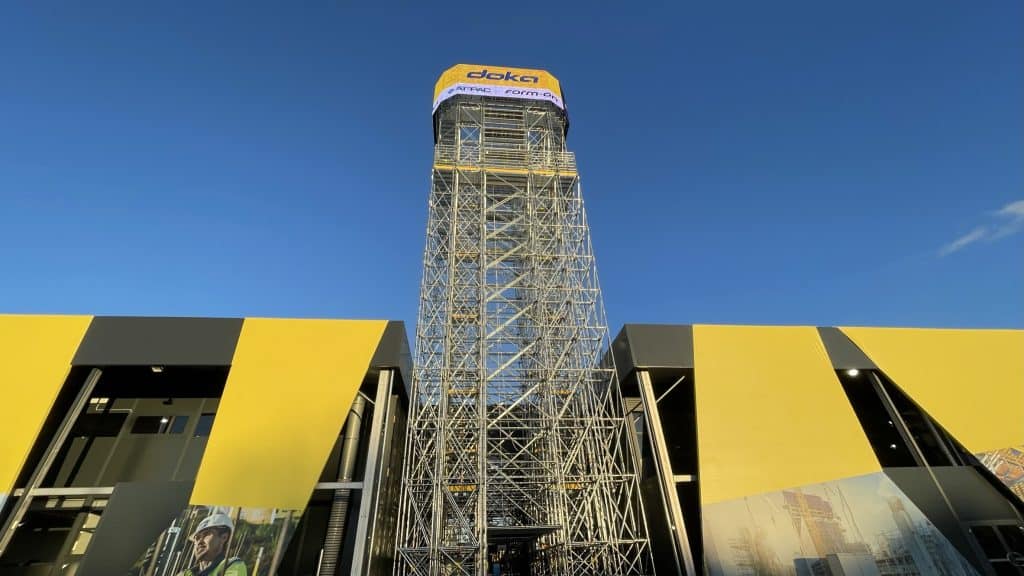 Julio Black, VP Technical Services & Marketing for AT-PAC on the Landmark Scaffold Tower said: “We wanted to do something truly remarkable for our visitors and shine a bright light on our DIBt approved Ringlock System Scaffold. We did this by designing and engineering a 30m freestanding tower, with integrated access and egress for visitors to enjoy the view across the fairground from our 20m high viewing deck.
Furthermore, we designed the scaffold to support a full 360-degree LED screen that could be seen from miles away and brought in visitors from all over the world. We erected 52 tonnes of Ringlock and 250 tonnes of reinforced concrete at the foundation. We had over 7,000 visitors enjoy the view throughout the week.”
Ringlock was installed all over the 5,600m2 Doka booth highlighting its commercial & industrial construction scaffold applications along with 3 live install demonstration on the main stage each day.
Julio Black, VP Technical Services & Marketing for AT-PAC on the Landmark Scaffold Tower said: “We wanted to do something truly remarkable for our visitors and shine a bright light on our DIBt approved Ringlock System Scaffold. We did this by designing and engineering a 30m freestanding tower, with integrated access and egress for visitors to enjoy the view across the fairground from our 20m high viewing deck.
Furthermore, we designed the scaffold to support a full 360-degree LED screen that could be seen from miles away and brought in visitors from all over the world. We erected 52 tonnes of Ringlock and 250 tonnes of reinforced concrete at the foundation. We had over 7,000 visitors enjoy the view throughout the week.”
Ringlock was installed all over the 5,600m2 Doka booth highlighting its commercial & industrial construction scaffold applications along with 3 live install demonstration on the main stage each day.
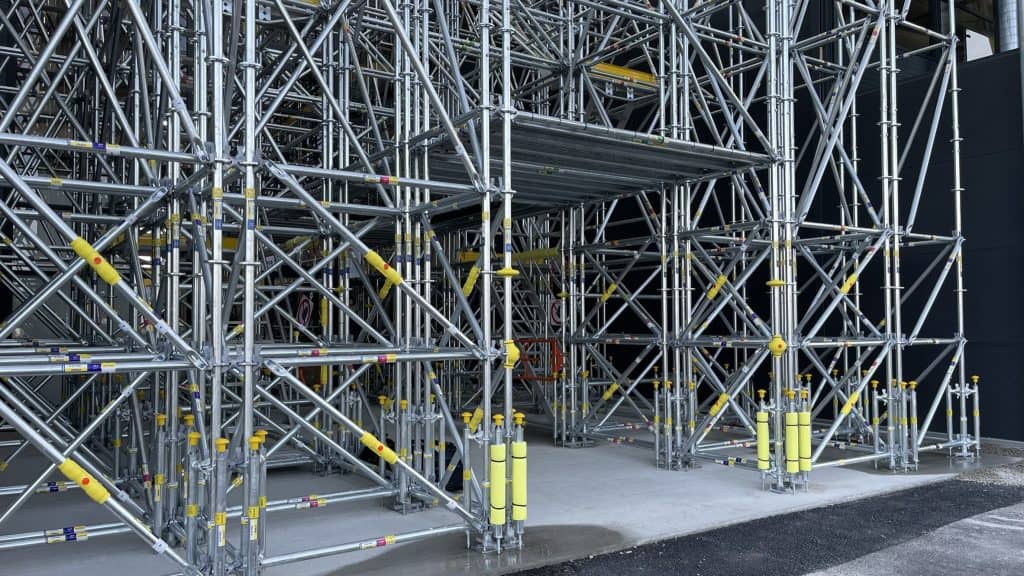 AT-PAC’s Ringlock system scaffold is the first non-European produced modular scaffold system to attain DIBt approval, which is a true testament to the quality, design and engineering provided by AT-PAC and enjoyed by thousands of customers.
AT-PAC’s proprietary scaffold management software – Hi-Vis® was heavily on display throughout the week.
Hi-Vis® provides scaffold contractors, EPC’s & EPCM’s the tools to better plan, manage and execute the entire scaffold lifecycle on any project. Tools such as easy to read dashboard reports, NFC Smart Tags for quick and easy scaffold inspections, request management & estimating, detailed labor tracking and inventory management.
AT-PAC’s Ringlock system scaffold is the first non-European produced modular scaffold system to attain DIBt approval, which is a true testament to the quality, design and engineering provided by AT-PAC and enjoyed by thousands of customers.
AT-PAC’s proprietary scaffold management software – Hi-Vis® was heavily on display throughout the week.
Hi-Vis® provides scaffold contractors, EPC’s & EPCM’s the tools to better plan, manage and execute the entire scaffold lifecycle on any project. Tools such as easy to read dashboard reports, NFC Smart Tags for quick and easy scaffold inspections, request management & estimating, detailed labor tracking and inventory management. 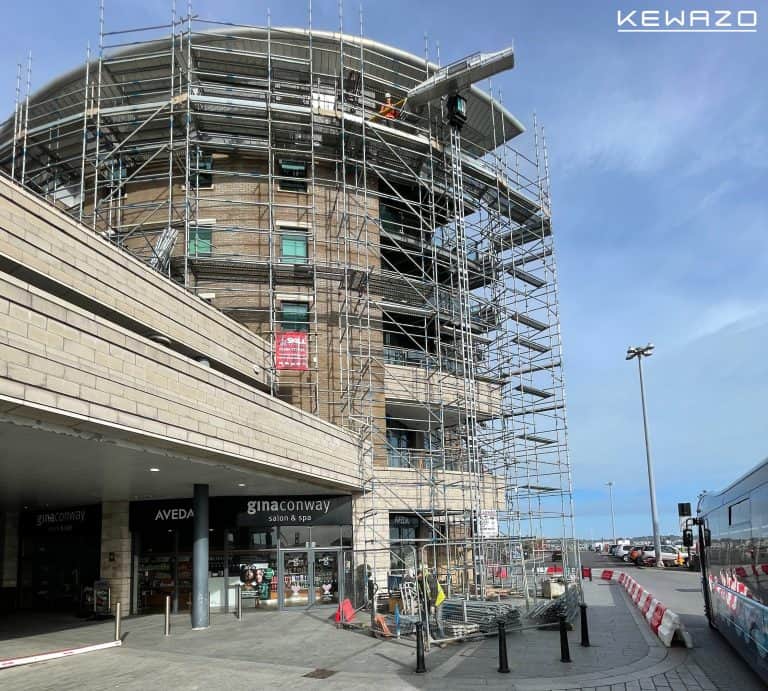
 LIFTBOT has since continuously proven to be success on a number of projects across the South of England, including a project at London Heathrow. Recently, the system has returned to its flagship project at Poole Quay to support the 2nd and 3rd phases of subsequent site work.
KEWAZO has been supporting Skill Scaffolding in all aspects related to LIFTBOT – with training right after the delivery, and with annual and emergency maintenance support today.
KEWAZO added from their side: “We are extremely glad to be able to count on such motivated innovators as Skill Scaffolding. We are already looking forward to seeing LIFTBOT deployed on further trial and pilot projects across the UK.”
This article was first published in the ScaffMag Magazine Issue 17
LIFTBOT has since continuously proven to be success on a number of projects across the South of England, including a project at London Heathrow. Recently, the system has returned to its flagship project at Poole Quay to support the 2nd and 3rd phases of subsequent site work.
KEWAZO has been supporting Skill Scaffolding in all aspects related to LIFTBOT – with training right after the delivery, and with annual and emergency maintenance support today.
KEWAZO added from their side: “We are extremely glad to be able to count on such motivated innovators as Skill Scaffolding. We are already looking forward to seeing LIFTBOT deployed on further trial and pilot projects across the UK.”
This article was first published in the ScaffMag Magazine Issue 17 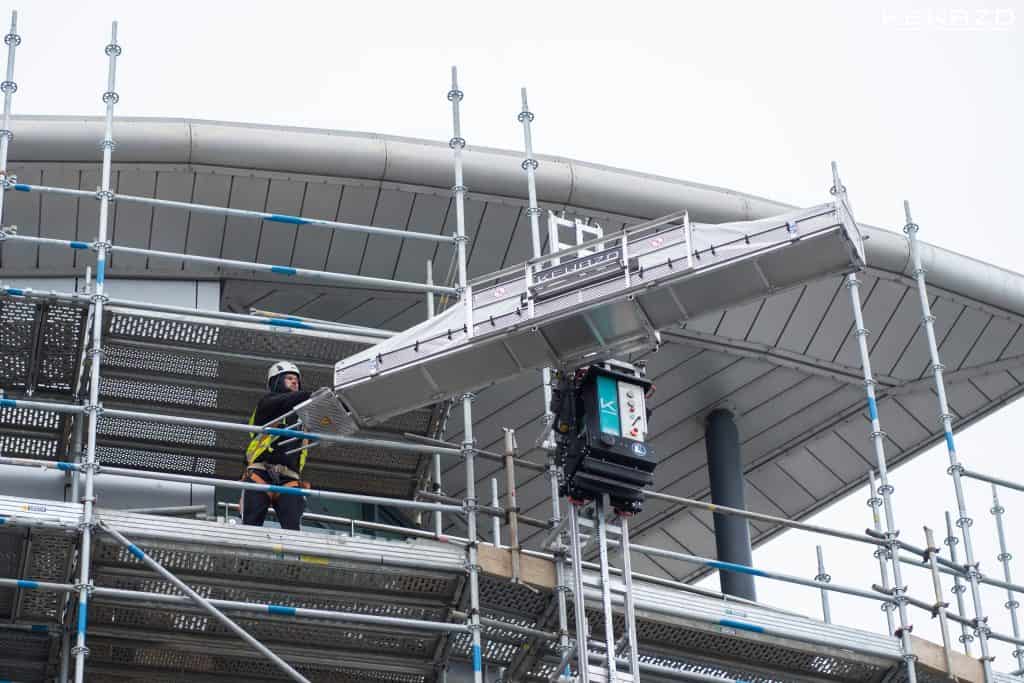 LIFTBOT has since continuously proven to be success on a number of projects across the South of England, including a project at London Heathrow. Recently, the system has returned to its flagship project at Poole Quay to support the 2nd and 3rd phases of subsequent site work.
KEWAZO has been supporting Skill Scaffolding in all aspects related to LIFTBOT – with training right after the delivery, and with annual and emergency maintenance support today.
KEWAZO added from their side: “We are extremely glad to be able to count on such motivated innovators as Skill Scaffolding. We are already looking forward to seeing LIFTBOT deployed on further trial and pilot projects across the UK.”
This article was first published in the ScaffMag Magazine Issue 17
LIFTBOT has since continuously proven to be success on a number of projects across the South of England, including a project at London Heathrow. Recently, the system has returned to its flagship project at Poole Quay to support the 2nd and 3rd phases of subsequent site work.
KEWAZO has been supporting Skill Scaffolding in all aspects related to LIFTBOT – with training right after the delivery, and with annual and emergency maintenance support today.
KEWAZO added from their side: “We are extremely glad to be able to count on such motivated innovators as Skill Scaffolding. We are already looking forward to seeing LIFTBOT deployed on further trial and pilot projects across the UK.”
This article was first published in the ScaffMag Magazine Issue 17 





 Those attending were wooed and impressed by the dramatic entrance of the new beam as it was slowly lowered from the roof wrapped in a bespoke chocolate bar wrapper ready for unveiling.
The new two-piece multifunctional beam which has been aptly named after the well-known chocolate bar is made entirely from high-grade aluminium and produced at the world-famous Layher Eibensbach factory near Stuttgart in Germany.
Those attending were wooed and impressed by the dramatic entrance of the new beam as it was slowly lowered from the roof wrapped in a bespoke chocolate bar wrapper ready for unveiling.
The new two-piece multifunctional beam which has been aptly named after the well-known chocolate bar is made entirely from high-grade aluminium and produced at the world-famous Layher Eibensbach factory near Stuttgart in Germany.
 The TwixBeam will have many uses for specialist scaffolding contractors including conventional scaffolding, industrial scaffolding/boiler scaffolds and shoring in combination with TG60.
Speaking about the event and the new TwixBeam, Sean Pike Layher UK’s Managing Director said: “We were, as always humbled by the huge attendance and most grateful to all who came for giving up their time to spend with us.
This year, the attendance has grown significantly, and we were delighted to welcome many new faces and celebrate with them many examples of their work with our products, as well as taking the opportunity to highlight our hints, tips and solutions as well as launch our new Twixbeam.
The interest on the day in the Twixbeam was one of the biggest responses we have ever had to a new product launch, topped only by receiving our first order for it on the day, with several other enquiries quickly following”.
The TwixBeam will have many uses for specialist scaffolding contractors including conventional scaffolding, industrial scaffolding/boiler scaffolds and shoring in combination with TG60.
Speaking about the event and the new TwixBeam, Sean Pike Layher UK’s Managing Director said: “We were, as always humbled by the huge attendance and most grateful to all who came for giving up their time to spend with us.
This year, the attendance has grown significantly, and we were delighted to welcome many new faces and celebrate with them many examples of their work with our products, as well as taking the opportunity to highlight our hints, tips and solutions as well as launch our new Twixbeam.
The interest on the day in the Twixbeam was one of the biggest responses we have ever had to a new product launch, topped only by receiving our first order for it on the day, with several other enquiries quickly following”. 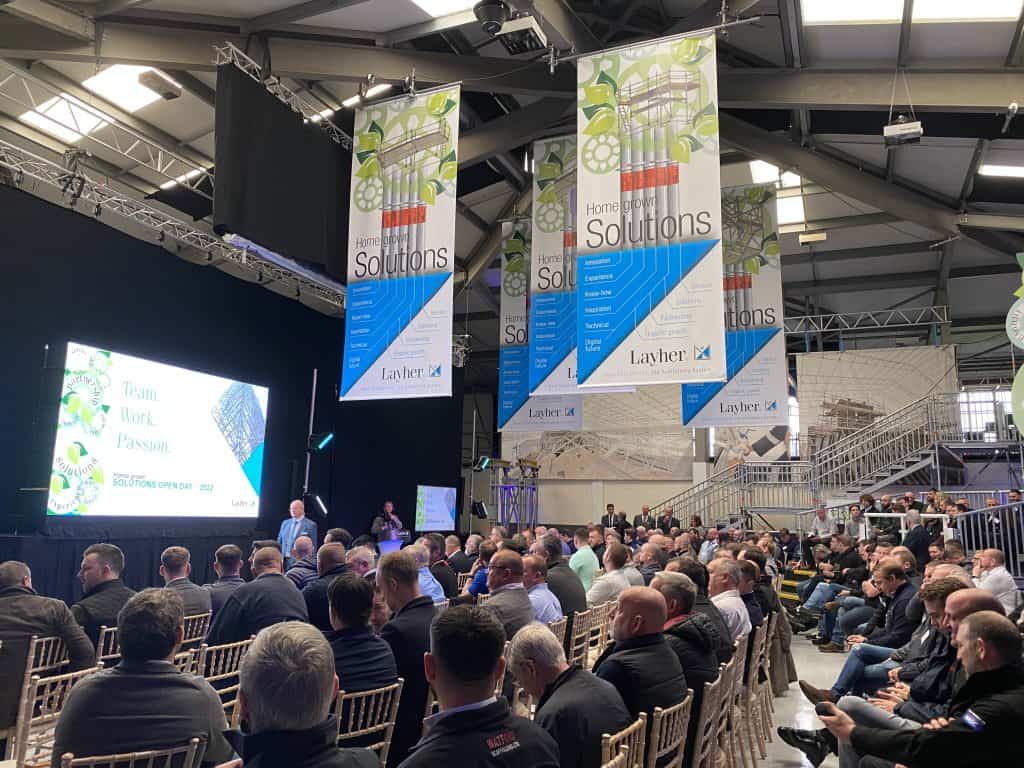 Those attending were wooed and impressed by the dramatic entrance of the new beam as it was slowly lowered from the roof wrapped in a bespoke chocolate bar wrapper ready for unveiling.
The new two-piece multifunctional beam which has been aptly named after the well-known chocolate bar is made entirely from high-grade aluminium and produced at the world-famous Layher Eibensbach factory near Stuttgart in Germany.
Those attending were wooed and impressed by the dramatic entrance of the new beam as it was slowly lowered from the roof wrapped in a bespoke chocolate bar wrapper ready for unveiling.
The new two-piece multifunctional beam which has been aptly named after the well-known chocolate bar is made entirely from high-grade aluminium and produced at the world-famous Layher Eibensbach factory near Stuttgart in Germany.
 TwixBeam is a low weight easy to dismantle and incredibly strong beam that effortlessly integrates into the Layher Allround System.
Users of the scaffolding system will also benefit from its versatility as it works perfectly in tandem with the highly successful Flexbeam that launched in 2018.
Weighing just 12kg/m the new smart multifunctional beam will be available in an array of lengths from 0.8m to an impressive 6.6m.
TwixBeam is a low weight easy to dismantle and incredibly strong beam that effortlessly integrates into the Layher Allround System.
Users of the scaffolding system will also benefit from its versatility as it works perfectly in tandem with the highly successful Flexbeam that launched in 2018.
Weighing just 12kg/m the new smart multifunctional beam will be available in an array of lengths from 0.8m to an impressive 6.6m.
 The TwixBeam will have many uses for specialist scaffolding contractors including conventional scaffolding, industrial scaffolding/boiler scaffolds and shoring in combination with TG60.
Speaking about the event and the new TwixBeam, Sean Pike Layher UK’s Managing Director said: “We were, as always humbled by the huge attendance and most grateful to all who came for giving up their time to spend with us.
This year, the attendance has grown significantly, and we were delighted to welcome many new faces and celebrate with them many examples of their work with our products, as well as taking the opportunity to highlight our hints, tips and solutions as well as launch our new Twixbeam.
The interest on the day in the Twixbeam was one of the biggest responses we have ever had to a new product launch, topped only by receiving our first order for it on the day, with several other enquiries quickly following”.
The TwixBeam will have many uses for specialist scaffolding contractors including conventional scaffolding, industrial scaffolding/boiler scaffolds and shoring in combination with TG60.
Speaking about the event and the new TwixBeam, Sean Pike Layher UK’s Managing Director said: “We were, as always humbled by the huge attendance and most grateful to all who came for giving up their time to spend with us.
This year, the attendance has grown significantly, and we were delighted to welcome many new faces and celebrate with them many examples of their work with our products, as well as taking the opportunity to highlight our hints, tips and solutions as well as launch our new Twixbeam.
The interest on the day in the Twixbeam was one of the biggest responses we have ever had to a new product launch, topped only by receiving our first order for it on the day, with several other enquiries quickly following”.