
How to become a Scaffold Designer

The guys at 48.3 Scaffold Design have written this great Q & A  on how to make the big step from being a Scaffolder to Scaffold Designer.. Enjoy.

People in the scaffolding industry often ask us “how do you get into scaffold design?” and some are interested in making the change themselves. It is not an easy transition to make, as Andrew Kitley from the 48.3 Scaffold Design team explains in this Q & A. Andrew began the transition from scaffolder to scaffold designer in 2008 and has now gained experience of a wide range of design work, as well as providing valuable practical insights through his first-hand knowledge of scaffold erection. Here Andrew explains how he started in the scaffolding industry, followed by the trials, tribulations and triumphs of his personal journey so far from scaffolder to scaffold design engineer. How long were you a scaffolder for, and what level did you reach? I first started scaffolding in 2000 when one of my friends asked me to help out at his Dad’s company for a week. I loved the laughs I had on site that week and decided to take it up full-time. I progressed through the ranks overs the years as most do, from labourer, to second-hand, charge-hand and, finally, supervisor. What made you want to become a design engineer and when did you make that decision? In 2008 I decided that I should try to find a career that has more longevity and not put my body under the continuous physical strains that scaffolding does. What was the first step in your transition from scaffolder to scaffold designer? I was in a very fortunate position where the person who taught me how to scaffold had recently started the transition to a design engineer himself. We discussed different routes I could try in order to get a job within a company that could train me, and in a lucky twist of fate the company where he was working was looking for trainee designers. How long have you been designing scaffolding and has design work made you think differently about scaffolds?  I have now been designing scaffolding for three and a half years, but it has not been without its struggles. When I started designing I found it frustrating that the people around me were telling me how to draw scaffolding, when I had been erecting it successfully for years. In my opinion you have to forget what you think you know because your ‘say-so’ or experience doesn’t actually mean anything if the scaffold cannot be proven (in calculation). What qualifications have you gained and what do you plan to achieve in the future? This summer will see me attain my HNC in Civil Engineering and I am looking forward to continuing on the degree course at Southbank University. Engineering is an amazing subject to learn and I find it really enjoyable. How has your previous experience in scaffolding helped you? I try to use my knowledge of erection procedures (i.e. how I would safely carry out the work) in my designs and the rest of the team will tell you I am not shy when it comes to details on drawings. What has been the hardest part of becoming a designer? The hardest stepping stone for me has been continuing education. I have struggled at university; this is not to do with the work but with managing my time correctly around my studies. The first day of university was the first time I had written anything other than my name and address in over 8 years. To study the correct amount you need three evenings a week and probably most of your weekend. From start to finish it will take me a minimum of six years to attain a degree in engineering. What is the most enjoyable thing about being a scaffold designer? There are many rewarding aspects of designing scaffolding: not hating your job throughout the whole of winter; solving problems theoretically and then being able to see it work in practice; and the one I enjoy the most is the respect you receive from everyone for your knowledge. Finally, do you have any advice for anyone who would like to make the switch from scaffolder to scaffold designer? For anyone wishing to become a design engineer, I would say you must consider that you will take a considerable pay cut, depending on you ability as a scaffolder it could be up to 50%. To reach a proficient engineering level you will need to work towards a degree, this will mean studying and if you have children or even a very active social life/long work hours you will find this difficult.

With Thanks to 48.3 Scaffold Design, visit their site for more information

BAM erects huge scaffolding birdcage inside Bluewater

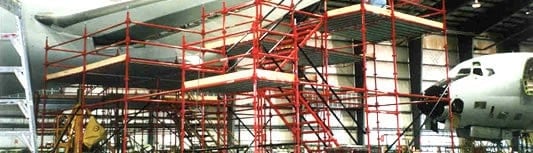
Over 280,000 feet of tube, 12,000 scaffold boards and 90,000 fittings were used to create this huge scaffolding birdcage inside the new Events Venue at the Bluewater shopping center in Kent.

The multi million pound development which is due to open next month, will provide a venue for exhibitions, music concerts, fashion shows and other events. The scaffolding was shoe-horned between existing retail buildings and car parks. In some places there is less than 10mm between the external walls and the buildings next to it. Workforce manager Phil Manning said: “‘The complexities of this scaffold job show the quality of work that our scaffolders are capable of achieving.” BAM Construction is the main contractor for the construction of the venue that is due to be finished in November.

New Harsco guide takes safety to a higher level

A new publication issued by Harsco Infrastructure has been designed to help construction industry professionals re-appraise their safety procedures for operations which involve working at height. Intended for use by client and contractor staff at all levels, the new Harsco Infrastructure Guide to Working at Height is set to become an invaluable source of relevant information and best-practice guidance. The new 34-page document is believed to be the most up-to-date, comprehensive and authoritative of its kind and draws on Harsco Infrastructure’s experience as a world-leading supplier of access, formwork, shoring and maintenance services and products to the construction and industrial markets. Its contents have been designed to help the reader understand the many implications of working at height, adopt best practice procedures, select the most appropriate equipment and access and offer guidance on its safe use. Harsco’s Health and Safety SHEQ Director, Tony Horsfall said:
“Today more than ever, markets are converging rapidly to create an increasingly universal standard of safety, Our aim in creating the new guide has been to help people understand the many issues which surround working at height – a common, everyday situation which can have dramatic consequences unless it’s managed properly.”
Included in the new publication is information on the selection of different types of access, collective fall and personal protective equipment, plus references to examples of site equipment and operator-related hazards. This is complemented by principal design standards for different types of access equipment, and explanations of the variations in safety requirements that exist between different European markets. Copies of the new publication are available by emailing [email protected] or visiting there members’ area at www.harsco-i.co.uk/register  

Scafftag UK offers a free download

You can now download a free digital harness register from Scafftag UK. The register also comes with a guidance booklet compiled to provide management with a summary of health and safety legislation, and to enable them to be better informed regarding the management and use of safety harnesses, lanyards, and fall arrestors within the workplace. Click here For more information and the FREE download

Peri to showcase new products in Dubai

Peri will showcase their state of the art products at the MEC 2011 during November 21 – 24 at the Dubai International Exhibition Centre in the Saeed Halls.

Professionals will be treated to a wealth of information at the Peri stall including intensive discussions with Peri team of experts, tours of the exhibited products, latest documentation and live product demonstrations which will highlight the advantages of the Peri products. On an area of around 72 m² Peri will be presenting proven system equipment, solid product enhancements and numerous new developments. As one of the leading formwork and scaffolding suppliers in the Middle East with offices throughout the entire MENA region, Peri will not only exhibit already well­known and established products, but also launch a new product targeted at the high demand within oil and petrochemical projects. Presentation of proven and innovative systems Among the products showcased at the Peri stand are proven formwork systems as well as the flexible Peri UP Rosett Flex modular scaffolding system. With interactive live demonstration and product experts from Germany, Peri will demonstrate how easy it is to erect Peri SKYDECK, the light-weight aluminium panel slab formwork for faster assembly. Equipped with a drophead, early striking is possible after only one day (depending on the slab thickness and concrete strength). On-site material requirements can be reduced as the beams and panels are then available for the next concreting cycle. SKYDECK is made of aluminium; no component weighs more than 15 kg. Thanks to the low weight of the individual components, SKYDECK enables easy and tireless erection and striking. The SKYDECK main beam reduces the number of props needed – only 0.29 props per square metre of slab are required. This saves time and offers more workspace which simplifies the transportation of formwork materials across the site.
PERI UP Rosett Flex System
For the first time in the Middle East, Peri will introduce the type-tested Peri Up Rosett Flex modular scaffolding system at MEC 2011. Utilized for industrial, petrochemical as well as oil and gas projects, the system fulfils the requirements for these particularly challenging projects. Peri UP Rosett Flex offers maximum flexibility in scaffolding construction. Peri UP Rosett Flex has integrated safety features, which allows the same components to be used as shoring, stair towers, suspended scaffold, reinforcement scaffold or working platforms. This results in reduction of on-site material requirements and increased material utilization rates. The industrial decks are self-securing and can be mounted at any position within the scaffold on standard ledgers. The main components of Peri Up Rosett Flex, such as standards, ledgers and decks, have a uniform length and width grid arrangement of 25 cm or 50 cm. Therefore the system can be adapted to suit almost any geometrical form. Peri Up Rosett Flex can be erected quickly and efficiently, it is extremely versatile and fulfils the highest levels of safety requirements. With Peri Up only a few components are required to economically carry out an extremely diverse range of on-site scaffolding operations. The multi-functional system saves assembly time, thus, construction progress will be accelerated and building costs will clearly be reduced. Sustainable solutions for the industry Peri has been represented for many years in the Middle East region, and has provided cost­effective and efficient formwork and scaffolding solutions for numerous major projects. These include, for example, the Emirates Towers in Dubai and the Saadiyath Bridge in Abu Dhabi. However, Peri provides far more than just intelligently­ designed system equipment. The company’s wide range of activities also includes various technical, commercial and logistical services which support customers in ensuring cost­effective and safe realisation of their projects. In all its activities, Peri also makes a valuable contribution to more sustainability. Many aspects of the company’s business operations demonstrate economic and environmental thinking and action. For example, product development aims to achieve the best­ possible material utilization and thus reducing the amount of materials actually required – the system equipment stands out through high utilisation rates and a long service life. Procurement at Peri is also carried out in accordance with ecological sustainability; for instance, timber is used from certified growing regions as far as possible. And not least because the economically optimised formwork and scaffolding solutions minimise material utilisation on the construction site and contribute to waste avoidance. Completely in keeping with the main focus on sustainability at this year’s fair, Peri will be providing detailed information on this important topic at its stand. Via: Press Release 

Wildcat strikers at Lucite to return to work

0
Scaffolders who have been demonstrating outside an industrial site were expected to return to work today. And talks are being sought to resolve the situation regarding the 14 temporary contractors who sparked unofficial industrial action at chemical firm Lucite. Dozens of workers have been protesting outside the company’s Billingham site over the last week. It came after 14 temporary scaffolders and labourers were escorted from the premises. That prompted other workers on the site to join the dispute. David Massey, Hertel’s HR and Communications Director said: “We are pleased that this unofficial dispute has now ended. We will be having discussions with Unite and GMB about the issues that have been raised over the last couple of days and see dialogue as a positive step forward.” A source at Hertel, which employs the temporary workers at the Lucite site, said yesterday that Hertel had ended the temporary scaffolding contract due to a reduction in the planned work required at the Cassel Works site. It meant “around 14 scaffolders out of a total workforce of 160 contractors employed by the company” were given a week’s pay in lieu of notice. But workers claimed their action was prompted because they were laid off following a pay review request. A spokesman for union Unite said it had been agreed they would return to work today “under the condition that once there was a return to normal working we will be endeavouring to hold a meeting as soon as possible through the offices of Acas. Advanced scaffolder Tony Seaman, of Ormesby, told the Gazette: “Negotiations can now take place. I am happy that things are moving.” Via: www.gazettelive.co.uk

Scaffold collapse in Fulham UK

0
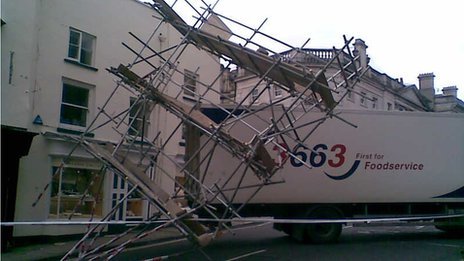
This is the scene after the scaffold collapsed at around 1pm on Monday in a busy stretch of road in Fulham. The scaffold fell onto the pavement that hundreds of schoolchildren use everyday. Miraculously, no cars or people were near at the time of the collapse. A local shop keeper heard the collapse from behind his counter he said: “It’s amazing no one was passing – this is one of the busiest roads in the area and is used by hundreds of people a day. There is no doubt this could have killed someone.” “It was a huge bang, you could really feel the power of it.” Another eyewitness saw the incident and said: “I was standing outside smoking and out of the corner of my eye I saw something moving. It seemed to come down in slow motion, the polls were bending 90 degrees and then it crashed to floor. “If someone had been underneath they would have died, unless they were a very small child. It’s really lucky no one was walking down there at the time.” The scaffolding was on a three-storey block of flats that are being built on the footprint of a former council building. The local shop keeper said that activity at the site had died down recently, but he was concerned about the scaffolding for some time as the structure had been swaying in the wind. More Photos : Courtesy of  fulhamchronicl.co.uk   Written By Daniel Norton  

UPDATE: 14 Scaffolders sacked over pay rates

0
ATTEMPTS are being made today to bring an end to an unofficial strike which has seen dozens of workers protest outside an industrial site see our first report on this here. It is thought the Unite union was due to meet with representatives of a group demonstrating outside Lucite in Billingham. Crowds of around 100 workmen have been reported at the company’s entrance in recent days in an action which has delayed planned maintenance work. The protest comes after 14 scaffolders and labourers were escorted from the chemical company’s site – triggering a disagreement which saw other workers join the dispute. A source at Hertel, which employs the workers at the Lucite site, said the “unofficial strike action” had been going on for several days and involved the “unlawful secondary picketing” of the premises. He claimed many of the demonstrators had no direct connection with the work in question, adding the firm had written to its employees to “counter false allegations that the dispute is in any way linked to pay or that the men were forcibly removed from the site.”
The source said Hertel had ended a temporary scaffolding contract last week due to a reduction in the planned scope of scaffolding work required at the Cassel Works site. The decision meant that around 14 scaffolders out of a total of workforce of around 160 contractors employed by the company were given a week’s pay in lieu of notice.
The company says that is in line with the agreed terms of the temporary contracts. But the workers claim their action comes after they were laid off following a pay review request. A Hertel spokesman said the situation all of the 14 were employed as temporary scaffolders and labourers.
“The process was managed in accordance with standard procedures with appropriate notice issued to each of the affected employees,” he added.
It is believed that the spokesmen for the parties involved in the dispute were due to meet today.

14 Scaffolders sacked over pay rates

0
A picket line has been set up outside the old Cassel Works, Billingham, Teesside after 14 scaffolders lost there jobs at the end of last week. The sackings came after one of the scaffolders Tony Seaman who is an activist for UNITE union took a letter of grievance to management on Wednesday asking to talk about increasing pay. The scaffolders claimed he was then asked to leave the site along with 13 other scaffolders. The industrial action was immediately set up outside the site which swelled to over 100, involving other trades such as fitters and electricians that walked out in sympathy for the scaffolders, calling for the men to be reinstated. Officials from UNITE and GMB unions held talks with the company to get the men back to work. However, no deal could be met. Scaffolder, Tony Seaman said: “I think it is wrong and we are very angry about this. “All we wanted was a review into our pay. We are on £10.46 an hour and under the blue book agreement we wanted £14. What is wrong with that?” It’s understood that union officials and the company agreed on Friday to take the matter to the conciliation service ACAS, but a condition was that the picket line should be removed. However workers refused to call off the action until they were given their jobs back and on Friday the matter was deadlocked. UNITE official Bill Green said: “The unions have told the men that they are on their own because the walk-out is illegal. The company claimed they never received a grievance letter. This is an unfortunate and regrettable matter that needs to be sorted out.” Communications Director David Massey at Hertel UK said: “Due to changes in the scope of the work we are carrying out at Lucite, the company was in a position where it needed to end a number of temporary contracts.” “This has involved 14 men, all of whom were employed as temporary scaffolders and labourers. The process was managed in accordance with standard procedures with appropriate notice issued to each of the affected employees.” Talks are expected to continue soon.

Let us know what you think about this story in the comments box bellow

Scaffolder dies 43 years on after asbestos accident

0
A YORKSHIRE man survived an industrial accident in 1965 only to die 43 years later because he was not protected from asbestos particles in the aftermath, his family has revealed. Ken Hoggett worked at the giant Ferrybridge power station when three cooling towers collapsed in 100mph winds. Nobody died in the accident, but tragedy struck generations later as the grandfather succumbed to an industrial disease. The scaffolder had cleared up in clouds of dust at the site near Pontefract, West Yorkshire, inhaling deadly asbestos fibres which caused mesothelioma, an aggressive form of lung cancer. Barely two weeks after diagnosis, Mr Hoggett – who had suffered breathing problems for years – was dead. Now his family is speaking out to warn others about the dangers. A former member of the Green Howards regiment and a veteran of the invasion of Sicily and the D-Day landings, Mr Hoggett was of a generation which bore suffering in silence, according to his family. His daughter Sue Stoppard, 57, said: “I think if other people have got concerns like my dad had they shouldn’t suffer in silence – they should get themselves checked. That’s why we are speaking out. “We don’t know how many other people have yet to discover this. If people can read about us and think ‘Well, I should be tested’, there might be something they can do. “Within less than a fortnight of finding out what he had, my dad was dead.” He was 85 when he died and had been caring for his wife of 60 years Ann, who had her own health problems. Mrs Hoggett, from Doncaster, started legal action against her husband’s former employers but passed away aged 89. Sue, and the devoted couple’s other daughter Kay Cowx, 63, continued the action and now the company Joseph Nadin Ltd has paid out damages of £49,000 after admitting a breach of duty of care to its employee. The family’s solicitor, Rebecca Moore-Yelland, a personal injury specialist from the Doncaster office of Shaw & Co, said finding the firm and proving that it employed men on site around the time of the collapse could be crucial in any further claims by other employees. “The defendant was hard to track and identify given the lapse of time, but has now been firmly placed as an employer of men working at the power station in this era,” said the solicitor, who has many years’ experience in tracing former employers of people who worked with asbestos decades ago. “The case also serves to illuminate the hazards of the industry at the time. It’s likely that many men will have some asbestos-induced disease dormant, which will come to light in the coming years, if it has not already.” In sworn evidence, a co-worker of Mr Hoggett told Shaw & Co that health and safety at the time “received little more than lip service” with accidents caused by poor lighting and training, and inadequate warnings. Mr Hoggett, who died in 2008, had also helped to mix and apply asbestos lagging with his bare hands before the collapse of the towers. Mrs Stoppard, of Doncaster, said many workers like her father were told to help in the clear-up. “Everybody had to muck in and help, and they swept and cleaned everywhere,” she said. She added: “We were determined to settle it out of dad’s memory – and for my mum because she wanted it to be done as well. “The day that my dad found out that he had it he said ‘Something should be done about this’. Well, now it has.” Mr Hoggett worked between 1964 and 1966 for a company called Joseph Nadin Ltd, believed to be based in Lancashire at the time. It is no longer trading and, according to lawyers, is not believed to be connected to any other company of a similar name. Via: Yorkshirepost.co.uk[email protected]

Have you ever been affected by Asbestos while at work ? Let us know about it in the comment box below.