Munich based KEWAZO has raised a further $5 million in investment from a leading investor in Silicon Valley
Kewazo has today announced that venture capitalists True Ventures have become investors in the business to help scale its robotic fleet of ‘Liftbot’ into the $50 billion scaffolding industry.
Existing investor MIG AG, a Munich-based venture capital firm and one of the founding investors in BioNTech, also participated in the round.
New investors True Ventures provides seed and Series A financing to entrepreneurs in today’s fastest-growing markets. True Ventures has helped more than 300 companies launch and scale their businesses, creating more than 25,000 jobs worldwide.
Kewazo’s scaffolding robot ‘Liftbot’ has now raised a cool $9 million in total following a series of funding rounds since 2018 when its robotic material hoist was just a prototype.
Initially, Kewazo is focused on scaffolding assembly — a $50 billion industry. During the building or dismantling of scaffolding, more than 80 percent of projects are still done completely manually.
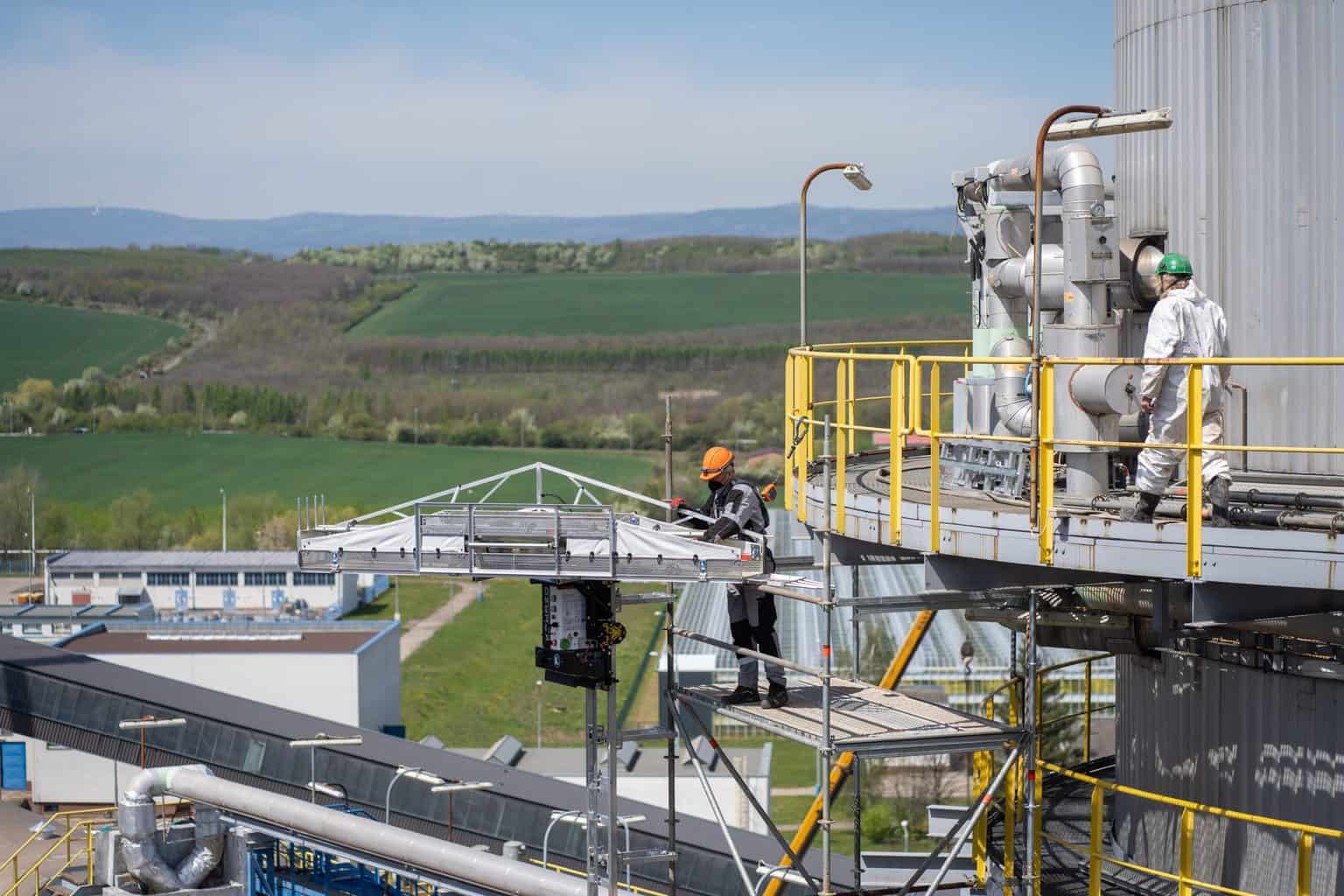
‘Liftbot’ makes assembly more efficient by automating manual material transport. Using the robot saves up to 44 percent of man-hours, which directly addresses the labour shortage, a long-term problem in the industry, says Kewazo.
The robot reduces the risk of accidents and improves working conditions on-site. With minor adjustments, the technology can be applied to additional tasks such as insulation, painting and other on-site material transport.
Liftbot also collects operational data and provides it to customers in the form of a data analytics platform. Those insights aid planning and improve profitability, and customers benefit from faster, more predictable projects.
Scaffmag understands that a number of UK scaffolding contractors are currently piloting liftbot on some high-profile projects.
Artem Kuchukov, CEO of Kewazo told us: “We’re excited to have found a partner in True Ventures that understands our vision of bringing robotic technology to the construction industry.” “With the new investment, we aim to expand our robotic fleet in Europe and the U.S., to introduce the RaaS model, and to enable further digital services. LIFTBOT improves worker safety, makes jobs more efficient, and drastically cuts the amount of man-hours projects take, all while saving money.” “Since our Seed-Investment in 2018, Kewazo has come a long way from prototype to the marketable and robust LIFTBOT system. Having True Ventures now leading the Series A round takes the company to the next level and we are proud to further support Kewazo’s international development”, states Matthias Guth, MIG Venture Partner and Kewazo Board member.
The first batch of ‘Liftbots’ has been successfully delivered to key customers in the EU markets. Prospective projects worldwide include scaffolding assembly at greenfield projects and maintenance jobs at construction sites, oil and gas refineries, power plants, and shipbuilding yards.
Kewazo has completed more than 40 pilot and test projects, and has delivered robots to major customers like Bilfinger, a leading European industrial service provider, on oil and gas sites in Germany.
“We have tested Liftbot during ongoing operations and immediately recognized the potential of the solution,” said Alexander Brod, branch manager of Bilfinger Arnholdt in Gelsenkirchen. “With innovative technologies from the fields of robotics and automation, we offer our industrial customers an even safer and more efficient service.”“So many aspects of the construction industry stand to benefit immensely from robotic intelligence and RaaS offerings,” said Puneet Agarwal, partner at True Ventures. “The Kewazo team has a strong track record and proven solution that addresses a significant need in a critical part of the industry. We’re excited to fund this team and help them expand to new verticals in construction and other markets.”
The scaffolding industry is being urged to get involved with the ‘Big Brew’ – a new national campaign to highlight the mental health crisis in the construction sector.
The Big Brew will start on 1 October and will encourage scaffolders and other tradespeople to connect and talk over a cuppa in a bid to remove the taboo around mental health across the construction industry.
The event is the brainchild of the national construction charity Band of Builders (BoB), which is organising a range of events on construction sites and at builders’ merchants up and down the UK to encourage people within the industry to come together to discuss mental health issues and support one another, breaking down the stigma around mental health – and also helping the charity fund its vital services.
Resideo (through its Honeywell Home brand), Jewson, DeWalt and JW Grant are supporters of the Big Brew and have already pledged to host events throughout October.
The campaign comes amid a mental health crisis within the industry, with the suicide rate of UK construction workers estimated to be as high as two people every day. UK construction workers are also nearly three times more likely to die by suicide than their counterparts in other industries.
Further shocking figures show that:
In the UK alone, more than 400,000 working days were lost to mental health issues in 2018 (55% of all days lost)1
Mental health issues cost the UK construction industry approximately £37 billion every year
A survey in 2019 found that 90% of construction managers said they had struggled with their mental health2
BoB is a registered charity that helps members of the UK construction industry who are battling illness or injury. It does this through the completion of practical projects, with volunteer tradespeople giving up their time to work on these projects, while materials are donated by companies across the construction industry.
Peter Cape, Big Brew lead at BoB, wants to encourage tradespeople to get involved with the Big Brew.
“It’s so important that members of the construction community look out for each other, including talking about mental health or looking for the telltale signs that fellow roofers may be struggling – and what better way to do it than over a brew, especially a big one,” said Peter.
He went on to say: “We are all acutely aware of the mental health crisis within construction. Suicide rates in the sector were already at one per day before the COVID pandemic, according to ONS figures, and it’s widely accepted that these have worsened to closer to two per day3.“At Band of Builders, we see the struggles of our colleagues within our community on a regular basis and see peer-to-peer support as vital to addressing this crisis. That’s where the Big Brew comes in. By encouraging people to do such a basic thing – sharing a brew – we want to create a space where tradespeople and others in the sector can share experiences, break down taboos around mental health and support one another. The Big Brew isn’t just about a few one-off events but about creating something long term that will address one of the biggest issues in our industry all year round.”
What the Big Brew will fund
Anyone can host a Big Brew – and builders wishing to register to host their own events can visit https://www.bandofbuilders.org/the-big-brew/ to find out more. Hosting a Big Brew will offer a place for people to meet and share a cuppa. It will also help raise funds to provide a range of mental health support services aimed at members of the UK construction industry and focused on supply chain companies, small businesses and the self-employed, who were recently discovered to be at higher risk than those working in larger organisations.
These support services will include:
Funding dedicated industry mental health support lines
The provision of interim counselling services to support members of the UK construction industry
The provision of counselling support for BoB beneficiaries and volunteers
The provision of 300 free mental health awareness course places for small and medium-sized businesses and the self-employed. BoB will also work with fellow construction charity The Lighthouse Club and partners on the Beacons campaign, which aims to increase the provision of, and access to, regional peer support groups
Know your wellbeing STATS
Peter Cape added that, as part of the campaign, the Big Brew will encourage tradespeople to remember their wellbeing STATS and support one another:
S – Support each other
T – Talk about it
A – Always ask twice
T – Take it seriously
S – Stop the cycle
He said: “Wellbeing STATS around mental health are vital, and we hope that the Big Brew will be a way for tradespeople to start opening up, even just a little bit, because we all need to do everything we can to start reversing the mental health crisis in the construction sector.”
Support the Big Brew at https://www.bandofbuilders.org/the-big-brew/
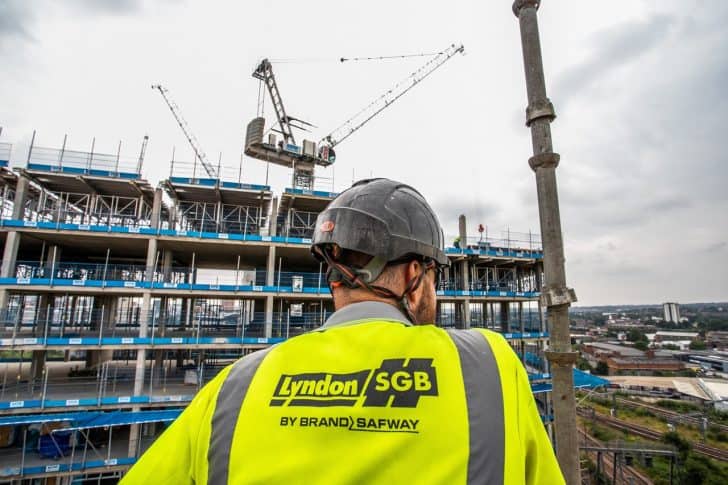
Teams from Lyndon SGB’s Leeds branch are busy supplying complex scaffolding and access solutions on a landmark modern construction project in Leeds city centre
The £105m construction scheme lead by Galliford Try is set to transform the South West of Leeds city centre, on the former Monk Bridge steelworks site, just off Whitehall Road, bordering onto the Leeds-Liverpool canal.
The 665-home development (being constructed on behalf of Highline Investments) consists of five new-build residential tower blocks and more than 15 scaffolding operatives from Lyndon SGB have been at work on the site since August 2020 and will be in action there until August 2022.
The scaffolding project features an in-house designed, highly detailed Cuplok access scaffold combined with Omega hop-up system – covering the five residential blocks, varying from 12 to 22 storeys in height.
Jonathan O’Connor, Lyndon SGB General Manager at Leeds said: “Monk Bridge is an extremely challenging project in particularly from a logistical perspective. From a location, design and resource point of view as a business we are ideally placed to help Galliford Try deliver this prestigious project. Special praise should also go to Jamie Field & Matt Grosvenor, who received monthly supervisors award in the first month on site.”
Stephen Hart, Project Director at Galliford Try, commented: “We are delighted to be able to start work on such a prestigious high-density residential building development in the heart of Leeds. This scheme is a significant investment in the current economic environment.”
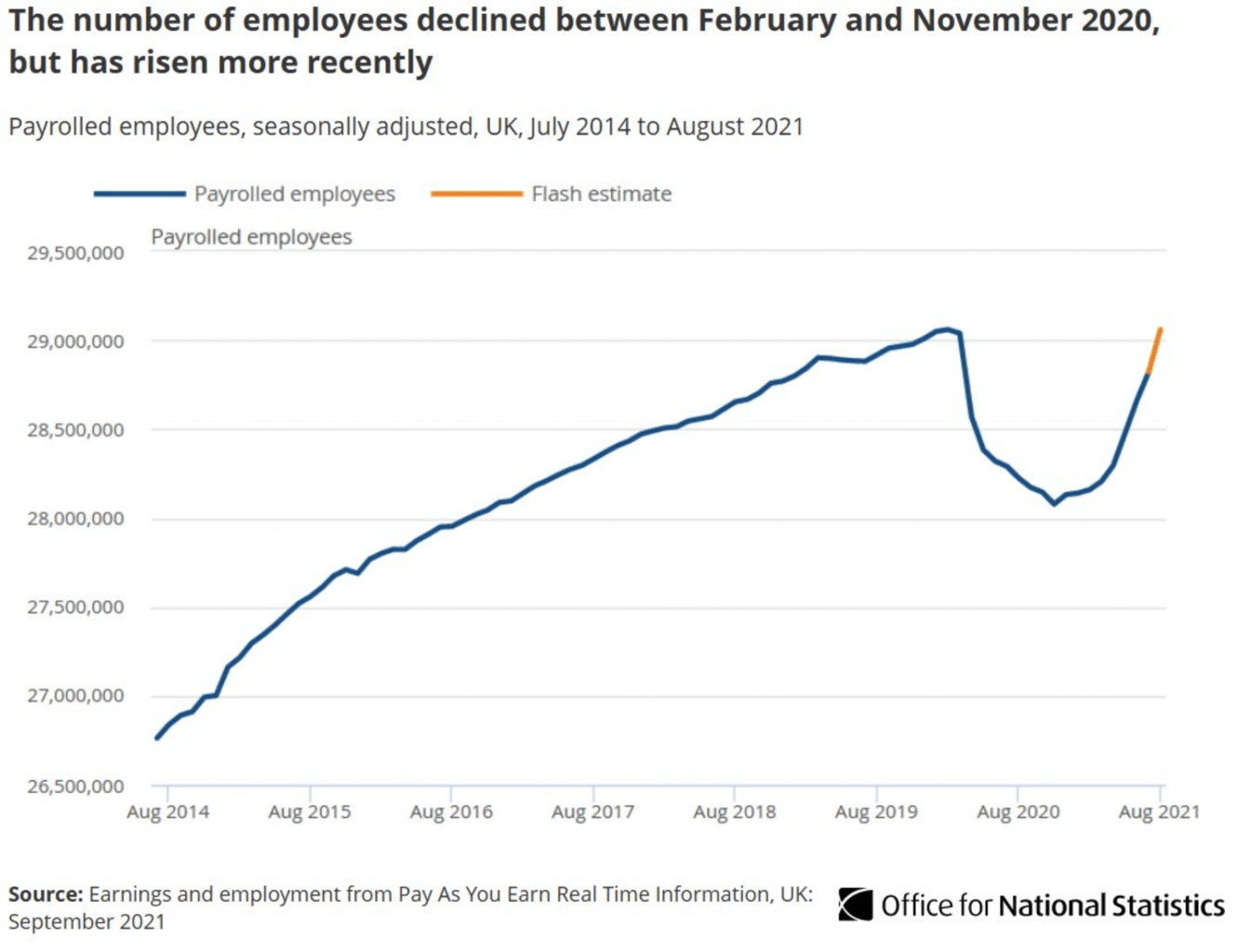
Official figures show an improving picture for the UK jobs market with vacancies hitting new record levels
The number of job vacancies available in the UK has climbed to over one million for the first time since records began, says the Office of National Statistics (ONS).
The construction sector has also seen vacancies reach their highest ever level, with 37,000 positions available between June and August. This is an increase of 2,000 from May to July, which, at the time, was another record for the industry.
Scaffolders and other industry operatives are also in huge demand across the country with shortages of skilled scaffolders being reported.
Marco Verdonkschot, Managing Director at IronmongeryDirect, said: “Such high numbers of vacancies suggest that UK construction firms are feeling confident about their future and have sufficient work and finances to be able to increase their staff numbers.
“This is good news for unemployed construction workers, as the number of people out of work currently stands at 53,000. Hopefully they will be able to take advantage of the vacancies and get back into employment.
“They may consider turning self-employed, as the latest data suggests many workers in the sector are doing just that. There was a big jump between March and June, with 28,000 new self-employed construction workers, taking the UK total to 269,000, which is the highest in a year.
“This follows the general pattern in the industry, as the total number of employees in UK construction reached 518,000 in June, which is the highest since records began in 1978.
“There is some regional variation, however, as while some areas, like London (14%) and the West Midlands (6%) saw growth, others experienced slight decreases in their staff numbers, like the East Midlands (-5%) and the North East (-2%).
“This shows that while the country appears to be heading in the right direction and recovering after a long and challenging 18 months, there is still work to be done before everyone is back to where they were before.”
The Scaffolding Association says the latest construction output statistics offer little comfort to the sector
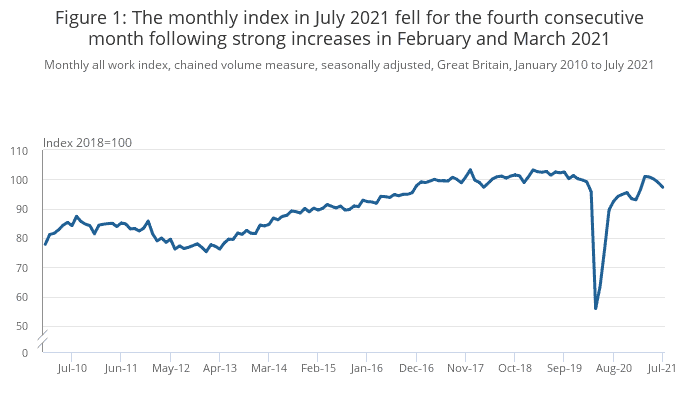
The latest data from the Office for National Statistics (ONS) published last week, show construction output in July 2021 was worth £257m (1.6% in volume terms) less than the month before the pandemic hit.
It is the second month in a row where construction activity remained lower than pre covid levels according to the latest ONS figures.
Rising prices and supply chain issues were sighted as the main reasons for the decline. According to a recent Construction Index survey, respondents told the ONS that order book volumes were high, but shortages of products are impacting live projects which is hitting the industry hard in the short-term.
Weakened demand from private housing was the biggest contributor to July’s decline, which saw sharp falls in both new work, and repair and maintenance of 7.5% and 6.2% respectively compared with the previous month.
Perfect Storm
Robert Candy, Chief Executive of the largest UK scaffolding trade body the Scaffolding Association said “Supply shortages, rising costs of materials and supply chain issues are all playing their part in this perfect storm.A significant amount of construction is needed in the coming decade to fulfil the government’s plan for building 300,000 new homes per annum. The uncertainty around product availability and costs is already resulting in developers pausing or rethinking their development plans which will impact these ambitious targets”.
He added: “Unfortunately there is no evidence to suggest that this situation will resolve itself anytime soon. The contributing factors are part of a global crisis, and it will be several months, if not longer, before things level out and we see some stability”.
The National Access and Scaffolding Confederation (NASC) has spoken out about the growing concern for shortages of qualified scaffolders after a recent survey found its contributing to ‘suffocating growth’ within the construction industry
The survey conducted by the Confederation of British Industry (CBI) found shortages of scaffolders, bricklayers, carpenters and electrical engineers. They now fear these shortages could last for ‘years’.
Dave Mosley, NASC Training Director, exclusively spoke to Scaffmag to give his reaction to the findings of the research.
He said “NASC recognises that overcoming labour shortages both now and in the medium-term presents a huge challenge to the whole of construction. While this issue has been exacerbated by the impacts of the Covid-19 pandemic and Brexit, it was by no means been created by them. The need to address the skills gap has been understood by NASC and the scaffolding sector for some time. “NASC has a number of projects and initiatives in place to raise awareness of the benefits of taking up a career in scaffolding to a variety of jobseekers, all of which are aimed at bringing more people into the scaffolding industry. “We are working closely with partners such as the Department for Work and Pensions and Ministry of Justice to help promote a wide range of opportunities within our membership, which we communicate to jobseekers through the NASC’s dedicated scaffolding careers website. “Our work with DWP has led to the creation of the NASC Kickstart Gateway, via which close to 500 six-month work experience placements at 80+ NASC member companies across the UK have been made available to young people. Nearly 100 of these placements have been filled to date. “The NASC continues to offer financial incentives to its members to support the training of new scaffolding industry employees. These include a £50,000 funding pot through which NASC Contractor members can claim up to £125 per operative for completing the New Entrant, CISRS Operative Training Scheme, and a £150,000 fund to re-train ex-Military personnel. “The NASC understands that tackling the skills shortage is crucial if the scaffolding industry wants to continue to thrive. There is no “quick fix” however, through initiatives like those outlined above we must strive to promote scaffolding to as wide an audience as possible.”“We’re excited to share these with you in more detail in the next issue of Scaffmag.”
Thirty TRAD staff members, including senior leadership, are putting in the miles as part of its 50th-anniversary appeal.
TRAD Group (‘TRAD’), one of the UK’s leading scaffolding and access companies, is busy training for October’s Three Peaks Challenge – part of the Group’s commitment to raising £75,000 during the course of this year.
The teams, which represent all TRAD’s offices and depots, are now in serious training so that they can complete the 24-mile walk in just 12 hours.
All money raised will go towards supporting three charities chosen by the company’s staff: The Royal British Legion, MIND and the Multiple Sclerosis Society.
The intrepid charity trekkers include CEO Des Moore, Peter McShane, MD of TRAD Scaffolding Ltd. And Jim Gorman, Deputy Managing Director of TRAD UK.
The Yorkshire Three Peaks is a circular walk that takes in the county’s three highest peaks – Pen-Y-Ghent, Whernside and Ingleborough.
“Our fundraising goal for this challenge is £30,000,” says Des Moore. “We know that’s a big target, but these charities are really deserving of all our support. We have had a great response from our staff and their families and friends, and we’ve had donations from clients and suppliers. We’d love to smash this target, which will help us to celebrate our 50th anniversary in style.”
The Royal British Legion, MIND and the Multiple Sclerosis Society have been chosen by TRAD’s staff members across the UK, and the group has committed to raising a considerable amount during the year, which will be equally split between the charities.
The Royal British Legion helps members of the Royal Navy, the Army, the Royal Air Force, veterans and their families. It is best known for its annual poppy appeal, but offers day-to-day support to serving and veteran armed forces personnel and is active in campaigning for their care and rights. The huge need for this support has become headline news recently with the fall of the government in Afghanistan and the knock-on effects on our veterans who served in that campaign over the past 20 years.
MIND supports better mental health. It is a nationwide charity that offers a wide range of information and support to those with mental health issues and the people who care for them, and is an active campaigner for a better understanding of mental health and greater support for it.
“This is a cause close to our hearts,” says Des Moore. “Between 2011 and 2015 alone, more than 1,400 construction workers took their own lives in the UK, and we have had personal experience of this at TRAD. It’s been a key focus of mine to bring mental health issues to the fore across the industry and within TRAD itself, so supporting MIND is very important to us all.”The Multiple Sclerosis Society supports people with Multiple Sclerosis, a condition that affects the brain and the spinal cord, resulting in a wide range of symptoms. More than 130,000 people in the UK have MS. The charity runs a helpline and offers a wide range of support for everything from managing finances to supporting carers.
Anyone who would like to sponsor the teams or make a donation to TRAD’s charity appeal can donate here: https://www.collectionpot.com/pot/275521/
Construction employers have backed CITB’s Levy Proposals to support skills and training across England, Scotland and Wales, by way of the Consensus process.
The provisional result will now be taken to the Secretary of State for Education to make the final decision on the issue of a new, three-year Levy Order which, if approved, would be issued for 2022-2025.
This will see the Levy continue at the following rates at 0.35% for PAYE and 1.25% for Net paid (Taxable) CIS Sub-contractors.
CITB has said it will now get on with delivering this year’s Business Plan and working with the industry to agree its forward plan.
In doing so, it will listen to the feedback it received on how it can communicate its plans and impact more clearly and ensure its support is relevant, accessible and easily understood.
Overall, 66% or two-thirds of the total number of Levy-paying employers agreed to the proposals, with 63% agreeing when measured by the total amount of Levy paid. This result was based on submissions from the 14 Prescribed Organisations (trade bodies representing employers across the industry) and an independent survey of 4,000 employers who were not members of POs. Eleven of the 14 Prescribed Organisations supported the Levy Proposals.
Apprenticeships and Skills Minister Gillian Keegan said: “My thanks go out to both the staff at the CITB for facilitating a complex process and to the employers, other members and reps for your active participation.“These last 18 months have been unusually challenging for the construction sector and that is why the CITB decided to delay the consensus process from 2020 to 2021. I recognise that Covid-19, one of the key factors for the postponement, has not gone away. Therefore the sector’s willingness to engage with the CITB is even more valuable. “The next step in the process to progress the Levy Proposals towards a Levy Order now rests with me, before doing so I will be considering the Proposals in detail.“I know that the CITB will relish returning its entire focus to delivering skills provision for the construction sector at a time when it is more crucial than ever. I also want to welcome Tim Balcon in his new role as CITB CEO from 1 October and thank Sarah Beale for the great work she has done for many years in leading the CITB.”
Peter Lauener, CITB Chair, said: “Construction has been through a tremendously difficult couple of years. CITB moved quickly to support employers by freezing Levy collection last year, cutting bills by half this year, and putting the right support in place. “We will carry on with delivering our current plans and get started with shaping our future ones. I want to thank everyone who participated in the Consensus process this year – your input is invaluable and will help shape CITB’s support for you in future.”
Creator Scaffold Design and UKSSH were proud to be part of supplying a complex HAKI Temporary Roof that enabled the removal of radioactive sludge in record time.
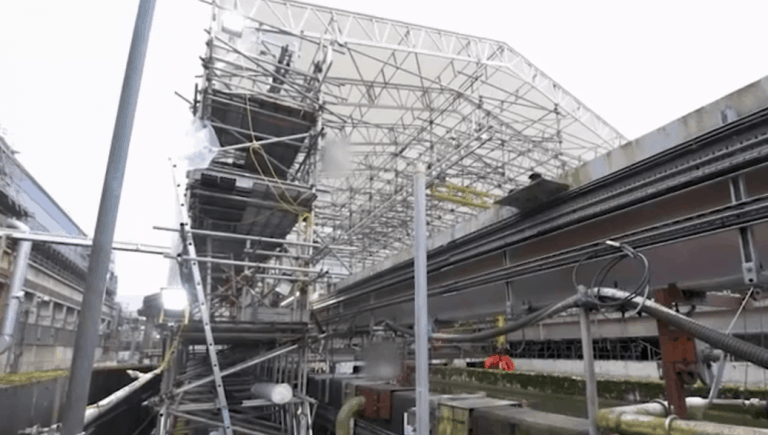
Working closely with Creator Scaffold Design, UKSSH supplied a Haki Temporary Roof that enabled a redundant sixty-year-old settling tank at Sellafield to be cleared of radioactive sludge and then be resealed in record time.
Despite the complexity of the project, it took Creator Scaffold Design just 12 weeks to design, deploy and commission the structure.
Clay Pickworth of Creator Scaffold Design explains that the rolling aspect of the roof was critical to the success of the project: “By designing a rolling roof we enabled scaffolders to build the structure from a position of relative safety and push it out over the tank – the alternative (traditional) approach would have required scaffolders to work over an open tank of radioactive liquor”.
A leak from the sump of a redundant settling tank was discovered in 2019 and – although it posed no immediate risk to people – required urgent work to fix it.
The settling tank had been put into a care and maintenance regime in the 1990’s, with decommissioning planned for the 2030’s, but that all changed in 2019 when the leak was discovered.
In the 1990’s the work could have taken years, but despite the Covid-19 lockdown, the work was completed in just nine months with innovations that have helped accelerate the decommissioning of the wider site.
The primary requirement was to perform waste retrieval operations at a safe distance for humans while minimising any airborne contamination. The HAKITEC 750 Roof System from UK System Scaffold Hire was the perfect solution: Lightweight, safe, fast and easy to erect, the HAKITEC 750’s highly effective weatherproof seal provides maximum protection against the elements and helps to contain hazardous materials.
The temporary roof enabled a gantry to be built above the tank which supported a remotely operated crane that lowered the necessary tooling to safely remove radioactive sludge and waste before re-concreting the base of the tank to reseal it.
The solution was so effective that, now that the immediate problem has been overcome, the system remains in place to clean up other areas of the same facility.
A major survey of building firms by the CBI has found that shortages of scaffolders, bricklayers, carpenters and electrical engineers are suffocating growth in housebuilding and civil engineering projects.
The CBI now fears these shortages could last for ‘years’ as some of the most in-demand tradesmen, such as bricklayers, have been left off the post-Brexit Shortage Occupation List.
Tony Danker, CBI Director-General, said: “Labour shortages are biting?right across? the economy. While the CBI and other economists still predict growth returning to pre-pandemic levels later this year, furlough ending is not the panacea some people think will magically fill labour supply gaps. These shortages are already affecting business operations and will have a negative impact on the UK’s economic recovery.”“Other European countries are also experiencing staffing shortages as their economies bounce back. In the UK, many overseas workers left during the pandemic affecting sectors including hospitality, logistics and food processing. And new immigration rules make replacing those who left more complex.“Building a more innovative economy – coupled with better training and education – can sustainably improve business performance, wages and living standards.? But transformation on this scale?requires planning?and takes time.?The Government’s ambition that the UK economy should become more high-skilled and productive is right. But implying that this can be achieved overnight is simply wrong. And a refusal to deploy temporary and targeted interventions to enable economic recovery is self-defeating.“Let’s be clear – employers back existing Government schemes to get people back into work. And businesses are already spending significant amounts on training, but that takes time to yield results, and some members suggest it could take two years rather than a couple of months for labour shortages to be fully eliminated.“Using existing levers at the UK’s control – like placing drivers, welders, butchers and bricklayers on the Shortage Occupation List – could make a real difference. The Government promised an immigration system that would focus on the skills we need rather than unrestrained access to overseas labour. Yet here we have obvious and short-term skilled need but a system that can’t seem to respond.“Great economies like great businesses can walk and chew gum. We need short-term fixes to spur recovery and long-term reforms to change our economic model.”
We use cookies on our website to give you the most relevant experience by remembering your preferences and repeat visits. By clicking “Accept”, you consent to the use of ALL the cookies.
This website uses cookies to improve your experience while you navigate through the website. Out of these, the cookies that are categorized as necessary are stored on your browser as they are essential for the working of basic functionalities of the website. We also use third-party cookies that help us analyze and understand how you use this website. These cookies will be stored in your browser only with your consent. You also have the option to opt-out of these cookies. But opting out of some of these cookies may affect your browsing experience.
Necessary cookies are absolutely essential for the website to function properly. These cookies ensure basic functionalities and security features of the website, anonymously.
Cookie
Duration
Description
cookielawinfo-checbox-analytics
11 months
This cookie is set by GDPR Cookie Consent plugin. The cookie is used to store the user consent for the cookies in the category "Analytics".
cookielawinfo-checbox-functional
11 months
The cookie is set by GDPR cookie consent to record the user consent for the cookies in the category "Functional".
cookielawinfo-checbox-others
11 months
This cookie is set by GDPR Cookie Consent plugin. The cookie is used to store the user consent for the cookies in the category "Other.
cookielawinfo-checkbox-necessary
11 months
This cookie is set by GDPR Cookie Consent plugin. The cookies is used to store the user consent for the cookies in the category "Necessary".
cookielawinfo-checkbox-performance
11 months
This cookie is set by GDPR Cookie Consent plugin. The cookie is used to store the user consent for the cookies in the category "Performance".
viewed_cookie_policy
11 months
The cookie is set by the GDPR Cookie Consent plugin and is used to store whether or not user has consented to the use of cookies. It does not store any personal data.
Functional cookies help to perform certain functionalities like sharing the content of the website on social media platforms, collect feedbacks, and other third-party features.
Performance cookies are used to understand and analyze the key performance indexes of the website which helps in delivering a better user experience for the visitors.
Analytical cookies are used to understand how visitors interact with the website. These cookies help provide information on metrics the number of visitors, bounce rate, traffic source, etc.
Advertisement cookies are used to provide visitors with relevant ads and marketing campaigns. These cookies track visitors across websites and collect information to provide customized ads.

 Artem Kuchukov, CEO of Kewazo told us: “We’re excited to have found a partner in True Ventures that understands our vision of bringing robotic technology to the construction industry.”
“With the new investment, we aim to expand our robotic fleet in Europe and the U.S., to introduce the RaaS model, and to enable further digital services. LIFTBOT improves worker safety, makes jobs more efficient, and drastically cuts the amount of man-hours projects take, all while saving money.”
“Since our Seed-Investment in 2018, Kewazo has come a long way from prototype to the marketable and robust LIFTBOT system. Having True Ventures now leading the Series A round takes the company to the next level and we are proud to further support Kewazo’s international development”, states Matthias Guth, MIG Venture Partner and Kewazo Board member.
The first batch of ‘Liftbots’ has been successfully delivered to key customers in the EU markets. Prospective projects worldwide include scaffolding assembly at greenfield projects and maintenance jobs at construction sites, oil and gas refineries, power plants, and shipbuilding yards.
Kewazo has completed more than 40 pilot and test projects, and has delivered robots to major customers like Bilfinger, a leading European industrial service provider, on oil and gas sites in Germany.
Artem Kuchukov, CEO of Kewazo told us: “We’re excited to have found a partner in True Ventures that understands our vision of bringing robotic technology to the construction industry.”
“With the new investment, we aim to expand our robotic fleet in Europe and the U.S., to introduce the RaaS model, and to enable further digital services. LIFTBOT improves worker safety, makes jobs more efficient, and drastically cuts the amount of man-hours projects take, all while saving money.”
“Since our Seed-Investment in 2018, Kewazo has come a long way from prototype to the marketable and robust LIFTBOT system. Having True Ventures now leading the Series A round takes the company to the next level and we are proud to further support Kewazo’s international development”, states Matthias Guth, MIG Venture Partner and Kewazo Board member.
The first batch of ‘Liftbots’ has been successfully delivered to key customers in the EU markets. Prospective projects worldwide include scaffolding assembly at greenfield projects and maintenance jobs at construction sites, oil and gas refineries, power plants, and shipbuilding yards.
Kewazo has completed more than 40 pilot and test projects, and has delivered robots to major customers like Bilfinger, a leading European industrial service provider, on oil and gas sites in Germany.
 “We have tested Liftbot during ongoing operations and immediately recognized the potential of the solution,” said Alexander Brod, branch manager of Bilfinger Arnholdt in Gelsenkirchen. “With innovative technologies from the fields of robotics and automation, we offer our industrial customers an even safer and more efficient service.”
“So many aspects of the construction industry stand to benefit immensely from robotic intelligence and RaaS offerings,” said Puneet Agarwal, partner at True Ventures. “The Kewazo team has a strong track record and proven solution that addresses a significant need in a critical part of the industry. We’re excited to fund this team and help them expand to new verticals in construction and other markets.”
“We have tested Liftbot during ongoing operations and immediately recognized the potential of the solution,” said Alexander Brod, branch manager of Bilfinger Arnholdt in Gelsenkirchen. “With innovative technologies from the fields of robotics and automation, we offer our industrial customers an even safer and more efficient service.”
“So many aspects of the construction industry stand to benefit immensely from robotic intelligence and RaaS offerings,” said Puneet Agarwal, partner at True Ventures. “The Kewazo team has a strong track record and proven solution that addresses a significant need in a critical part of the industry. We’re excited to fund this team and help them expand to new verticals in construction and other markets.” 
 “It’s so important that members of the construction community look out for each other, including talking about mental health or looking for the telltale signs that fellow roofers may be struggling – and what better way to do it than over a brew, especially a big one,” said Peter.
He went on to say: “We are all acutely aware of the mental health crisis within construction. Suicide rates in the sector were already at one per day before the COVID pandemic, according to ONS figures, and it’s widely accepted that these have worsened to closer to two per day3.
“At Band of Builders, we see the struggles of our colleagues within our community on a regular basis and see peer-to-peer support as vital to addressing this crisis. That’s where the Big Brew comes in. By encouraging people to do such a basic thing – sharing a brew – we want to create a space where tradespeople and others in the sector can share experiences, break down taboos around mental health and support one another. The Big Brew isn’t just about a few one-off events but about creating something long term that will address one of the biggest issues in our industry all year round.”
“It’s so important that members of the construction community look out for each other, including talking about mental health or looking for the telltale signs that fellow roofers may be struggling – and what better way to do it than over a brew, especially a big one,” said Peter.
He went on to say: “We are all acutely aware of the mental health crisis within construction. Suicide rates in the sector were already at one per day before the COVID pandemic, according to ONS figures, and it’s widely accepted that these have worsened to closer to two per day3.
“At Band of Builders, we see the struggles of our colleagues within our community on a regular basis and see peer-to-peer support as vital to addressing this crisis. That’s where the Big Brew comes in. By encouraging people to do such a basic thing – sharing a brew – we want to create a space where tradespeople and others in the sector can share experiences, break down taboos around mental health and support one another. The Big Brew isn’t just about a few one-off events but about creating something long term that will address one of the biggest issues in our industry all year round.”

 Jonathan O’Connor, Lyndon SGB General Manager at Leeds said: “Monk Bridge is an extremely challenging project in particularly from a logistical perspective. From a location, design and resource point of view as a business we are ideally placed to help Galliford Try deliver this prestigious project. Special praise should also go to Jamie Field & Matt Grosvenor, who received monthly supervisors award in the first month on site.”