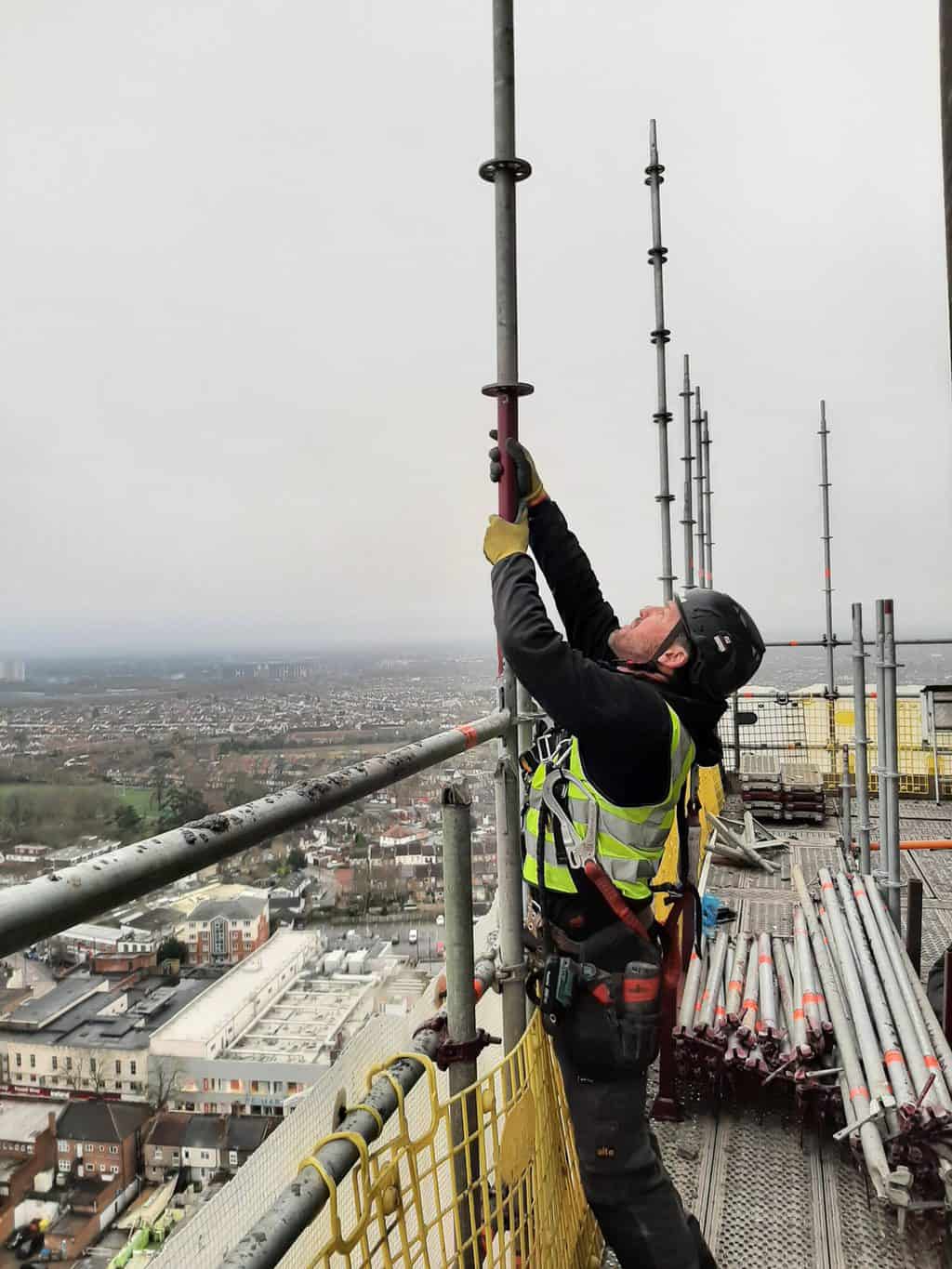
Gordon Vandrill has overcome a major car crash and the loss of a leg in a long journey taking him back to work as a scaffolder on some major projects. Scaffmag has been looking at his incredible story and how it can inspire others.
Gordon Vandrill is proof positive all human beings can achieve things regardless of any physical setback. Just imagine being trapped inside a crashed car for 90 minutes eventually having to be cut free by the fire brigade. Picture the medics realising the injury you have could be quite serious as they rush you off to hospital.
Just think about those hospital doctors discovering the full extent of your bodily damage before you’re rushed to theatre. In the case of this amazing scaffolder, surgeons battled through the night to save his life, when all seemed lost.
In fact, Gordon was left in a coma for two months enduring many more procedures. He’d lost a leg and was facing his biggest ever challenge. Two gruelling years of physiotherapy was to follow, but a fantastic will to overcome his problems coupled with a determination to get the most out of life began to win the day.
He takes up the story: “The most challenging aspect of being a scaffolder with one leg is if a lot of gear has to be walked a long distance, even though I wouldn’t like to show it, this would be very challenging for my leg and I get tired quicker being an amputee as I have to use more energy. I still scaffold in all aspects of the role, including beam work, setting out, managing, traversing, and completing all my training.“When I completed my Advance Training at Bircham Newton in 2018 I was led to believe I was the only amputee to have completed the course and asked for no special treatment.”
Naturally, Gordon wanted to get back to work as soon as possible. Far from simply preparing for what might lay ahead, he thought a nice little trip on a mountaineering expedition in the Atlas Mountains of Morocco would be just the job. A lover of mountaineering he’d need all his previous experience to get the most out of this demanding adventure.
Base camp for the Atlas Mountains is 3,200m above sea level, far higher than Gordon had climbed before. After a successful training day, the first challenge was Jebel Ouanakrim at 4,088m followed by the highest peak in the mountain range, North Africa’s largest, at 4,167m above sea level. This was what Gordon signed up or, but in the morning of the climb he didn’t feel too optimistic: He told me: “I was aching and feeling sick, I really didn’t think I could make it, but I went for it.”
Through Pain and long after his body wanted to give up, Gordon finally saw the summit!
When Gordon, who’s been in the industry for more than 20 years starts a new job, the people employing him usually have little idea he has a prosthetic leg. If the question arises, does he have a firm way of dealing with it?
Gordon explained: “People are Shocked to start with as they usually don’t have any idea, this also applies to work with new companies. I don’t wish to be judged any differently on my performance, so I chose not to highlight this to start with for fear of being wrongly judged in terms of mobility.“When I do tell people, site manager or colleagues, they are met with disbelieve and surprise, followed by positive comments on my scaffolding ability and work ethic, which I pride myself on.“I get up, do a good days work, be confident in my work, and hopefully have a few laughs along the way.“When it comes to having one leg The summers are the worst, as the hot weather is uncomfortable on my prosthetic held on with a rubber lining. The heat makes my skin sweat through lack of air, and wearing work trousers, this throughout the day becomes difficult as my stump becomes hot, swells and can blister.“Over the years I’ve learnt to manage the best I can by going to the toilet to remove my prosthetic and dry my leg, which relieves the heat and the sweat. blisters, would make my day extremely hard and painful.“I don’t let it hold me back and generally no one notices, unless I’m in pain and start to limp then people ask, but I don’t like to show this side as my determination drives me forward and I don’t like to show any weakness.”
Gordon has worked on some impressive projects including Heathrow the Queens Terminal, Kew Gardens Temperate House, Earls Court, Olympia, and HS2 Euston.
So, what advice does this charismatic young man have for anyone facing any sort of physical setback?
“Just be determined and be yourself. I don’t see myself as disabled, more so I have a disability that makes me more determined and more focused.“It was a state of mind to get myself back and go back into scaffolding and do my job well.“My mental state of mind is to get up every-day and go to work. I won’t let my leg be a psychological barrier. I push myself harder and pride myself I can hold my own with able bodied scaffolders (if not better).”
Speaking with his employer, PHD Managing Director, Danny Dwyer said: “Gordon is a fantastic role model to those that work with him as he is incredibly focused and determined. There is nothing that he can’t do. We are so proud of him as part of the PHD Access team and as a great example of overcoming adversity.”
According to new research, 83% of UK tradespeople don’t know which materials can be recycled with scaffolders being least likely to recycle at all.
More than four in five (83%) UK tradespeople say they could recycle more of their work waste, but don’t because they aren’t confident on the rules and regulations, new research has found.
The 2022 study that involved 500 UK tradespeople by IronmongeryDirect, found that almost nine in ten (87%) tradespeople feel uncertain about waste management laws.
In fact, the vast majority (80%) of workers don’t know where their local recycling facilities are located.
However, there is a strong appetite to address the issue. Almost a quarter (24%) of tradespeople say they are actively trying to reduce the amount of excess they send to landfill, and a similar number (28%) would like more support from local authorities to be able to recycle more.
Furthermore, a fifth (20%) try to reuse any materials leftover from jobs and almost one in six (16%) donate spare parts to good causes.
Perhaps due to the nature of their work like scaffolders, some trades are more likely to recycle their waste than others.
Plumbers recycle the most often, with almost three-quarters (73%) saying they do so either always or most of the time. This could be because they are the most knowledgeable about waste management regulations (23%), suggesting education is key.
Interestingly, young tradespeople are far more likely to send waste to landfill than their older counterparts. Almost a third (31%) of millennials (25-34s) say their excess materials go straight to the tip, which is more than double the figure for 45-55-year-olds and over 55s (both 12%).
However, millennials are also the most vocal about wanting support to recycle more (36%), showing an eagerness to be more environmentally friendly.
Dominick Sandford, Managing Director at IronmongeryDirect, said: “Tradespeople are naturally going to produce waste in their line of work, and while more could be recycled, it’s clear that there’s a real willingness to be as green as possible.
“The figures around young workers in particular point to a clear opportunity to educate and train the next generation of tradespeople in more sustainable practices.
“That’s why we’ve partnered with waste management experts to explain the rules tradespeople need to follow and give advice on how to dispose of each material.”
Billy Jones, Managing Director of scaffolding specialist, Millcroft, explains how an agile response to projects, partnership approach and in-house training adds value to clients and leads to repeat business. Construction companies are under pressure. Projects that have been months or even years in the design and planning stages often need to begin on-site quickly after finally getting the green light because time, as the adage tells us, is money, and added costs mean lower yields.
When a construction company needs to be on site quickly, its entire supply chain has to respond with equal urgency. For scaffolding companies, it can sometimes be frustrating that there can be a significant hiatus between quoting for a job and getting the first boots on the ground, but this is an integral part of how we operate.
The hazard and risk that needs to be managed in the scaffolding sector doesn’t only apply to site activities, but also to the commercial risk of bidding on projects and working around the client’s requirements.
But for those of us willing to go the extra mile to meet the client’s needs and the capability to offer an agile, rapid response, the rewards are significant, in terms of both reputation and repeat business.
Design Expertise
One of the ways in which Millcroft adds value for clients is with the capabilities of our in-house design team. Our experienced scaffolding design engineers do not simply follow the client’s brief, but look for ways in which to enhance it. This involves understanding any limitations of the location, site-specific health and safety considerations, how the scaffolding will be used and, critically, what the programme involves.
It is vitally important to us to understand the client’s priorities. Safety is always paramount, but a common mistake is to assume that cost is the next most critical factor, and often that’s not the case. At Millcroft, when we value engineer a project, our design team is looking for where we can introduce additional value into the design. That might be in creating a scaffold that is quicker to install, or one that enables easier adaptations. Cost is always a factor, but a well-designed scaffold can help a construction or demolition contractor to save costs on programme delivery, labour and health and safety measures, so value should be considered more holistically.
Working in partnership with the client also demands that a scaffolding company accepts that change can happen, and it can often be last minute. Amendments to the project scope, the programme, the start date and the risk assessment can all put additional demands on the design team and the operational management of the business. At Millcroft, we work around these challenges with a skilled in-house team and a yard that has the resources to hit the ground running. Our skilled scaffolding engineers can revise scaffolding designs, to adapt to what the client needs and be proactive in suggesting strategies for minimising the cost and disruption of any changes.
Skilled Resource
Not everything that agile response clients need from scaffolding companies is centred around design capabilities; having the right mix of skills and experience ready to deploy at short notice is also vital.
Millcroft scaffolding for the Crossrail project, Elizabeth Line, Paddington
At Millcroft, we have our own team of scaffolding professionals, which enables us to respond to clients’ needs on a day-to-day basis, reacting quickly to changing requirements as and when they arise. Alongside the skills needed to erect, adapt and strike scaffolds, we also have in-house health and safety expertise, ensuring that site safety visits are carried out regularly and documented as part of a thorough approach to management and reporting. Our directors also carry out site visits, to implement the highest quality standards and connect management of the project with what’s happening on the ground.
Training has an essential part to play in delivering the correct level of skills and certification for this rapid response to site requirements. As demand for skills increases, our commitment to training, and our own CITB Site Safety Plus certified training facility, enable us to nurture the skills we need and helps us to attract and retain good people because we’re able to offer them tangible career development.
For some projects, particularly where safety is highly regulated, such as the rail sector, there is often a minimum requirement for the certified skills on site at any one time. Our training capabilities, which include accredited in-house trainers, mean that we can upskill existing members of the team quickly if we need to. Overall, however, we have an exceptionally high level of advanced scaffolders on the team, as this means that we are ready to take on a brief of any complexity quickly, for any client sector.
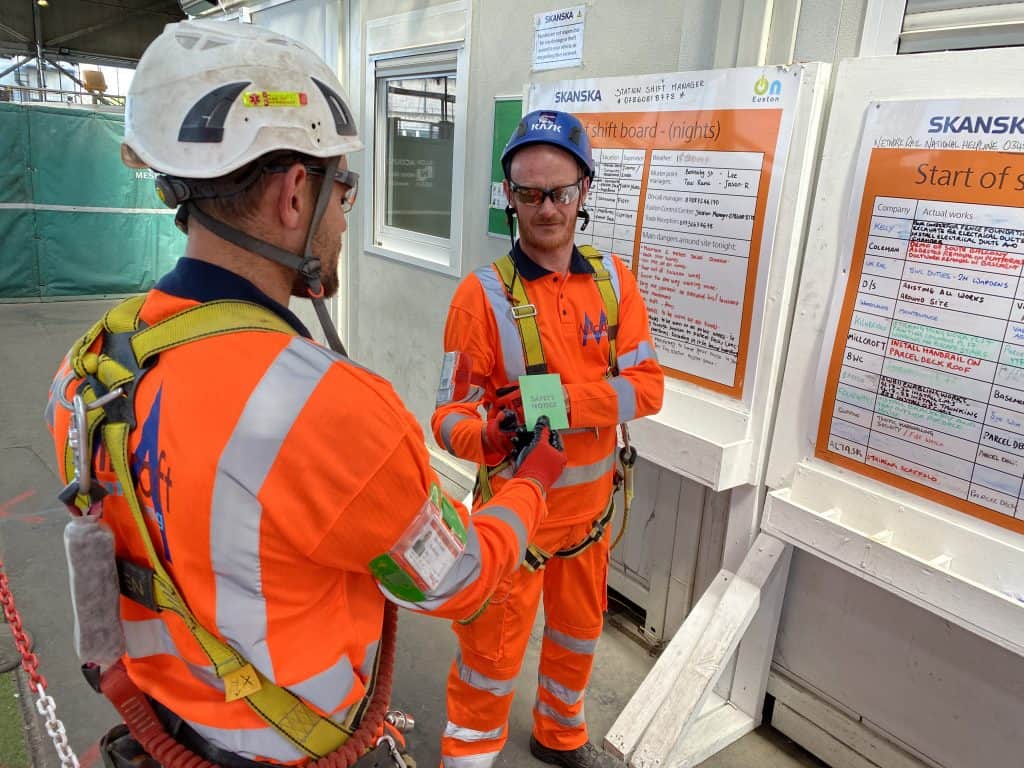
Millcroft Health and Safety in action on site at Euston
Partnership Approach
The most effective business development strategy for any company is to build relationships that lead to repeat business. The only way to differentiate and build those relationships effectively is to work in partnership and add value at every touchpoint in the project journey, from bid to handover. Responding quickly and proactively to the client’s needs throughout the design and delivery phases is critical to the success of that approach.
This article was first published in the ScaffMag Magazine Issue 15
TRAD has revealed its fundraising this year in memory of former director and popular scaffolding industry figure, John Paterson.
The TRAD Group, one of the UK’s leading scaffolding groups, has launched its charity focus for this year, with a number of fundraising events already planned.
The project, “22 for 22” aims to raise a minimum of £22,000 for The Anthony Nolan Trust, a charity focused on providing support to everyone who needs a stem cell transplant. As well as providing support, the Trust invests in life-saving research and lobbies on behalf of the people it represents.
The Trust was founded in the early 1970s by Anthony Nolan’s Mum, Shirley. Anthony was born with Wiskott-Aldrich syndrome, a rare condition that could only be cured with a bone marrow transplant. At the time, there was no system in place to find matching unrelated donors – and so Shirley started one.
Today, the donor register reaches more than 750,000 people and has the actor Olivia Colman as its patron. The best donors are aged between 16 and 30, and the charity is particularly keen to get its message out to young men, who provide 55% of the stem cell donations, but only make up around 18% of people on the register.
“This charity is very close to our hearts at TRAD Group”
“This charity is very close to our hearts at TRAD Group,” says Des Moore, CEO at the company. “John Paterson was a much-loved member of the TRAD family, and was incredibly well-respected throughout the scaffolding and construction industry. We were all devastated by his loss last year, and it seems fitting that we should concentrate this year on supporting a charity that was important to John and his wife, Jane.”
In fact, Jane Paterson will be taking part in TRAD’s first major fundraising event of the year – the Surrey 3 Peaks – which takes place in early April. Walkers from across the Group will take on Box Hill – used in the cycling road race in the 2012 Olympics – Holmbury Hill and Leith Hill, the highest point in the county. Keeping with the ‘22’ theme, the walk is a 22-mile round trip and takes in some of the county’s most beautiful countryside.
TRAD has set up a JustGiving page for this year’s challenge – anyone is welcome to make a donation in John’s memory: TRAD Group is fundraising for Anthony Nolan (justgiving.com)
TRAD has paid its respects to John by creating a memory book in his honour. “John was so well thought of across the business,” says Des Moore. “We had a lot of people asking how they could share their memories, so we created a special book with recollections and anecdotes from staff. This has helped everyone to give a voice to their own thoughts, and has been a really positive way to remember John and his influence on the company and on individuals.”
You can see the memory book here: john-paterson-book.pdf (traduk.co.uk)
A new app-led Mind Fitness training solution built by and for the construction industry to help tackle its mental ill health issues, officially launches this week.Ownminder, is the first industry-specific proactive psychological health solution, created to help address the sector’s stark mental health situation, that sees a suicide rate three times more than the national average, equating to two people per day in the UK construction industry taking their own lives (ONS).
Founders Dr Vanessa Moulton, a Chartered Psychologist and expert in the field of Mind Fitness and Tom Storey, a strategic consultant in the construction and property sector, created Ownminder based on their supported belief that prevention is just as important as reactive only mental health strategies.
Founding partners include key industry figures Danny Lucas (Lucas UK), Danny Chaney (blu-3), Brian Morrisroe (Morrisroe Group) and David Darsey (The Erith Group), who have combined their knowledge, experience and insights to help develop, build and shape the initiative.
Ownminder enables organisations within the construction industry to provide all their employees and supply chains with Mind Fitness training, which includes accessible tools and strategies to enable them to take a positive, proactive and preventative approach to their psychological health and wellbeing.
It provides them with a deeper understanding of the factors underpinning their own psychological health and allows them to take ownership of their Mind Fitness, which can in turn help mitigate the risk of mental ill health in the future.
All this is achieved through senior leadership training, as well as on-site training and an app accessible to all. Across these different platforms, Ownminder provides industry tailored on-demand modules, as well as personalised tools, strategies and techniques that can be easily incorporated into everyday life to help strengthen Mind Fitness.
Anonymised reports, that include user engagement levels and regularly updated mental wellbeing scores to validate progress, will provide businesses with insights and data, relevant to certain health and safety compliance, public procurement and other ESG requirements related to proactive psychological health.
Dr Vanessa Moulton, Co-founder of Ownminder commented: “There has never been a more important time to launch Ownminder to the construction industry, with our sole mission to create a highly targeted solution fit for a digital age. There is a lot of focus on how we respond to mental ill health and not so much on how to prevent it. We can all positively impact our psychological health if we understand how our minds work and armed with the right tools. Right now, psychological health and mind fitness should be given as much focus and priority as physical health and fitness.”
Founding partner Danny Lucas, Exec Chairman and Managing Director of Lucas, said “Being a founding partner is something that really empowers me. It’s been a privilege to be involved with the development of the product and be able to help shape its roll out across the industry.”
CEO and Founder of the Morrisroe Group, Brian Morrisroe, also a founding partner commented: “We all care for our workforces and the opportunity to get involved with Ownminder to do something more for them is invaluable. I’m pleased to be part of this journey that is striving for better mental health across the sector.”
Managing Director of the Erith Group and founding partner of Ownminder, David Darsey said, “Allowing employees to be able to own their mind and be in control of their psychological health and fitness is incredibly important. As employers, we have a responsibility and a duty of care to ensure our staff across all levels are not just physically safe, but mentally safe too.”
Founding partner Danny Chaney, Chairman of blu-3, went on to say, “It’s an honour to be part of Ownminder. Very much driven by my own personal experience, I have been championing mental health and wellbeing in the sector for years. Ownminder is with you 24 hours a day to tap into when you need it, with the end goal being a psychologically healthier, happier and more productive workforce within the construction industry.”
The advisory board for the initiative includes David Richmond CBE, Damon Brown (Portfolio Lead for Construction Legal and General), Professor Neil Greenberg (Professor of Defence Mental Health and Chair of the Occupational Psychiatry Special Interest Group at the Royal College of Psychiatrists). Paul Flexney-Briscoe (Construction Director of Sellar), Vicky Fairhall (ex-Senior Vice President, Brookfield Properties UK) and Matt Evans (Fund Manager Investec Asset Management).
For more information, as well as a demo, please email [email protected].
A new Oxfordshire based firm has been established to provide independent dynamic testing for Roof Edge Protection systems.
Edge Protection is a common sight on most UK construction sites. It prevents those working on roofs from falling. But testing of edge protection is often overlooked on many sites across the country.
Harrigen Ltd that’s been set up by Rob Harris and Phil Gennard aims to facilitate this vital testing.
Edge protection is a collective solution identified within the Work at Height Regulations as being the preferred measure over personal protection.
BS EN 13374:2013+A1:2018 “Temporary edge protection systems – Product Specification – Test methods” is the standard to which Edge Protection should be installed. It exists to ensure that those working at height are afforded the highest levels of fall protection.
Harrigen Ltd Founding Director Rob Harris explained that at the centre of the guidance is the different classes of roof, based upon the pitch of the work surface. The Standard requires that classes B & C need to withstand dynamic loads because on steeper surfaces, a worker may slide or roll towards the edge protection and create high loads upon himself and the system.
It is important that the edge protection system restrains the worker whilst absorbing energy to minimise injury. Confirmation that the system will absorb the required energy at the point of impact cannot be proven by calculation, and must be proven by dynamic testing.
“This is regularly overlooked by those placing orders for edge protection and those installing edge protection, says Rob.
“The absence of this testing is potentially life-threatening to those working at height because there is no evidence the system will restrain the falling person upon impact.”
Rob and Phil’s company has been established to facilitate this testing. It is independent of product suppliers and installers. Rob said: “The guidance within the Standard is clear. To ensure a worker doesn’t fall through the edge protection because it’s not strong enough, it has to be tested”.
The test involves swinging a 50kg bag at specified locations along a built edge protection system, and measuring the relative deflection to establish sufficient energy absorption. This is best carried out away from site, in a controlled environment, to ensure safety and accuracy.
“So often we see double or triple rail systems installed by default. Roofing companies must first identify the class of roof (A, B or C) and if it is between a 10º and 30º pitch they must ensure that there are no gaps that a 250mm sphere can pass through and, crucially, see evidence from their installer that the Edge Protection design has successfully passed the swing bag test. If this is not available, the installation doesn’t comply,” Rob said.
Harris believes the reason the testing is not requested is because roofing companies and PC’s may not be aware of the requirement and don’t ask for it. Edge protection installers are likely to be aware of the requirement, but struggle to find anywhere that is both capable and independent to carry it out.
Rob added: “Principle Contractors clearly have a role to play by seeking confirmation the testing has been completed when considering edge protection as part of their Temporary Works planning. PC’s need to be questioning all participants within their supply chain to ensure it has been completed”.
Harrigen provides an independent swing bag testing service that is easy to organise and plan. It was established by Rob Harris and Phil Gennard, both highly experienced individuals within the edge protection industry. The pair have a combined knowledge totalling some 50 years.
Phil Gennard says:” To make it easy for clients, they send us a drawing of their Edge Protection design and we build it on our test rig. We then set up measurement devices and cameras and swing the bag as prescribed in BS EN 13374. We record the results of the test and issue a written report and video. The report and video is made available to the clients who in turn use it as evidence to confirm the testing has been successfully completed.”
FASET member Jobsafe recently carried out this testing with Harrigen. Jobsafe Director Jon Obank commented:- “As a member of FASET, Jobsafe recognised the need to test our class B Edge Protection Systems. The dynamic testing was carried out by Harrigen and we found them to be really easy to deal with and very professional in the way they produced the evidence that our system passed the test. The report and videos mean we can easily prove our Edge Protection system meets the requirements of BS EN 13374.”
For more information visit: www.harrigen.com
The NASC has won the Crisis Management – Covid Member Support (Large Associations) award at this year’s Trade Association Forum Best Practice Awards.
The category was open to trade associations that moved quickly and effectively to safeguard and support their members and the wider sector the association represents throughout the Coronavirus pandemic.
The NASC’s entry focused on the various ways in which the Confederation attempted to keep scaffolding industry businesses up-to-date and informed, including the creation and distribution of daily Covid-19 e-bulletins, the establishment of a dedicated Coronavirus News section of its website, and the production and dissemination of free to download Guidance for Scaffolding Operations During the Coronavirus (Covid-19) Pandemic and an associated Toolbox Talk.
Robin James, NASC Managing Director, said: “We are absolutely over the moon to have been presented with this award. It’s a great tribute to a collective effort, and demonstrates the excellent support which the NASC has provided to its members during the pandemic.“During the first few months of the pandemic there was a lot of often complex information being announced and implemented by Government on an almost daily basis. “The NASC team worked tirelessly to communicate this information to members and the scaffolding industry at large in a clear and effective way, enabling businesses to make important commercial decisions with confidence. The team also worked proactively to support the scaffolding industry, producing its Guidance for Scaffolding Operations During the Coronavirus (Covid-19) Pandemic and Toolbox Talk of the same name, and regularly reviewing and updating these resources as Government guidance changed.“As the trade body for access and scaffolding in the UK, keeping members and indeed non-members informed of ever-changing rules and Government support schemes during the Covid-19 pandemic was of paramount importance to us. I am delighted with how the team stepped up for its members and the scaffolding industry during this unprecedented and extremely challenging period.”
Weather experts are warning the whole of the UK will be affected by extremely strong and damaging winds today.
Following yesterdays rare red weather warning for the coastline of Devon, Cornwall and the south coast of Wales, the Met Office this morning issued a second red warning for the East of England including London.
The new warning will be in place from 10am to 3pm this afternoon.
Many in the industry are being urged to stay at home by bosses as the approaching storm Eunice could be among the UK’s worst in 30 years.
The Met Office fears “significant gusts” could lead to flying debris endangering lives, power lines being brought down, and roofs being blown off homes.
A red warning means “dangerous weather is expected” with it “very likely that there will be a risk to life, with substantial disruption to travel, energy supplies and possibly widespread damage to property and infrastructure”.
People are being advised to avoid non-essential travel today.
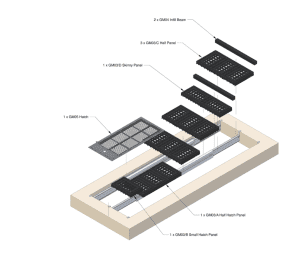
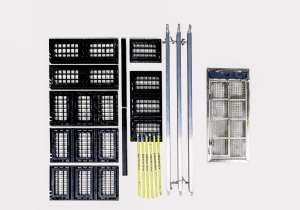
Work at height safety training and temporary safety systems brand, G&M Group has created a brand new stairwell void cover and hatch system –MAP Modular Access Platform Safety System – in response to a series of costly industry accidents.
The all-new G&M MAP – Modular Access Platform – Safety System has been specifically designed for use in stair voids in residential and commercial construction projects; to avoid further injury and loss of life caused by a series of serious accidents in recent years.
In 2018, three bricklayers fell 2.5m onto a concrete floor, as a temporary stairwell cover gave way, leading to life-changing injuries for all three and a £213,332 fine for a leading housebuilder.
The HSE reported that the site did not have a robust enough system in place to ensure the temporary stairwell cover was clearly identified as a temporary working platform.
This is just one of several high personal and financial cost incidents in the UK construction scene alone, resulting in life-changing work at height injuries and potentially even death.
And after a near miss on one of the housing sites involving their own operatives over a stairwell void, safety-driven work at height providing family firm, G&M, said enough was enough.
They have now used their product development skills – famous for bringing the market-leading G&M Safe Deck working platform and other top temporary safety systems to the market – to develop the all-new G&M MAP Safety System.
Designed to be a safe, strong and stable platform over stair voids, the new G&M MAP System offers:
A unique flush fitting design, removing the tripping hazard caused with other stairwell covers that sit on top of the opening.
Savings on the waste and cost of installing sacrificial joists and flooring over stairwell openings.
A robust system that can be loaded to 2.0kN/m2.
Telescopic Joists: Typically three telescopic beams are screwed in place to support the decking panels. This ensures that the platform is securely fitted and level with the floor.
Use in a wide range of stairwell sizes from between 2-4m long and between any width. It is also suitable for use in L shaped stairwells. And openings next to party walls are no problem as the system is recessed into the stairwell void.
Ability to be fixed in place to prevent accidental dislodgement or removal.
Easy installation – by one man in as little as 10 mins – within manual handling regulations.
An incorporated access hatch within the system – allowing all trades to access floors and allowing materials to be passed up with safety and ease.
The G&M MAP Safety System can be installed at the earliest stages of construction – directly after the joists and other load bearing members have been installed – and can then be used in conjunction with ladders or other temporary access stairs systems.
Additionally, access hatches in the platform can be configured as required to allow full or partial access for operative and materials, working alongside another key safety system product; G&M Safety Decking Hatch. And additional platform panels can also be easily removed to accommodate access for larger or irregularly shaped equipment or materials.
And the new, lightweight, modular G&M MAP Safety System offers incredible versatility, making it suitable for use and re-use on wide range of construction projects.
G&M Group Managing Director, Mark Pickles said: “The MAP Safety System has been born out of an urgent need to stop accidents and injuries occurring on construction site temporary stairwells. People are going to be losing their lives and are already suffering horrible, life-affecting injuries from unnecessary falls from height on building sites.“Even with all our decades of safety training and highly skilled operatives, we came close to having an accident on a site recently – so something had to be done.“The answer was to use our safety and construction know-how combined with our expertise in manufacturing temporary safety systems for work at height – creating a perfectly designed product to eliminate the risk of falling through a stairwell void.“G&M MAP System is the only multi-configurable system that can be installed flush into the stairwell void eliminating the use of sacrificial joist and beams. The standard telescopic beams can be installed into any sized void from 2.2-3.4m – by just one operative. And the G&M boards are then placed onto the beam flush to the floor eliminating any trip hazard and enabling any decking system to be installed on top. It’s a brilliantly safe design that is cost-effective and easy to install.”
Other hatch system products are available on the market for this fall from height issue, but G&M’s system is stronger, safer and more advanced, needs no back prop for strength or board spacers for unevenness (as G&M system is more robust and sits flush to the floor) and has the highest load class. And crucially, rival systems sit between 50 and 70mm above the floor height, causing trip hazards – the main cause of accidents and injuries in scaffolding and work at height.
Get those scaffolds checked: The Met Office has issued a rare red weather warning as the UK braces itself for 100mph winds.UPDATE: Met Office issues second RED weather warning as high winds hit the UK.
The most severe weather warning has been issued for the coastline of Devon and Cornwall as well as the south coast of Wales amid fears that the approaching storm Eunice could be among the UK’s worst in 30 years.
The high alert which is in force for tomorrow (18 Feb) comes after the Met Office upgraded its “danger to life” amber alert covering almost the whole of England.
Forecasters fear strong winds could hit 100mph in some parts of the country and may endanger lives, tear roofs from houses and bring down power lines and scaffolding.
The Met Office said a red warning means “dangerous weather is expected” with it “very likely that there will be a risk to life, with substantial disruption to travel, energy supplies and possibly widespread damage to property and infrastructure”.
People are also advised to avoid travelling where possible.
We use cookies on our website to give you the most relevant experience by remembering your preferences and repeat visits. By clicking “Accept”, you consent to the use of ALL the cookies.
This website uses cookies to improve your experience while you navigate through the website. Out of these, the cookies that are categorized as necessary are stored on your browser as they are essential for the working of basic functionalities of the website. We also use third-party cookies that help us analyze and understand how you use this website. These cookies will be stored in your browser only with your consent. You also have the option to opt-out of these cookies. But opting out of some of these cookies may affect your browsing experience.
Necessary cookies are absolutely essential for the website to function properly. These cookies ensure basic functionalities and security features of the website, anonymously.
Cookie
Duration
Description
cookielawinfo-checbox-analytics
11 months
This cookie is set by GDPR Cookie Consent plugin. The cookie is used to store the user consent for the cookies in the category "Analytics".
cookielawinfo-checbox-functional
11 months
The cookie is set by GDPR cookie consent to record the user consent for the cookies in the category "Functional".
cookielawinfo-checbox-others
11 months
This cookie is set by GDPR Cookie Consent plugin. The cookie is used to store the user consent for the cookies in the category "Other.
cookielawinfo-checkbox-necessary
11 months
This cookie is set by GDPR Cookie Consent plugin. The cookies is used to store the user consent for the cookies in the category "Necessary".
cookielawinfo-checkbox-performance
11 months
This cookie is set by GDPR Cookie Consent plugin. The cookie is used to store the user consent for the cookies in the category "Performance".
viewed_cookie_policy
11 months
The cookie is set by the GDPR Cookie Consent plugin and is used to store whether or not user has consented to the use of cookies. It does not store any personal data.
Functional cookies help to perform certain functionalities like sharing the content of the website on social media platforms, collect feedbacks, and other third-party features.
Performance cookies are used to understand and analyze the key performance indexes of the website which helps in delivering a better user experience for the visitors.
Analytical cookies are used to understand how visitors interact with the website. These cookies help provide information on metrics the number of visitors, bounce rate, traffic source, etc.
Advertisement cookies are used to provide visitors with relevant ads and marketing campaigns. These cookies track visitors across websites and collect information to provide customized ads.
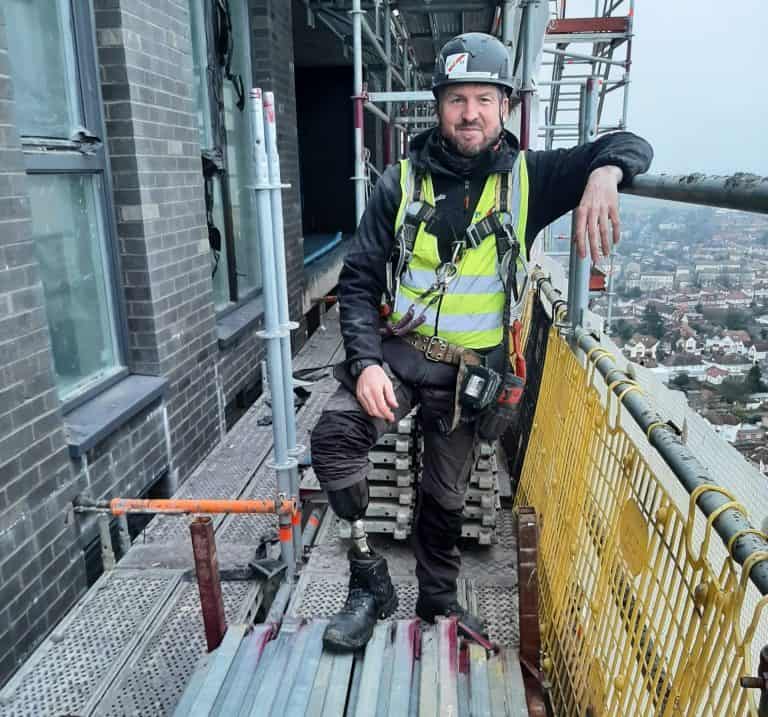
 Gordon explained: “People are Shocked to start with as they usually don’t have any idea, this also applies to work with new companies. I don’t wish to be judged any differently on my performance, so I chose not to highlight this to start with for fear of being wrongly judged in terms of mobility.
“When I do tell people, site manager or colleagues, they are met with disbelieve and surprise, followed by positive comments on my scaffolding ability and work ethic, which I pride myself on.
“I get up, do a good days work, be confident in my work, and hopefully have a few laughs along the way.
“When it comes to having one leg The summers are the worst, as the hot weather is uncomfortable on my prosthetic held on with a rubber lining. The heat makes my skin sweat through lack of air, and wearing work trousers, this throughout the day becomes difficult as my stump becomes hot, swells and can blister.
“Over the years I’ve learnt to manage the best I can by going to the toilet to remove my prosthetic and dry my leg, which relieves the heat and the sweat. blisters, would make my day extremely hard and painful.
“I don’t let it hold me back and generally no one notices, unless I’m in pain and start to limp then people ask, but I don’t like to show this side as my determination drives me forward and I don’t like to show any weakness.”
Gordon explained: “People are Shocked to start with as they usually don’t have any idea, this also applies to work with new companies. I don’t wish to be judged any differently on my performance, so I chose not to highlight this to start with for fear of being wrongly judged in terms of mobility.
“When I do tell people, site manager or colleagues, they are met with disbelieve and surprise, followed by positive comments on my scaffolding ability and work ethic, which I pride myself on.
“I get up, do a good days work, be confident in my work, and hopefully have a few laughs along the way.
“When it comes to having one leg The summers are the worst, as the hot weather is uncomfortable on my prosthetic held on with a rubber lining. The heat makes my skin sweat through lack of air, and wearing work trousers, this throughout the day becomes difficult as my stump becomes hot, swells and can blister.
“Over the years I’ve learnt to manage the best I can by going to the toilet to remove my prosthetic and dry my leg, which relieves the heat and the sweat. blisters, would make my day extremely hard and painful.
“I don’t let it hold me back and generally no one notices, unless I’m in pain and start to limp then people ask, but I don’t like to show this side as my determination drives me forward and I don’t like to show any weakness.”
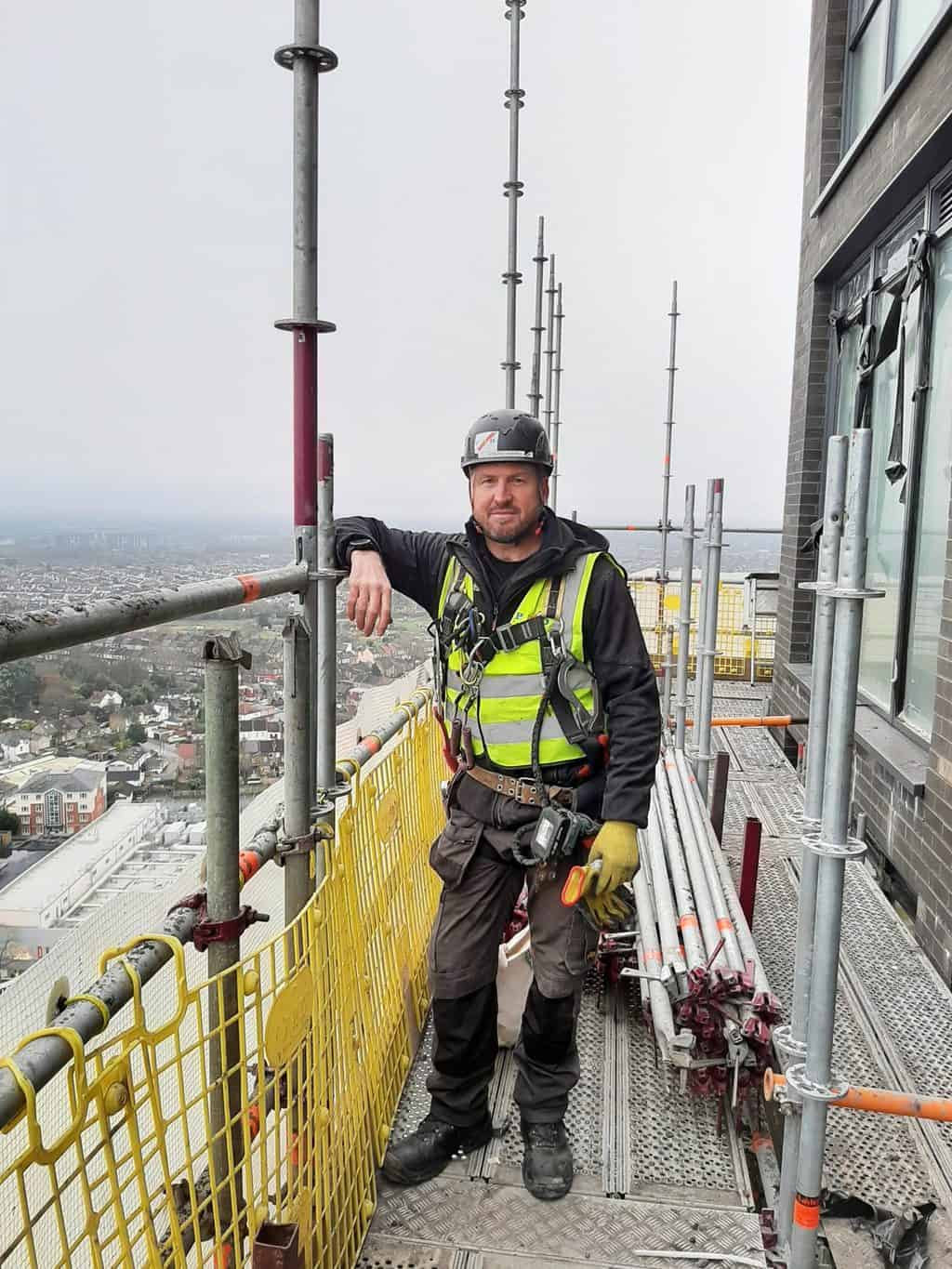 Gordon has worked on some impressive projects including Heathrow the Queens Terminal, Kew Gardens Temperate House, Earls Court, Olympia, and HS2 Euston.
So, what advice does this charismatic young man have for anyone facing any sort of physical setback?
“Just be determined and be yourself. I don’t see myself as disabled, more so I have a disability that makes me more determined and more focused.
“It was a state of mind to get myself back and go back into scaffolding and do my job well.
“My mental state of mind is to get up every-day and go to work. I won’t let my leg be a psychological barrier. I push myself harder and pride myself I can hold my own with able bodied scaffolders (if not better).”
Speaking with his employer, PHD Managing Director, Danny Dwyer said: “Gordon is a fantastic role model to those that work with him as he is incredibly focused and determined.
There is nothing that he can’t do. We are so proud of him as part of the PHD Access team and as a great example of overcoming adversity.”
Gordon has worked on some impressive projects including Heathrow the Queens Terminal, Kew Gardens Temperate House, Earls Court, Olympia, and HS2 Euston.
So, what advice does this charismatic young man have for anyone facing any sort of physical setback?
“Just be determined and be yourself. I don’t see myself as disabled, more so I have a disability that makes me more determined and more focused.
“It was a state of mind to get myself back and go back into scaffolding and do my job well.
“My mental state of mind is to get up every-day and go to work. I won’t let my leg be a psychological barrier. I push myself harder and pride myself I can hold my own with able bodied scaffolders (if not better).”
Speaking with his employer, PHD Managing Director, Danny Dwyer said: “Gordon is a fantastic role model to those that work with him as he is incredibly focused and determined.
There is nothing that he can’t do. We are so proud of him as part of the PHD Access team and as a great example of overcoming adversity.” 
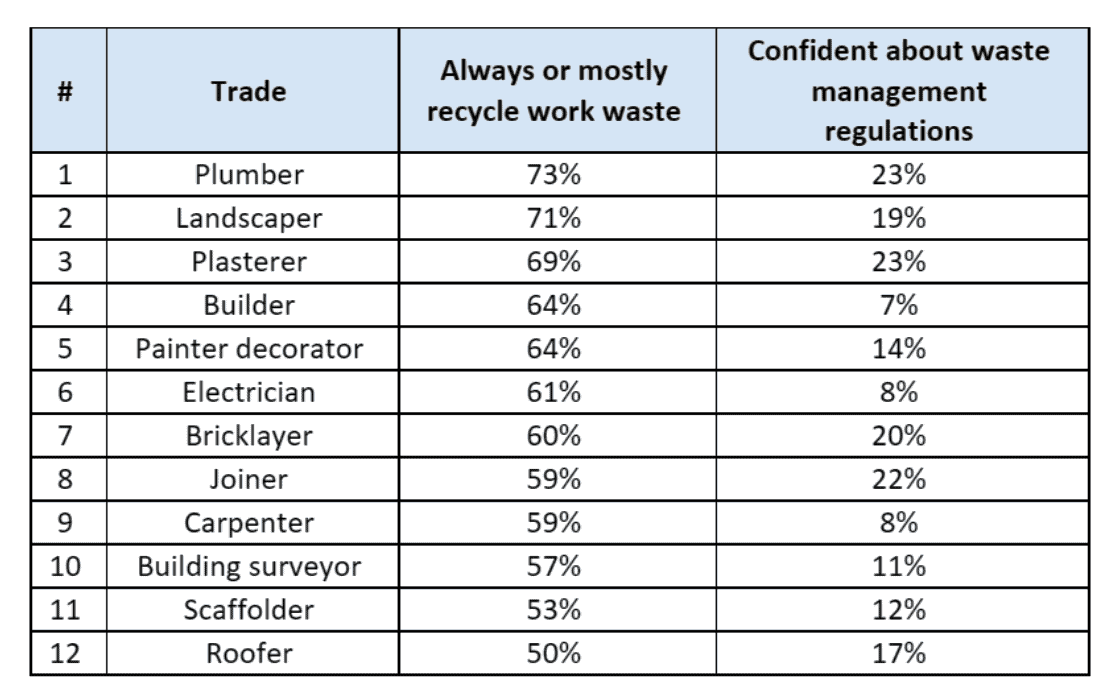 Plumbers recycle the most often, with almost three-quarters (73%) saying they do so either always or most of the time. This could be because they are the most knowledgeable about waste management regulations (23%), suggesting education is key.
Interestingly, young tradespeople are far more likely to send waste to landfill than their older counterparts. Almost a third (31%) of millennials (25-34s) say their excess materials go straight to the tip, which is more than double the figure for 45-55-year-olds and over 55s (both 12%).
However, millennials are also the most vocal about wanting support to recycle more (36%), showing an eagerness to be more environmentally friendly.
Dominick Sandford, Managing Director at IronmongeryDirect, said: “Tradespeople are naturally going to produce waste in their line of work, and while more could be recycled, it’s clear that there’s a real willingness to be as green as possible.
“The figures around young workers in particular point to a clear opportunity to educate and train the next generation of tradespeople in more sustainable practices.
“That’s why we’ve partnered with waste management experts to explain the rules tradespeople need to follow and give advice on how to dispose of each material.”
Plumbers recycle the most often, with almost three-quarters (73%) saying they do so either always or most of the time. This could be because they are the most knowledgeable about waste management regulations (23%), suggesting education is key.
Interestingly, young tradespeople are far more likely to send waste to landfill than their older counterparts. Almost a third (31%) of millennials (25-34s) say their excess materials go straight to the tip, which is more than double the figure for 45-55-year-olds and over 55s (both 12%).
However, millennials are also the most vocal about wanting support to recycle more (36%), showing an eagerness to be more environmentally friendly.
Dominick Sandford, Managing Director at IronmongeryDirect, said: “Tradespeople are naturally going to produce waste in their line of work, and while more could be recycled, it’s clear that there’s a real willingness to be as green as possible.
“The figures around young workers in particular point to a clear opportunity to educate and train the next generation of tradespeople in more sustainable practices.
“That’s why we’ve partnered with waste management experts to explain the rules tradespeople need to follow and give advice on how to dispose of each material.” 
 Billy Jones, Managing Director of scaffolding specialist, Millcroft, explains how an agile response to projects, partnership approach and in-house training adds value to clients and leads to repeat business.



 All this is achieved through senior leadership training, as well as on-site training and an app accessible to all. Across these different platforms, Ownminder provides industry tailored on-demand modules, as well as personalised tools, strategies and techniques that can be easily incorporated into everyday life to help strengthen Mind Fitness.
Anonymised reports, that include user engagement levels and regularly updated mental wellbeing scores to validate progress, will provide businesses with insights and data, relevant to certain health and safety compliance, public procurement and other ESG requirements related to proactive psychological health.
Dr Vanessa Moulton, Co-founder of Ownminder commented: “There has never been a more important time to launch Ownminder to the construction industry, with our sole mission to create a highly targeted solution fit for a digital age. There is a lot of focus on how we respond to mental ill health and not so much on how to prevent it. We can all positively impact our psychological health if we understand how our minds work and armed with the right tools. Right now, psychological health and mind fitness should be given as much focus and priority as physical health and fitness.”
Founding partner Danny Lucas, Exec Chairman and Managing Director of Lucas, said “Being a founding partner is something that really empowers me. It’s been a privilege to be involved with the development of the product and be able to help shape its roll out across the industry.”
CEO and Founder of the Morrisroe Group, Brian Morrisroe, also a founding partner commented: “We all care for our workforces and the opportunity to get involved with Ownminder to do something more for them is invaluable. I’m pleased to be part of this journey that is striving for better mental health across the sector.”
Managing Director of the Erith Group and founding partner of Ownminder, David Darsey said, “Allowing employees to be able to own their mind and be in control of their psychological health and fitness is incredibly important. As employers, we have a responsibility and a duty of care to ensure our staff across all levels are not just physically safe, but mentally safe too.”
Founding partner Danny Chaney, Chairman of blu-3, went on to say, “It’s an honour to be part of Ownminder. Very much driven by my own personal experience, I have been championing mental health and wellbeing in the sector for years. Ownminder is with you 24 hours a day to tap into when you need it, with the end goal being a psychologically healthier, happier and more productive workforce within the construction industry.”
The advisory board for the initiative includes David Richmond CBE, Damon Brown (Portfolio Lead for Construction Legal and General), Professor Neil Greenberg (Professor of Defence Mental Health and Chair of the Occupational Psychiatry Special Interest Group at the Royal College of Psychiatrists). Paul Flexney-Briscoe (Construction Director of Sellar), Vicky Fairhall (ex-Senior Vice President, Brookfield Properties UK) and Matt Evans (Fund Manager Investec Asset Management).
For more information, as well as a demo, please email
All this is achieved through senior leadership training, as well as on-site training and an app accessible to all. Across these different platforms, Ownminder provides industry tailored on-demand modules, as well as personalised tools, strategies and techniques that can be easily incorporated into everyday life to help strengthen Mind Fitness.
Anonymised reports, that include user engagement levels and regularly updated mental wellbeing scores to validate progress, will provide businesses with insights and data, relevant to certain health and safety compliance, public procurement and other ESG requirements related to proactive psychological health.
Dr Vanessa Moulton, Co-founder of Ownminder commented: “There has never been a more important time to launch Ownminder to the construction industry, with our sole mission to create a highly targeted solution fit for a digital age. There is a lot of focus on how we respond to mental ill health and not so much on how to prevent it. We can all positively impact our psychological health if we understand how our minds work and armed with the right tools. Right now, psychological health and mind fitness should be given as much focus and priority as physical health and fitness.”
Founding partner Danny Lucas, Exec Chairman and Managing Director of Lucas, said “Being a founding partner is something that really empowers me. It’s been a privilege to be involved with the development of the product and be able to help shape its roll out across the industry.”
CEO and Founder of the Morrisroe Group, Brian Morrisroe, also a founding partner commented: “We all care for our workforces and the opportunity to get involved with Ownminder to do something more for them is invaluable. I’m pleased to be part of this journey that is striving for better mental health across the sector.”
Managing Director of the Erith Group and founding partner of Ownminder, David Darsey said, “Allowing employees to be able to own their mind and be in control of their psychological health and fitness is incredibly important. As employers, we have a responsibility and a duty of care to ensure our staff across all levels are not just physically safe, but mentally safe too.”
Founding partner Danny Chaney, Chairman of blu-3, went on to say, “It’s an honour to be part of Ownminder. Very much driven by my own personal experience, I have been championing mental health and wellbeing in the sector for years. Ownminder is with you 24 hours a day to tap into when you need it, with the end goal being a psychologically healthier, happier and more productive workforce within the construction industry.”
The advisory board for the initiative includes David Richmond CBE, Damon Brown (Portfolio Lead for Construction Legal and General), Professor Neil Greenberg (Professor of Defence Mental Health and Chair of the Occupational Psychiatry Special Interest Group at the Royal College of Psychiatrists). Paul Flexney-Briscoe (Construction Director of Sellar), Vicky Fairhall (ex-Senior Vice President, Brookfield Properties UK) and Matt Evans (Fund Manager Investec Asset Management).
For more information, as well as a demo, please email 


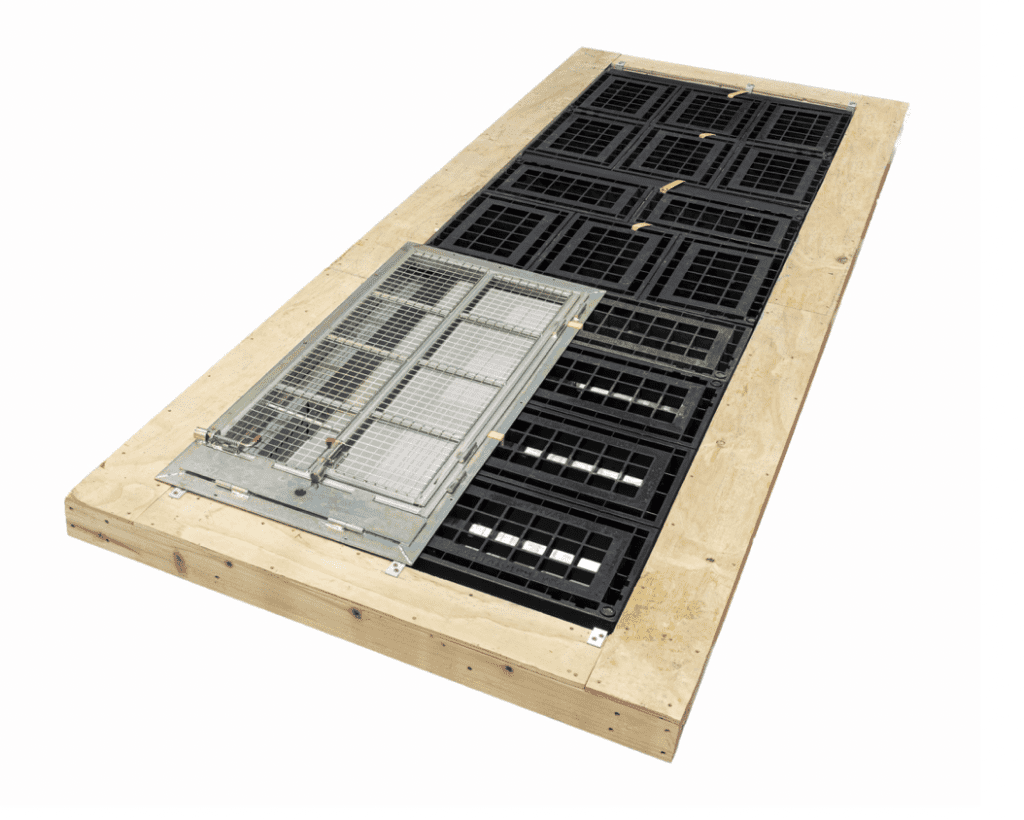 Designed to be a safe, strong and stable platform over stair voids, the new G&M MAP System offers:
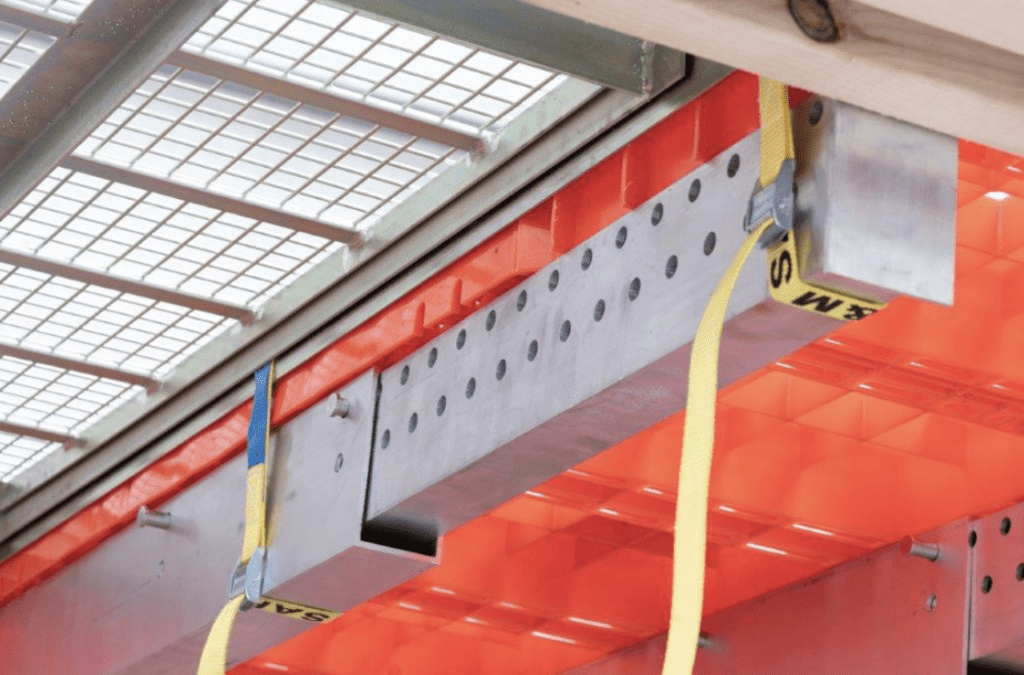 The G&M MAP Safety System can be installed at the earliest stages of construction – directly after the joists and other load bearing members have been installed – and can then be used in conjunction with ladders or other temporary access stairs systems.
Additionally, access hatches in the platform can be configured as required to allow full or partial access for operative and materials, working alongside another key safety system product; G&M Safety Decking Hatch. And additional platform panels can also be easily removed to accommodate access for larger or irregularly shaped equipment or materials.
And the new, lightweight, modular G&M MAP Safety System offers incredible versatility, making it suitable for use and re-use on wide range of construction projects.
The G&M MAP Safety System can be installed at the earliest stages of construction – directly after the joists and other load bearing members have been installed – and can then be used in conjunction with ladders or other temporary access stairs systems.
Additionally, access hatches in the platform can be configured as required to allow full or partial access for operative and materials, working alongside another key safety system product; G&M Safety Decking Hatch. And additional platform panels can also be easily removed to accommodate access for larger or irregularly shaped equipment or materials.
And the new, lightweight, modular G&M MAP Safety System offers incredible versatility, making it suitable for use and re-use on wide range of construction projects.